
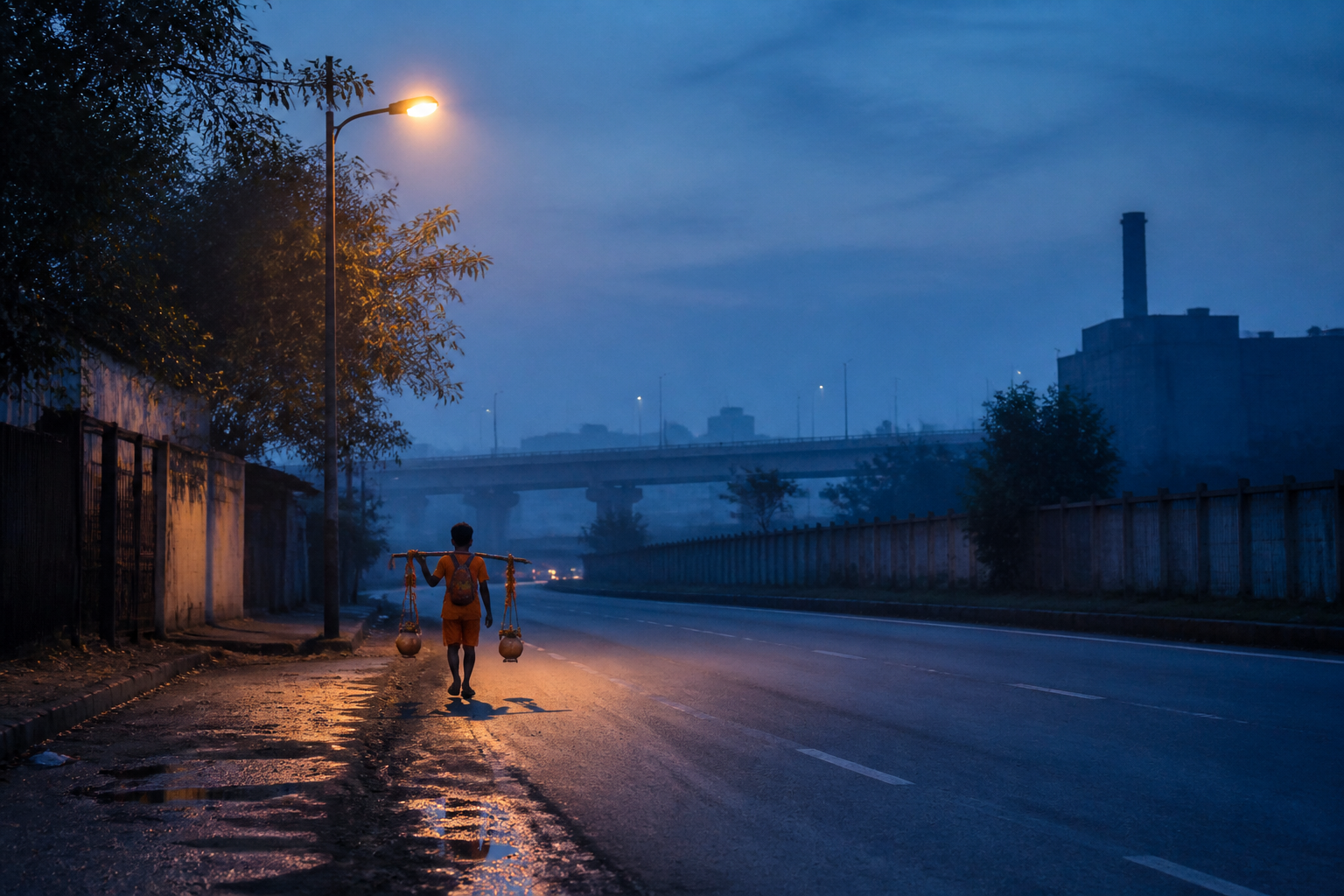
If you arrived after seeing Neeraj’s name in a social-media post, begin with the human fact: a 16-year-old has been killed. Do not let his death disappear beneath slogans, victim-blaming, or claims that the known evidence cannot yet support.
You can stand firmly with a Hindu family, insist that every possible motive be investigated, and still distinguish a reported fact from an allegation or assumption. That discipline does not dilute the demand for justice. It makes the demand harder to dismiss.
What is known about Neeraj’s killing
Neeraj was a 16-year-old Hindu factory worker who had returned from the Kanwar Yatra on 11 August 2026. He was killed in the Lal Bagh settlement of Delhi’s Adarsh Nagar area on the night of 12 August.
Police were alerted at about 12:15 a.m. following information about a stabbing and gunfire. Officers took Neeraj to a nearby hospital, where doctors declared him dead. His reported injuries included both knife and gunshot wounds.
Neeraj’s friend Sahil described a sequence beginning at a shop. He and Neeraj encountered Aman Mulla and another person there, an argument occurred, and the two friends left. They were later heading back toward the shop to retrieve a beer bottle they had forgotten. Aman Mulla and the other person were identified as the accused.
That sequence needs to be read with care. The bottle explains why the boys reportedly turned back; it does not justify the violence, make Neeraj responsible for his own death, or establish the assailants’ motive. A contextual detail is not a moral verdict.
- The reported event: Neeraj suffered fatal knife and gunshot injuries after a dispute.
- The allegation: two people, including Aman Mulla, have been named as accused. An accusation is not a conviction.
- The motive: a dispute is reported, but the information presently available does not establish whether Neeraj’s Hindu identity or Kanwar pilgrimage caused the attack.
Keep those three levels separate whenever you discuss the case. Neeraj’s Hindu identity and pilgrimage are relevant facts. They deserve neither concealment nor automatic conversion into proof of a religious motive.
A serious demand for justice begins with precise questions
Public anger often moves faster than a criminal investigation. The useful response is not to fill each information gap with certainty. It is to identify the next fact that police, prosecutors, or a court should be able to establish.
- What is the FIR or other official case-reference number, and which police station is responsible for the investigation?
- Have both named suspects been conclusively identified, and what is each person’s current custody or legal status?
- What does the established timeline show between the shop argument, Neeraj and Sahil leaving, their return, and the fatal attack?
- Are CCTV recordings, mobile-phone records, witness accounts, the knife, firearm evidence, or ballistic findings available to connect particular acts to particular suspects?
- Has Sahil’s account been formally recorded and tested against independent evidence?
- Are investigators examining motive separately from identity, including any prior threats, religious abuse, deliberate targeting, or communications connected with the attack?
- What is the next public procedural milestone: arrest confirmation, court production, filing of charges, or another dated status update?
Not every detail can responsibly be released during an active investigation. Witness addresses, private phone numbers, graphic images, and evidence that could be contaminated through publicity should remain protected. Custody status, the case number, the offences being investigated, and major court milestones can still be requested without demanding disclosure of sensitive material.
If you track the case, maintain a simple four-part record: date, authority, exact update, and a link or copy of the underlying record. Mark an unanswered question as unconfirmed. A gap is a reason to keep asking; it is not permission to invent an answer.
How to advocate for Neeraj without weakening the case
Careless advocacy can injure the cause it intends to serve. A false quotation, misidentified photograph, or premature declaration of guilt gives attention to the error instead of the killing. It can also expose uninvolved people to harassment and make later corrections harder to circulate.
- Use legal-status words accurately. Call a person an accused or alleged assailant unless a court has convicted that person. An FIR, arrest, criminal charge, and conviction are different stages.
- Separate identity from motive. It is accurate to say Neeraj was Hindu and had returned from the Kanwar Yatra. It is not yet accurate to present religious hatred as the established motive. Ask investigators to examine that possibility rather than announcing the answer for them.
- Keep incidental details in proportion. The reported beer bottle is part of the timeline, not an explanation for lethal violence. Do not use it either to malign Neeraj or to construct an unsupported theory.
- Protect the family and witnesses. Do not circulate home addresses, phone numbers, unblurred identity documents, graphic images, or a witness’s location. A family’s grief is not public property.
- Preserve provenance. Share the full link, publication date, and exact wording behind a claim. Cropped screenshots hide qualifications and are easily altered.
- Correct errors visibly. If you shared an unsupported claim, edit it or publish a correction where the original audience can see it. Quietly deleting a post leaves copied misinformation in circulation.
- Reject collective blame. Pursue the individuals supported by evidence. Threatening a wider religious community neither honours Neeraj nor helps prove the case against his killers.
A pro-Hindu response does not require silence about a possible anti-Hindu motive. It requires enough seriousness to establish that motive with evidence. Words spoken during the confrontation, prior threats, targeted selection, witness testimony, digital communications, or other corroboration could matter. The mere pairing of a Hindu victim with an accused person’s name cannot do that work by itself.
Key takeaways
- Neeraj was a 16-year-old Hindu factory worker who had returned from the Kanwar Yatra one day before the reported attack.
- He died after suffering both knife and gunshot injuries in Delhi’s Adarsh Nagar area.
- Aman Mulla and another person have been named as accused, but accusation and conviction are not interchangeable.
- A shop dispute is part of the reported sequence; the motive for the killing has not yet been established by the information available.
- The most useful public response is to seek dated procedural updates, protect the family and witnesses, and refuse both victim-blaming and collective retaliation.
What you can do today

If you want to act, send one concise request through the relevant police public-information or grievance channel and to the appropriate elected representative: Please provide a dated update on the case concerning 16-year-old Neeraj in Lal Bagh, Adarsh Nagar, including the official case number, the custody status of the named accused, and the next procedural milestone, while protecting the family’s and witnesses’ private information. Do not use an emergency line for a status request.
If a fundraiser appears, verify the organiser’s identity, the beneficiary, and the route by which money reaches the family before donating or forwarding it. No appeal becomes trustworthy merely because it uses Neeraj’s photograph or a religious slogan.
Dharma asks us to hold satya and nyaya together: truth and justice. Share the core facts once, label every unknown honestly, and keep asking for the next official milestone. That is how public attention becomes durable accountability rather than a brief cycle of outrage.
References
