
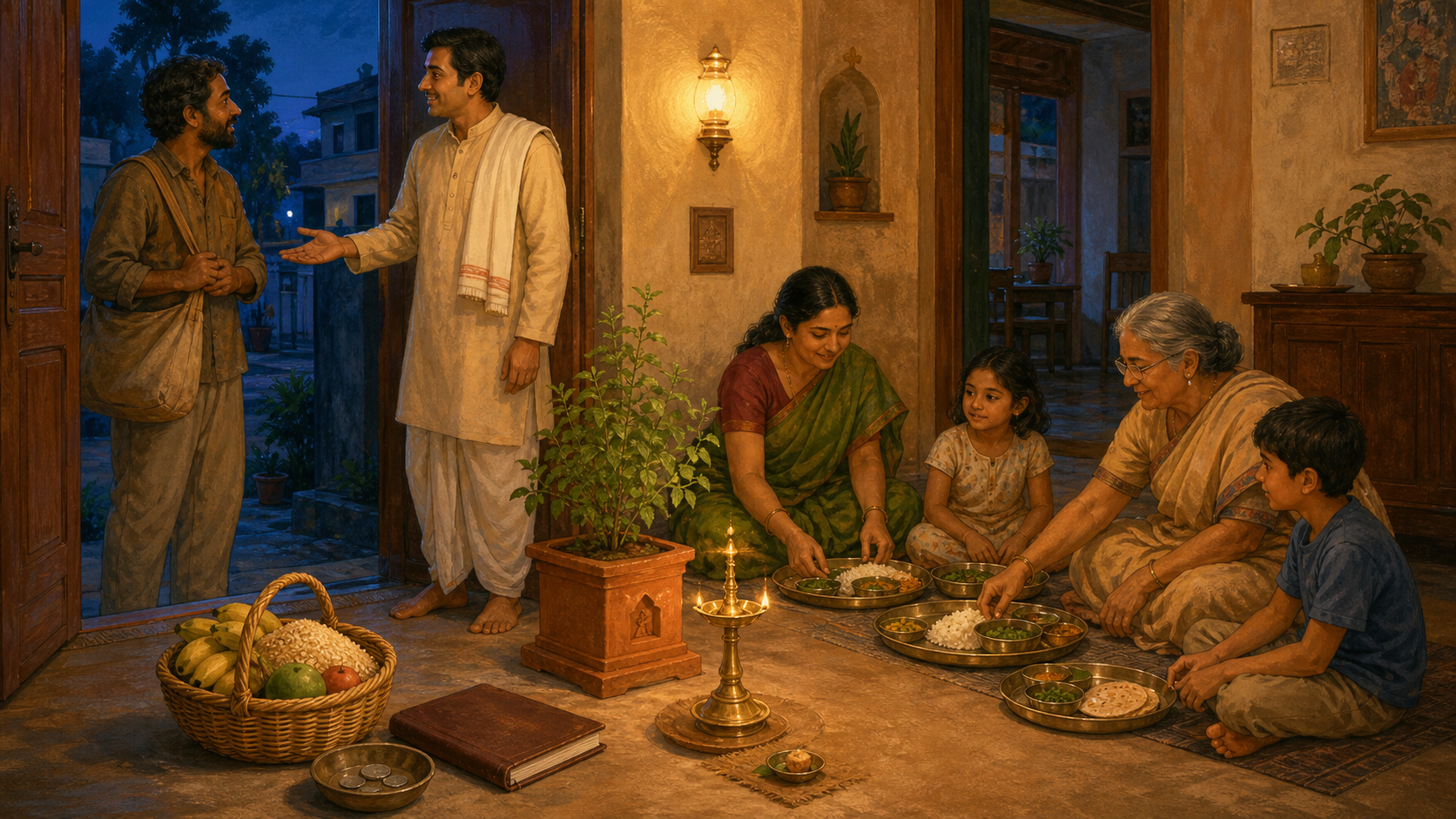
You may be earning honestly, caring for relatives and keeping some form of sadhana, yet still wonder whether ordinary household life is carrying you toward Bhagavan or merely keeping you busy. The difficult question is not whether family responsibilities matter. It is whether those responsibilities have become a reason for accumulation, control and spiritual postponement.
Bhagavatam 7.14 does not force a choice between abandoning the home and becoming absorbed in it. It gives you a harder and more useful task: arrange earning, eating, relationships, hospitality, worship and giving so that the household becomes a place of service rather than a private kingdom.
The chapter changes the purpose of a household
A householder’s spiritual problem is not the existence of possessions. It is the belief that possession gives unrestricted moral entitlement. Income, food, property, skill and influence may be under your control, but householder dharma asks what legitimate duties they must serve before they serve preference.
This is the difference between treating the household as an ashrama and treating it as an engine of consumption. An ashrama disciplines desire. It gives family life a sacred purpose, places enjoyment within limits and turns responsibility into seva. A consumption-driven home does the reverse: every increase in income quietly creates a new definition of necessity, while worship is fitted around whatever time remains.
Ask four questions whenever a household resource comes under your control: What duty must this serve? Who else has a rightful claim on it? What would enough look like? Will its use strengthen remembrance of Bhagavan or deepen forgetfulness? These questions make the chapter practical without reducing it to a rigid household formula.
The result is neither forced poverty nor consumerism decorated with devotional symbols. It is stewardship. You maintain what has genuinely been entrusted to you, enjoy without making enjoyment the governing aim, and release surplus toward purposes larger than the self.
Put householder dharma into five decisions

- Decide what enough means before desire decides for you. Identify the real requirements of food, shelter, health, lawful obligations and dependent care. Then examine what remains. A larger income may expand your ability to serve, give and prepare responsibly for genuine needs; it does not automatically make every upgraded preference a necessity.
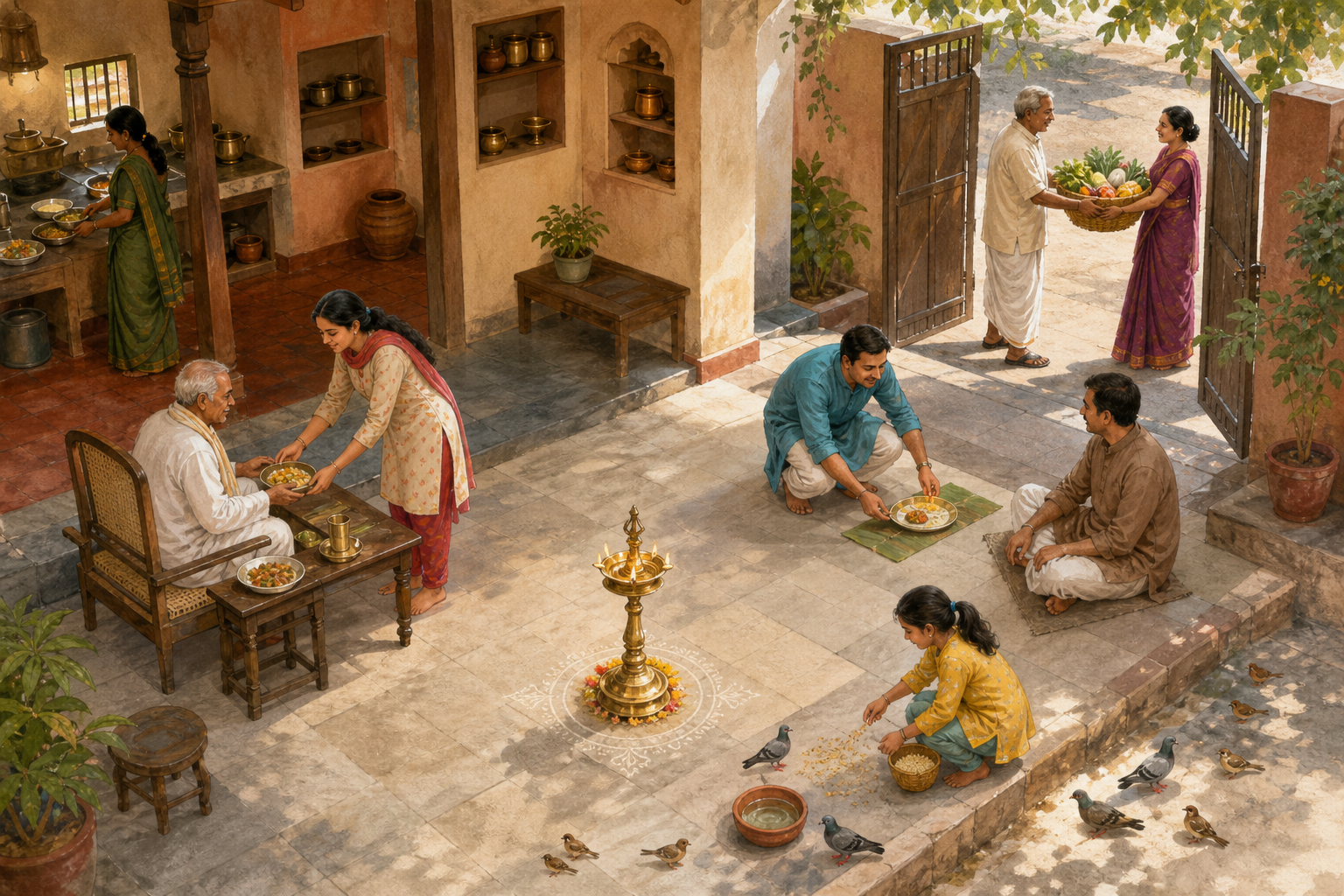
- Let offering and sharing come before enjoyment. In the chapter’s devotional logic, food is not merely acquired and consumed. It passes through gratitude, offering and responsibility. Establish a visible sequence in your home: prepare with care, offer the meal to Bhagavan according to your tradition, serve those who depend on you, share where appropriate and avoid waste.
- Give without turning generosity into theatre. A gift should answer a real dharmic claim, not purchase a reputation for piety. Consider whether it supports spiritual learning, worship, essential care or someone facing genuine need. Generosity that neglects dependants, hides dishonesty or seeks applause has preserved the appearance of dharma while losing its order.
- Extend moral concern beyond your preferred circle. Bhagavatam 7.14 widens the householder’s field of care to beings who can easily be treated as inconvenient or useful objects. Give appropriate care to animals dependent on your household, reduce needless harm and waste, and notice when convenience has made another living being invisible to you.
- Give remembrance a dependable place in household life. Hearing sacred teachings, chanting, worship, association and observance should not depend entirely on spare time appearing. Attach a manageable practice to a stable household moment, such as waking, preparing food or gathering before rest. A modest practice that shapes conduct is more valuable than an elaborate observance that repeatedly collapses.
Hospitality also needs thoughtful translation into present conditions. You are not required to ignore household safety or admit an unknown person into a vulnerable home. You can feed a known neighbour, help through a trusted community effort, make room for a visiting devotee or ensure that a worker is treated with dignity. The enduring principle is that the home must not become so closed around its owners that another person’s need has no claim on it.
The chapter’s attention to sacred observance, worthy giving, time and place also prevents spirituality from becoming a private mood. Calendar and geography can train remembrance, but pilgrimage and ceremony cannot compensate for injustice at home. When studying the relevant passage, hear this Vaishnava teaching on Bhagavatam 7.14.25-26 after reading the verses, and write down the household decision that the discussion places before you. Commentary has done its work when it changes how you earn, receive, offer or share.
Learn to distinguish duty from possessiveness

Detachment in household life is often misunderstood as emotional distance. That can become an excuse for neglect. The chapter points toward a more demanding detachment: care fully without treating the people and resources in your care as extensions of your ego.
A spouse is not property, a child is not a prestige project, and an elderly relative is not an obstacle to spiritual ambition. Nor should devotion be used to silence reasonable household concerns. Service becomes dharmic when it respects the other person’s dignity and meets a real responsibility; it becomes possessive when help is made conditional on obedience, praise or control.
- When someone resists your preference, can you identify an actual duty being violated, or are you calling disappointment adharma?
- When income rises, does your definition of enough rise automatically with it?
- Does your sadhana make you more truthful, patient and dependable in the home, or does it give you a respected way to withdraw from difficult care?
- When need appears at your door, do you first ask how to help safely, or immediately search for a reason that the need is not yours?
- If nobody saw a ritual, donation or act of hospitality, would you still perform it with the same care?
- When plans fail, are you grieving harm to dharma or merely the loss of control?
An uncomfortable answer does not prove that your household life has failed. It identifies the place where practice must become concrete. Name the recurring trigger, such as a purchase, a meal, a disagreement or a request for help, and decide in advance what a less possessive response would be. Detachment grows through these repeated acts of reordering, not through a dramatic claim that nothing belongs to you.
This also guards against a common mistake: using renunciation language to avoid competence. Bills still need attention. Children still need steady care. Promises still need to be kept. Food still needs to be prepared. Householder detachment changes the motive and manner of responsible action; it does not erase the action.
Key takeaways for a dharmic household
- Treat the home as an ashrama whose resources are held for duty, worship, care and appropriate enjoyment.
- Define enough deliberately so that changing social expectations do not define it for you.
- Place gratitude, offering and sharing before consumption, especially around food and income.
- Meet genuine obligations to dependants before using charity or ritual to display virtue.
- Extend care beyond the household’s favoured insiders, including to vulnerable people and nonhuman life.
- Judge detachment by reduced control and increased reliability, not by coldness or neglected responsibilities.
Begin at the next household threshold

Do not begin by announcing a complete reform of family life. Begin at the next threshold where a resource changes hands: the next meal, payment, purchase, family disagreement, guest or request for help.
- Name what has come under your control: money, food, time, authority, attention or space.
- Name everyone with a legitimate claim on it, including people whose claim is easy to overlook.
- Separate actual duty from habit, fear, prestige and personal preference.
- Make the offering, fulfil the obligation or set aside the share before taking your own enjoyment.
- Notice where you resist. That resistance identifies the part of householder dharma that needs practice rather than further abstraction.
Repeat that discipline at the same threshold until it becomes part of the household’s ordinary rhythm. You do not need to wait for retirement, pilgrimage or freedom from family demands. Bhagavatam 7.14 places the spiritual work precisely where you already stand: among the people, creatures, duties and resources entrusted to your care.
References
