
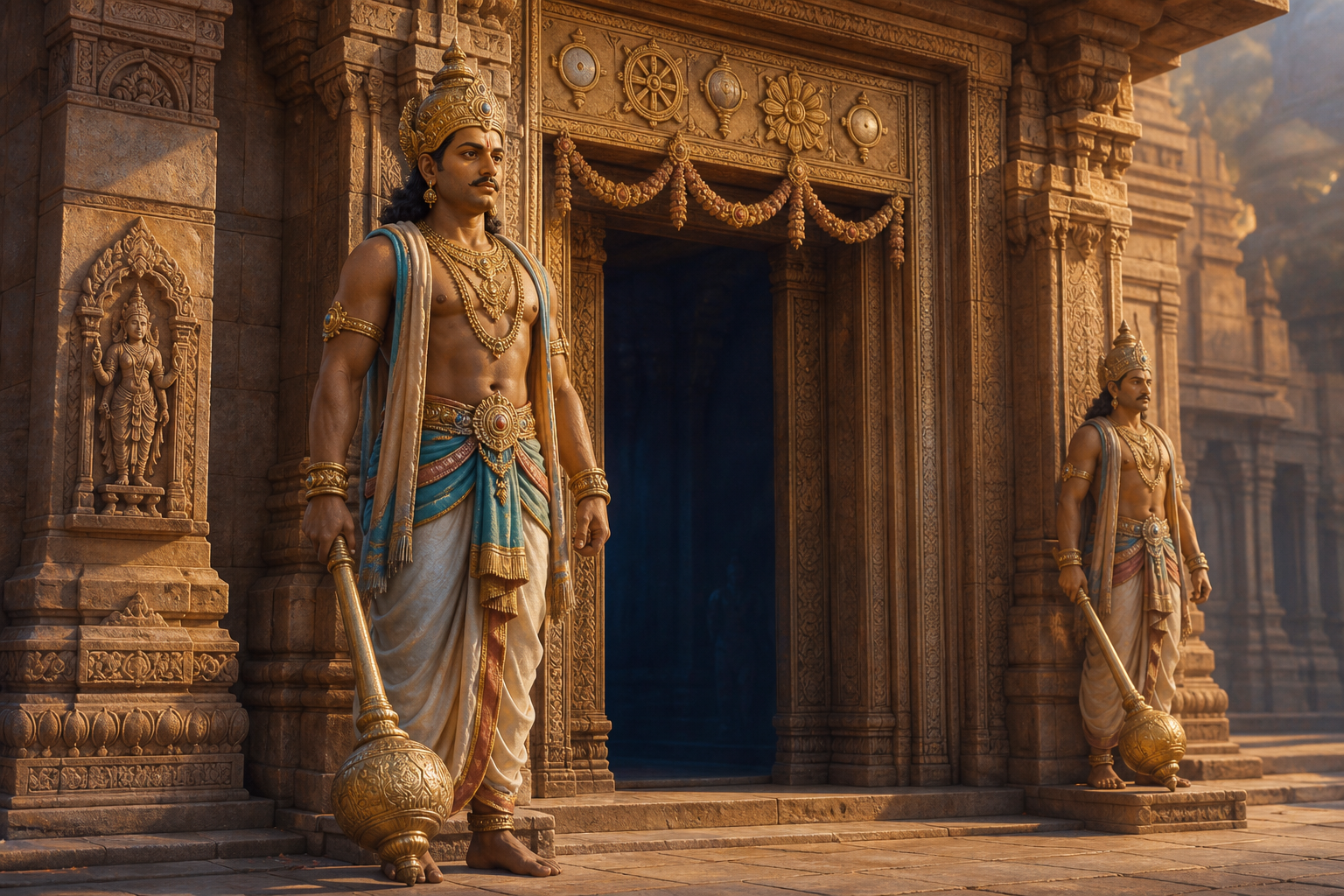
You are looking at a guardian beside a temple doorway, perhaps in a photograph with no useful caption. The figure appears important, but how can you tell whether it is Nanda, what the golden association means, and why a guardian belongs at the entrance to a divine abode?
The safest answer begins with context rather than a weapon, gesture, or ornament. Nanda’s iconographic identity joins four elements: his name, his office as a dvarapala, his service to Vishnu, and his golden character. Once you keep those elements distinct, you can interpret the figure without turning a plausible identification into a false certainty.
First establish whether the guardian is really Nanda
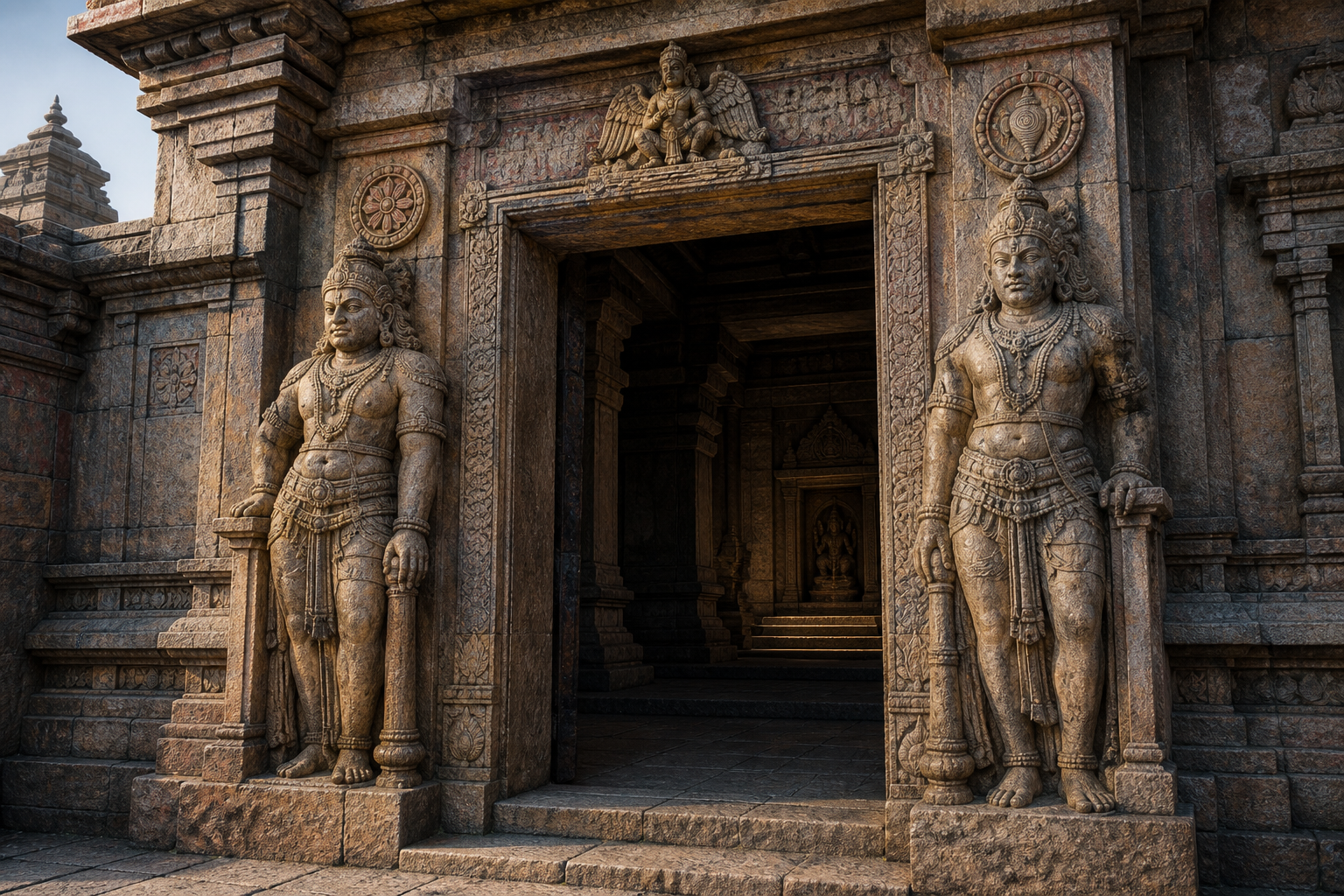
The word dvarapala means a protector or guardian of a doorway. It identifies an office before it identifies a particular person. Nanda is more specific: he is presented as the golden guardian and a door sentinel of Vishnu.
That distinction prevents the most common mistake in reading temple guardians. A figure at a doorway may securely be called a dvarapala, yet its personal name may remain uncertain. In this Vaishnava setting, every correctly identified Nanda serves as a dvarapala, but not every dvarapala should automatically be named Nanda.
Use an evidence ladder when you examine an image:
- Begin with the local identification. A temple inscription, established label, ritual tradition, or informed temple authority gives the strongest basis for using the personal name Nanda.
- Confirm the Vaishnava setting. Determine whether the doorway belongs to a shrine or sacred space dedicated to Vishnu. A guardian’s architectural setting can carry more identifying weight than an isolated visual detail.
- Verify the threshold function. Look at the original placement. A statue moved into a museum, courtyard, or storage area may no longer reveal the doorway it once guarded.
- Treat appearance as supporting evidence. Colour, ornaments, posture, and held objects matter, but none should be made decisive unless the temple’s own iconographic tradition connects that feature with Nanda.
If only the last two kinds of evidence are available, use a careful caption such as “Vaishnava dvarapala, possibly Nanda.” That wording tells the reader what is visible, what is inferred, and where uncertainty remains.
Read the golden quality as a clue, not a colour test
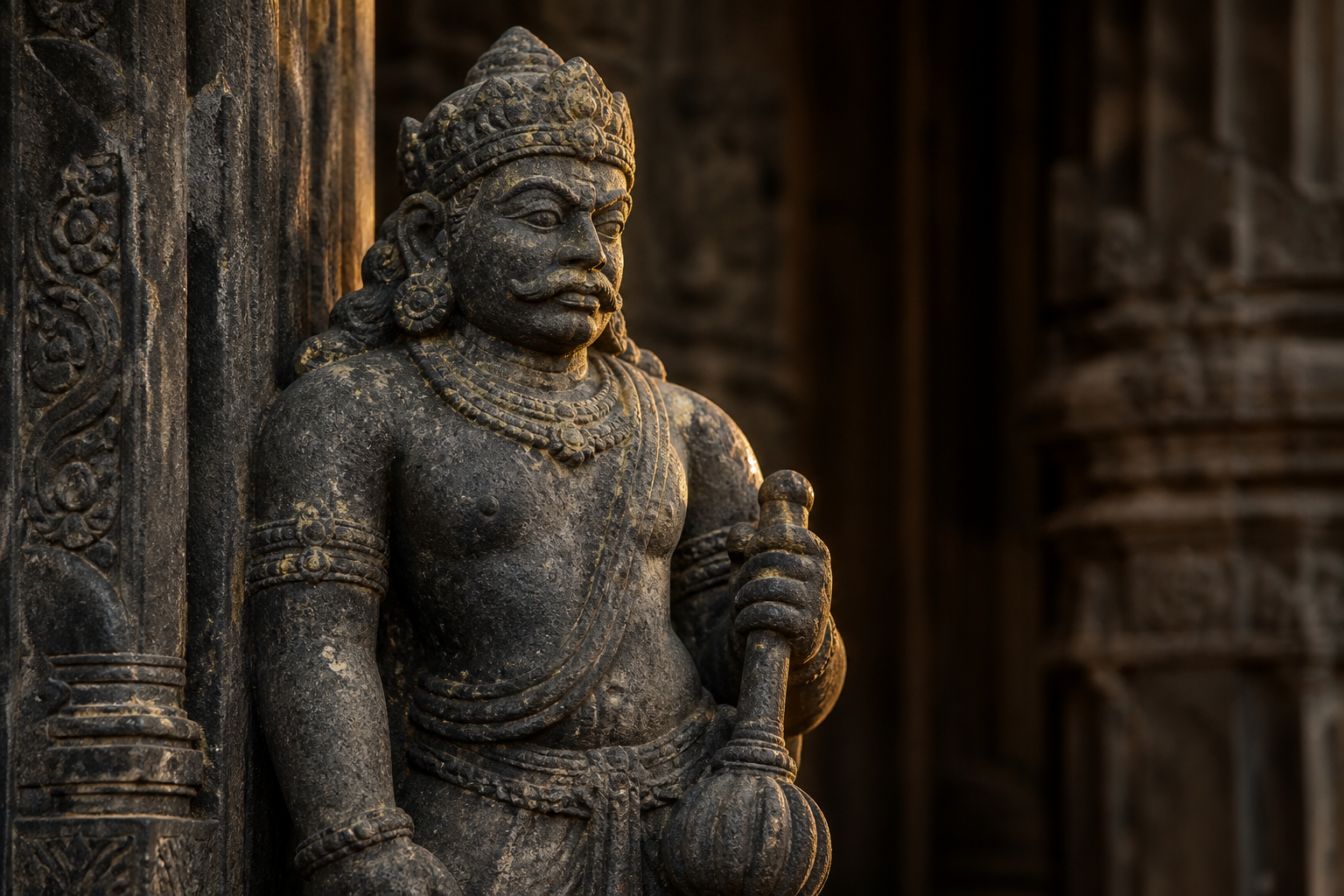
Calling Nanda golden does not require every surviving representation to display a bright metallic surface. Temple figures can be carved in stone, made in metal, painted, repainted, weathered, or stripped of an earlier surface treatment. An iconographic colour may also persist in a name or sacred description even when it is no longer visible on the object before you.
Gold therefore works on two possible levels. It may describe an actual visual treatment, but it may also signal luminosity, preciousness, dignity, or nearness to the divine. The responsible interpretation keeps those possibilities open until the object and its local tradition tell you more.
Ask three questions before drawing a conclusion:
- Is gold visibly present as paint, gilding, metal, or another surface effect?
- Does the temple tradition call the guardian golden even when the material itself is not gold-coloured?
- Could the present surface be the result of age, cleaning, repainting, or restoration?
This approach also guards against a crude reading of sacred colour as ordinary skin colour. In iconography, colour can communicate a being’s spiritual character rather than imitate everyday human appearance. For Nanda, the golden association belongs to the meaning of the guardian; it should not become a shortcut that overrides placement, affiliation, and local identification.
The doorway is part of Nanda’s iconography
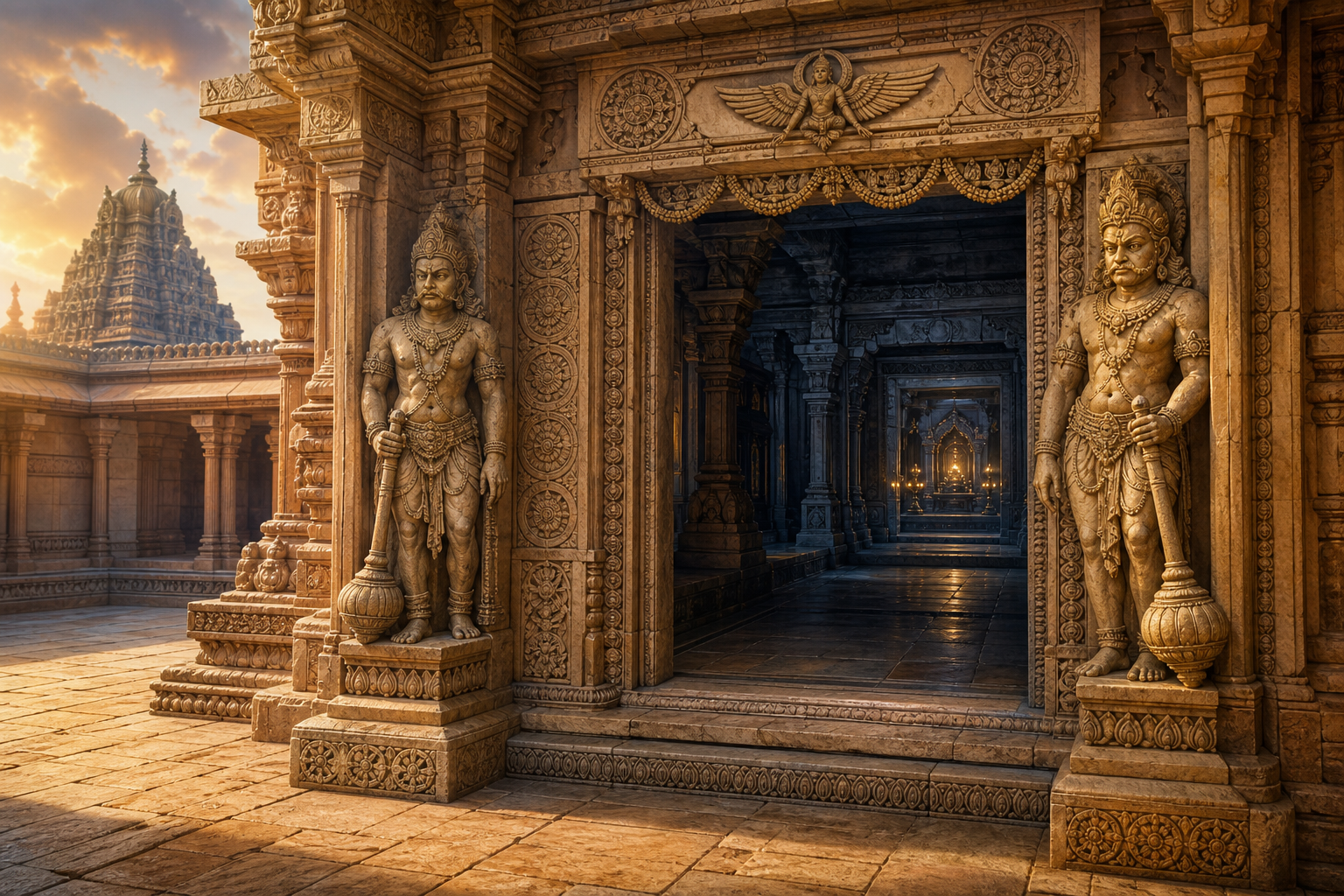
A dvarapala cannot be understood fully as an isolated statue. The doorway is part of the image’s meaning. Nanda stands at a boundary between ordinary space and the divine abode of Vishnu. His position tells you that entering sacred space is a deliberate transition, not merely movement from one room to another.
This is why the guardian should not be dismissed as architectural decoration. The figure makes the threshold visible as a spiritual event. Before the devotee approaches the deity, the architecture calls for attention, order, and inward readiness. The guardian gives that demand a personal form.
Nor should you read Nanda as an enemy blocking access to Vishnu. A sacred guardian protects the integrity of the passage. The underlying question is not simply, “May anyone walk through this door?” It is, “In what state of attention are you approaching the divine?”
You can respond to that iconography during a temple visit without inventing a new ritual. Pause where local practice permits. Notice the change in space. Set aside casual conversation, hurried photography, and distraction. Then approach with the conduct expected in that temple. The guardian has already done his interpretive work if the threshold changes the quality of your attention.
A five-step method for reading a Nanda image
When you are documenting a temple, checking a museum caption, or studying an online photograph, follow the same sequence every time:
- Start with the whole doorway. Record the building, shrine affiliation, exact entrance, and the figure’s position in relation to the sacred space. Do this before cropping the photograph.
- Describe only what you can see. Note posture, orientation, number of arms, held objects, headgear, ornaments, material, visible colour, and condition. Observation should come before interpretation.
- Look for a transmitted name. Check inscriptions, temple records, established local usage, and informed custodians. Do not assign Nanda merely because the statue resembles another guardian seen elsewhere.
- Test all four anchors. Ask whether the proposed identification accounts for Nanda’s personal name, dvarapala office, relationship to Vishnu, and golden association. One matching feature is not the same as a complete identification.
- Interpret the threshold. Ask what changes as a worshipper passes the guardian: public space to sacred space, movement to attention, or ordinary conduct to disciplined approach. This turns an inventory of features into an iconographic reading.
Keep the final description proportional to the evidence. “Nanda, the golden dvarapala of Vishnu” is suitable when the personal identification is established. “A dvarapala at a Vishnu shrine” is better when only function and affiliation are secure. “Guardian figure” may be the honest choice when the original setting is unknown.
This restraint is not a failure of interpretation. It preserves the difference between what the sculpture shows, what the sacred tradition names, and what a modern viewer infers. That difference is essential when regional style, age, material, damage, or later repainting has altered the figure’s appearance.
Key takeaways
- Nanda is identified through the combined context of Vishnu, the dvarapala’s threshold office, the personal name, and the golden character.
- A doorway guardian is not automatically Nanda. Establish the Vaishnava and local context before supplying a personal name.
- Gold may be a visible material or a symbolic quality. Its absence from a weathered surface does not by itself disprove the identification.
- The doorway belongs to the iconography because Nanda marks the transition into divine space.
- A trustworthy caption separates direct observation, transmitted identification, and modern interpretation.
At the next temple doorway, spend a moment on the setting before studying the guardian’s details. Record what you see in one sentence and what the tradition identifies in a second. That small discipline will help you recognise Nanda with greater care and, more importantly, understand why Vishnu’s guardian stands at the threshold at all.
References
