
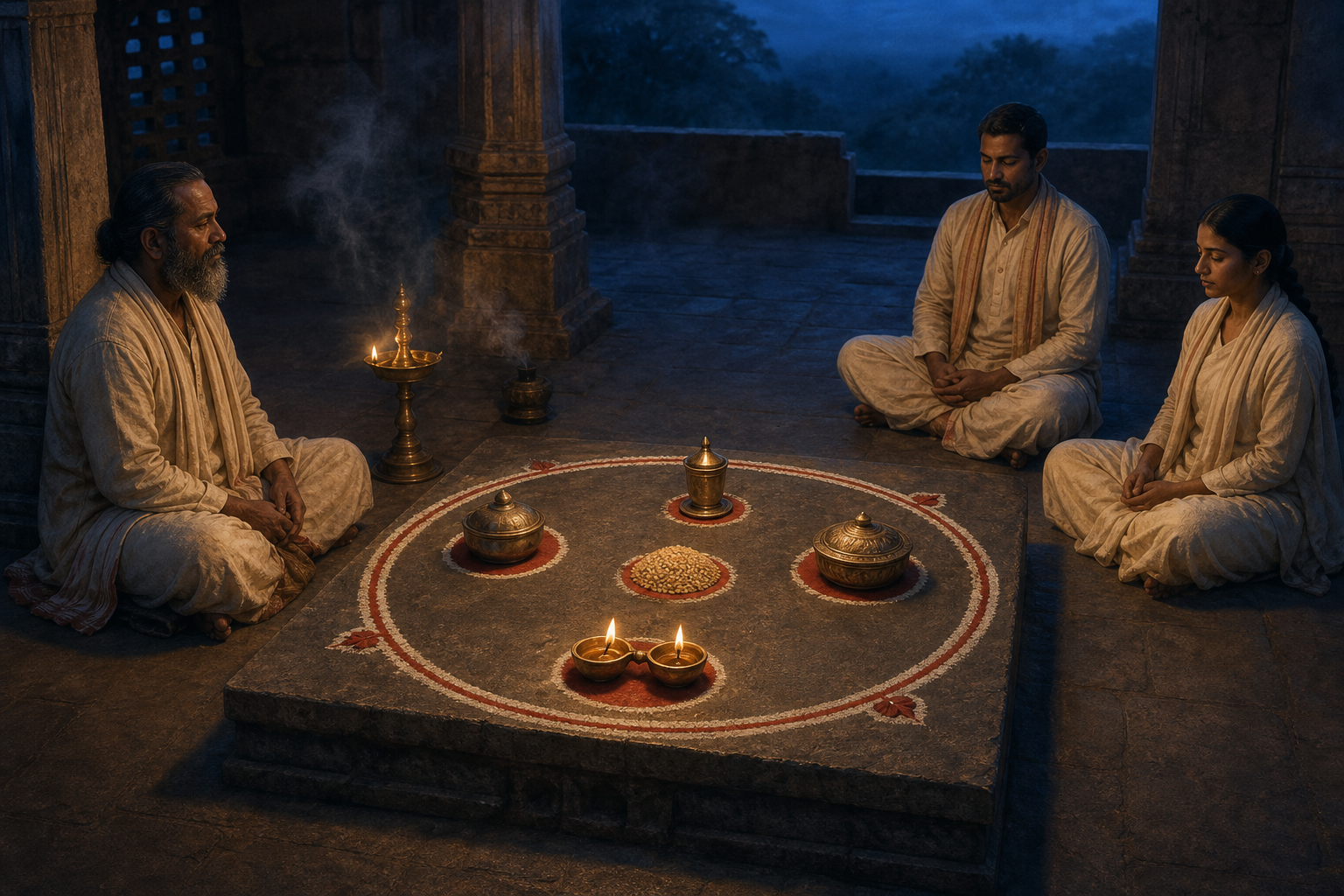
If you arrived after hearing that Tantra sanctifies wine, meat, and sex, pause before accepting either the scandalised version or the romantic one. Panchamakara cannot be understood by extracting five provocative objects from their ritual setting.
Your most useful question is not simply whether the Five Ms are literal or symbolic. Ask which tradition is teaching them, what discipline surrounds them, who is considered eligible, and what transformation the practice is supposed to produce. Without those answers, you have vocabulary but not a practice.
The Five Ms are a ritual grammar, not a shopping list
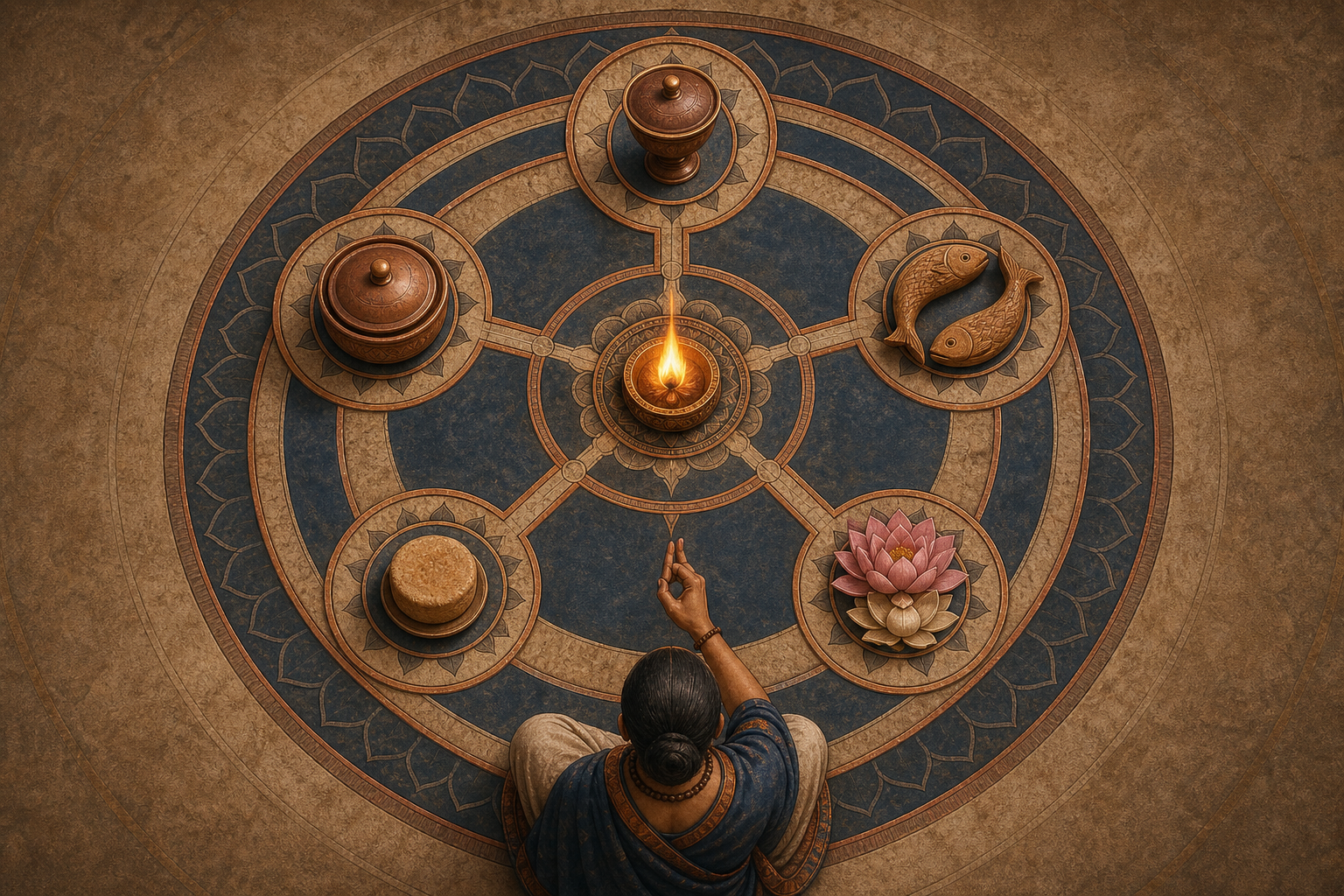
Panchamakara means the five items whose Sanskrit names begin with the letter M. It is a five-part Tantric framework also known as the Five Ms or Panchatattva. The ordinary referents of the terms are straightforward, even though their ritual uses and interpretations are not uniform.
| Term | Ordinary referent | What requires context |
|---|---|---|
| Madya | Wine or alcohol | It can signify ecstasy, spiritual intoxication, and a loosening of ego-bound control; that symbolism is not permission for casual intoxication. |
| Mamsa | Meat | A tradition may employ the material, replace it, or interpret it through another ritual or inward discipline. |
| Matsya | Fish | The named substance alone does not reveal how a particular lineage understands or uses it. |
| Mudra | Often a grain preparation or ritual food in this list | Mudra has other meanings, including seal or gesture, in wider Hindu and Tantric usage. The immediate context decides the sense. |
| Maithuna | Sexual union | Interpretations range from a regulated external rite to substitution or an inward account of union. One form must not be projected onto every tradition. |
This table gives you the vocabulary, not a procedure. Seeing the five names in a book, video, or workshop description does not tell you whether physical substances are used, who may participate, or what preparatory disciplines are assumed.
Panchatattva can denote this same fivefold set in a Tantric setting, but tattva is used in many other philosophical and ritual classifications. Do not assume that every reference to five tattvas concerns Panchamakara. Read the surrounding teaching before equating the terms.
Why Tantra places difficult things inside ritual boundaries
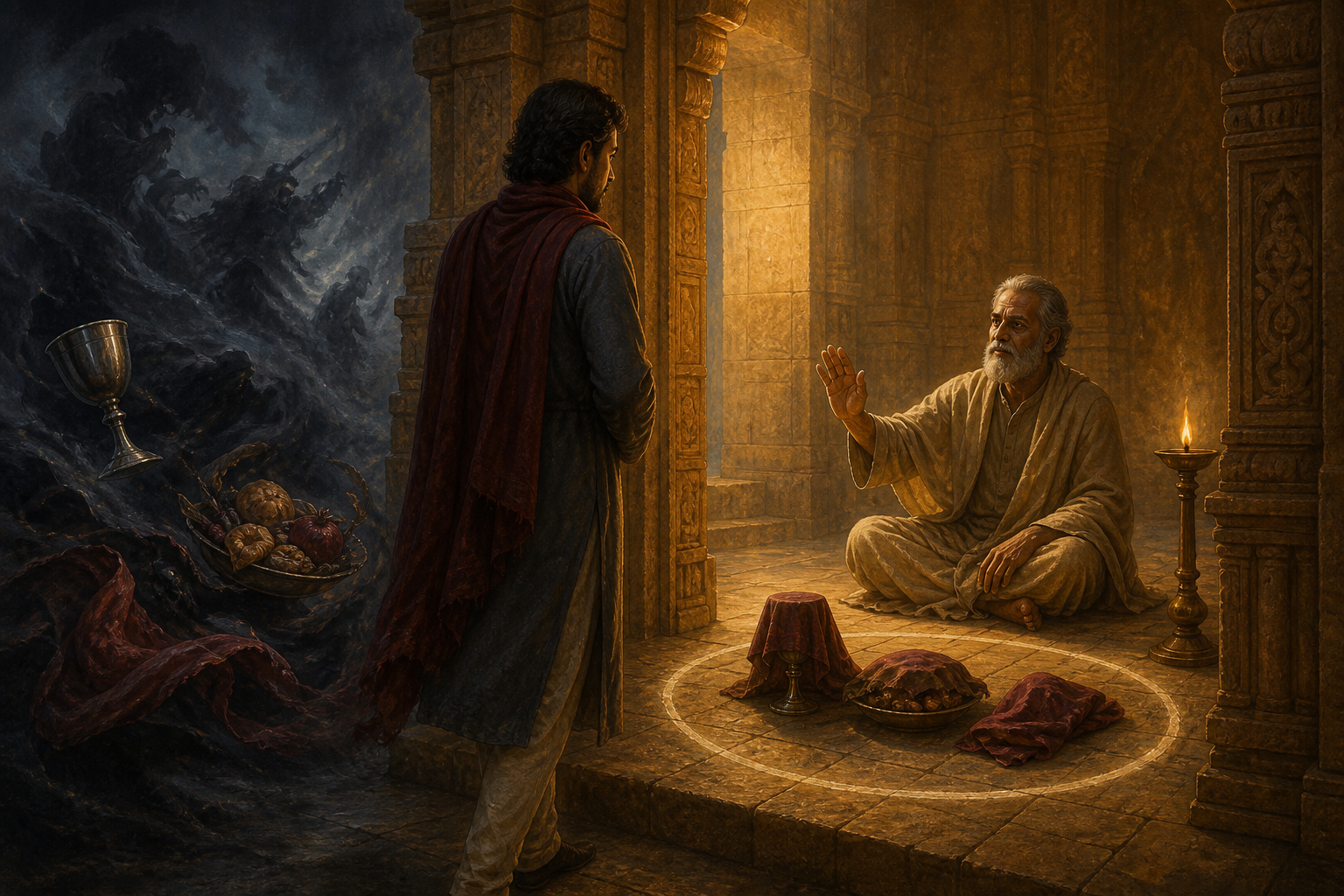
The five items can arouse desire, aversion, fear, shame, or arguments about purity. That is part of why they attract attention. In traditions that employ Panchamakara, however, provocation is not the whole purpose. A difficult material is placed within a disciplined ritual frame so that the practitioner’s reaction can become an object of awareness and transformation.
Madya shows the distinction clearly. Wine can serve as a sign of divine bliss or the dissolution of rigid ego boundaries, but ordinary intoxication does not become spiritual attainment merely because Tantric language has been attached to it. Alcohol can just as easily reduce awareness and impair judgment. The symbol and the substance must not be confused with the result being sought.
The same distinction applies across the set. Consuming something is not automatically freedom from attachment, and refusing it is not automatically purity. A person may remain governed by an object through compulsive desire, mechanical disgust, fascination, or fear. Tantric discipline asks whether that governing reaction is actually being transformed.
When you assess an explanation of Panchamakara, test it with three questions:
- Is desire being observed and disciplined, or merely given a sacred-sounding excuse?
- Is aversion being brought into awareness, or is shock being treated as an achievement?
- Does the claimed transformation appear as greater self-command, humility, and responsible conduct outside the rite?
These questions keep attention on sadhana rather than spectacle. The fact that an act crosses a social boundary does not prove that it transcends ahankara. Transgression can feed the ego as readily as respectability can.
Literal, substituted, and inward readings are not interchangeable
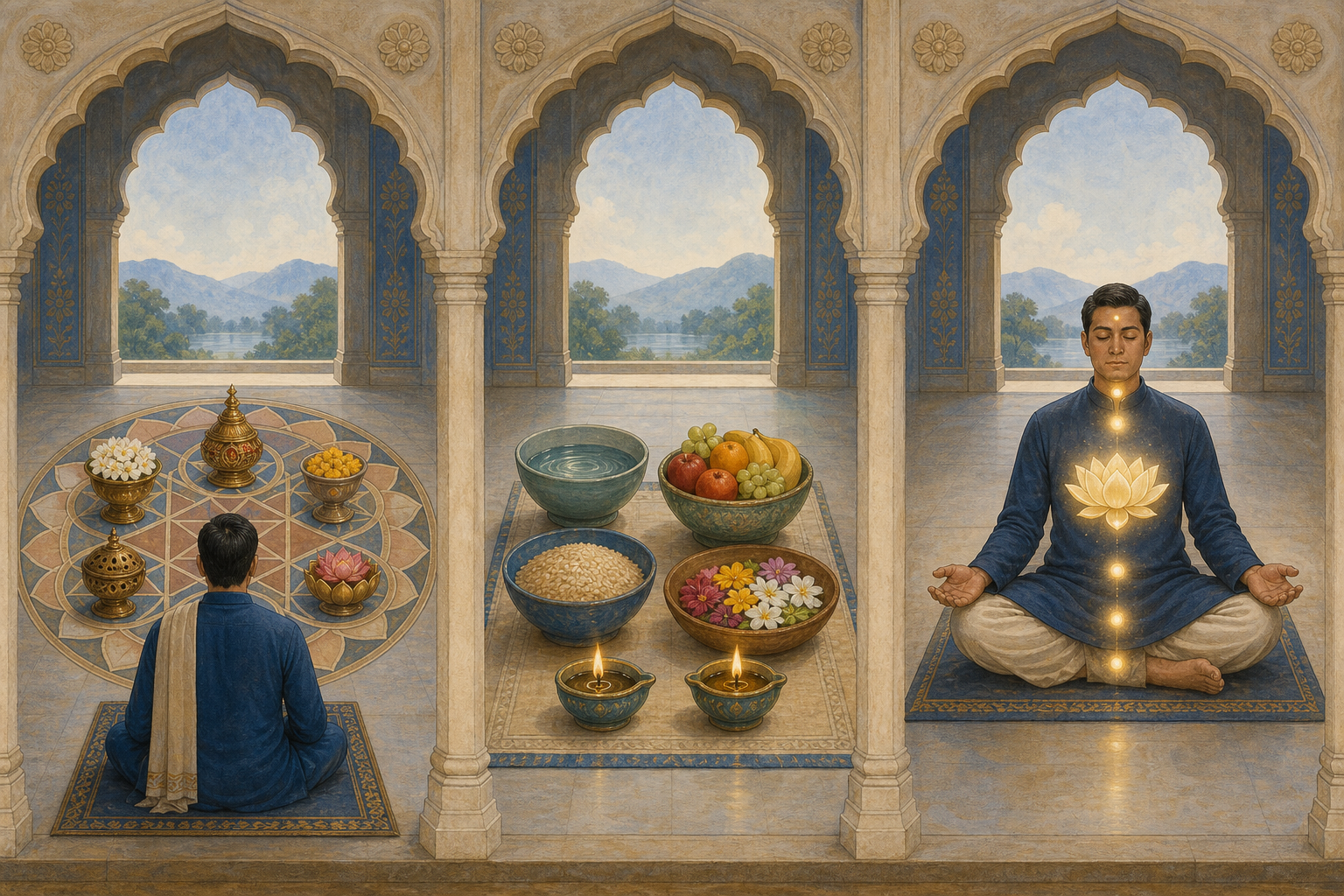
You will encounter three broad ways of discussing the Five Ms. They are useful orientations, not a universal classification imposed identically by every lineage.
- External or literal practice: the named materials or acts are physically present, but within a prescribed ritual structure. Their presence alone does not reproduce that structure.
- Substituted practice: another offering stands in for a prohibited, unavailable, or unsuitable item. The substitution is determined by the tradition rather than invented for convenience.
- Inward or contemplative practice: the terms are related to processes of consciousness, disciplined awareness, or a form of inner union rather than ordinary consumption and intercourse.
Do not turn those orientations into a ranking. Literal does not automatically mean more authentic, and symbolic does not automatically mean more elevated. A physical rite without its discipline can become indulgence; a symbolic explanation detached from a lineage can become empty wordplay. The authority of either approach comes from its complete ritual and philosophical setting.
Nor should you build a universal decoder in which every M always corresponds to one chakra, faculty, breath, or psychological state. Exact correspondences differ. A neat chart circulating without a named tradition may conceal that variation rather than explain it.
Before treating any Panchamakara teaching as practical instruction, write down the answers to these questions:
- Which sampradaya, lineage, or ritual system is being represented?
- Which of the five terms are literal, substituted, or inward in that system?
- Does the practice require initiation, preliminary discipline, mantra, or direct supervision?
- Who is considered eligible, and what would make a person ineligible?
- Which vows, ethical limits, and safeguards continue to govern the practitioner?
- What observable change in conduct is expected, beyond having completed an unusual rite?
If the teacher or material cannot answer these questions, treat it as a description of a topic, not authorisation to perform it. Information about a rite is not initiation into that rite.
Consent, sobriety, and existing vows remain binding
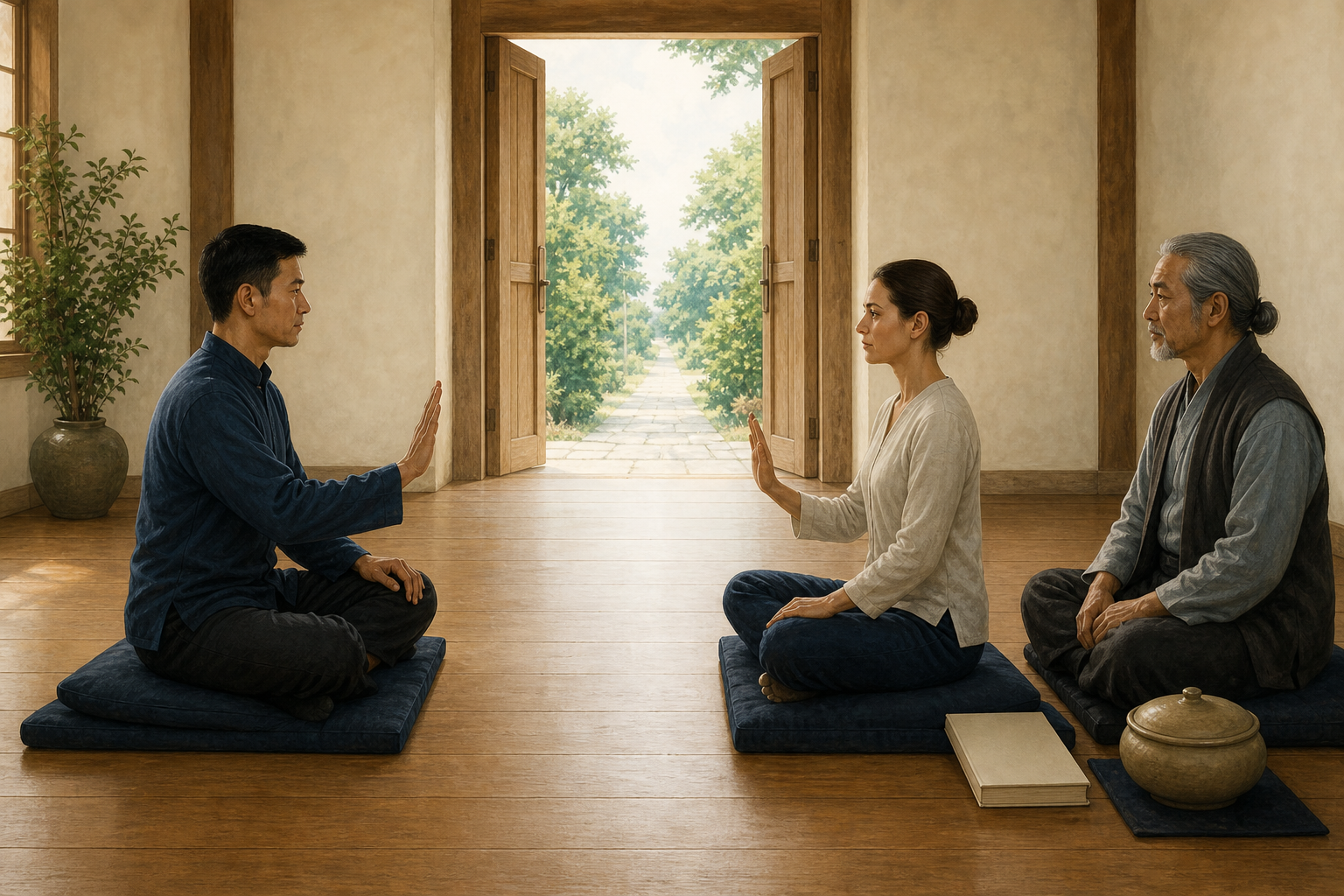
Panchamakara can touch alcohol, sexuality, and strong teacher-student authority. Those features demand clearer boundaries, not weaker ones. A religious title, lineage claim, mantra, or promise of rapid spiritual progress does not cancel consent, civil law, or your existing dharmic obligations.
Do not improvise a literal rite from a list on the internet. Alcohol can impair the judgment needed to recognise pressure and maintain boundaries. Sexual contact introduces consequences that a symbolic explanation cannot remove. If alcohol is unsafe or unlawful for you, do not consume it for ritual reasons. No minor should ever be drawn into sexual activity, and no adult should be pressured to participate.
Consent must be explicit, specific, freely given, and reversible. Spiritual obedience is not sexual consent. Prior consent is not permanent consent. Intoxication must never be used to obtain compliance, and withdrawing from a rite must not be met with threats, humiliation, or claims that refusal proves spiritual inferiority.
Walk away from a proposed practice when any of the following appears:
- Sexual access to a teacher is presented as a compulsory test of surrender or eligibility.
- You are asked to agree while intoxicated or before the relevant acts have been explained plainly.
- Refusal is answered with threats of a curse, spiritual failure, exclusion, or public shame.
- Secrecy is used to stop you consulting a trusted person or an independent teacher.
- Your commitments to sobriety, vegetarianism, celibacy, fidelity, or another vrata are dismissed without serious discussion.
- Extraordinary promises replace a clear account of lineage, preparation, ritual limits, and responsibility.
Ritual privacy and exploitative secrecy are different. A tradition may reserve teachings for initiated practitioners, but confidentiality cannot be used to conceal coercion or prevent someone from seeking help. If you are uncertain, seek a second opinion from a respected practitioner who has no financial, institutional, or sexual stake in your participation.
Your present vows do not disappear because another Tantric stream uses different rules. If Panchamakara conflicts with the discipline given by your guru or upheld in your family and sampradaya, resolve that conflict before going further. Not every practice belongs to every seeker, and choosing not to participate is not a spiritual deficiency.
Key takeaways
- Panchamakara names five Tantric ritual elements: madya, mamsa, matsya, mudra, and maithuna.
- The list supplies vocabulary; it does not reveal a lineage’s procedure, eligibility rules, substitutions, or inner interpretation.
- Literal, substituted, and contemplative forms all require their own tradition-specific explanation. They cannot be freely mixed.
- The relevant test is transformation of attachment and ahankara, not the mere performance of a transgressive act.
- Consent, sobriety, law, and existing vows remain binding. Sacred language never excuses coercion or unsafe improvisation.
- Before approaching practice, identify the lineage, prerequisites, meaning of each M, ethical boundaries, and the teacher responsible for guidance.
If you are studying Panchamakara, make a one-page record with five rows, one for each M, and columns for the lineage’s meaning, mode of practice, prerequisites, safeguards, and intended result. Leave no gap hidden behind the word esoteric. If you cannot complete the record from accountable instruction, you do not yet have enough information to practise. Keep studying, honour your vows, and do not improvise.
References
