
If you have heard that ISKCON has formed a Puri engagement committee and are wondering whether your local Ratha-yatra date must now change, the short answer is no – not on the facts currently available. A coordinated process has begun, but no universal date rule, settlement with Puri’s leadership, or directive to cancel or reschedule a festival has been made public.
Your practical task is to distinguish process from policy. The committee will assess the issues, coordinate engagement, formulate ISKCON’s position on Ratha-yatra dates, and prepare recommendations for the Governing Body Commission. Until a later decision is issued, its existence should not be treated as a verdict.
Key takeaways
- The GBC Executive Committee has created a central body to coordinate ISKCON’s approach to Ratha-yatra observance outside India and its dealings with Jagannath Puri’s leadership.
- The committee began its formal work on 6 August 2026, when it approved its Terms of Reference, confirmed its members, and agreed on working procedures.
- It is presently a coordination and recommendation body. No new worldwide festival date has been declared.
- Stakeholder engagement is expected over the coming weeks, followed by recommendations for the GBC’s Mid-Term Meeting and subsequent consideration.
- Devotees should wait for exact official wording. Festival organisers should preserve their plans and supporting records, but avoid irreversible changes based only on the committee’s formation.
The committee is a coordination body, not a calendar ruling
The labels “Puri Engagement Committee” and “Puri Official Committee” have both been used for this initiative. The substance matters more than the shorthand: the GBC Executive Committee established it to coordinate two connected areas – the observance of Ratha-yatra outside India and ISKCON’s interactions with leaders associated with the Jagannath Puri temple, particularly the King of Puri and his administration.
Its assigned work has four identifiable parts:
- Assess the issues involved rather than assume that every concern has already been settled.
- Coordinate communications and engagement so that different parts of ISKCON do not send conflicting messages.
- Articulate ISKCON’s position concerning Ratha-yatra dates.
- Prepare recommendations for the GBC’s consideration at its Mid-Term Meeting and beyond.
Those verbs establish the committee’s present limits. To assess is not to decide. To articulate a position is not to announce that the other party has accepted it. To recommend is not the same as adopting a binding policy. If a future communication changes an observance date or creates an organisation-wide requirement, that instruction will need to say so directly and define its scope.
The committee also has a protective mandate. It is expected to consider ISKCON’s devotees, projects, reputation, and other assets while pursuing respectful dialogue. That makes this more than a discussion about a date on a calendar. Public claims, local operational decisions, institutional relationships, and the welfare of devotees can affect one another, so coordination is a substantive part of the work.
Why a central channel matters for Ratha-yatra
Ratha-yatra is simultaneously sacred observance, public festival, and institutional undertaking. Outside India, organisers may also have local venue schedules, permits, suppliers, volunteers, travel arrangements, and community expectations to manage. A date question can therefore have devotional, administrative, reputational, and financial consequences at the same time.
Puri adds another dimension. ISKCON is not discussing the matter only within its own international structure; the committee is also charged with constructive engagement involving the King of Puri and his administration. A single coordinated channel reduces the risk that an unauthorised comment, a local assumption, or an online argument will be mistaken for ISKCON’s considered position.
The reasonable inference is that the question still requires institutional work. It would be premature to read the committee’s formation as either a concession by ISKCON or a rejection of Puri’s concerns. Neither conclusion has been established. The stated aim is to develop a coordinated approach while dialogue and assessment continue.
This distinction should shape how you discuss the matter. You can acknowledge Puri’s religious importance without claiming to know what its leaders will accept. You can support ISKCON’s worldwide devotional service without inventing a policy that the GBC has not adopted. Respect does not require speculation, and institutional loyalty does not require declaring a result before the process is complete.
Who is serving and what the mix of roles tells us
| Name | Stated role or affiliation |
|---|---|
| Govardhana Dasa | GBC; committee convenor |
| Gauranga Dasa | GBC; Puri Committee |
| Anuttama Dasa | GBC Minister of Communications |
| Parijata Devi Dasi | GBC Communications; GBC Executive Support Office |
| Braj Hari Dasa | ISKCON Bureau; Puri Committee |
| Krishna Kirti Dasa | Convenor, ISKCON India Scholars Board |
| Brajprem Dasa | President, ISKCON Puri Project |
| Mukunda Chaitanya Dasa | Gajapati District Duty Officer, Odisha |
| Nanda Kishor Dasa | Advisory support through the GBC Executive Support Office |
This composition tells you what kinds of competence the GBC considers relevant. Governance is needed because recommendations will return to the GBC. Communications expertise matters because public wording can affect dialogue and reputation. Scholarly input can help distinguish a defensible institutional position from a slogan. Bureau and project representation connects deliberation with ISKCON’s work in India and Puri. Odisha-based experience gives the committee a closer view of the local institutional environment.
Do not infer more than the membership establishes. A person’s inclusion does not reveal how that person will assess every question, and the list does not disclose voting weights, internal disagreements, or the recommendation that will emerge. Nanda Kishor Dasa is identified under advisory and support, so his role should not be casually described as identical to that of the eight listed committee members.
What to watch next and what you should do now
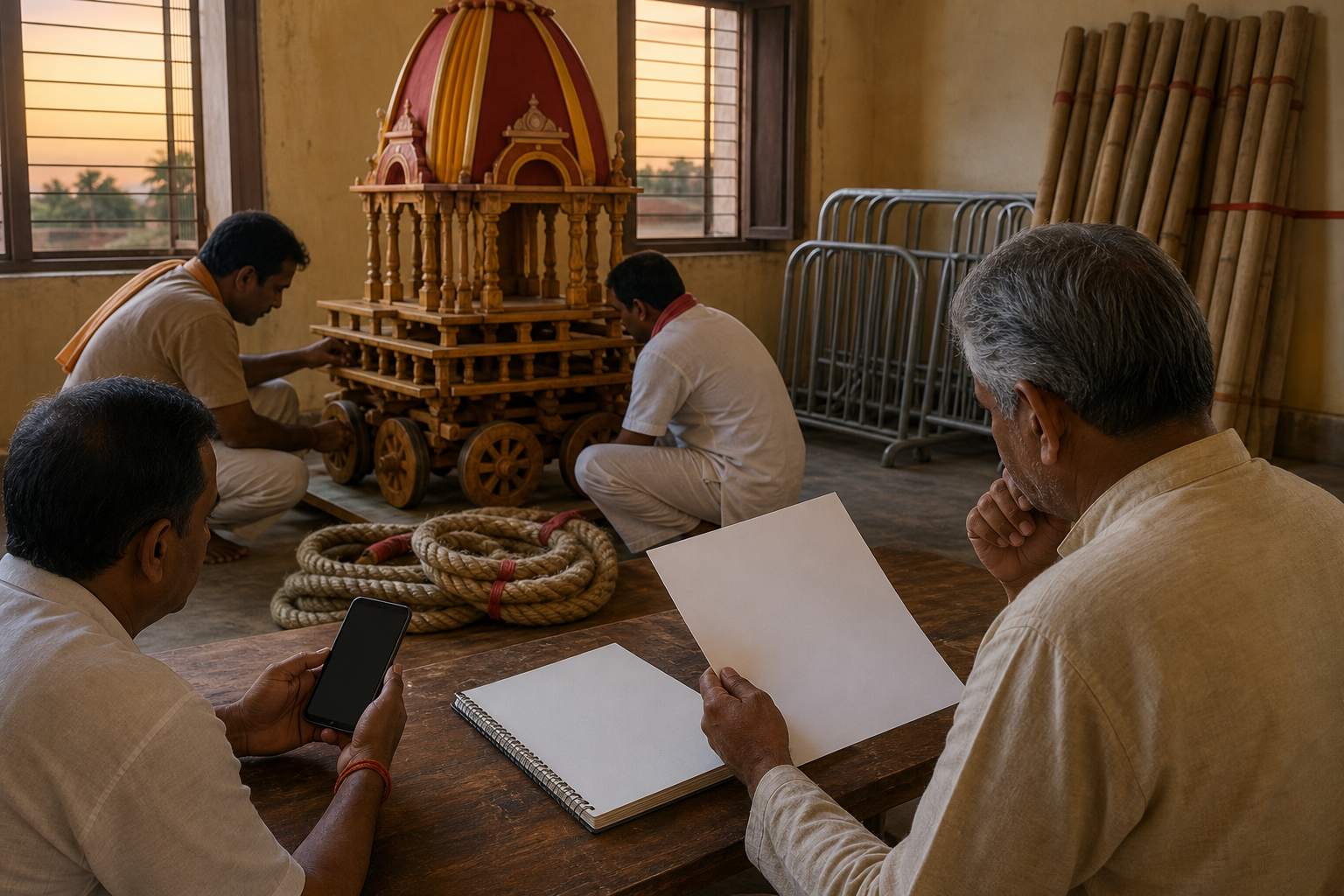
The committee held its inaugural meeting on 6 August 2026. It adopted its Terms of Reference, confirmed its membership, and settled its working procedures. The next stated phase is engagement with relevant stakeholders over the coming weeks. Recommendations are then expected to reach the GBC at its upcoming Mid-Term Meeting and, if necessary, through later work. No exact deadline for a final decision has been given.
Several questions therefore remain open:
- What position will ISKCON ultimately adopt regarding dates for Ratha-yatra outside India?
- Will future guidance distinguish between different countries, local circumstances, or types of ISKCON-organised observance?
- Will the GBC adopt the committee’s recommendations unchanged, modify them, or request more work?
- What understanding, if any, will emerge from engagement with the King of Puri and his administration?
- When would any adopted policy take effect, and who would be responsible for implementing it?
A credible future directive should answer the questions that apply to it. Check who issued it, whether it is an update or an adopted decision, which events and territories it covers, when it takes effect, and what local organisers are required to do. A committee update, a committee recommendation, a GBC resolution, and a local festival notice are not interchangeable documents.
If you are a devotee following the discussion
- Look for complete communications through established ISKCON channels. Do not rely on cropped screenshots, unattributed messages, or paraphrases that omit whether a statement is a proposal or a decision.
- Do not declare a particular Ratha-yatra approved, prohibited, valid, or invalid merely because the committee exists. No event-specific ruling has been identified at this stage.
- When sharing an update, retain its date, issuer, and exact scope. A statement about observance outside India should not be silently rewritten into a claim about every Ratha-yatra everywhere.
- Keep disagreement focused on the actual policy question. Personal attacks on committee members or Puri representatives make careful engagement harder and supply no evidence about the correct festival date.
- Include the committee’s service in your prayers if that is part of your practice; the GBC Executive Committee has specifically requested devotees to do so.
If you help organise a Ratha-yatra
- Do not cancel, move, or publicly reconfirm a date solely because the committee has been formed. Keep existing preparations stable until the competent authority issues guidance that actually applies to your event.
- Prepare a concise decision file recording your proposed date, the basis used to select it, venue and permit constraints, contractual commitments, volunteer needs, public notices already issued, and the practical effect of changing it. This gives your leadership concrete information if the committee seeks local input.
- Route questions through your established ISKCON governance channel. The committee was created partly to coordinate engagement, so parallel public lobbying or unauthorised claims of representation work against its mandate.
- Nominate one person to track official updates and preserve the exact wording. This prevents separate teams from acting on different versions of the same message.
- If a later date change could affect signed contracts, permits, insurance, transport, or public-safety arrangements, obtain appropriate local professional advice before making the change. A religious directive does not automatically erase civil obligations already undertaken.
- In public language, separate what is known from what is pending. Say that consultation is underway if that is the current position; do not announce agreement with Puri, GBC approval, or a worldwide rule unless those developments are explicitly confirmed.
The GBC has said that devotees will receive periodic information as the work progresses. For now, the sound course is simple: preserve the facts, keep preparations reversible where possible, and wait for a communication that clearly identifies both the decision and its scope.
References
