
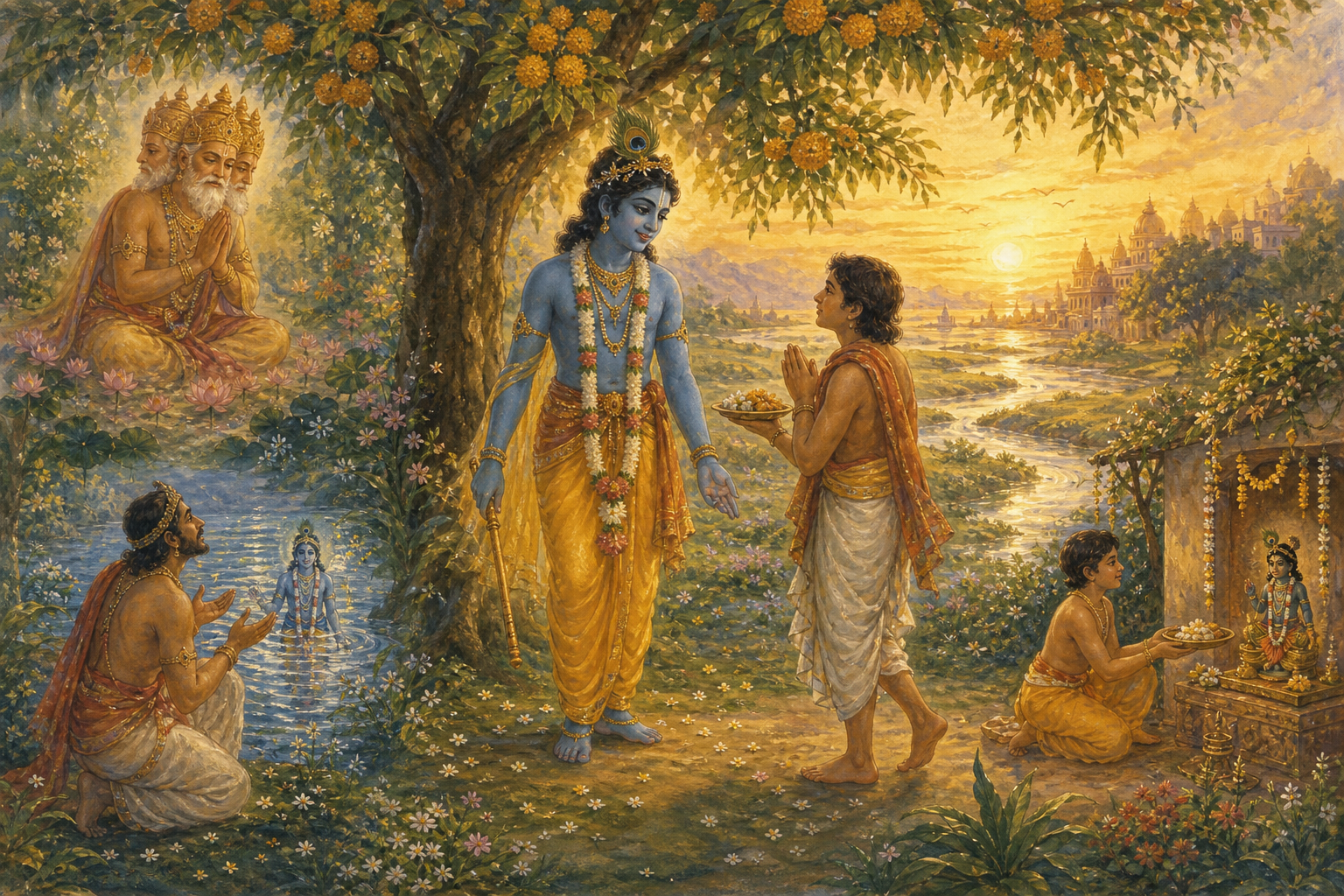
You may understand that bhakti means devotion and still wonder what Bhagavata theology asks you to do tomorrow morning. Should you study metaphysics, try to reproduce a saint’s emotions, or simply perform your regular practice more carefully?
The Gaudiya answer begins with relationship. Notice how Bhagavan makes Himself knowable, how the devotee responds, and how that response becomes service. Brahma, Akrura, and Sri Raghunandana Thakura then become more than admired personalities: they teach you how revelation, humility, and loving attention belong together.
Bhagavan is known in relationship, not captured as an object
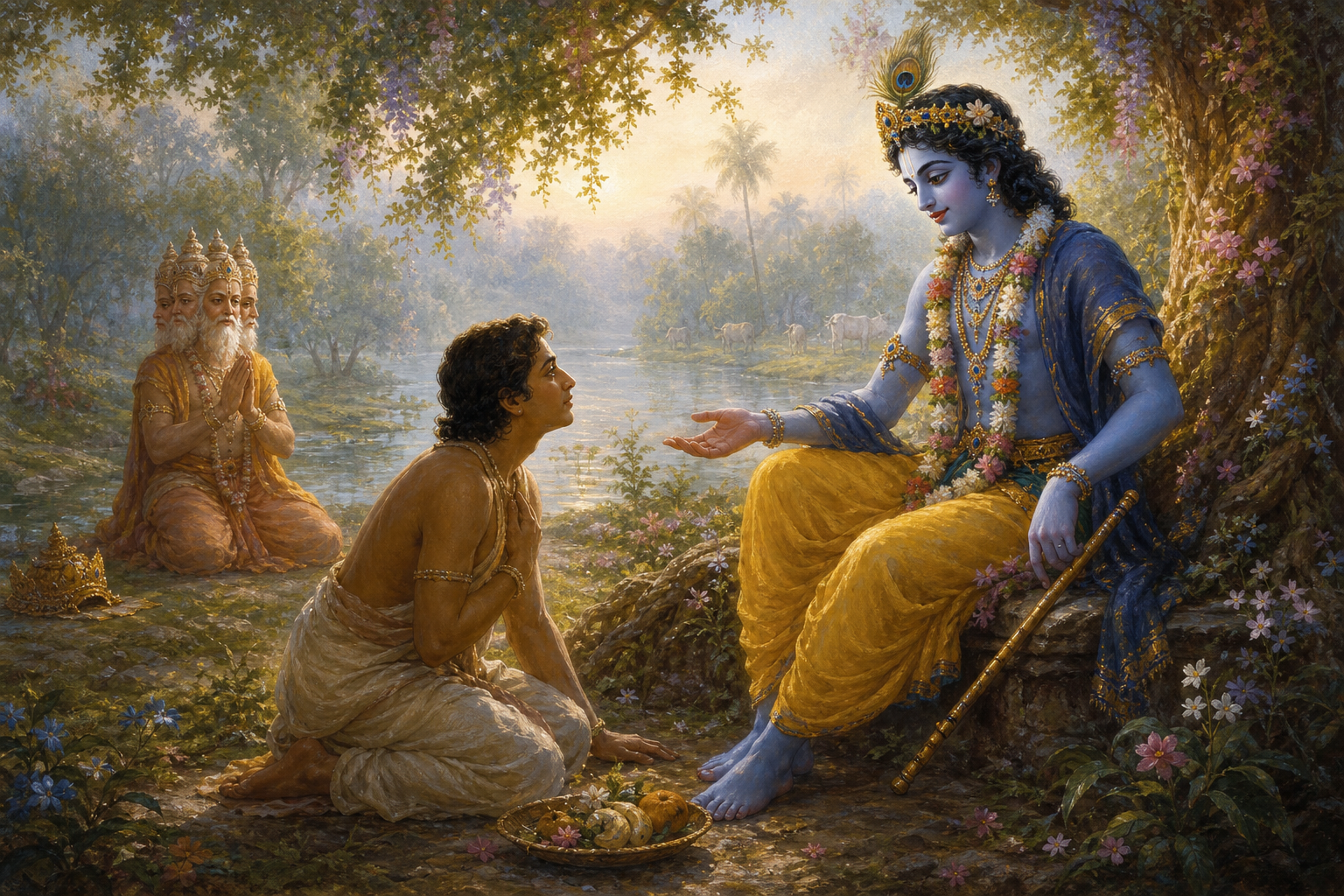
In a Gaudiya reading, the Absolute is not an inert object waiting to be mastered by analysis. Bhagavan possesses initiative. He reveals, speaks, receives service, and allows the devotee to enter a relationship with Him. Human effort matters, but it does not turn God into the product of a technique.
Srimad Bhagavatam 2.9.18, read within Brahma’s encounter with Bhagavan, gives you a useful starting point for this theology. Brahma’s knowledge does not arise from speculation alone. Divine reality becomes intelligible because Bhagavan permits a personal encounter and communicates within it. Revelation is therefore not merely the transfer of information. It establishes a relation between the one who reveals and the one who receives.
This changes the purpose of sadhana. Hearing, chanting, remembering, worship, and service are not levers by which you compel Bhagavan to appear. They prepare attention, purify intention, and place you in a posture of reception. Grace does not make discipline unnecessary; grace tells you what discipline is for.
Gaudiya Vaishnavism expresses this relationship through acintya-bheda-abheda, inconceivable difference and non-difference. The jiva is not collapsed into Bhagavan, because love and service require a real relation. Yet the jiva is not an independent, unrelated absolute either. Dependence upon Bhagavan is not a defect to overcome; it is the ground on which loving reciprocity becomes possible.
When you read a Bhagavata episode, ask three questions before looking for a moral: What does Bhagavan disclose about Himself? How does the devotee receive that disclosure? What becomes possible between them? These questions keep theology personal without reducing it to sentiment.
Akrura shows what happens when realization reaches the body

Devotion is not confined to an opinion inside the mind. Srimad Bhagavatam 10.38.34-43 presents Akrura approaching Krishna and Balarama with bodily humility and overwhelming emotion. He bows, struggles to speak, and is personally lifted and received. Recognition, surrender, and welcome form one movement.
The important point is not that you should manufacture Akrura’s visible emotion. Tears can accompany devotion, but they are not a score by which you can safely rank yourself or another devotee. A person can display intense feeling and remain inattentive in service; another can serve steadily without a dramatic outward state. The transferable lesson is Akrura’s orientation: he does not stand before Krishna as an evaluator demanding proof.
You can apply that orientation in an ordinary morning practice. Prepare the place rather than beginning amid avoidable clutter. Bow before reading or chanting. Pronounce the divine names carefully enough to hear them. Keep the body from becoming an unattended passenger: sit with intention, handle sacred objects respectfully, and complete the service you began. These are small disciplines, but they train the whole person to acknowledge Bhagavan’s presence.
Akrura’s reception also corrects a subtler mistake. Humility is not the belief that Bhagavan has no interest in you. It is the relinquishment of entitlement while remaining open to mercy. If your practice consists only of declaring yourself unworthy, it can become another form of self-absorption. Bowing and being lifted belong to the same devotional grammar: the devotee surrenders, and Bhagavan remains free to respond.
Raghunandana teaches simplicity without miracle-chasing
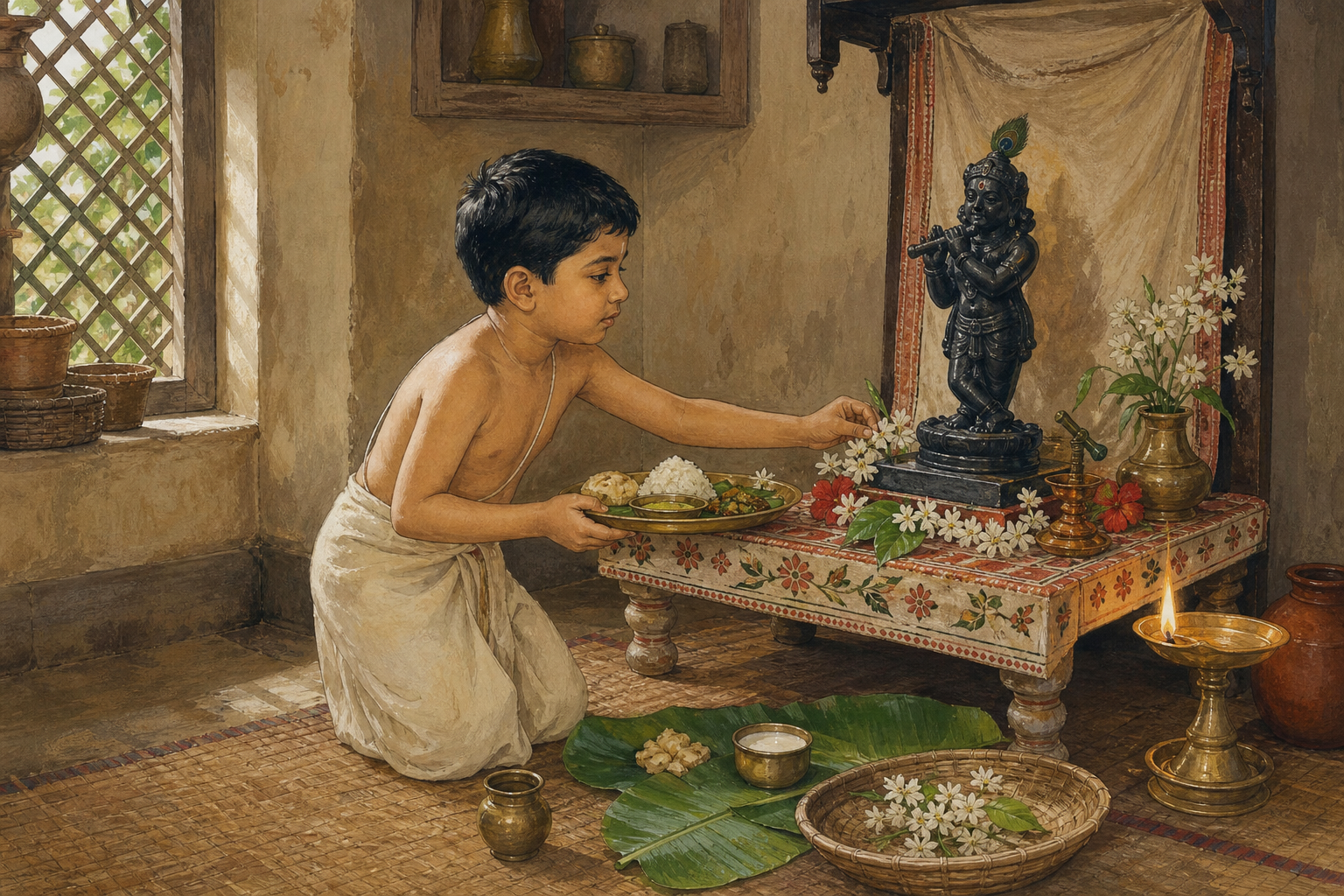
Gaudiya memory honours Sri Raghunandana Thakura as the devotee whose love awakened Krishna. His value as an exemplar lies in the seriousness of his loving attention. Bhagavan is not treated as decoration, inherited property, or an abstract idea. Service is offered to a person.
That emphasis can transform familiar worship. Routine becomes spiritually thin when you perform every external action while inwardly treating the Deity, the holy name, or the Bhagavata as an object that cannot address you. Raghunandana’s example asks whether your service contains actual regard: Did you prepare what you offered? Were you attentive while offering it? Did you behave afterward as though the offering had truly belonged to Bhagavan?
Do not turn this remembrance into a demand for supernatural confirmation. A devotional exemplar is not a laboratory formula, and Bhagavan is not required to validate your sincerity through an extraordinary event. Trying to test the Deity, invent private commands, or chase unusual experiences reverses the relationship: the worshipper begins placing Bhagavan under examination.
Childlike devotion also does not mean childish impulsiveness. Its transferable qualities are trust, directness, dependence, and freedom from calculation. It does not authorize you to discard scripture, bypass a genuine teacher, neglect ordinary duties, or treat every strong feeling as divine instruction. Mature simplicity stays answerable to guru, sadhu, and shastra.
Put this into practice through one complete offering rather than several distracted ones. Choose an act already appropriate to your tradition: chant a fixed round with attention, prepare and offer food properly, clean the place of worship, read a short Bhagavata passage aloud, or assist another devotee without seeking recognition. Give that act a clear beginning and end. Simplicity becomes credible when it produces reliable service.
Use a four-pass method to read devotional exemplars

The safest way to learn from a devotional personality is to distinguish the event you are reading from the disposition you can cultivate. Otherwise, you may either reduce the account to an abstract moral or imitate an exceptional act without possessing the devotion that gave it meaning.
- Read what actually happens. Identify the persons, actions, sequence, and response. Do not enlarge the account with details you merely assume.
- Name the theological claim. Ask what the episode shows about Bhagavan, the jiva, bhakti, grace, or devotional reciprocity. State the claim in one sentence.
- Separate disposition from circumstance. Akrura’s exact meeting and Raghunandana’s remembered experience are not events you can reproduce on command. Humility, attention, trust, and readiness to serve are dispositions you can cultivate.
- Choose one authorized action. Translate the disposition into a practice already grounded in your tradition. Keep it small enough to repeat and concrete enough to verify.
Try the method for seven days with one short selection. Spend the first part of each session reading slowly. Then write three lines: what Bhagavan reveals, how the devotee responds, and what you will practise that day. At night, review conduct rather than mood. Did the reading make you more attentive, less demanding of recognition, quicker to serve, or more careful with speech? Those changes are less spectacular than a vision, but they are harder to counterfeit.
Key takeaways
- Bhagavata theology begins with a personal Bhagavan who makes relationship possible; spiritual knowledge is not merely information about Him.
- Acintya-bheda-abheda preserves both intimacy and difference, allowing dependence, service, and reciprocity to remain meaningful.
- Akrura’s example directs you toward embodied humility, not the performance of extraordinary emotion.
- Raghunandana’s simplicity means attentive personal service, not rejection of scripture, guidance, or responsibility.
- Imitate a devotee’s orientation through steady, authorized practice; do not try to manufacture the devotee’s exceptional circumstances.
Begin tomorrow with one passage, one bow, and one undistracted act of service. Do not ask whether the session felt impressive. Ask whether you treated Bhagavan more like a person and yourself more like a servant. Repeated honestly, that question turns theology into devotional character.
References
- Dandavats – Srimad Bhagavatam 10.38.34-43 | Prabhupada Priya Devi Dasi | August 13, 2026
- Dandavats – Srimad Bhagavatam 2.9.18 Class with HH Sundar Chaitanya Goswami – Thursday 13th August 2026
- Dandavats – Who Was Sri Raghunandana Thakura? | The Devotee Whose Love Awakened Krishna
