

If you came here after seeing claims about Dhiraj Pardeshi’s death, you probably want two things: a clear account of what is actually known and a responsible way to demand justice. Both matter. Rumour does not honour a victim, and silence does not protect a community.
The responsible answer is narrow but serious. Hindu activist Dhiraj Pardeshi was fatally attacked while on duty in Ahilyanagar, and four accused have been arrested. His wife alleges that he was targeted because of his strong Hindutva convictions. These points warrant close public scrutiny. They do not warrant filling the remaining gaps with assumptions.
Separate the killing, the arrests and the alleged motive

Three different kinds of information are circulating around this case. Keeping them separate is the first protection against misinformation:
- The event: Dhiraj Pardeshi, identified as a Hindu activist, was killed after being attacked while on duty in Ahilyanagar.
- The procedural development: Four people described as accused have been arrested.
- The alleged motive: Pardeshi’s wife believes his Hindutva beliefs were the reason for the attack.
An arrest is not a conviction. It means suspects have been taken into custody while the criminal process continues. The wife’s allegation should not be dismissed, but it must remain clearly attributed unless investigators establish supporting evidence and a court reaches its findings.
This distinction is especially important in a case with a possible ideological or religious dimension. If the alleged motive is true, obscuring it would conceal a grave attack on a citizen’s freedom to hold and express Hindu convictions. If it has not yet been established, declaring it proven would place a conclusion ahead of the evidence. You can take the allegation seriously without misrepresenting its present status.
The limited facts also set boundaries around what you should not infer. The description “while on duty” does not, by itself, establish Pardeshi’s occupation, precise assignment or exact location within Ahilyanagar. The word “activist” does not establish every organisation with which he may or may not have been associated. Do not add details simply because they make a social-media post sound complete.
Use language that keeps the case credible
Careful wording is not timidity. It is how you prevent a legitimate demand for justice from being discredited by exaggeration. If you discuss the case, use sentences that preserve the status of each claim:
- “Hindu activist Dhiraj Pardeshi was fatally attacked in Ahilyanagar.”
- “Four accused have been arrested in connection with the killing.”
- “His wife alleges that his Hindutva convictions were the motive.”
Do not compress those statements into a declaration that identified people have already been judicially proven to have committed an ideologically motivated murder. That wording turns an arrest into a verdict and an alleged motive into an established finding.
The opposite distortion is also harmful. Do not casually describe the killing as a personal quarrel or an ordinary criminal dispute when no such explanation has been established here. That would erase the family’s stated concern before it has been examined. The honest formulation keeps the possible ideological motive visible while making clear that it remains under question.
Headlines, captions and short videos often strip away these distinctions first. Before forwarding one, ask three questions: Does it identify what happened? Does it distinguish accused persons from convicted persons? Does it attribute the motive allegation to Pardeshi’s wife? If any answer is no, correct the wording or do not share it.
A dharmic response joins courage with restraint
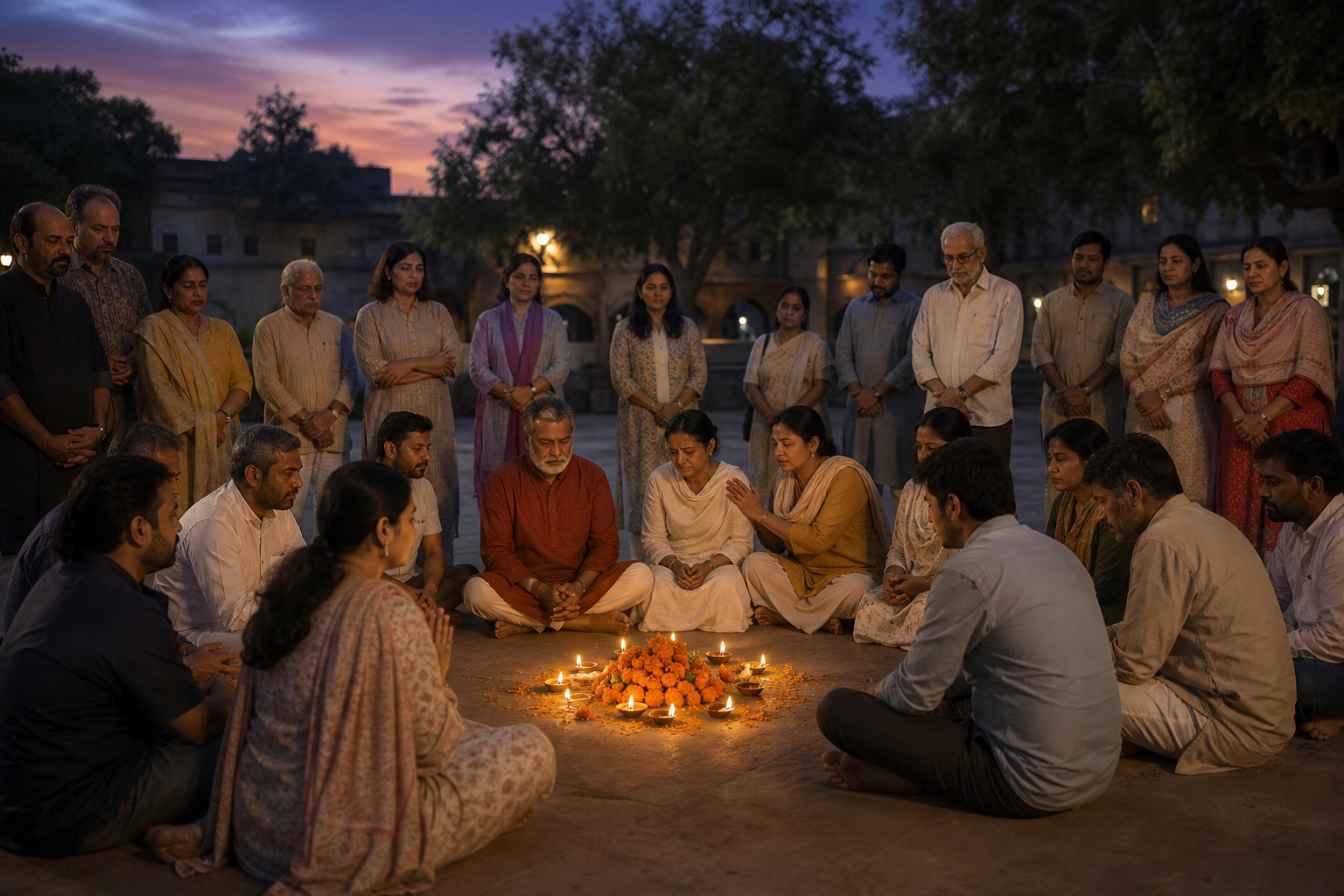
A Hindu response need not choose between firmness and ahimsa. Demanding a full investigation is not hatred. Refusing collective blame is not weakness. Courage and restraint belong together because the objective is justice for Dhiraj Pardeshi, not an indiscriminate reaction that creates more victims.
Keep criticism attached to conduct that can be investigated: planning, participation, incitement, concealment and motive. Do not treat an entire religious community as collectively guilty for the actions alleged against particular accused persons. Collective accusations are unsupported by the known facts and draw attention away from the people whose conduct authorities must examine.
This discipline also protects the public importance of the alleged motive. Violence intended to punish a person for Hindu advocacy would concern more than one family; it would threaten the freedom of others to speak, organise and participate in public life. That is precisely why the motive must be investigated rigorously rather than converted into a slogan.
A focused public demand should therefore include a lawful investigation of the killing, an explicit examination of the alleged ideological motive, preservation of relevant evidence, appropriate protection for the family and witnesses, procedural updates when they can responsibly be released, and a fair trial. None of these demands requires prejudging the final verdict.
What you can do without compromising justice

You do not need privileged access to respond usefully. You do need discipline. Start with actions that strengthen the factual record and protect the people involved:
- Share the factual core, not an embellished version. State that Pardeshi was fatally attacked, four accused were arrested, and his wife has alleged a Hindutva-related motive. Keep “alleged” attached to the motive unless its status changes.
- Preserve provenance. When saving a relevant public statement, retain its URL, visible date or time, and full context. A cropped image without its origin is harder to authenticate and easier to misuse.
- Do not expose private information. Avoid publishing home addresses, phone numbers, family details or the identities of people merely rumoured to be connected. Such disclosure can endanger uninvolved people and interfere with careful verification.
- Route possible evidence responsibly. If you possess firsthand material related to a threat or attack, preserve the original file and give it to the investigating authorities. Broadcasting it first may put witnesses at risk or make later verification more difficult.
- Use only authenticated support channels. Before donating or collecting money in the family’s name, verify that the family or a known organisation has authorised the recipient. Sympathy makes communities vulnerable to fraudulent appeals.
- Track procedural milestones separately. Arrest, formal accusation, bail, trial and judgment are not interchangeable. Update your language when an official milestone occurs rather than repeating the first viral description indefinitely.
- Correct errors without amplifying them. A short correction with a reliable link is usually more useful than reposting an inflammatory claim in full. Put the accurate wording first.
Questions that keep accountability concrete
Public attention is most useful when it seeks verifiable answers. Community representatives, journalists and concerned citizens should keep asking:
- Is the alleged Hindutva-related motive being formally examined?
- What evidence supports or contradicts that possible motive?
- What offences are formally alleged against each accused person?
- What is the next public procedural milestone in the case?
- Are the family and relevant witnesses receiving appropriate protection?
- Where can the public find authenticated updates rather than recycled social-media claims?
These questions are more demanding than a hashtag because they require institutions to clarify what is being investigated and how the case is progressing. They also leave room for evidence to determine the answer.
Key takeaways
- Dhiraj Pardeshi was a Hindu activist who was fatally attacked while on duty in Ahilyanagar.
- Four accused have been arrested, but arrest must not be confused with conviction.
- Pardeshi’s wife alleges that his strong Hindutva beliefs motivated the killing; that motive requires rigorous investigation and remains an attributed allegation.
- Demand justice for the individual case without assigning collective guilt to a wider community.
- Share only traceable information, protect private data, use authenticated support channels and follow official procedural developments.
Your next move can be simple: use accurate language, ask whether the alleged ideological motive is being investigated, and refuse to forward details you cannot verify. That combination keeps Dhiraj Pardeshi’s name at the centre of the demand for justice while giving rumour and retaliation no room to displace it.
References
