
You have generated a striking image of a devata. The face is serene, the ornaments are elaborate, and the hands look plausible. But you cannot tell whether you are looking at faithful iconography, decorative fantasy, or a polished mistake. Can you share it, teach from it, keep it as wallpaper, or place it in a puja space?
The answer depends first on use, then on accuracy, and finally on accountability. A private visual experiment and an image offered for worship do not carry the same burden. The closer an image moves toward public instruction or veneration, the less room there is for unreviewed generation.
Start by naming what the image will do
Asking whether AI sacred art is allowed is too broad to produce a useful answer. A wallpaper, an educational diagram, a devotional icon, and a ritually established murti are different things even when they depict the same devata. Their purposes create different obligations.
Use this practical classification before you write a prompt:
| Intended use | Main question | Prudent default |
|---|---|---|
| Private concept sketch | Could anyone mistake this for an authoritative depiction? | Keep it private and provisional. Do not use it as the sole reference for another sacred image. |
| Wallpaper or personal decoration | Are the identity and principal attributes recognisable and respectful? | Perform a basic accuracy check. If you share it, disclose that it is AI-generated. |
| Education, publishing, or public display | Could viewers learn a false detail from it? | Require tradition-specific references, human review, and a visible disclosure. |
| Personal devotional focus | Does the relevant sampradaya accept this kind of image for the intended practice? | Prefer a human-made, tradition-grounded image and ask a qualified practitioner when uncertain. |
| Temple, ritual, or consecrated use | Who has the authority to determine suitability? | Follow the temple’s or lineage’s procedures. Do not independently treat an AI output as a sacred substitute. |
These are risk-based defaults, not a claim that every Hindu community has issued one universal ruling. Household customs, lineages, and temple disciplines differ. In a specific ritual setting, the relevant tradition has more authority than a general rule found online.
The most permissive case is usually an image used only as personal decoration, such as a phone wallpaper. Even there, accuracy still matters. A decorative error can be copied, reposted, and eventually mistaken for inherited tradition.
Read iconography as a grammar, not a mood
A sacred form is not identified merely by looking luminous, fierce, compassionate, or recognisably Indian. Iconography works more like a grammar. Attributes, gestures, posture, companions, location, and relationships combine to communicate identity. Changing one element may change the meaning of the whole composition.
Consider Trailokyamohini. Her name means the enchantress of the three worlds, and some traditions honour her as a Yogini of Narasimha. Her significance cannot be recovered by generating a generic goddess with lavish jewellery and attaching her name afterward. The pairing places enchanting Shakti beside Narasimha’s protective force, holding serenity and fierceness in a meaningful relationship.
Placement can be just as important as appearance. Sankhanidhi and Padmanidhi appear as attendants of Kubera near temple thresholds, associated with the conch and lotus. At that boundary, they frame wealth as auspicious stewardship rather than accumulation alone. Move them into an unrelated fantasy scene, exchange their attributes, or omit the threshold context, and the figures may remain beautiful while their visual sentence becomes confused.
This is why shared Dharmic ancestry must not be turned into visual interchangeability. Hindu, Buddhist, Jain, and Sikh traditions can share symbols while assigning them distinct roles and relationships. AI systems can also produce stylistic bleed, including Tibetan Buddhist features in an intended Hindu form. An attractive blend is not automatically an accurate one.
Tradition is not frozen. Hindu image-making has passed through Gupta, Chola, regional, Mughal-influenced, naturalistic, printed, and digital expressions. The existence of historical change, however, does not make every alteration equally sound. Human artistic evolution has usually remained open to interpretation, correction, patronage, practice, and community memory. A generator can imitate the surface of many styles without understanding the boundaries between them.
The Vāstusūtra Upaniṣad presents image-making as grounded in the rishis’ discernment of manifested forms and cosmic forces. That does not mean every devotional print is consecrated or every artist is a rishi. It does mean that sacred iconography claims an inherited basis in vision, trained interpretation, and responsibility. Novelty alone is not its authority.
Before generating anything, write one complete iconographic sentence: the exact name and form, the tradition or region, the required attributes, the posture, the companions, the setting, and the intended use. If you cannot complete that sentence from reliable guidance, you are not ready to prompt for a public or devotional image.
Put every image through seven gates
A long prompt is not the same as a disciplined process. Use these gates in order. A failure at an early gate should stop the image from moving to a higher-stakes use.
- Define the function. Write down whether the output is a private draft, decoration, teaching material, devotional aid, or proposed ritual image. Do this before generation, because changing the use later changes the required review.
- Name the precise form. Avoid prompts such as Hindu goddess, Buddhist deity, or temple guardian. Record the specific form, sampradaya, regional expression, and context. If authorities differ, preserve that disagreement instead of making a synthetic compromise.
- Build a reference sheet. For a form governed by a dhyana mantra, extract the described attributes before prompting. Add recognised temple examples, lineage instructions, and guidance from a traditional artist or iconographer where available. Do not use another unverified AI image as your primary reference.
- Constrain the generation. Specify every verified attribute and explicitly exclude unverified additions. Ask for a plain background during the first pass if elaborate scenery makes the hands, objects, or companions difficult to inspect.
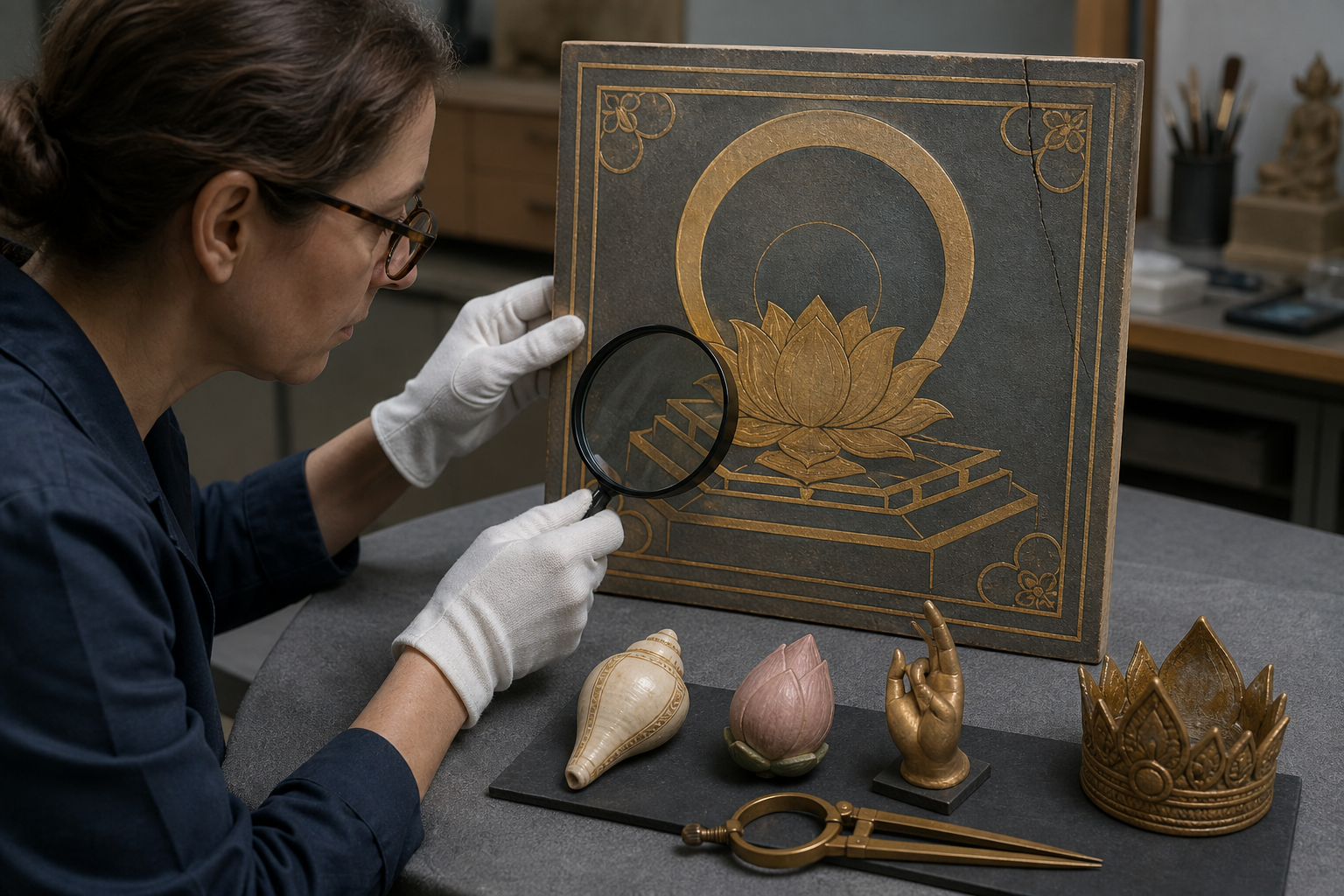
- Audit element by element. Count limbs, faces, eyes, ornaments, weapons, ritual objects, and attendant figures. Map each object to the correct hand or position from your reference sheet. Then check mudra, posture, vahana, direction of gaze, relative scale, and setting. General visual plausibility is not enough.
- Obtain accountable human review. The reviewer should know the particular tradition, not merely AI tools or digital art. Record whether the person reviewed anatomy, iconography, ritual suitability, or all three. Approval for one scope must not be presented as approval for another.
- Assign a final status. Mark the image private draft, decorative, educational, devotionally suitable under named guidance, rejected, or retired. If you cannot assign a defensible status, keep it out of public circulation.
Do not allow aesthetic polish to overrule this sequence. A symmetrical composition can still contain a wrong attribute. A moving facial expression can still misidentify a form. Sincere bhakti and correct iconography answer different questions; one should not be invoked to erase the other.
Use a disclosure that tells the reader something
The label AI-generated is necessary for public use, but it is often insufficient. It says how an image was made, not whether anyone checked it. Match the disclosure to what actually happened:
- For an unreviewed decorative image: AI-generated devotional-style illustration; iconographic accuracy has not been verified.
- For a reviewed educational image: AI-generated illustration based on the named form and references; reviewed for the listed iconographic features by a named person or role.
- For a corrected image: Revised after iconographic review; the earlier version contained the specifically named error.
Use the reviewer’s name only with permission. If the reviewer checked the objects but not ritual suitability, say exactly that. Precise disclosure protects the practitioner, the reviewer, and the tradition from claims none of them made.
Keep AI in a role that can be corrected
A tradition-centred position holds that AI output is not inherently sacred because a generator cannot meditate upon a dhyana mantra or spiritually perceive the form it recombines. This is not a claim that digital pixels are impure. It is a distinction between producing a likeness and participating in the devotional chain that gives a sacred form its authority.
That distinction suggests a workable boundary. AI can assist where its contribution remains visible, reversible, and subordinate to human judgement. It should not be allowed to decide what tradition requires.
Lower-risk roles for a generator
- Private composition studies that will later be rebuilt or corrected by a human artist.
- Background, colour, or layout experiments after the central sacred form has been verified and protected from alteration.
- Draft educational visuals that remain unpublished until a qualified reviewer checks them.
- Mock-ups that help a patron and traditional artist discuss format without treating the generated figure as the finished authority.
These uses do not become harmless merely because they are preliminary. Keep draft files clearly marked. Otherwise an assistant, editor, devotee, or future collaborator may retrieve a rejected image and assume it was approved.
Decisions a generator should not make
- Which attributes belong to a devata when the tradition’s description is unclear.
- How to reconcile conflicting regional or sampradaya-specific forms.
- Whether an image is suitable for puja, temple installation, or consecration.
- Whether a visually pleasing innovation preserves or changes the theological meaning.
- Whether the absence of an obvious error amounts to spiritual or ritual approval.
The model cannot accept responsibility for any of these judgements. The person who prompts, edits, publishes, installs, or recommends the image remains accountable.
Rare forms need more review, not less
A lesser-known or regional devata may be difficult to find in accessible art. That creates a narrow case for careful AI assistance, but scarcity is not permission to invent. Begin with the dhyana mantra or the relevant lineage description, involve someone trained in that form, and preserve a conspicuous provisional label until the details are resolved.
If no qualified person can verify the output, keep it as a private study. Do not publish it as the missing canonical image. The rarer the form, the easier it is for one confident-looking mistake to become the image everyone else copies.
That danger is amplified by a digital feedback loop. Uncorrected outputs can circulate, become familiar, and influence later generated depictions. What began as one model’s error can return as apparent evidence that the error is traditional.
A temple, publisher, school, or community archive using generated imagery should therefore keep a compact image record containing:
- The exact intended use and audience.
- The named devata, form, tradition, and regional context.
- The textual and visual references used before generation.
- The generator’s role and the human edits made afterward.
- The reviewer’s identity or role, review date, and precise scope.
- Known uncertainties, the public disclosure, and the image’s current status.
If an inaccurate image is already public, do not silently replace it and leave the old file circulating without explanation. Withdraw or relabel it, publish the corrected version, and state the specific correction. A transparent correction teaches viewers what to notice and prevents the obsolete image from retaining false authority.
Key takeaways
- Classify the intended use before generating. Decorative, educational, devotional, and ritual uses require different levels of care.
- Beauty is not evidence of iconographic accuracy. Audit attributes, posture, companions, placement, and context separately.
- Shared Dharmic symbols do not make different traditions visually interchangeable.
- Bhakti matters, but sincere intent does not correct a false attribute or establish ritual suitability.
- Use AI for reversible, subordinate tasks. Do not let it resolve lineage questions or act as its own reviewer.
- Public sacred imagery needs provenance, scope-specific human review, honest disclosure, and a way to correct or retire mistakes.
Before your next prompt, write the intended use at the top of the page. If the image is meant for education, devotion, or ritual, do not proceed until you can name the form, the tradition-specific references, and the person competent to review it. If you cannot name those three things, keep the result private and provisional.
That boundary is not hostility to technology. It is how you keep a powerful tool in service to dharma without allowing visual confidence to impersonate sacred knowledge.
References
- DharmaRenaissance Blog – Discover the Divine Enchantment of Trailokyamohini: Secret Power of Narasimha’s Yogini
- DharmaRenaissance Blog – Discover the Secret Guardians of Wealth: Sankhanidhi & Padmanidhi – Essential Temple Symbolism
- Hindu American Foundation – Can AI-Generated Images Be Used in Worship?
