

If Kartik arrives while you are grieving, ordinary devotional advice can feel badly timed. Lighting a lamp, completing japa, or joining a katha may look like something a composed person does, and you may not feel composed at all.
Gunavati’s story gives you a more honest starting point: you do not have to silence sorrow before turning toward Bhagavan. During Kartik, shravana, or sacred listening, offers a practice you can receive when you have little energy to produce anything. Bhakti then gives that listening direction through remembrance, duty, and care.
Gunavati’s grief is not a failure of faith

Within Sri Krishna’s narration, Gunavati learns that a rakshasa has killed her husband and her father. She does not respond with instant serenity. She laments her loneliness and asks painfully practical questions: without them, who will provide her food, clothing, and security?
Those concerns matter. Bereavement is not only an inward feeling. It can overturn a person’s household, identity, income, daily routine, and sense of protection. Gunavati’s lament therefore resists a shallow spiritual response to loss. No one is helped by being told to stop crying, display detachment, or prove faith before immediate needs have been addressed.
The devotional turn begins with truthfulness. You can acknowledge that something devastating has happened while refusing to let devastation become the only authority over your next action. That is different from denying pain. It means placing pain inside a larger life of dharma, relationship, and remembrance.
- Name the loss plainly. Before prayer, say what or whom you are grieving. You do not need to make the sentence pious.
- Name today’s material concern. Food, sleep, childcare, income, transport, paperwork, or companionship may require attention before an ambitious vrata does.
- Name one duty that still belongs to you. Choose the next manageable responsibility, not every responsibility at once.
- Accept appropriate help. Receiving a meal, a ride, financial guidance, or company is not a breach of spiritual independence.
If you are supporting someone in mourning, do not use karma, attachment, or divine will to close the conversation. Listen first. Ask what has become difficult in the household. Then offer one specific form of help. Compassion becomes credible when it reaches the need the grieving person actually has.
A devotional routine can support grief, but it is not a substitute for mental-health or medical care. If grief is making it difficult to remain safe, attend to essential needs, or function for a sustained period, contact a qualified professional or an appropriate emergency service while keeping trusted family or community members close.
Sacred listening is a discipline, not background audio

At Naimisharanya, Suta addresses an assembly of 88,000 sages and begins the Kartik katha. The transmission is situated through Sri Krishna and Devarshi Narada, while shravana is associated with the removal of accumulated demerit and the attainment of Vaikuntha. The setting makes listening an intentional sacred act conducted within humility, permission, and lineage.
That is not the same as letting a recitation play while your attention remains scattered across messages, chores, and conversation. Sacred listening asks you to become available to what is heard. Its immediate fruit is not the number of pages completed. It is the movement from hearing a passage to noticing what it asks of your memory, conduct, and relationships.
You can establish a simple shravana session without turning it into a performance:
- Choose a trustworthy recitation or text. Use the version followed by your family, temple, or sampradaya. If its provenance is unclear, ask a priest, guru, or teacher you trust rather than relying on an unattributed clip.
- Make a brief sankalpa. Hold a clear intention such as May this listening steady my remembrance and clarify my duty. If you are grieving someone, you may include that person in the intention.
- Hear one coherent passage attentively. A short section received fully is more useful than a large quantity heard mechanically. Put aside avoidable interruptions.
- Pause before commentary. Ask three questions: What suffering is being shown? What response accords with dharma? What must I remember or do after rising?
- Seal listening with a response. Offer japa, pranama, a moment of silence, or a written resolution. The response should be small enough to carry into the day.
If the original language is inaccessible to you, listen with a translation you understand. Sacred attention does not require pretending comprehension. You may retain familiar names, verses, or mantras in their received form while using translation for meaning. When concentration is poor, return to the same passage rather than chasing novelty.
Listening with family can also redistribute the burden of devotion during grief. One person may read, another may prepare the sacred space, and another may simply sit. No one needs to produce an interpretation after every session. Sometimes steady presence is the first form of satsang.
Build a Kartik rhythm gentle enough to continue
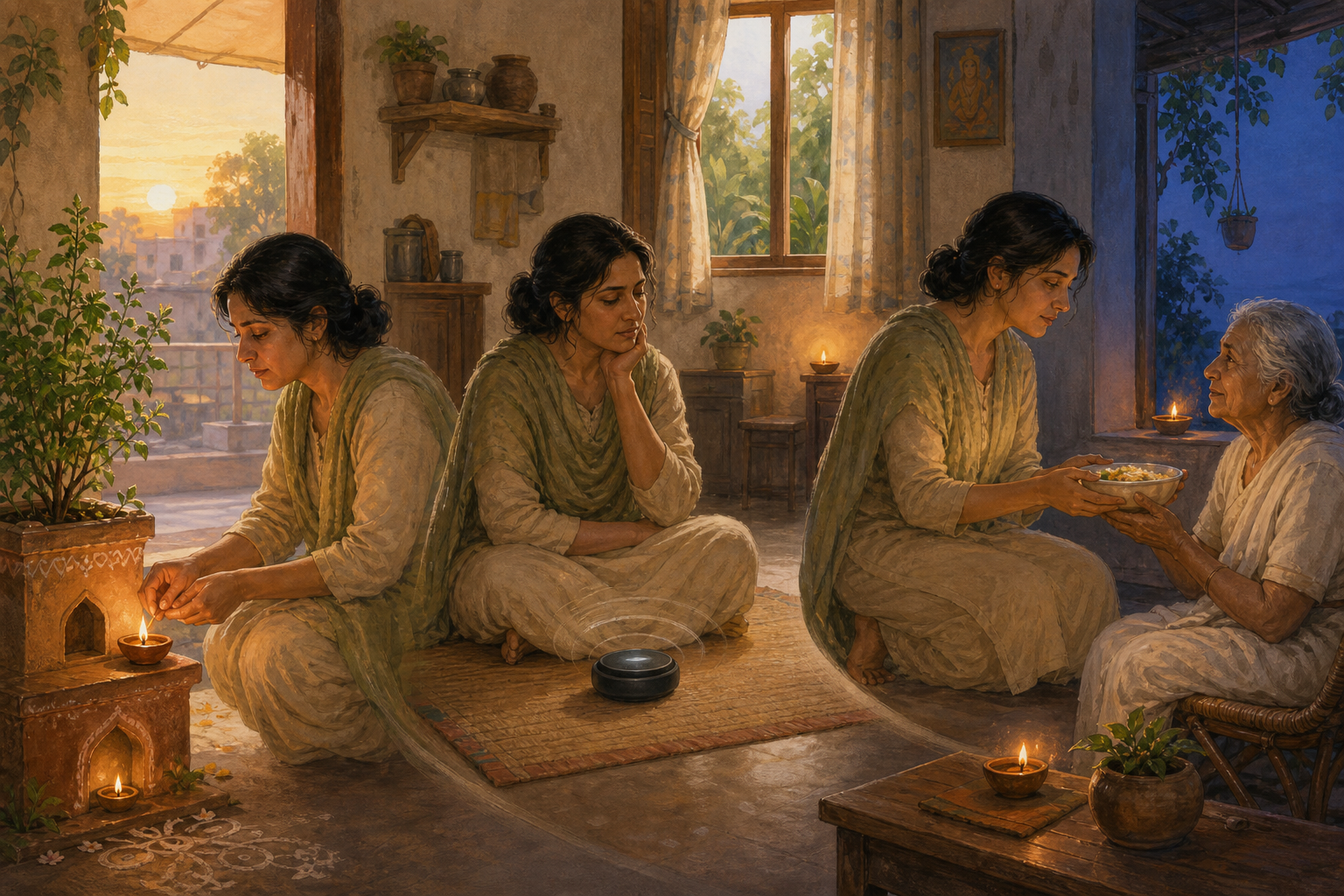
Kartik observance commonly brings together deep-daan, japa, sattvik conduct, reverence for Tulsi, contemplation of Sri Krishna, and charity. These practices can give shape to days that grief has made shapeless. Their value, however, does not depend on turning the month into a contest of intensity.
Decide in advance what your minimum, regular, and communal observances will be. This removes a daily negotiation with your energy and reduces the temptation to abandon the entire practice after one difficult day.
- Minimum observance: sit in the sacred space, offer a safe lamp if circumstances permit, hear or read one passage, and complete a short period of japa.
- Regular observance: add a fuller katha session, reverence for Tulsi according to your tradition, and a written note naming one duty revealed by the listening.
- Communal observance: join satsang or recitation and connect the gathering with charity or a specific act of seva.
Use an existing daily anchor. You might begin after your morning preparation or before the evening meal, depending on household practice. Keep the text, japa mala, and other required items together so that beginning does not require repeated decisions. If an open flame would be unsafe, omit it rather than creating a hazard; shravana, japa, remembrance, and seva can still be practised.
Sattvik observance should clarify conduct, not punish a grieving body. Pay attention to speech, agitation, consumption, and the treatment of others. Do not invent severe dietary restrictions merely to make the vrata feel serious. If you already follow a prescribed vrata, observe the guidance of your tradition without neglecting medical needs or essential family duties.
A missed session need not become a second loss. Unless your sampradaya gives a particular rule for interruption, return at the next available opportunity. Do not compensate by making a dramatic promise you cannot sustain. Devotional renewal usually becomes visible through faithful repetition: you return to the lamp, the name, the katha, and the next right action.
Let bhakti answer the practical questions of grief
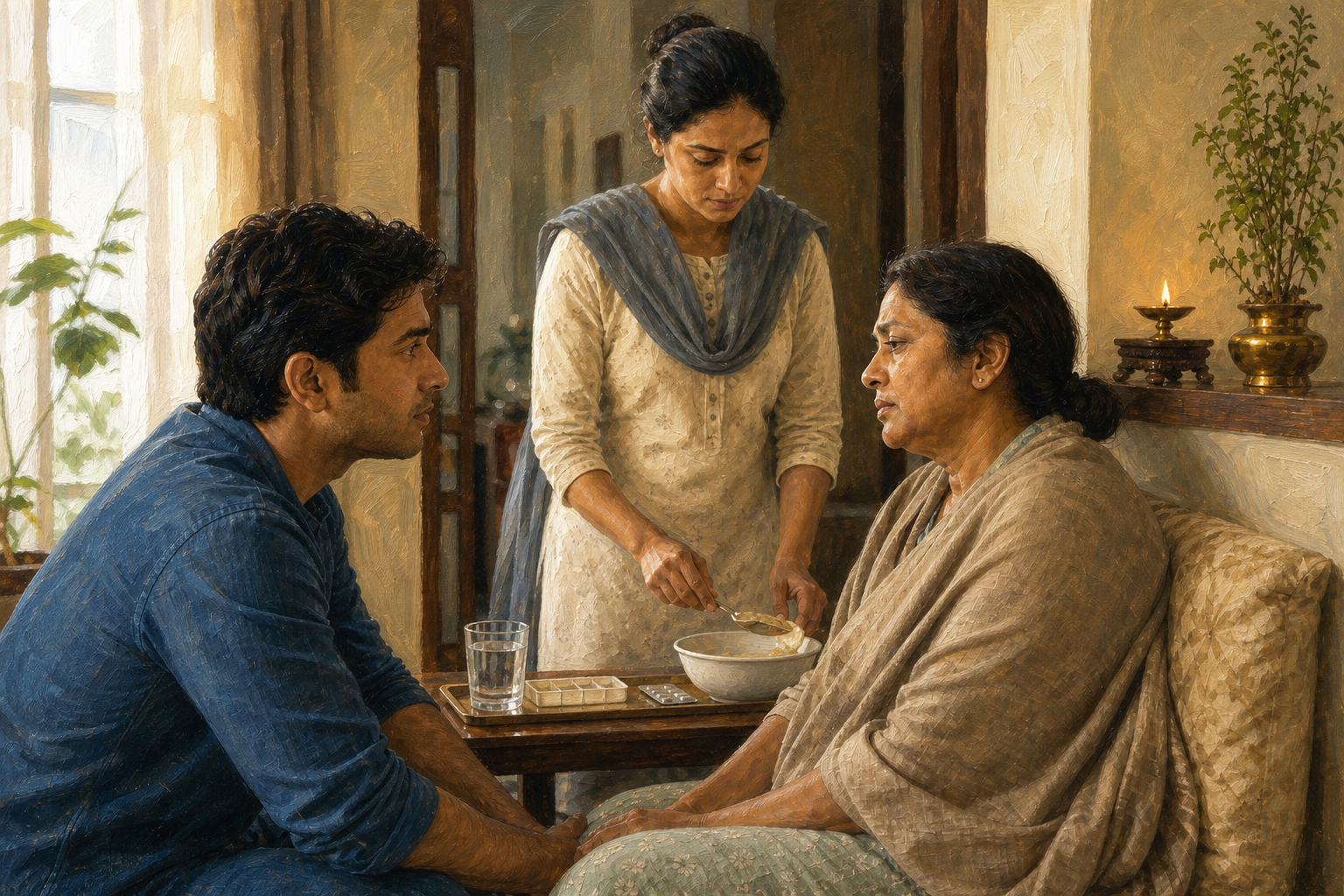
Gunavati’s concern about food and clothing exposes a test that devotional communities should take seriously. When loss removes a provider, caregiver, or protector, expressions of sympathy do not by themselves restore stability. Dharma requires attention to the person’s dignity as well as the ritual meaning of the moment.
Use a dignity-first sequence when helping a bereaved household:
- Ask before deciding. Replace a vague offer with a concrete question: Would a prepared meal, transport, an errand, or help with a form be useful this week?
- Address the recurring need. Immediate condolences are valuable, but food, school journeys, appointments, and administrative responsibilities continue after visitors leave.
- Preserve agency. Present choices and obtain consent. Do not treat grief as permission to take control of someone’s household.
- Protect privacy. A person’s financial or family difficulty is not material for community gossip, even when assistance is being organised.
- Return after the first wave of support. Agree on a later check-in instead of assuming that silence means the need has ended.
You can connect each Kartik practice to one outward responsibility. After katha, prepare a meal for a household under strain. After japa, make the call you promised. After deep-daan, contribute discreetly to an essential expense if you are able. If money is not available, offer transport, an errand, patient company, or practical knowledge. Seva is not measured only in currency.
Karuna, ahimsa, and seva also provide recognisable ethical meeting points among Hindu, Buddhist, Jain, and Sikh traditions. Their theological meanings should not be flattened into sameness. Yet families and communities with different Dharmic commitments can still cooperate in relieving suffering while retaining their own prayers, teachings, and disciplines.
This is where sacred listening becomes more than private consolation. You hear a life placed under pressure, recognise the vulnerable person before you, and respond without spectacle. The movement from shravana to smarana to seva turns devotion into protection rather than sentiment alone.
Key takeaways
- Grief does not disqualify you from Kartik devotion. Truthful lament can be the place where practice begins.
- Shravana means attentive reception, reflection, and response, not merely having a recitation within earshot.
- A minimum daily practice is not an inferior practice. Make it small enough to continue on the hardest days.
- Deep-daan, japa, Tulsi reverence, sattvik conduct, katha, and charity work best as one rhythm rather than disconnected religious tasks.
- Translate remembrance into a specific duty or act of seva, especially where bereavement has created practical insecurity.
- Use spiritual practice alongside appropriate professional care when grief compromises safety, health, or basic functioning.
Begin with one complete cycle at your next observance. Name the grief without ornament, listen to one coherent passage, offer japa, and write down one act of care. Complete that act before enlarging the vow. You do not have to wait until you feel renewed; return to the next faithful action and let Kartik give it continuity.
References
- DharmaRenaissance Blog — Proven Insights on Kartik Maas Mahatmya Chapter 2: Discover the Katha’s Transformative Power
- DharmaRenaissance Blog — Kartik Maas Mahatmya Chapter 1: Essential, Proven Insights to Transform Your Devotion
