
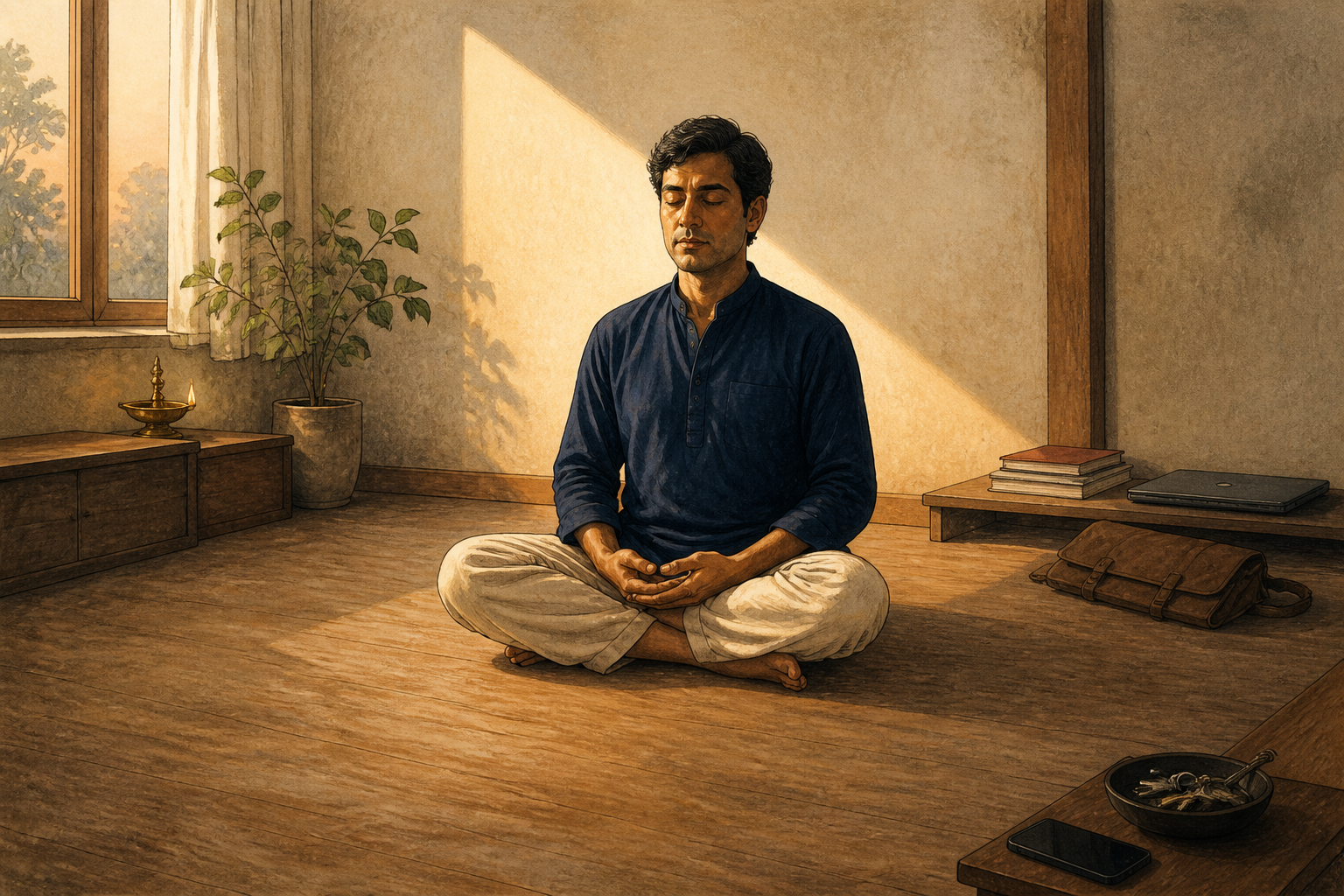
You may be keeping your commitments, finishing difficult work, and maintaining a spiritual practice, yet still feel that your mind is always reaching for the next relief, achievement, distraction, or sign of approval. When outer competence doesn’t produce inner sufficiency, another productivity trick won’t solve the central problem.
Dharmic mind training gives you a more demanding and more useful aim: make attention reliable, conduct less reactive, work less dependent on praise, and inquiry deep enough to expose what you expect the world to provide. The routine below turns that aim into something you can practise during an ordinary day.
Decide what kind of freedom you are training for
Calm is valuable, but it is not a sufficient definition of progress. You can feel calm because you are attentive, or because you have withdrawn from a responsibility. You can feel intense while acting with remarkable clarity. A better working aim is this: notice mental movement earlier, choose a response consistent with dharma, and loosen the demand that a particular outcome must complete you.
The Dharmic traditions share important disciplines, but they do not offer interchangeable accounts of liberation. Respecting those differences makes practice more coherent:
- Hindu Yoga trains steadiness through abhyasa, sustained practice, and vairagya, freedom from compulsive attachment. The mind is repeatedly returned rather than bullied into silence.
- Buddhist practice develops mindfulness and clear observation of craving, impermanence, and reactivity. Its account of freedom should not be collapsed into Advaita Vedanta’s teaching about Atman and Brahman.
- Jain practice joins attention to restraint, ahimsa, aparigraha, tapas, and the purification of conduct. Mental discipline that leaves harmful behaviour untouched is incomplete.
- Sikh practice joins remembrance of Naam to honest work, seva, sharing, and steadiness amid responsibility. Withdrawal from ordinary duty is not the default measure of depth.
If you already belong to one of these paths, let its teachings, vocabulary, and established practices supply your centre. The shared pattern can help you understand the work, but it should not become a blended creed that strips each tradition of its distinctive vision.
Now write a sankalpa that names behaviour, not a desired mood. A usable intention might be: When I seek quick relief, I will pause, remember my chosen teaching, and do the next non-harming action. Compare that with a vague promise to be peaceful. The first tells you what to do when practice is tested; the second merely describes how you hope to feel.
Choose one recent incident as your baseline. Record the trigger, the first bodily sign, what you did, what reward you were seeking, and who was affected. This gives you an actual pattern to train. Without a concrete incident, spiritual aspiration can remain flattering but unverifiable.
Build the practice around cues that already exist
A habit is easier to change when you can see its cue, routine, and reward. Dharmic psychology adds a deeper concern: repetition leaves impressions that make the next repetition easier. Each response is therefore both an action in the present and training for the mind you will bring to the next encounter.
Don’t wait for a perfectly quiet morning or a sudden surge of devotion. Attach practice to events that already happen. A workable daily rhythm looks like this:
- Protect the first available inward moment. Before voluntary messages, news, or entertainment, sit in the same place and use the primary practice of your path: breath awareness, mantra japa, Naam Simran, contemplative recollection, or another practice you have properly learned. If family or work duties require immediate phone use, protect the first transition after those duties instead.
- Set one behavioural intention. Name the arena in which steadiness will matter: a difficult conversation, study, caregiving, physical work, or an unresolved decision. State what you will do, not what others must do.
- Use transitions as bells of mindfulness. When one task ends and another begins, stop before reaching automatically for the phone. Feel your feet, relax the jaw, soften the gaze, and let the breath become unforced. Before a demanding conversation, a three-minute period of mindful breathing can serve as a concrete reset.
- Rehearse the replacement before the cue arrives. If an afternoon loss of energy usually leads to something sweet for a quick lift, decide in advance to test a brief walk or gentle breathing first. The cue can remain the same while the routine changes and the desired refreshment is sought more deliberately.
- Close with release. Review whether you acted sincerely, repair anything that needs repair, and relinquish the demand to control what follows. Release is not an excuse to ignore consequences; it prevents consequences from becoming a verdict on your worth.
Keep the method stable long enough to learn from it. Constantly changing the mantra, text, teacher, meditation object, or tracking system can feel like spiritual curiosity while protecting you from repetition. Abhyasa acquires force through continuity. Vairagya prevents one bad session, one distracted morning, or one missed day from becoming a reason to abandon the discipline.
Use gentle, natural breathing for an unsupervised reset. Forceful pranayama, prolonged retention, and advanced breath practices are different undertakings and should be learned from a qualified teacher. If an exercise causes dizziness, pain, or distress, stop rather than treating discomfort as proof of progress.
Intercept an impulse before it becomes your next action
The most useful moment is often not the moment of action but the earlier ripple: the hand moving toward the phone, the jaw tightening before harsh speech, the mental rehearsal of an insult, or the sudden desire to escape an uncertain task. A wandering mind can gather momentum like a ball descending a staircase. Your first job is to interrupt acceleration.
- Recognise the earliest signal. Name what is happening in plain language: irritation is rising, escape is beginning, or approval is being sought.
- Add physical friction. Put the device face down, step away from the food, leave the reply unsent, or close the extra browser tab. A pause is easier when the environment is no longer pushing in the opposite direction.
- Settle the body without demanding instant serenity. Feel the feet, release unnecessary tension, and breathe naturally. The purpose is to recover choice, not to manufacture a special state.
- Name the reward honestly. Ask whether you want stimulation, relief, comfort, control, connection, or avoidance of uncertainty. The visible routine is often only one attempted route to that reward.
- Choose a counter-routine. Meet the legitimate need in a way that does less harm and leaves a better impression. Then perform the next small action before debating with yourself again.
The following substitutions are experiments, not universal prescriptions. The middle column matters because a replacement that ignores the desired reward rarely survives contact with the real cue.
| Cue | Possible reward to test | Counter-routine |
|---|---|---|
| Afternoon energy dip | Stimulation or a pause | Take a brief walk or use gentle breathing before deciding whether food is what you need. |
| A message that provokes anger | Release, control, or self-defence | Set the device down, breathe, draft without sending, and reread for truth, necessity, and non-harm. |
| An unclear task | Relief from uncertainty | Name the next visible physical action and begin that action instead of planning the entire project again. |
| An automatic urge to scroll | Novelty, escape, or rest | Move the phone out of reach, return briefly to mantra, Naam, or breath, and then choose deliberate rest if rest is the actual need. |
Apply an ethical test as well as a behavioural one. Replacing sweets with sarcasm may interrupt one routine while strengthening a worse tendency. Ask whether the alternative supports ahimsa, truthful speech, restraint, responsibility, or service. Attention becomes Dharmic mind training when it helps conduct align with dharma.
After a lapse, conduct an audit rather than a trial. What was the cue? What reward were you seeking? What was the earliest signal you missed? What single environmental change would make recognition easier next time? This converts regret into instruction. Self-condemnation usually keeps attention fixed on the self-image of failure instead of the next wholesome action.
Spiritual practice is not a substitute for mental-health care. If panic, depression, trauma symptoms, compulsive behaviour, severe sleep disruption, or thoughts of self-harm are interfering with daily life, seek qualified professional or emergency support appropriate to your location. Meditation, prayer, sacred study, and community practice may accompany care, but they should not be used to postpone it.
Use study, work, and inquiry as one field of training
Let sacred study change the next decision
Sacred study trains more than the ability to collect teachings. Careful recitation, memorisation, contemplative reading, and discussion require continuity of attention. They can cultivate focus, recall, humility, and meaning-oriented reflection when the discipline is treated as practice rather than display.
Use a small passage from your own tradition. Read or recite it accurately. Paraphrase it without looking. Then ask three practical questions: What does this teaching ask me to notice? What attachment or error does it expose? What action would embody it in the situation already named by my sankalpa? Revisit the same passage after attempting that action. The second reading will usually reveal where your first understanding remained merely verbal.
Treat the discipline in the spirit of a sattvika yajna: something undertaken because it is worthy, not as a performance for applause. The orientation associated with Bhagavad Gita 17.11 corrects a subtle trap. Even cognitive improvement can become another object of vanity if study is used mainly to appear learned.
Occasional partner study or satsanga can test whether you understand the passage or have merely become familiar with its words. Ask your partner to challenge your paraphrase and your proposed application. Precision is especially important when different schools use similar terms for different philosophical claims.
Make work expose attachment without abandoning standards
Repetitive work, caregiving, study, and service reveal the mind more reliably than imagined tests do. Set a clear intention before the task, return attention when it wanders, and close with a deliberate release. This rhythm turns effort into sadhana rather than a transaction for self-worth.
Non-attachment does not mean careless execution. You still plan, practise, keep promises, examine results, accept consequences, and repair mistakes. What you release is the claim that success proves your completeness or that failure removes it. Karma Yoga becomes evasive when detachment is invoked before responsibility has been met.
Service provides an especially sharp test. Notice whether you can contribute without controlling recognition, resenting the absence of praise, or making the recipient carry your need to feel virtuous. In Sikh practice, seva belongs with remembrance and honest living; in other Dharmic paths, generosity, compassion, and non-harming perform related ethical work without becoming identical doctrines.
Investigate what you expect achievement to deliver
Behavioural discipline can make you more effective without answering why effectiveness still feels insufficient. At that point, inquiry must go deeper than optimisation. Ask what you believe the completed project, improved reputation, desired possession, or successful relationship will finally establish about you.
Within Advaita Vedanta, Triptidipa presents fulfillment as the stabilisation of Self-knowledge: Atman is non-different from Brahman, and fullness is revealed rather than manufactured by acquisition. Sravana, manana, and nididhyasana move the seeker from hearing the teaching, through resolving doubt, to sustained assimilation. Ethical composure, discernment, and dispassion prepare the mind to receive that knowledge.
Other Dharmic paths frame the culmination differently. Buddhist training examines craving and the conditions of suffering. Jain discipline joins right orientation to restraint and the loosening of passions and attachment. Sikh practice looks toward remembrance, grace-filled steadiness, and a life ordered through Naam, work, sharing, and seva. You don’t need to pretend that these metaphysical accounts are identical in order to recognise a practical convergence: freedom becomes visible as compulsion weakens and ethical presence becomes steadier.
Measure that maturation through ordinary evidence. Are impulses noticed earlier? Do you recover more quickly after a lapse? Is difficult speech less reactive? Can you do necessary work without turning every result into a judgment of your identity? Does kindness arise with less calculation? Can you remain responsible when praise is absent? These tests are more reliable than chasing an uninterrupted pleasant mood.
Watch for false versions of progress. Numbness is not vairagya. Avoidance is not peace. Collecting techniques is not abhyasa. Winning a philosophical argument is not Self-knowledge. Enjoying struggle is not mandatory, either. The useful question is whether meeting difficulty with attention, ethical effort, and release is making you freer to do what dharma requires.
Key takeaways
- Define mind training by earlier awareness, wiser action, and weaker compulsion, not by the demand to feel calm at all times.
- Keep one tradition as your primary centre. Shared disciplines can illuminate one another without erasing genuine differences in doctrine and liberation.
- Attach practice to reliable cues: the first protected moment, transitions between tasks, predictable urges, and the close of work.
- When an impulse appears, identify the reward it is seeking and choose a counter-routine that meets the legitimate need without reinforcing harm.
- Use sacred study to produce one concrete application, work to expose attachment, and inquiry to examine what you expect outcomes to prove.
- Look for progress in reduced reactivity, faster recovery, steadier duty, measured speech, and easier kindness.
At your next predictable transition, protect three minutes. Put down the device, settle the body, remember the teaching or Name central to your path, and identify the next non-harming action. Do that action attentively. Then release the demand that its result must make you whole. Repeated honestly, that small sequence is already the beginning of a trained mind.




References
- DharmaRenaissance Blog — Essential Habit Breakthrough: Master Proven Yogic and Scientific Secrets to Transform Behavior
- DharmaRenaissance Blog — Proven Benefits of Sacred Study: Discover Focus, Memory, and Clarity through Dharmic Texts
- DharmaRenaissance Blog — Triptidipa Explained: Master the Panchadasi’s Seventh Chapter for Inner Fulfillment
- DharmaRenaissance Blog — Master the Wandering Mind: Ancient Hindu Wisdom for a Proven Modern Focus Breakthrough
- DharmaRenaissance Blog — Essential Dharmic Wisdom: Discover Joy in Struggle with a Proven Path to Inner Freedom
