
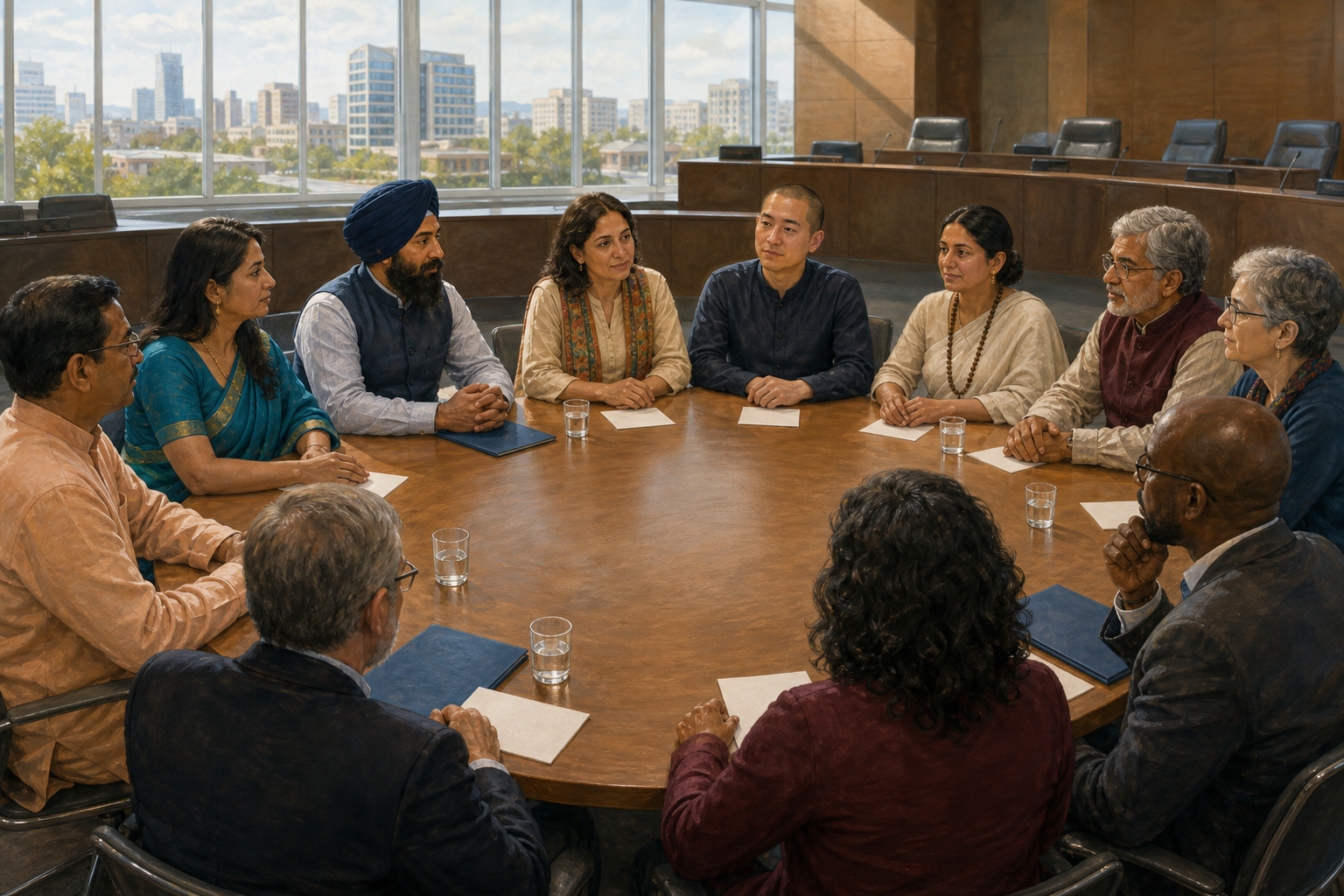
You may be trying to secure a place for a Dharmic voice on a civic committee, correct a distorted public description, or make sure a Diwali celebration represents more than a convenient stereotype. The invitation itself is rarely the hardest part. The harder task is building representation that remains accurate and accountable after the ceremony, controversy, or news cycle has passed.
You can do that without demanding ideological agreement or special treatment. Ask for fair procedures, define who actually has a mandate to speak, document claims carefully, and turn each symbolic opening into a durable civic relationship.
Know what kind of representation you are being offered
A diya at city hall, a mantra before a council meeting, or a Hindu name on an advisory board can be meaningful. None of these, by itself, tells you whether the community has acquired a voice in the decisions that shape its public portrayal.
Before accepting an invitation or declaring a breakthrough, identify the level of representation involved:
- Recognition: Is the institution acknowledging a Dharmic tradition, festival, or community in public?
- Participation: Can community members help design the program, wording, curriculum, exhibit, or policy?
- Authority: Who chooses representatives, resolves disputed claims, and approves the final public description?
- Continuity: Is this a recurring relationship with a named contact and a defined process, or a one-time appearance?
Recognition matters because unfamiliarity can keep Dharmic communities invisible. Participation matters because visibility designed entirely by outsiders can reproduce the same misunderstandings it was meant to correct. Authority matters because the decisive action may happen in a committee meeting, editorial discussion, or partner-selection process long before the public event begins.
Ask practical questions early. Who drafted the description? Can factual corrections be submitted? What evidence will be accepted? Who makes the final decision? Will the institution publish its criteria? When will the arrangement be reviewed? A vague promise of inclusion becomes much more useful when it produces clear answers to those questions.
Western public life is not one system. A municipal council, school, university, museum, media organization, and open encyclopedia operate under different rules. Even institutions in neighboring cities may handle religious participation differently. Read the relevant policy before copying a successful tactic from another jurisdiction, and frame your request in the institution’s own language of equal access, accuracy, public service, or editorial integrity.
Represent Dharmic plurality without flattening it
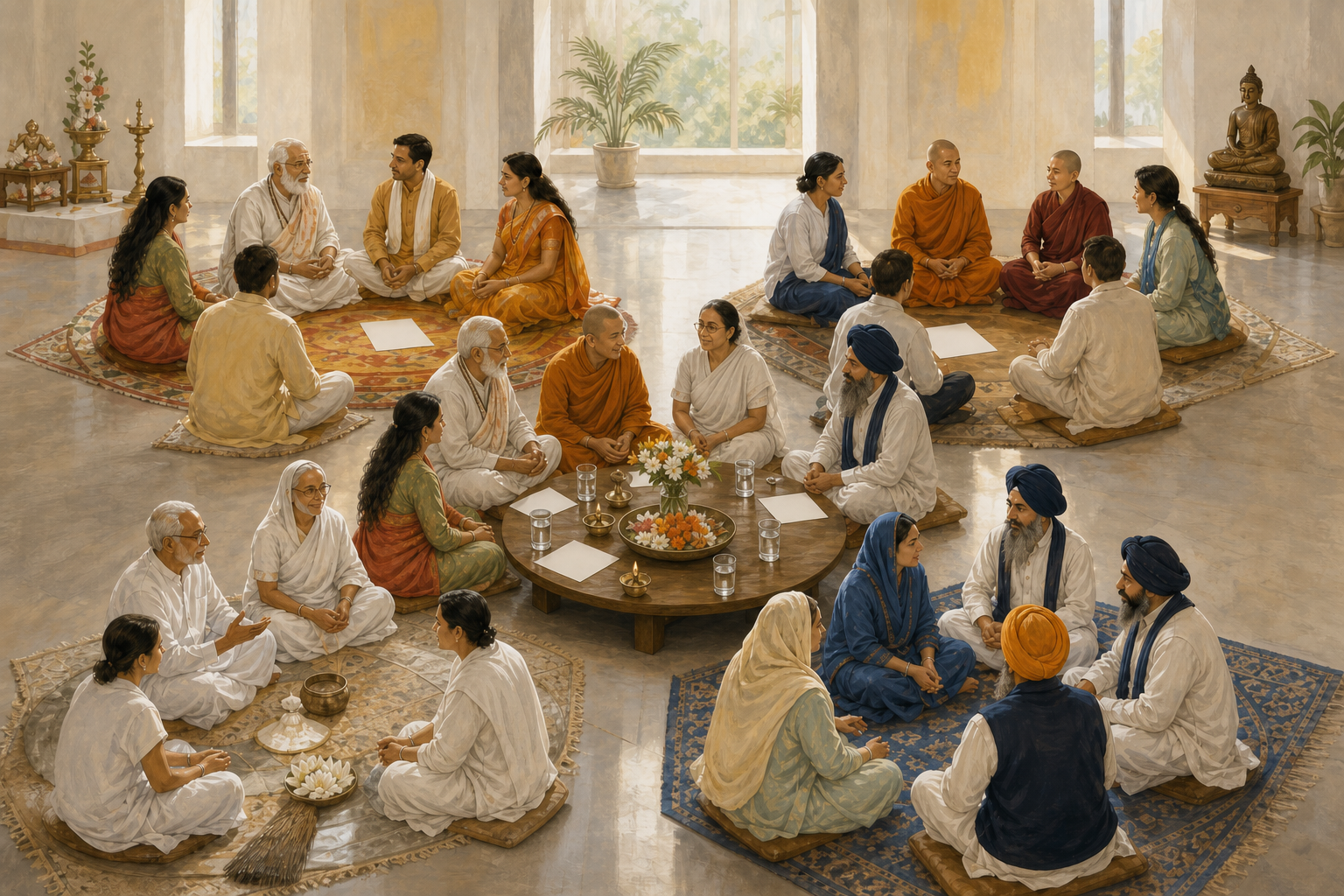
Dharmic solidarity is strongest when it does not pretend that Hinduism, Buddhism, Jainism, and Sikhism are interchangeable. Shared civilizational vocabulary and ethical commitments can support cooperation, while each tradition retains its own teachings, histories, institutions, and internal diversity.
Diwali shows why this distinction matters. A responsible civic program can acknowledge the Hindu celebration of light, the Jain commemoration of Mahavira’s Nirvana Kalyanak, the Sikh observance of Bandi Chhor Divas, and the participation of some Buddhist communities around themes of compassion and wisdom. That layered account is more accurate than either presenting Diwali as belonging to a single uniform constituency or stripping it of religious meaning and calling it merely a festival of lights.
Build a constituency map before choosing speakers or approving public language:
- Name the traditions and local organizations directly affected by the decision.
- Record how each representative was selected: election, institutional appointment, invitation, open application, or informal nomination.
- Ask each participant to state the scope of the mandate. Speaking as a Hindu practitioner, temple trustee, scholar, or advocacy-group representative is not the same as speaking for all Hindus.
- Separate shared civic language from tradition-specific teaching. Peace, compassion, seva, ahimsa, and public welfare can create common ground, but their meanings should not be forced into a single theological definition.
- Create a way to record principled disagreement instead of pressuring every participant to endorse a manufactured consensus.
- Rotate opportunities when no organization possesses a broad community mandate.
This also protects a representative from being used as a token. A person should be able to say which community, institution, or school of thought they represent and which questions fall outside that role. Public officials should not treat the first Dharmic participant they meet as an all-purpose authority on every Hindu, Buddhist, Jain, or Sikh matter.
When you review a program, plaque, lesson, web page, or public statement, apply three tests. Is it accurate enough that a knowledgeable practitioner would recognize the tradition? Is it plural enough to distinguish genuine differences? Is it accessible enough that a newcomer can understand why the distinction matters? A description can fail by being hostile, but it can also fail through friendly simplification.
Replace battles over legitimacy with transparent rules
Use the same due-diligence standard for every civic partner
Arguments over who is acceptable often become a contest of labels. One organization describes itself through service and cultural work; an opponent describes it through political associations or alleged harms. If officials have no published standard, the loudest campaign can become the de facto vetting process.
The dispute over VHP-UK’s participation in London Diwali brought this problem into view when Hindus for Human Rights UK asked the mayor to reconsider official collaboration. Concerns raised by an advocacy group deserve examination, but a concern is not automatically a finding. Nor should a record of volunteering make an organization immune from scrutiny. The sound response is a process that tests material claims and gives the affected organization an opportunity to answer them.
If you are dealing with a publicly supported festival or advisory body, ask organizers to publish:
- eligibility and exclusion criteria that apply to every prospective partner;
- the evidence standard used to assess allegations, including how anonymous, partisan, or disputed material is treated;
- required disclosures of political, financial, institutional, and advocacy affiliations;
- recusal rules for decision-makers with relevant conflicts of interest;
- a non-discrimination and conduct policy tied to observable behavior;
- a right of response before an adverse decision is finalized;
- written reasons for major partnership decisions; and
- a review or appeal route that does not depend on personal access to officials.
Your most effective request is procedural: apply the same published criteria, evidence threshold, disclosure rule, and right of response to every organization. That is harder to dismiss than a demand that officials certify one faction as authentic and another as illegitimate.
A Dharmic advisory council can help, provided it does not become an unelected gatekeeper. Its membership, selection method, term of service, affiliations, meeting record, and power over final decisions should be visible. Include Hindu, Buddhist, Jain, and Sikh participation where the program genuinely concerns all four, but do not reserve a nominal seat for a tradition without giving its representative time, information, and influence.
Treat public knowledge platforms as civic institutions
Representation is shaped in search results and reference pages as surely as it is shaped at city hall. A few words can determine the frame through which a student or journalist encounters a tradition. A disputed modern social label attached to Ekalavya, or a change in how Basava’s religious identity is classified, can move a page from describing competing interpretations to silently choosing one of them.
Open editing does not guarantee balanced outcomes. It rewards people who understand sourcing rules, talk-page procedure, revision histories, and the patience required to sustain an edit. In 2017, a coordinated Dalit History Month campaign reported edits to more than 300 pages that later accumulated over 132 million views. Scale does not make those edits either correct or incorrect. It shows why organized editorial activity should be evaluated through transparent methods rather than assumed to be merely spontaneous participation.
Funding requires the same care. The Wikimedia Foundation awarded Whose Knowledge? approximately $45,000 for a pilot covering marginalized knowledge, including Dalit and LGBTQ+ topics. Wikimedia support later continued through a 2024-2026 general-support grant reported at more than $250,000 annually. A grant does not prove bias, misconduct, or improper editing. It does make disclosure, conflict-of-interest safeguards, and multi-perspective review especially important when funded work can influence widely viewed religious and historical pages.
If you want to correct a page, do not begin with a mass call for sympathetic users to overwhelm it. That turns a question of evidence into a factional contest and can undermine a valid correction. Use a disciplined record instead:
- Copy the exact sentence in dispute and identify the precise factual or framing problem.
- Distinguish among what a primary tradition says, what historians or religious-studies scholars argue, and what a contemporary advocacy organization claims.
- Check that each citation supports the exact wording, not merely the general topic.
- Prefer strong academic sourcing and represent material scholarly disagreement explicitly.
- Disclose relevant organizational, financial, or advocacy relationships rather than allowing others to uncover them later.
- Explain the proposed change on the talk page in neutral language and answer the strongest objection to it.
- Save the revision link, discussion, citations, and outcome so another volunteer can continue without reconstructing the entire dispute.
- If consensus is impossible, propose narrower wording that identifies the interpretation and attributes it to its actual proponents.
The aim is not to replace an anti-Dharmic frame with uncritical praise. It is to stop contested interpretation from masquerading as uncontested fact. That distinction becomes more consequential when search summaries and AI systems can repeat language drawn from highly visible web platforms.
Convert ceremonial openings into lasting civic participation
Symbolic recognition is not trivial. From October 7 to 9, 2025, Hindu prayers opened council meetings in Burley, Arimo, and St. Anthony, marking a documented first in the civic histories of those Idaho municipalities. Vedic mantras entered local government through a non-sectarian invocation centered on peace, service, ethical duty, and the welfare of residents.
A well-prepared invocation lets neighbors encounter Sanatana Dharma through its own language while connecting that language to the civic purpose of the meeting. It should not be treated as proof that every representation problem has been solved. Use the opening to create a reliable path for future participation.
Before the event, confirm the institution’s written rules and use the same application process expected of other faith communities. Give the host the exact text, transliteration, translation, pronunciation help, tradition-specific context, and a brief explanation of why the passage suits a civic setting. Clarify that the invocation is reflective rather than proselytizing. Choose a reciter who can explain the words responsibly instead of treating Sanskrit sound as decoration.
During the event, identify the tradition without making universal claims on behalf of all Dharmic communities. Translate the central meaning so non-Dharmic listeners are not left outside the moment. Keep partisan slogans and unrelated disputes out of the invocation; civic inclusion is weakened when sacred language is turned into a test of political allegiance.
Afterward, preserve the official agenda, recording, text, translation, and institutional contact. Thank the host, correct any errors in the public description, and ask how future religious or cultural participation will be scheduled. A recurring rotation, heritage program, educational resource, or advisory relationship gives the ceremony a civic afterlife.
Use the same sequence for a festival, school resource, museum display, or media consultation. Prepare a compact representation brief containing:
- The objective: the exact decision or public description you want changed.
- The constituency: who is affected and who has authority to speak for which part of it.
- The evidence: the strongest citations, primary material, and relevant scholarly disagreement.
- The procedure: the policy, meeting, editorial route, or selection process through which the change can occur.
- The continuity plan: who owns the next contact, where the record is stored, and when the matter will be reviewed.
Measure success by more than attendance or applause. Check whether the public wording was accurate, multiple Dharmic voices could contribute, selection rules became clearer, corrections entered the official record, and a future access point now exists. Those are signs that visibility is becoming representation.
Key takeaways
- Ask what changed in decision-making power, not only what appeared in the ceremony or publicity.
- Use Dharmic solidarity to coordinate, but declare each representative’s actual mandate and preserve differences among traditions.
- When an organization is challenged, request consistent criteria, verifiable evidence, disclosure, recusal, a right of response, and written reasons.
- Approach Wikipedia and similar platforms with exact claims, strong academic citations, transparent affiliations, and a preserved editorial record.
- Turn every invocation, festival, consultation, or correction into a continuing relationship with a named process and next step.
Choose one live arena where your community is currently visible but lacks influence. Before the next meeting or editorial exchange, prepare the representation brief, request the governing criteria in writing, and invite a reviewer from another relevant Dharmic tradition. That is a manageable first move, and it creates a record on which the next person can build.

References
- DharmaRenaissance Blog – Proven Insights: Discover Who Funds and Shapes Hindu and Dharmic Narratives on Wikipedia
- DharmaRenaissance Blog – London Diwali Controversy: Essential Facts on VHP-UK and a Proven Path to Community Unity
- DharmaRenaissance Blog – Historic Breakthrough: Hindu Mantras Open Idaho City Councils in a Proven Unity Milestone
