
You can see anger rising and still be carried away by it. You can watch a thought and immediately replace it with a subtler thought: "I am the witness." Neither experience necessarily means that you have recognized Sākṣī.
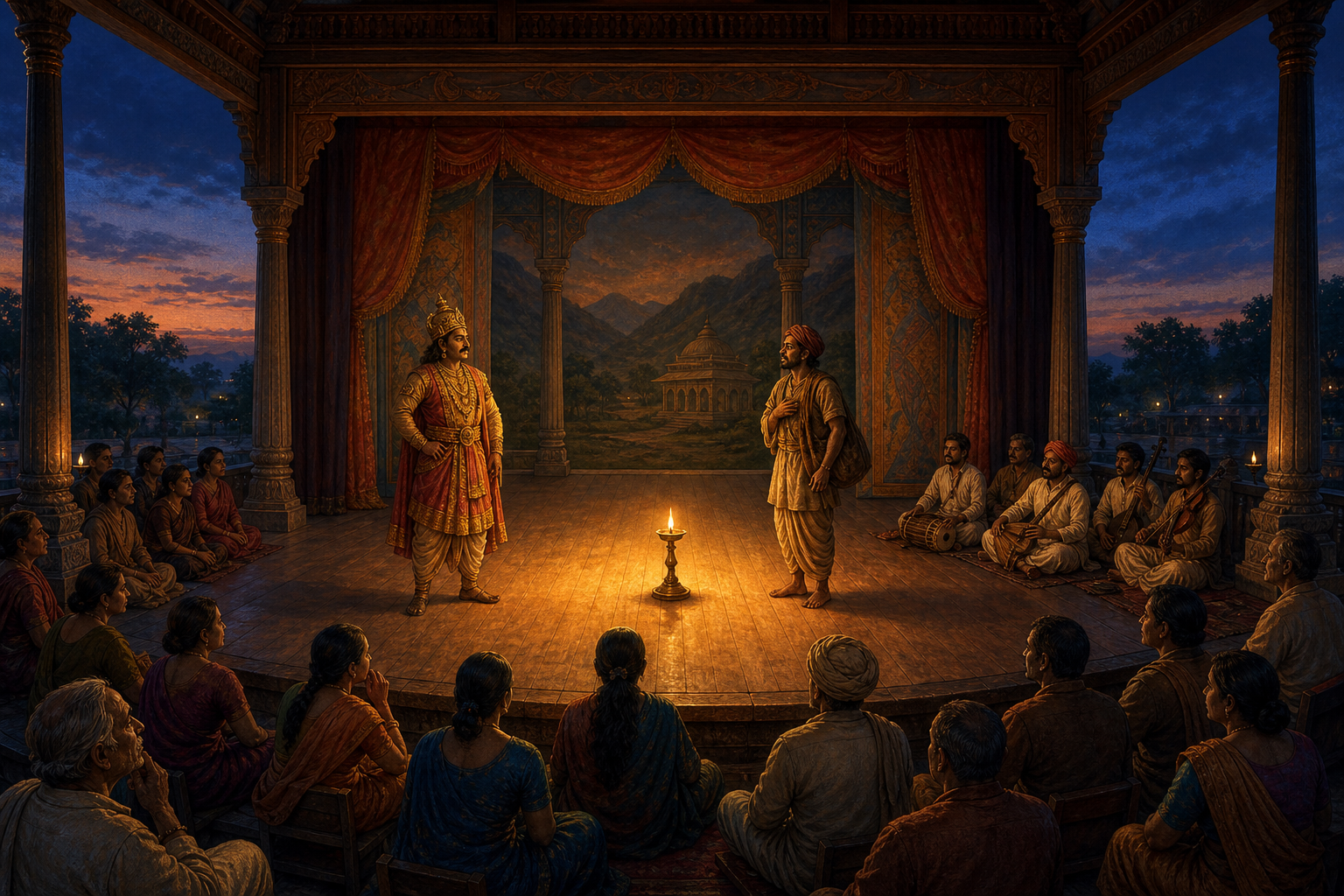
Nātakadīpa helps at precisely this point. Its theater metaphor lets you distinguish the changing body-mind from the awareness by which every change is known. The aim is not to withdraw from relationships, work, or dharmic responsibility. It is to stop asking temporary roles to tell you what you ultimately are.
Begin with what changes and what knows the change
A thought appears, remains for a while, and disappears. An emotion intensifies and weakens. The body moves from comfort to discomfort, youth to age, activity to rest. Your social identities also change: child, parent, student, professional, friend, opponent, success, or failure. Whatever the experience may be, you know that it is present and later know that it has changed.
That simple fact is the doorway into witness consciousness. The thought is known, so the thought cannot be the final knower. The emotion is known, so the emotion cannot define the awareness to which it appears. Even the sentence "I am observing" is a mental event that can be noticed.
This doesn’t mean that every changing thing is unreal in the everyday sense. Pain still calls for care. A promise still creates a duty. Words still have consequences. The distinction concerns identity: a condition appearing in you is not the whole truth of you.
- Name the present event plainly: "anger is present," "the body is tense," or "a defensive thought has appeared."
- Notice that the event is already known. You don’t have to manufacture an observer to make it knowable.
- Ask whether the event was present before it arose and whether it will remain after it passes. If not, don’t grant it the status of your unchanging identity.
- Respond to the situation from your clearest understanding of dharma. Witnessing is complete only when it supports lucid action rather than avoidance.
The most important correction is this: Sākṣī is not a special peaceful mood. Peace is known, agitation is known, and the movement between them is known. If your "witness" vanishes whenever the mind becomes noisy, you have probably been identifying with a calm mental state.
Use the theater metaphor without turning it into another belief
Pañcadaśī’s tenth chapter, Nātakadīpa, traditionally attributed to Vidyāraṇya, concludes the Dīpa Pañcaka, the sequence formed by chapters six through ten. Its central image is a drama illumined by an unwavering light. The scenes change, but the condition that makes every scene visible does not become one of the scenes.
| Theater image | Advaitic meaning | What you can notice directly |
|---|---|---|
| Stage | The field in which bodily, sensory, and mental experience appears | Every event has a setting, but the setting also enters awareness |
| Actors and roles | Thoughts, emotions, memories, identities, and actions | Each role enters, performs, changes, and leaves |
| Reflected light | Cidābhāsa, the mind’s borrowed luminosity | The mind knows, remembers, judges, and imagines because it is illumined |
| Lamp | The illuminating character of awareness and the changelessness of Kūṭastha | Presence, change, and absence are all revealed without altering awareness |
| Spectator | Sākṣī, the witness standpoint | Experience is known without the witness becoming the experienced condition |
| Ground of the whole appearance | Brahman, the nondual substratum | No scene stands outside the reality in which it appears |
The lamp and spectator should not be imagined as two inner entities. They present two aspects of one recognition. The image of light emphasizes that experience is revealed. The image of a spectator emphasizes that awareness is not modified by the roles it reveals.
The metaphor also has a limit. An ordinary spectator is a person sitting at a distance from a stage. Sākṣī is not a tiny person hidden behind your eyes, looking at the mind from elsewhere. Body, sense of location, image of an inner observer, and thought "I am watching" all belong to the witnessed field. Sākṣī is the awareness because of which that whole arrangement is known.
Apply this during conflict. Your role may require you to disagree, set a boundary, protect another person, admit an error, or complete an unpleasant duty. Let the role perform its proper action. At the same time, notice that neither praise nor blame can add anything to the awareness that reveals them. This prevents non-attachment from collapsing into passivity.
Distinguish Kūṭastha from the mind’s reflected consciousness
The distinction between Kūṭastha and cidābhāsa prevents a common mistake. Kūṭastha is the changeless Self, identical in Advaita with Ātman-Brahman. Cidābhāsa is consciousness as reflected in the mind. Because of this reflection, the mind appears sentient and can say, "I know," "I remember," or "I imagine."
A mirror can reflect sunlight without producing the sun. In the same way, the mind can manifest knowledge without being the original reality of consciousness. The condition of the mirror affects the reflection: a distracted mind knows one way, an attentive mind another, and a sleeping mind manifests no waking scene. None of those variations implies a corresponding alteration in Kūṭastha.
You can test the distinction whenever an identity becomes overpowering:
- Did this condition arise? If it began, it is a changing appearance rather than Kūṭastha.
- Can it be described? Whatever you can describe has become an object of knowledge, even when the object is subtle.
- Does it vary? Confidence, doubt, attention, memory, and self-image vary. The awareness of variation is not another variation of the same kind.
- What reveals its absence? You know when a thought ends, when an emotion subsides, or when a sound stops. Absence is also known.
Don’t answer these questions by constructing a picture of a bright inner Self. A picture is visible to the mind and therefore belongs with the actors. Nor should you wait for an extraordinary sensation. Sensations have beginnings and endings. The inquiry points to the immediate fact of knowing, not to a new object that might appear later.
This also explains why repeating "I am Sākṣī" is useful only up to a point. The statement can correct the contrary assumption that you are merely the body-mind. Yet the words themselves remain a mental movement. Use them to remove confusion, then notice the awareness in which both the confusion and its correction appear.
Examine waking, dream, and deep sleep carefully
The three states offer a sharper inquiry than watching isolated thoughts. In waking, you identify with a physical body and a shared environment. In dream, another body, location, danger, pleasure, and sequence can appear convincing. In deep sleep, the waking and dream displays are absent.
Within Advaita, this variation supports a precise question: if no single state remains continuously present, how can any one state contain your final identity? The waking personality is not operating as such in dream. The dream personality doesn’t survive waking. Deep sleep carries neither active drama. Nevertheless, on waking you can recognize continuity and say that you slept, sometimes reporting that you slept well.
That report is used in Advaitic reasoning to indicate that the absence of an active scene did not destroy the underlying continuity of awareness. It should not be turned into a careless claim that you remember a particular object called "pure consciousness" from sleep. Whatever is remembered as an image, feeling, or thought is content. The point is subtler: the disappearance of familiar content is not the disappearance of the Self.
Use the state analysis when you wake:
- Notice that the waking world has returned together with the waking body and its concerns.
- If a dream is remembered, observe that its world felt present while it lasted but is absent now.
- Recognize that deep sleep was not a second waking scene. Don’t mistake blankness for realization.
- Ask what is constant while the contents and capacities of these states differ.
The answer is not the waking ego claiming ownership of all three. That ego is itself most evident in waking. The inquiry directs attention beyond the state-dependent claimant to Sākṣī, in whose presence waking, dream, and the absence of differentiated experience are recognized.
Carry witness consciousness from inquiry into conduct
Advaita traditionally organizes assimilation through śravaṇa, manana, and nididhyāsana. These are not three decorative Sanskrit terms for the same activity. Each addresses a different obstacle.
Śravaṇa gives the inquiry its direction
Śravaṇa is disciplined reception of the Upaniṣadic teaching under a coherent interpretation. Formulations such as neti, neti help you negate mistaken identification with knowable conditions. Tat tvam asi directs the inquiry toward the identity of the individual Self and ultimate reality. The Māṇḍūkya analysis of waking, dream, and deep sleep prevents you from confining the Self to the waking personality.
Study should therefore leave you with a definite question, not merely an admired vocabulary. After reading or listening, state the confusion being challenged: "I treat changing mental activity as the knower," or "I assume awareness is present only when attention feels clear."
Manana removes contradictions
Manana is reasoned reflection. Test whether your idea of the witness is coherent. If you imagine Sākṣī as a subtle observer with a location, that observer is still an object. If you believe awareness is produced by a peaceful mind, you must explain how agitation is known. If you call deep sleep the Self merely because it lacks thoughts, you have confused absence of mental activity with realization.
Keep the question open until the contradiction is visible. The purpose is not to silence doubt through repetition. It is to understand why the body, mind, ego, and reflected consciousness cannot independently occupy the position of the changeless knower.
Nididhyāsana makes the understanding available under pressure
Nididhyāsana is sustained contemplative assimilation. Bring the distinction into the moments when identification usually becomes automatic: criticism, embarrassment, desire, resentment, fear of failure, or attachment to praise.
- Pause before turning the first mental interpretation into speech or action.
- Identify the current scene: bodily sensation, emotion, memory, prediction, and social role.
- Recognize that all of these are present as known conditions.
- Rest without trying to replace them with a blank or pleasant mind.
- Choose the action that the situation and your dharma require.
- After the scene changes, notice that awareness did not acquire the victory or injury claimed by the role.
This practice isn’t successful because an unpleasant feeling disappears. Its immediate success is the end of total identification, even if the feeling remains. Over time, greater inward quietude, less compulsive attachment to roles, and more compassionate engagement are signs that understanding is reaching conduct. In Advaita, its culmination is jīvanmukti: freedom while living, not escape from life.
Watch for spiritual bypassing. "I am only the witness" does not cancel an apology, a debt, a family obligation, or the need to oppose adharma. Suppression is not transcendence, and numbness is not equanimity. If your interpretation makes you less truthful or less responsive to another being’s suffering, the actor has borrowed nondual language to defend itself.
The ethical movement runs in the other direction. When changing attributes no longer define the whole person, reactivity can soften. Seeing beings as illumined by the same consciousness gives compassion a metaphysical foundation while leaving practical distinctions intact.
Other dharmic traditions offer resonant disciplines without becoming interchangeable with Advaita. Buddhist mindful observation, Jain witness-attitude joined to ahiṁsā and equanimity, and Sikh remembrance of the nirguṇa One in sahaj can all sharpen attention and loosen egoic fixation. Nātakadīpa’s identification of the changeless Ātman with Brahman remains specifically Advaitic. Respecting that difference is more fruitful than forcing every tradition into one formula.
Key takeaways
- Sākṣī is not a calm state, an inner image, or a second personality watching the first.
- Kūṭastha names the changeless Self; cidābhāsa names consciousness reflected in the changing mind.
- A thought, feeling, identity, or state that arises and subsides cannot be the unchanging knower.
- Waking, dream, and deep sleep differ in content, while Advaitic inquiry traces the continuity that is not confined to any one state.
- Śravaṇa gives the teaching, manana resolves doubt, and nididhyāsana carries clarity into habitual reactions.
- Witness consciousness should make action clearer and compassion steadier, not provide an excuse to evade dharma.
At your next moment of friction, don’t try to become a detached spectator. Notice the scene, recognize that it is known, and do the next dharmic thing without turning the role into your Self. That is where Nātakadīpa stops being an elegant metaphor and begins to reshape a life.



References
