
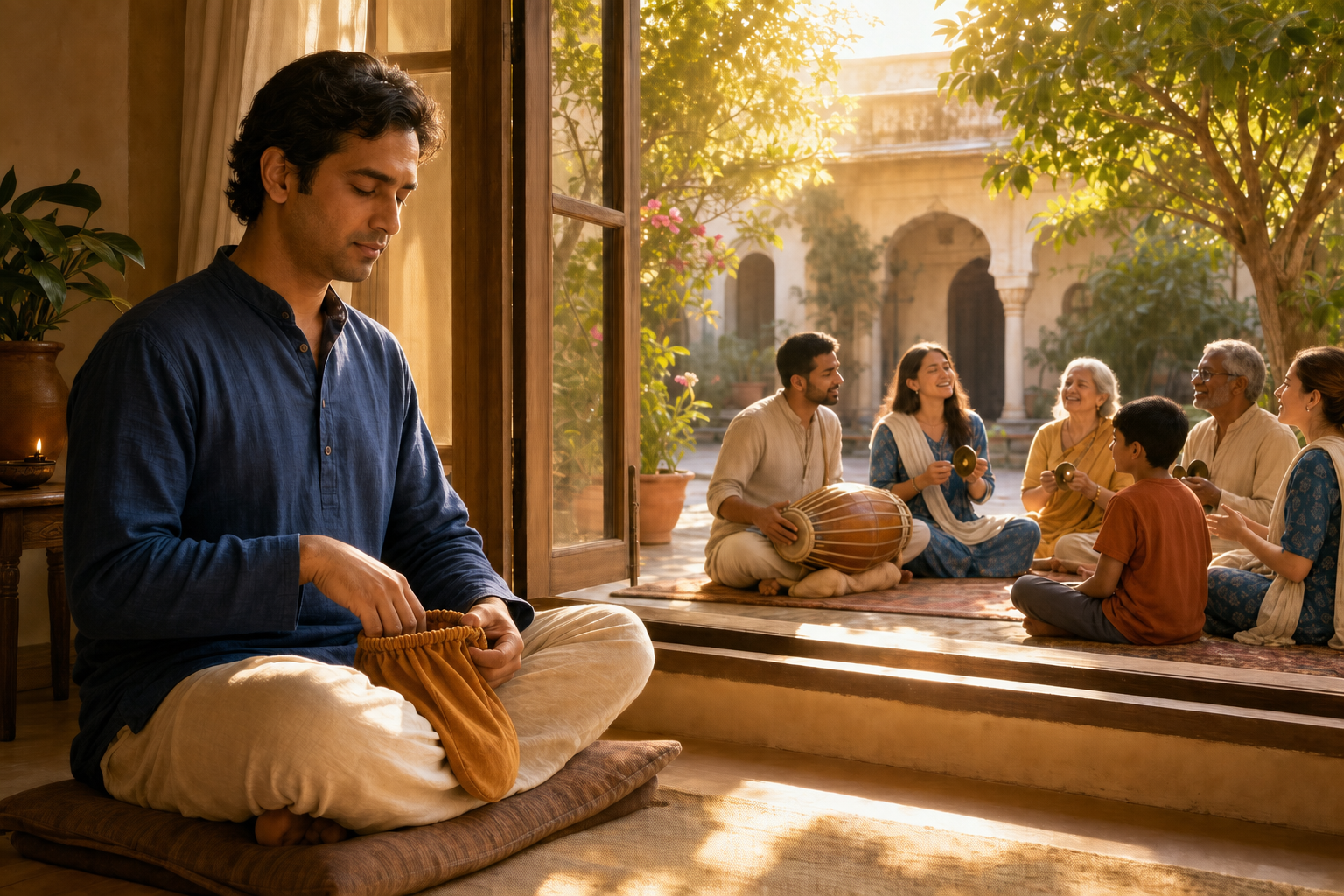
You may feel deeply drawn to chanting and still struggle to give it a stable place in your day. Or you may chant privately but hesitate to join a kirtan because you don’t know the melody, the etiquette, or whether you will belong.
You don’t have to choose between inward discipline and shared devotion. A sound personal practice trains attention and conduct; a sound communal practice supplies fellowship, rhythm, and opportunities for seva. The two become mutually reinforcing when you know what each is meant to do.
Private repetition and communal chanting do different work
Holy-name chanting is central to the Bhakti traditions of Hindu Dharma, but it doesn’t appear in only one form. The wider Dharmic family also includes Sikh Naam Simran, Buddhist chanting, Jain devotional recitation, and congregational practices built around sacred words, names, or mantras. These disciplines share an emphasis on remembrance and the refinement of attention, yet their theology and inherited forms remain distinct.
- Japa gives you a private field of practice. You repeat a name or mantra, hear it, notice when the mind has wandered, and return. It is especially useful for building regularity without depending on an event or an audience.
- Kirtan brings sacred sound into a shared musical setting. The leader, response, melody, rhythm, and physical presence of other participants make remembrance communal rather than solitary.
- Sankirtan or public Harinam carries chanting beyond the usual devotional gathering. It can give a passerby an unforced point of contact with sacred sound and offer newcomers an accessible way to participate.
- Naam Simran and other Dharmic recitations should be approached within their own teachings. Shared reverence for sacred sound does not make the Hare Krishna maha-mantra, Sikh remembrance, Buddhist mantras, and the Jain Namokar Mantra interchangeable.
The common ground is disciplined remembrance, not identical doctrine. Chanting across Dharmic traditions can support clarity, compassion, restraint, and ethical intention, while every practitioner remains responsible for understanding the name or mantra being recited.
Begin by locating yourself honestly. If you are practicing within your own lineage, follow its pronunciation, mood, and discipline. If you are visiting another community, arrive as a guest: listen first, learn what the words mean, and follow the host’s form. Respectful participation is better than assembling a spiritual sampler whose parts have been detached from their living traditions.
Build your personal practice around a cue, not a mood

The most fragile practice is the one you intend to do whenever you feel peaceful. Ordinary life rarely waits for that feeling. A reliable cue removes the daily argument about whether this is a convenient moment.
- Choose an anchor that already exists. Waking, bathing, lighting the evening lamp, returning from work, or preparing for rest can become the cue. Attach chanting to something that happens even on an inconvenient day.
- Set a boundary you can actually keep. Use a fixed period or a fixed number of repetitions appropriate to your tradition. The right starting boundary is one you can maintain when enthusiasm is low, not the largest commitment you can complete on an unusually free day.
- Prepare the physical setting. Sit or stand in a position that keeps you alert. Place the phone out of reach unless it is genuinely needed for the practice. Keep beads, a written mantra, or any other permitted aid ready before the cue arrives.
- Hear what you are saying. If your tradition permits audible japa, use a voice clear enough for you to hear without forcing it. Pronunciation and attention matter more than racing toward the end. When you are unsure of pronunciation, learn it from a competent teacher or established community rather than guessing from spelling alone.
- Return without turning distraction into drama. The mind will move toward plans, memories, irritation, and fantasy. Notice the departure and bring attention back to the next name. The return is part of the practice; condemning yourself for wandering only creates another distraction.
- Carry one intention into conduct. At the close, identify the next duty in front of you: speak gently in a difficult conversation, complete neglected work, refuse a harmful impulse, or perform an act of service without seeking recognition.
If you miss the practice, resume at the next reliable cue. Don’t punish yourself with an unrealistic compensating session that makes the routine harder to sustain. Steadiness is built by returning to the discipline, just as attention is built by returning to the name.
People commonly associate regular chanting with less mental agitation, weaker attachment to harmful habits, clearer judgment, and a stronger sense of purpose. Treat those as possible fruits of sincere practice, not as automatic rewards for accumulating repetitions.
Judge the practice by what happens after the chanting
A pleasant session is not the only sign of progress. Music, group energy, memory, and emotion can all make chanting feel powerful. Those experiences may be welcome, but the harder test begins when you return to work, family obligations, disagreement, temptation, and fatigue.
Choose one recurring behavior and observe it honestly. You might watch harsh speech, neglected duty, compulsive distraction, resentment, or the urge to claim credit. Ask whether chanting creates enough inner space for a different choice. A small act of restraint is a more dependable measure than a dramatic feeling that leaves your behavior unchanged.
- Attention: Do you notice distraction earlier and return more readily?
- Speech: Are you becoming more truthful without using truth as a weapon?
- Restraint: Is there a wider pause between an impulse and the action it demands?
- Duty: Does remembrance help you complete necessary work rather than using spirituality to avoid it?
- Relationship: Are apology, gratitude, patience, and forgiveness becoming more available?
- Seva: Can you help without requiring visibility, control, or praise?
This approach also prevents a common mistake: treating sacred sound as a technique for obtaining a mood while leaving character outside the practice. Holy-name chanting is devotional remembrance, but its credibility becomes visible through humility, compassion, self-discipline, and responsible action.
Chanting can support someone who is confronting cravings, intrusive thoughts, or destructive habits, but it is not a substitute for medical care, psychological treatment, crisis support, or a recovery program. If a condition is severe, dangerous, or disrupting ordinary functioning, seek qualified help and let spiritual practice serve as support rather than replacement.
Let communal chanting turn remembrance into relationship
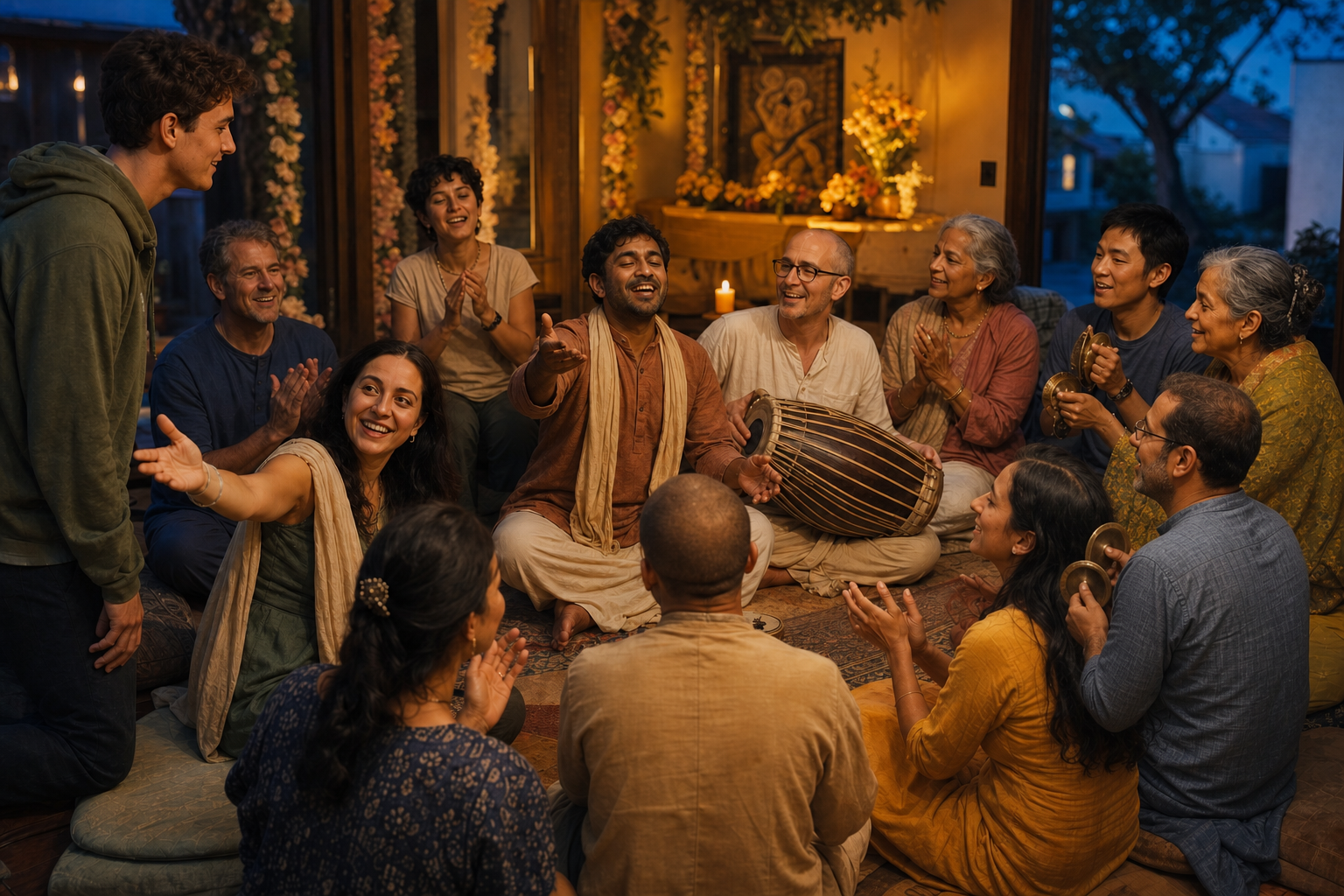
Private chanting can reveal your habits of mind. Communal chanting reveals how you behave around other people. Can you follow rather than dominate? Can you support a hesitant newcomer? Can you keep rhythm without treating the gathering as a performance? Can you accept a melody that isn’t your preference?
Coordinated vocal practice and rhythm can strengthen trust, empathy, mutual care, and prosocial conduct. In Dharmic language, a well-held gathering can nourish sattva: clarity, restraint, truthfulness, and benevolence. That effect depends partly on how the gathering is conducted. Volume and excitement alone do not create spiritual community.
When you attend
- Listen long enough to recognize the lead-and-response pattern before adding a harmony, variation, or instrument.
- Keep your voice within the gathering rather than trying to rise above it.
- Follow the leader’s pace. A response that rushes ahead weakens the shared attention the form is meant to cultivate.
- Make room for children, elders, newcomers, and people who participate quietly. Dancing may be natural for one person while attentive listening is the sincere response of another.
- Ask before photographing or recording identifiable participants, especially in a place of worship.
- Help with an ordinary task after the final chant. Moving seats, cleaning the space, welcoming someone, or putting away instruments protects kirtan from becoming a consumption experience.
When you organize public chanting
Public Harinam can make devotion audible in streets, festivals, and community spaces. Its most memorable moments are often simple: a passerby pauses, a child responds to the rhythm, or an elder recognizes a bhajan. The purpose is to offer a dignified encounter, not to turn the public into a captive audience.
- State the practice clearly. Tell newcomers which tradition the chant belongs to and provide the words in a readable form when possible.
- Keep participation voluntary. Invite response, listening, or quiet presence without pressuring someone to perform devotion.
- Respect the shared space. Follow applicable local requirements, keep pathways usable, manage sound responsibly, and avoid confrontations with residents or other users of the space.
- Assign welcoming roles. Someone should be free to explain the chant, assist a newcomer, or answer a practical question while the lead chanter and musicians continue.
- Design for more than confident singers. A clear response, a steady tempo, visible words, and room at the edge allow unfamiliar participants to enter without embarrassment.
- Make the event an act of seva. Care for the place, clean up fully, thank those who supported the gathering, and leave neighbors with a reason to welcome the community again.
At a gathering that includes several Dharmic paths, unity should not be purchased by erasing difference. Introduce each recitation accurately. Allow its own name, pronunciation, devotional purpose, and tradition to remain visible. The meeting point is a shared commitment to remembrance, ethical refinement, nonviolence, compassion, and mutual respect. This is unity expressed through spiritual diversity, not sameness imposed for convenience.
Key takeaways
- Choose a name or mantra within a tradition you understand, and learn its pronunciation and devotional setting.
- Attach private chanting to a dependable daily cue and give the session a realistic boundary.
- When attention wanders, return to the sacred sound without self-condemnation.
- Measure the fruit in speech, restraint, duty, relationships, and seva, not only in spiritual emotion.
- Enter communal chanting as a participant, not a performer competing for attention.
- Organize public chanting as an offering that respects listeners, neighbors, shared space, and Dharmic distinctions.
- Use chanting as spiritual support, never as a replacement for necessary professional care.
Your next step can be modest and exact. Choose the next dependable cue in your day, decide what you will chant, and prepare the place before the cue arrives. Then find a local gathering where you can listen, respond, and take responsibility for one small act of seva. That is enough to begin joining personal remembrance to communal life.
References
- Dandavats – Complete Insight: How Harinam Ruchi Transforms Lives: A Tribute to Jivananda Prabhu
- Dandavats – The Essential Power of the Holy Name: A Proven Path to Transform Mind, Society, and Spirit
