
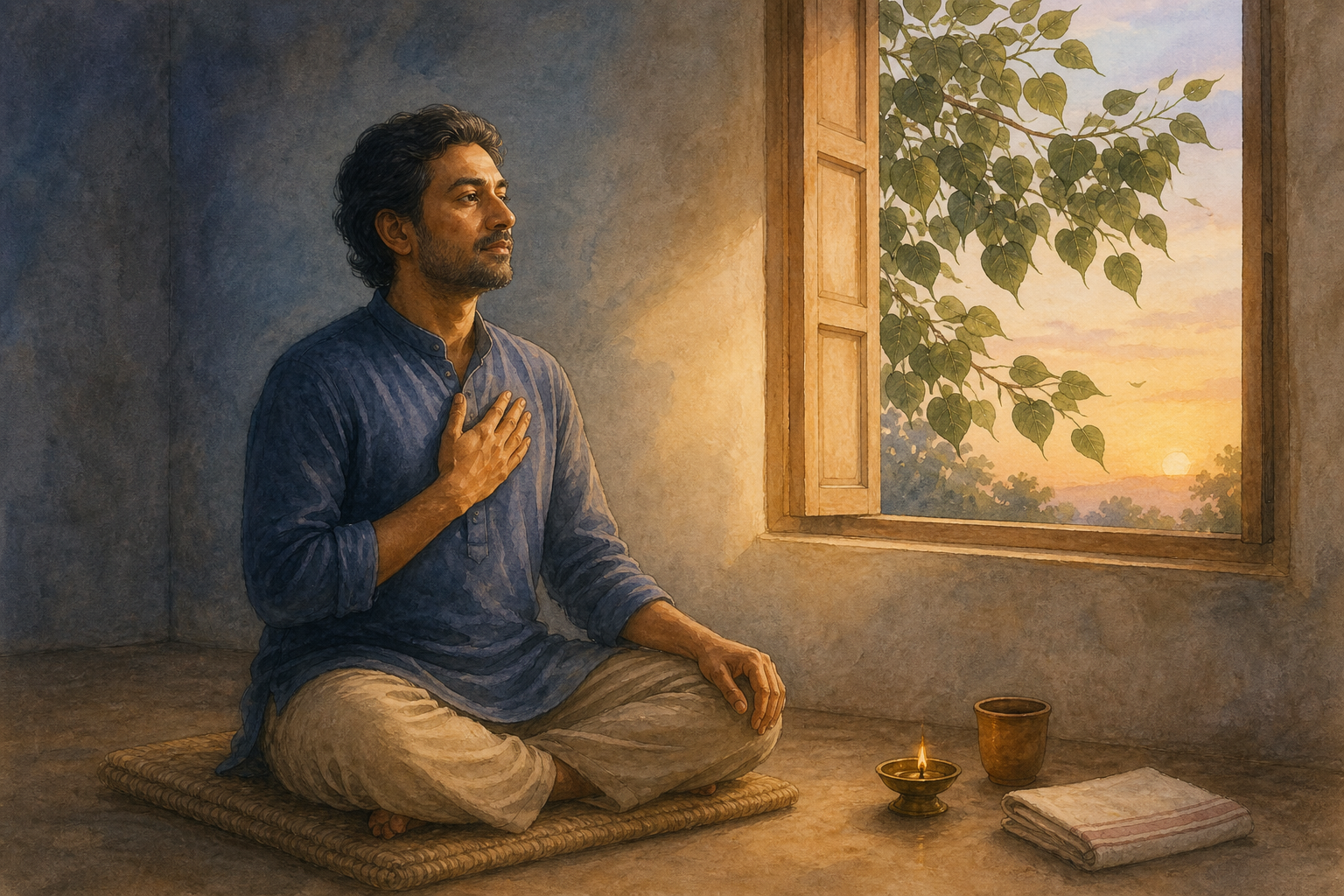
You notice the message, the raised voice, or the troubling headline. Before you have decided what it means, your body is tense and your mind is already composing a response. That gap between what happens and what you do next is where contemplative practice becomes practical.
You do not need to suppress the emotion or manufacture serenity. You need enough awareness to recognize what is moving through you, enough steadiness to remain present, and an ethical measure for choosing your response. The aim is not to feel calm at all times. It is to become less governable by the first thought, fear, or impulse that appears.
Awareness comes before emotional balance
Awareness and emotional balance are related, but they are not identical. Awareness lets you notice an experience without immediately becoming its servant. Emotional balance lets you stay with that experience long enough to respond deliberately.
A useful Dharmic image is sky-like awareness associated with akasha and the Ishana aspect of Shiva. Thoughts and emotions move through awareness as changing weather moves through the sky. The sky does not have to destroy a cloud in order to remain spacious. In the same way, you do not have to defeat anger, fear, grief, or desire before you can see it clearly.
When an emotion becomes strong, separate the experience into four parts:
- Sensation: What is happening in the body? Look for pressure, heat, restlessness, heaviness, shallow breathing, or an impulse to move.
- Feeling: What is the simplest honest name for the emotion? Anger, fear, shame, sadness, longing, and confusion are more useful than a long argument about why you are right.
- Story: What meaning or prediction is the mind adding? This is often where an unpleasant event becomes a catastrophe, a permanent verdict, or a judgment about another person’s motives.
- Urge: What do you want to do immediately? Send the reply, withdraw, accuse, seek reassurance, overindulge, or pretend nothing happened.
This separation matters because a sensation is not a command, a feeling is not a complete account of reality, and an urge is not an obligation. Returning to what is actually present can loosen rumination, catastrophizing, and automatic reactivity.
Then apply an ethical test. Ask: What is true here? What would avoid needless harm? What response preserves both dignity and restraint? Satya and ahimsa turn contemplation from private mood management into disciplined conduct. A practice that feels peaceful but leaves you more dishonest, callous, or irresponsible has missed its purpose.
A 12-minute practice you can repeat every day

Consistency matters more than intensity. A compact sequence can combine centering, gentle movement, Nadi Shodhana, visualization, mantra, and rest without turning practice into another demanding project. Use the same place when possible, but do not wait for perfect silence or a special mood.
- Arrive for two minutes. Sit upright without becoming rigid. Let your hands rest. Notice the support beneath you, the sounds around you, and the natural movement of breathing. Do not improve the breath yet. Your task is simply to arrive where the body already is.
- Move gently for three minutes. Use Cat-Cow, a comfortable spinal wave, or Baddha Konasana. Let movement follow the breath instead of chasing a deep stretch. If floor practice is inaccessible, remain seated and slowly move the spine, shoulders, and pelvis within a painless range.
- Practise Nadi Shodhana for three minutes. Close the right nostril gently and inhale through the left. Switch sides and exhale through the right; inhale through the right, switch, and exhale through the left. Continue without holding the breath or straining. If congestion, discomfort, or light-headedness makes the method awkward, release the hand and return to ordinary breathing.
- Observe for two minutes. Bring attention to the lower abdomen, the whole torso, or the place where emotion is most noticeable. If imagery helps, picture a calm body of clear water. Silently identify sensation, feeling, story, and urge. Nothing has to be fixed during these two minutes.
- Use mantra or remembrance for one minute. Om Namah Shivaya can orient a Shaiva practice toward steadiness and surrender. The bija mantra vam belongs to practices centered on Svadhisthana. If your discipline is Sikh simran, Buddhist metta or breath awareness, or Jain contemplation, remain with the established form of that path. Depth grows through fidelity; collecting unfamiliar sacred sounds is not the same as practice.
- Rest and choose for one minute. Drop the technique. Before rising, name the conduct you want to carry into the next part of the day: listening before answering, stating a boundary without contempt, completing a neglected duty, or declining an impulsive action.
The timing is a container, not a claim that every nervous system changes on schedule. The more meaningful measure appears outside meditation: Do you notice tension earlier? Can you interrupt a harmful reply? Can you acknowledge desire without being pulled into compulsion? Can you speak the truth with less aggression? Those are signs that awareness is entering conduct.
Use a shorter reset before you speak or decide

A daily sitting builds capacity, but emotional balance is tested in ordinary moments. When you feel the pressure to react, use this sequence before making the situation harder:
- Stop adding input. Put the phone down, stop drafting the reply, or turn away from the news feed. You are creating a pause, not avoiding the issue.
- Find the body. Feel your feet, the chair, or the movement of the abdomen. Let the exhalation become a little longer without forcing it. Grounding attention in the body gives the mind something present to attend to.
- State the fact plainly. Use only what could be observed or repeated accurately. Then identify the interpretation and prediction that your mind has added.
- Name the urge without obeying it. Silently acknowledge the impulse to attack, flee, please, withdraw, or seek immediate relief.
- Choose the smallest responsible action. Ask a clarifying question, draft without sending, state a boundary, take the required practical step, or postpone a non-urgent decision until you can examine it clearly.
Suppose a message makes you angry. The fact is its actual wording. The story may be that the sender never respects you. The urge may be to deliver a punishing response. Balance does not require pretending the message was acceptable. It gives you room to ask what is true, what needs a boundary, and which response will not create avoidable damage.
The same method helps when public events produce anxiety. Separate what is happening in your immediate surroundings, what calls for action, and what remains a feared prediction. Gratitude can then be used without denial: notice the people, duties, capacities, or forms of support still present. This does not make danger unreal. It prevents danger from occupying the whole field of awareness.
Match the practice to the pattern you actually have

Not every difficult state needs more stillness. A restless mind, an emotionally numb body, and a rigid sense of certainty may all be called imbalance, but they require different doorways. Notice your pattern before choosing the technique.
When thought is fast and the body is agitated
Begin with contact, movement, and an easy exhalation. Do not demand profound insight while the mind is racing. Feel the floor, move the spine gently, and practise unforced alternate-nostril breathing if it is comfortable. Once the body has settled somewhat, distinguish present facts from imagined outcomes. The immediate goal is not bliss; it is enough stability to avoid feeding the reaction.
When you feel numb, ashamed, or creatively blocked
The traditional Svadhisthana lens associates the water element with feeling, creativity, pleasure, and relational life. Helpful practices can include gentle hip mobility, awareness of breathing in the pelvic region, clear-water visualization, journaling, music, painting, or unforced movement. Ethical boundaries, mutual consent, and discernment remain essential; emotional openness does not mean surrendering judgment.
Treat chakra language as a contemplative framework, not a medical diagnosis. Do not force a hip-opening posture or try to produce an emotional release. If pelvic attention feels uncomfortable, move awareness to the hands, face, or general movement of breathing. The purpose is to restore a workable relationship with experience, not to prove that a particular energy center has been opened.
When the mind becomes narrow, defensive, or self-important
Ishana contemplation offers a different correction. Sit beneath an open sky, soften the gaze, and sense awareness as more spacious than the position you are defending. If you worship with a Panchmukhi Shivling, the upward-facing Ishana aspect may be honoured with a lamp, a simple water offering, and bilva leaves where appropriate, followed by silent Om Namah Shivaya. The outward form should lead inward to discernment, humility, and steadier action rather than becoming a claim of spiritual superiority.
Ask what you may not be seeing. Jain Anekantavada gives this question ethical force by encouraging humility before multiple standpoints. Non-attachment does not require indecision; it asks you to loosen your grip on the assumption that your first perspective is complete.
Keep related Dharmic practices distinct
Hindu dhyana, mantra, pranayama, and devotion; Buddhist mindfulness and metta; Jain ahimsa, aparigraha, and perspectival humility; and Sikh simran and seva can all support steadier attention and compassionate conduct. Their philosophies and sacred vocabularies are not interchangeable. Shared ethical resonances should deepen mutual respect, not flatten each path into a generic wellness method.
Choose a primary vocabulary and practice rooted in the tradition you follow. Use parallels to understand your Dharmic neighbours, while learning the method itself from a trustworthy teacher or lineage when it requires instruction. This protects both depth and integrity.
Know when gentleness or professional support is needed
If contemplation brings up difficult memories or emotions that feel overwhelming, stop the breath technique, open your eyes, feel the support beneath you, and look around the room. Rest or return to an ordinary activity. A qualified teacher can help you adjust a spiritual method; a qualified mental-health clinician is the appropriate support when distress is persistent, feels unsafe, or interferes with daily functioning. Contemplative practice should not be used as a substitute for psychological or medical care.
Key takeaways
- Practise when you are relatively settled so the method is available when emotion becomes strong.
- Move from body to breath, from breath to awareness, and from awareness to ethical action.
- Measure progress by earlier noticing, clearer boundaries, less harmful speech, and more deliberate choices, not by permanent calm.
- Keep breathing and movement comfortable. Strain is a reason to simplify, not evidence that the practice is working.
- Let satya and ahimsa test the result. Greater awareness should make truthful, restrained, and compassionate conduct more possible.
Set aside 12 minutes at your next ordinary transition: after waking, before work, or before the evening becomes crowded. When you finish, write down what arose and what action you intend to take. Look for a modest but decisive change: more space between feeling and action. That is where emotional balance begins to become character.
References
- DharmaRenaissance Blog – Discover Ishana’s Transformative Power: The Complete Benefits of Panchmukhi Shivling Worship
- DharmaRenaissance Blog – Master Svadhisthana: The Complete, Proven Guide to Balancing the Sacral Chakra for Creative Flow
- Tiny Buddha – How to Be Well in Unwell Times
