
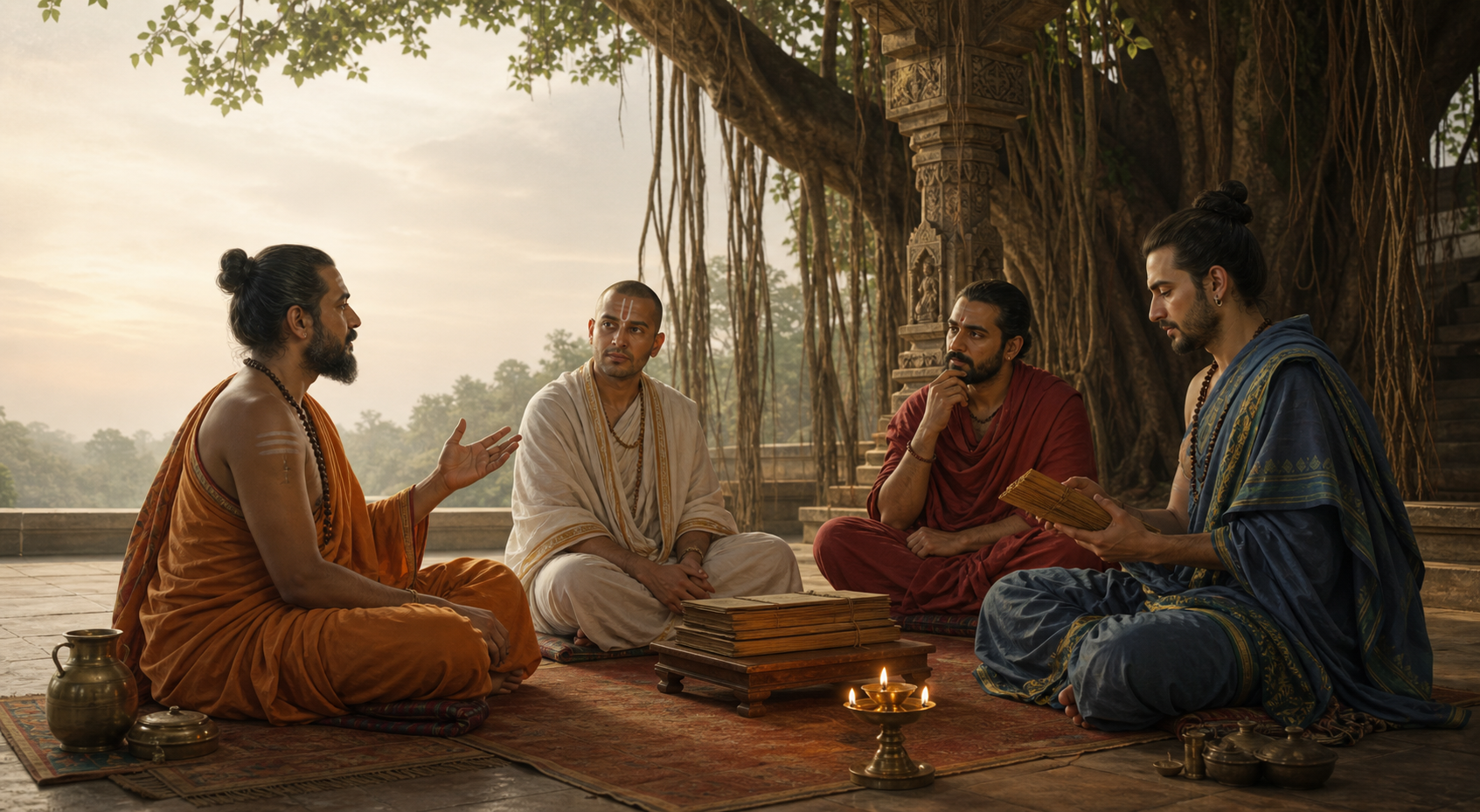
You ask whether a verse gives a universal rule or addresses a particular moral crisis. One person answers with a quotation, another appeals to experience, and a third treats any challenge as disrespect. Before long, nobody is examining the original question.
You do not have to choose between silence and a quarrel. Dharmic traditions offer a more demanding option: make disagreement a disciplined search for truth. That approach grows from Upanishadic conversation, the Bhagavad-Gita’s exchange on duty and discernment, and the rigorous practice of shastrartha. You can apply the same habits in a satsang, classroom, family discussion, interfaith meeting, or online exchange.
Decide whether you are seeking truth or defending a side
A debate becomes fruitless before anyone raises their voice. It fails when the participants want different outcomes but never say so. One person may want to understand a teaching, another to defend a community, and another to expose what they consider an error. Those purposes require different conversations.
Begin by stating the exact proposition under examination. Do not debate Hinduism, Buddhism, Jainism, Sikhism, tradition, modernity, or religion as undivided wholes. Ask a question narrow enough to answer: Does this passage support this interpretation? Does this inference follow from these premises? Is this practice being described accurately? What ethical principle should govern this case?
Then test whether everyone is ready for inquiry. A serious participant should be able to answer four questions:
- What precise claim are you defending or questioning?
- Can you restate the other position in words its advocate accepts?
- What evidence or reasoning could make you revise your view?
- What do both sides already agree is worth preserving?
If nobody can name what would change their mind, the exchange is advocacy rather than inquiry. Advocacy has legitimate uses, but it should not disguise itself as a search for truth. If participants cannot restate one another fairly, they are not yet disagreeing with the real positions. They are reacting to impressions.
This is where humility becomes intellectually useful. It does not require you to pretend all views are equally sound. It requires you to distinguish confidence from certainty and conviction from infallibility. You can defend a conclusion firmly while remaining willing to correct a premise, interpretation, or application.
Use pramana to keep every claim in its proper lane
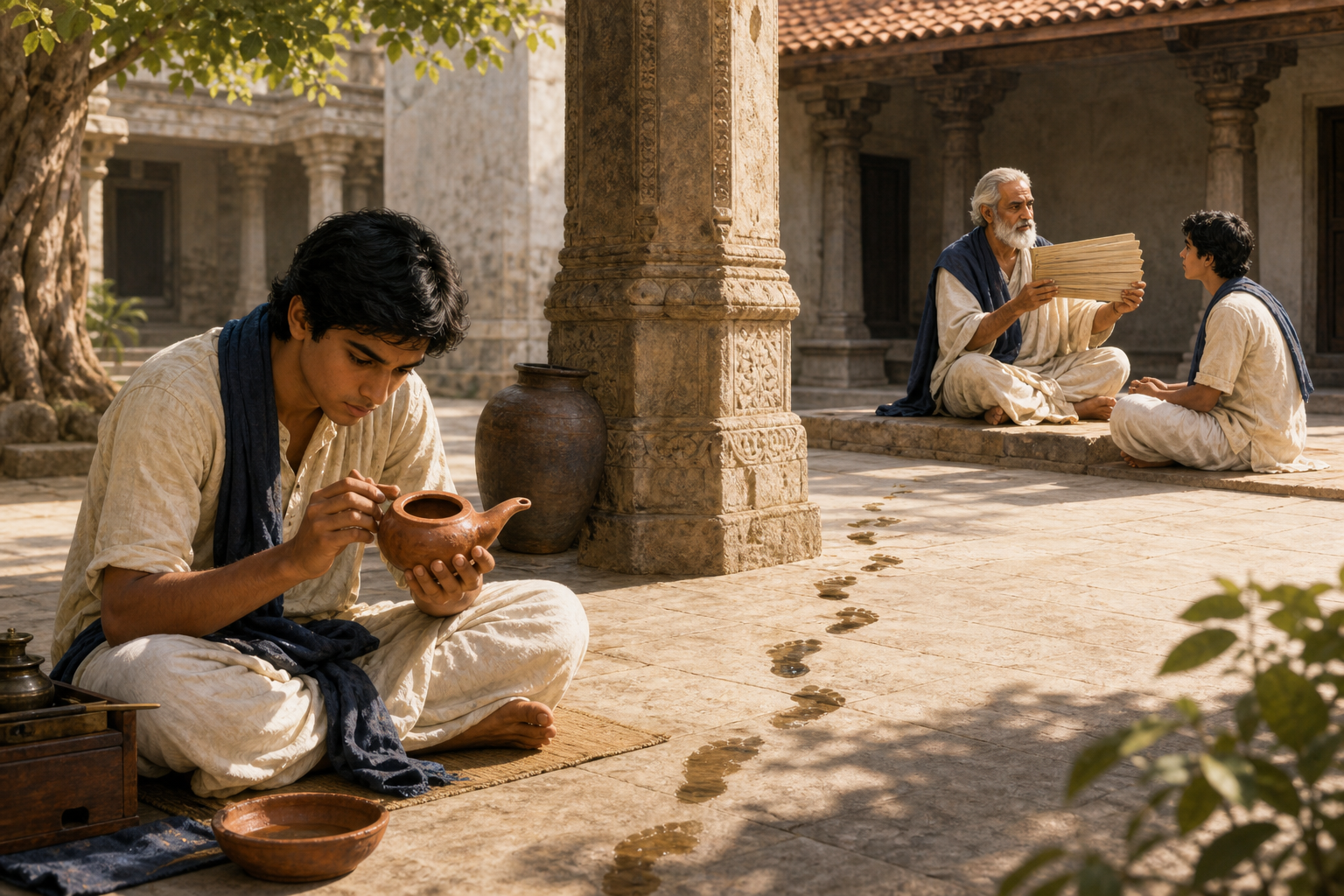
Many arguments continue because the participants are using different kinds of evidence without noticing. A practical Hindu framework distinguishes pratyaksha, or direct experience; anumana, or inference; and shabda, or trustworthy testimony. A claim may draw on more than one, but naming its main support reveals what the discussion must examine.
| Means of knowledge | What it can contribute | Common overreach | Question to ask |
|---|---|---|---|
| Pratyaksha: direct experience | What someone observed or experienced | Treating a personal experience as proof of a universal conclusion | What was directly experienced, and what interpretation was added afterward? |
| Anumana: inference | A reasoned movement from premises to a conclusion | Hiding an unsupported assumption inside an apparently logical argument | Which premise connects the evidence to the conclusion? |
| Shabda: trustworthy testimony | Knowledge conveyed through a trusted text, teacher, or witness | Treating every quotation or inherited assertion as equally authoritative and unambiguous | Why is this testimony trustworthy, and does the proposed interpretation fit its context? |
This distinction prevents category errors. A person who reports peace during a practice has given evidence about an experience. The report does not, by itself, prove every metaphysical explanation attached to it. A logically consistent argument may still rest on a doubtful premise. A quotation can establish that certain words appear in a text, but it does not automatically establish that only one interpretation is possible.
Use a simple note during a serious discussion: write the claim, its main pramana, and the bridge between the evidence and the conclusion. The bridge is often where the real disagreement sits. Once it is visible, you can stop trading declarations and examine the disputed premise directly.
This is a working framework, not a claim that every Hindu, Buddhist, Jain, and Sikh school has an identical theory of knowledge. The practical lesson is narrower: ask what kind of support a claim needs before deciding whether the support offered is adequate.
Learn across Dharmic traditions without flattening their differences
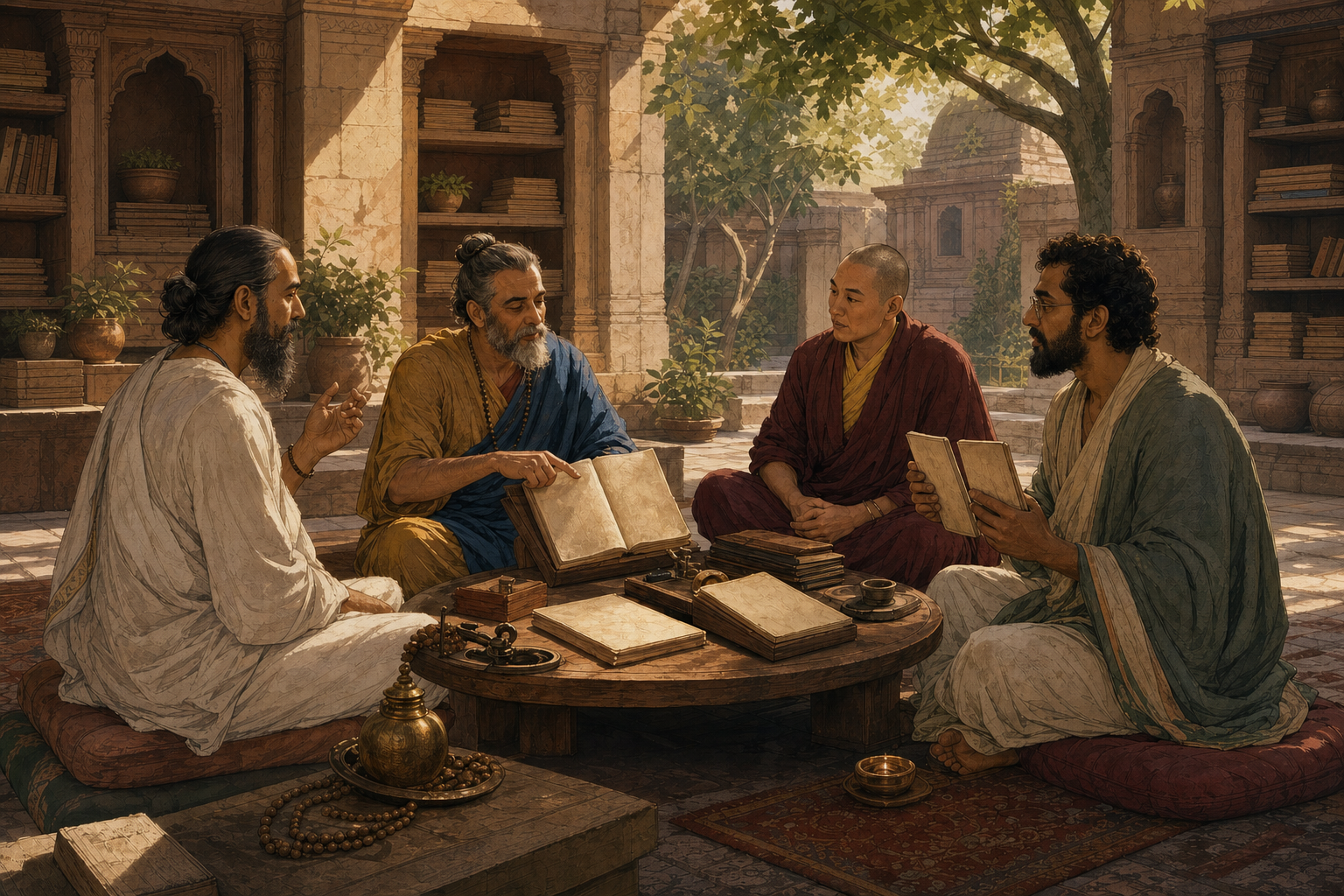
The Dharmic family does not hand us a single debate manual. It gives us related disciplines of inquiry, each shaped by its own teachings and aims. Their value lies in the family resemblance, not in pretending they are interchangeable.
- Hindu traditions: The Upanishads often pursue knowledge through question and response, while the Bhagavad-Gita places Arjuna’s confusion inside a sustained dialogue about duty, discernment, action, and liberation. The recognition of yoga, bhakti, jnana, and karma as different paths also reminds you to ask whether two teachings address different temperaments or spiritual needs before declaring them contradictory.
- Jain traditions: Anekantavada warns against mistaking one standpoint for the whole of reality. Apply it by adding a disciplined qualifier to your claim: from which standpoint is this true, and what aspect might another standpoint disclose? This does not mean every assertion is correct. It means a partial truth should not be inflated into an exhaustive one.
- Buddhist traditions: Debate and inquiry can refine understanding while exposing attachment to being right. Ask whether you are examining the claim or protecting an identity built around the claim. The distinction matters because evidence cannot correct a position that has become a shield for the ego.
- Sikh traditions: Sabad and reflection in sangat place understanding within divine orientation and community. Ask whether the exchange is helping the community listen more deeply or merely rewarding the quickest speaker. Collective reflection should make wisdom more available, not turn the gathering into an audience for individual cleverness.
These emphases give you four distinct checks: identify the purpose and path involved; look for the neglected standpoint; notice attachment to victory; and return interpretation to ethical community. Used together, they make pluralism exacting rather than vague. You still assess claims, reject weak reasoning, and preserve real distinctions. What you give up is the assumption that difference must end in contempt.
Run a discussion with a practical shastrartha protocol
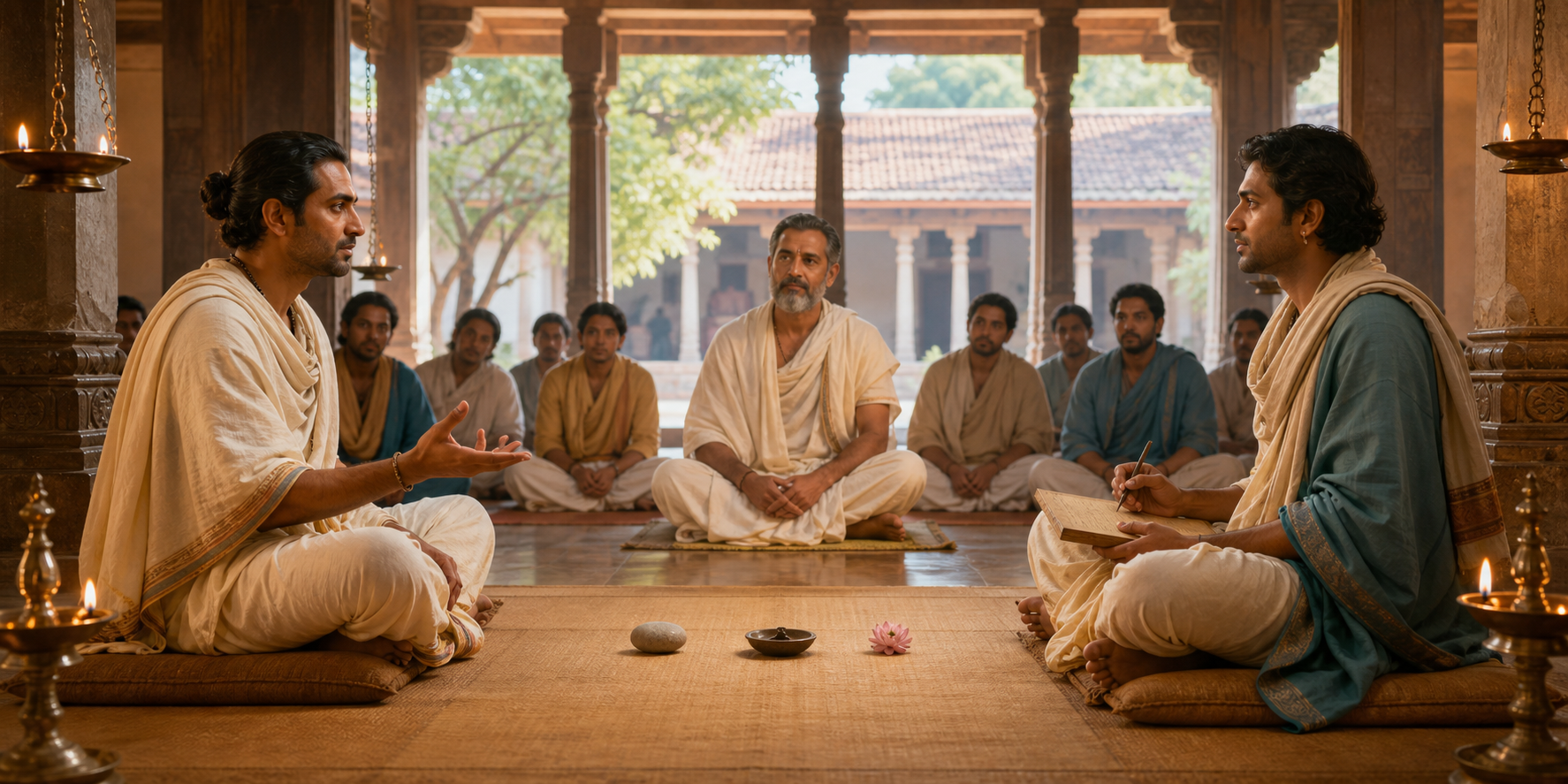
Classical shastrartha treated philosophical disagreement as reasoned engagement rather than an exchange of slogans. You can recover that spirit without trying to recreate every historical form. The following protocol works wherever participants are willing to be questioned and corrected.
- Set one question. Write it as a proposition or a choice between clearly stated interpretations. Park related disputes for later so a flood of side issues cannot replace an answer.
- Name the stakes. Say whether the conclusion concerns textual meaning, philosophical truth, spiritual practice, community conduct, or public policy. A disagreement about interpretation should not quietly become an accusation about someone’s character.
- Define the disputed terms. Words such as dharma, self, liberation, equality, tradition, and authority may carry different meanings. Ask each participant to state how a key term is being used in this discussion.
- Present the opposing view fairly. Before criticizing it, state its reasoning in a form its advocate recognizes. If the advocate says the summary is inaccurate, repair the summary before proceeding.
- Declare the pramana. Identify whether the claim rests mainly on experience, inference, or trustworthy testimony. Then expose the assumptions that connect that support to the conclusion.
- Answer the strongest objection. Do not choose the weakest example of the opposing position. Charity of interpretation means testing your view against the best available challenge, not making agreement compulsory.
- Close with an honest record. State what was clarified, what remains disputed, which premise needs further examination, and what could resolve it. A conversation that reveals the exact location of disagreement has made progress even without consensus.
Viveka and ahimsa govern the method. Viveka, or discernment, prevents a polite conversation from becoming intellectually soft. Ahimsa prevents rigor from becoming humiliation. Together they permit a direct sentence such as this inference does not follow, while ruling out the leap to therefore you are dishonest or foolish.
Set behavioral boundaries before a difficult exchange. Do not assign hidden motives as a substitute for answering an argument. Do not treat unfamiliarity as proof of bad faith. Do not bury one question beneath disconnected quotations. Do not use an audience, a pile-on, or ridicule to punish someone for revising a position. A person must be free to correct an error without being made to regret the correction.
Key takeaways for your next discussion
- Reduce the disagreement to one claim that can actually be examined.
- Name the main pramana and test the bridge from evidence to conclusion.
- Restate the opposing view accurately before attempting a refutation.
- Use viveka to preserve rigor and ahimsa to govern speech.
- End by recording what is settled, what is open, and what inquiry comes next.
Change the format when an online debate rewards heat

Digital discussion often rewards speed, certainty, and public performance. Those incentives are hostile to careful interpretation. When several claims arrive at once, select the central one and ask its defender to supply the relevant reasoning. When a quotation appears, ask what interpretation is being advanced and why the context supports it. When the exchange shifts to motives or group insults, return once to the proposition; if that fails, end the exchange.
Ahimsa does not require endless exposure to abuse, and openness does not require you to treat every provocation as a sincere question. A useful boundary is whether the other person will define a claim, answer a relevant question, and permit correction on both sides. If those conditions are absent, disengagement protects attention that can be used for genuine study.
Move difficult questions into a format that supports memory and accountability. A moderated study circle can keep a record of definitions, cited passages, agreed premises, and unresolved points. The aim is not to hide disagreement from public view. It is to prevent an audience’s appetite for victory from controlling the inquiry.
At your next satsang or study circle, choose one live disagreement and use the protocol from the beginning. Appoint someone to keep the question narrow, require each side to restate the other, and finish with the unresolved premise rather than a declaration of winners. That small change turns debate from a test of loyalty into a form of sadhana.
References
