
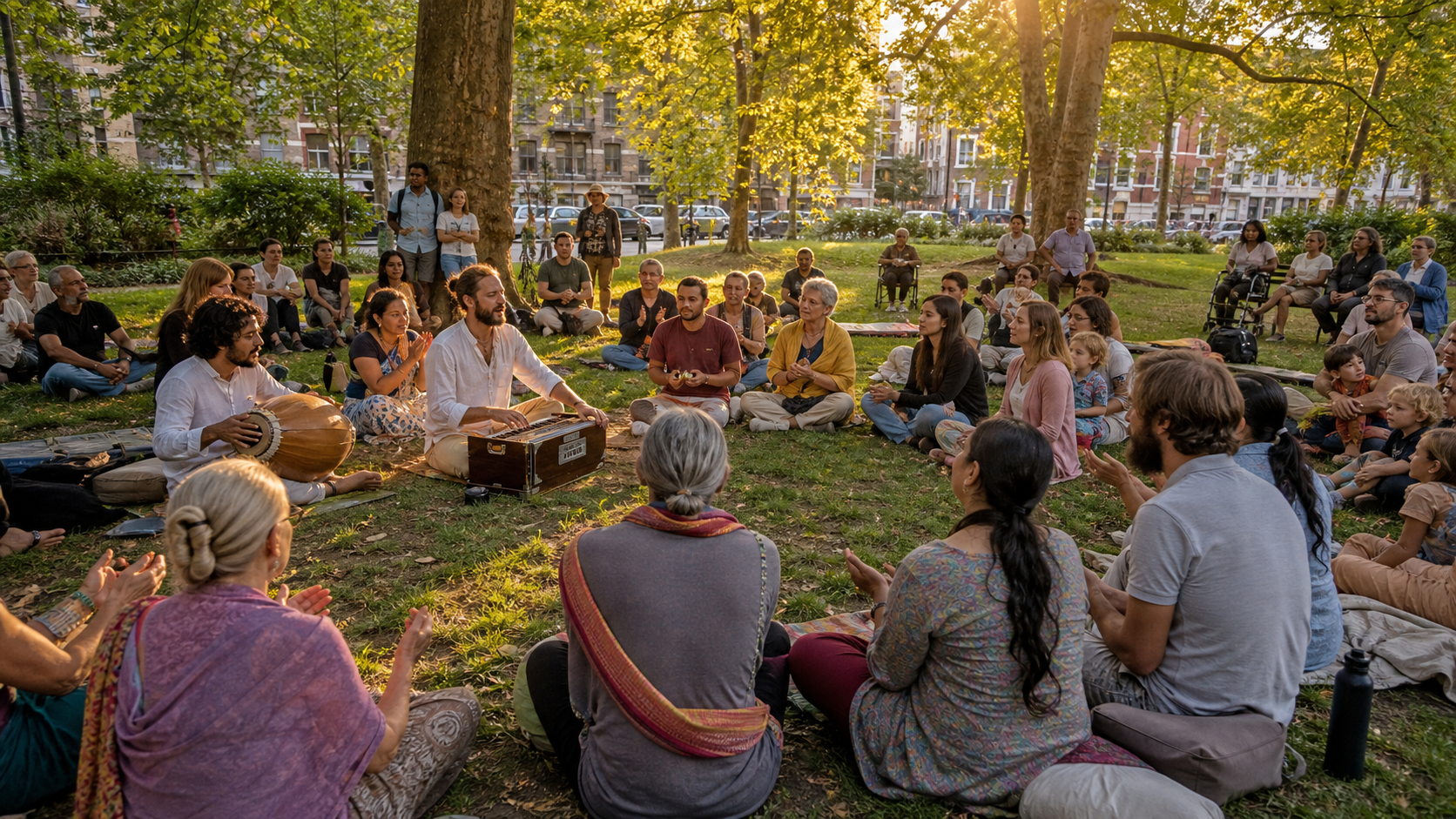
If you are preparing to take kirtan beyond a familiar temple community, your hardest decision is not the repertoire. It is the kind of encounter you want a stranger to have. A polished stage, skilled musicians, a sound system, and a table of books can all help, but none of them automatically makes public bhakti welcoming or devotional.
Use a simpler standard. A newcomer should be able to hear the mantra clearly, understand how to participate, remain without joining, and find a respectful next step afterward. Design the entire gathering around those four conditions.
Make the invitation clear before you amplify the sound
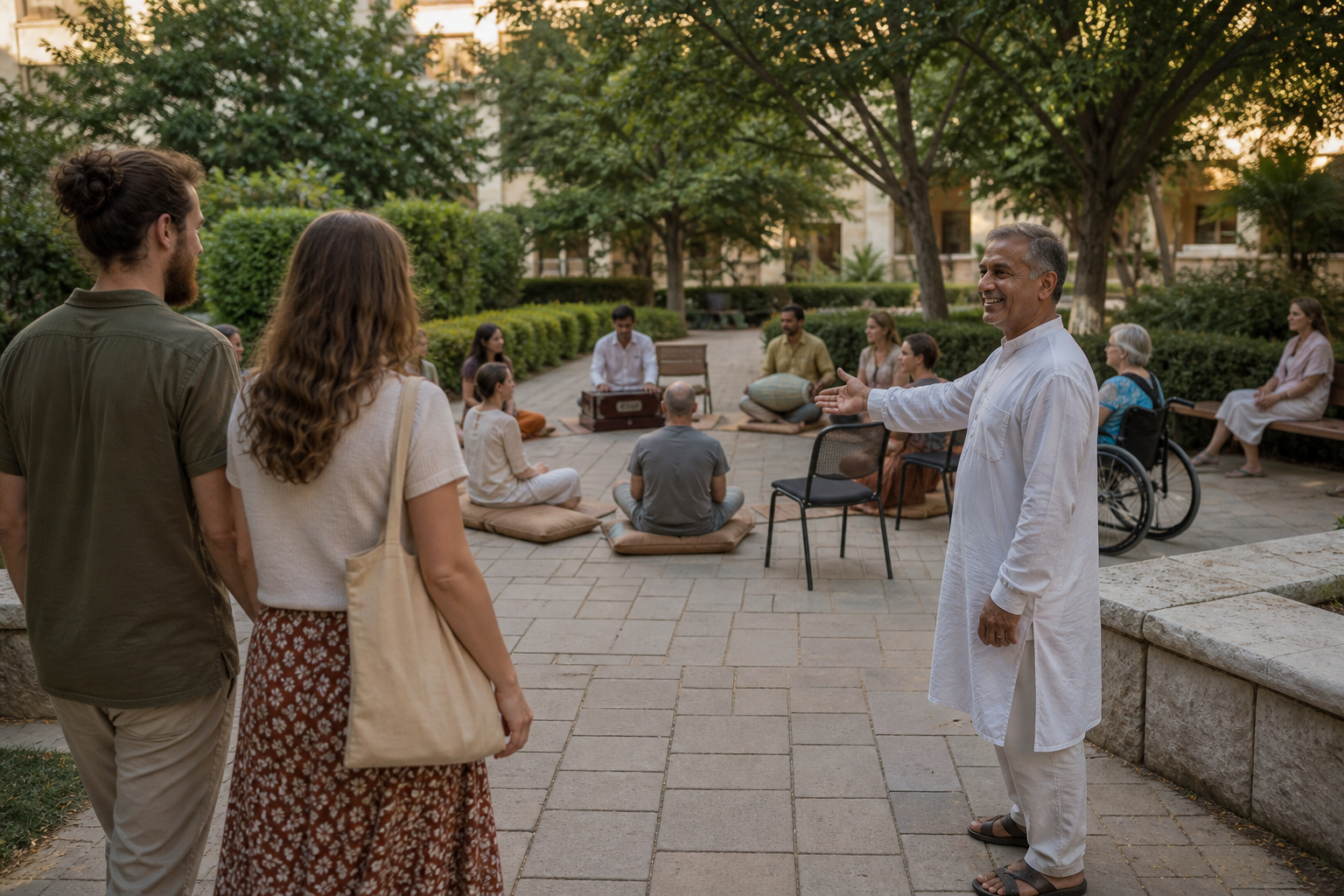
Public kirtan has several audiences in the same room. A devotee may experience it as sadhana and seva. A curious visitor may hear an unfamiliar sacred language for the first time. A venue host may understand it as a cultural or musical program. Problems arise when organizers speak to only one of these audiences.
If everyone is treated as an insider, newcomers have to guess when to sing, what the words mean, and whether participation carries an expectation of belief. If the gathering is presented only as entertainment, the mantra can become background material for a performance. If outreach begins with argument or persuasion, hospitality quickly feels conditional.
The better model is an explicit invitation. At a kirtan in a listed London theatre, the important movement was from attentive listening to wholehearted participation in a shared chorus. Artistic skill mattered, but its public value appeared when the room could join.
Before the first mantra, give the audience three pieces of information in plain language:
- What this is: Identify it as devotional, call-and-response singing from a particular bhakti tradition.
- What people can do: Say that they may sing the response, listen quietly, or simply observe.
- What happens afterward: Tell them where questions, literature, refreshments, or details of another gathering will be available.
A working welcome can be as simple as this: We will sing a mantra in call and response. The leader sings first, and you are welcome to repeat it with us. You are equally welcome to listen. We will explain the words and remain afterward for questions.
That short orientation removes uncertainty without diluting the sacred character of the gathering. It also makes consent visible. Nobody has to pretend familiarity in order to remain in the room.
Build a kirtan that people can enter, not merely admire
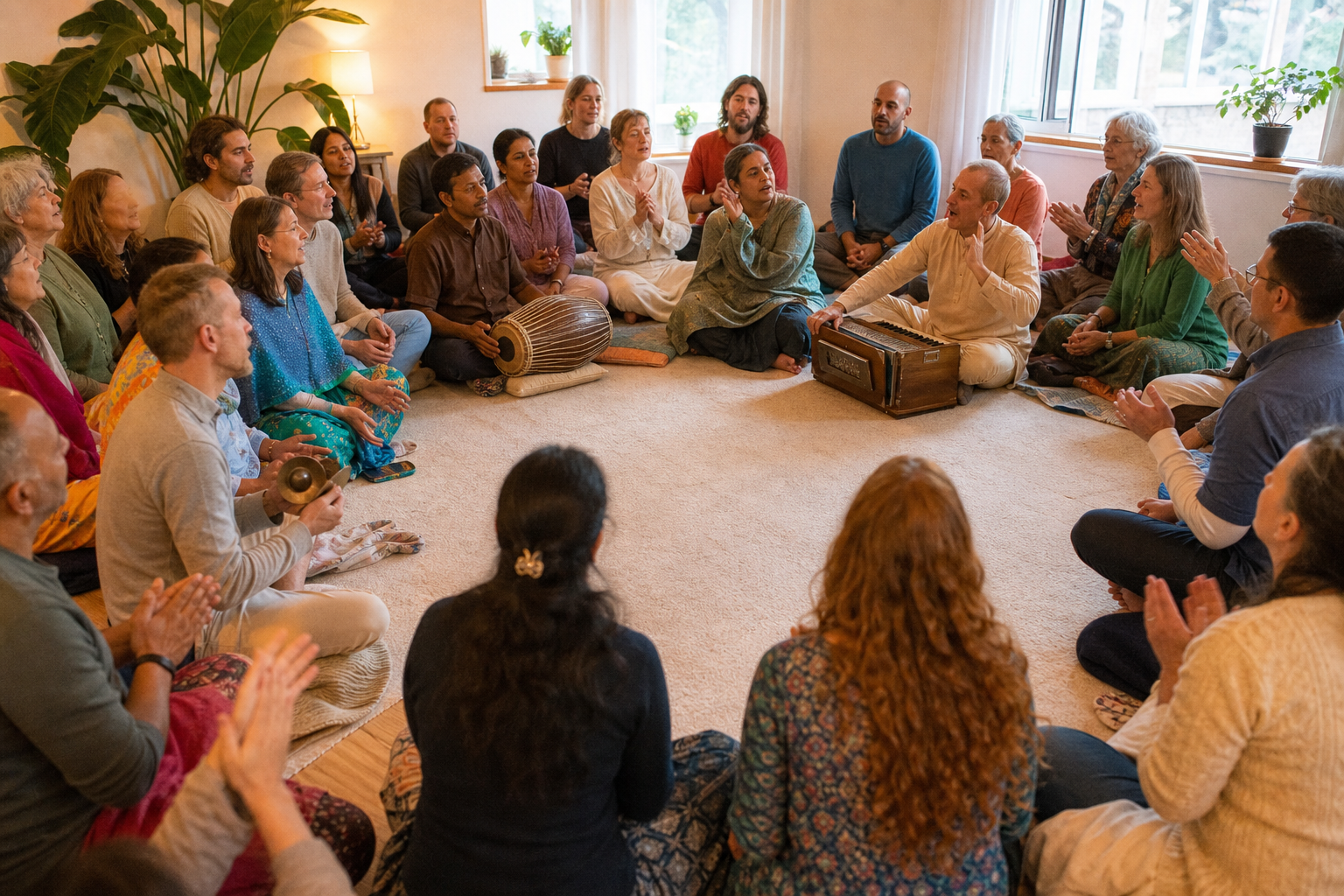
A public kirtan should not require musical confidence or prior knowledge. The leader, ensemble, projected or printed words, and room arrangement should all answer the same practical question: how will a first-time visitor know what to do next?
- Make the first response unmistakable. Let the leader sing alone, then leave enough space for the room to answer. A visible hand gesture can reinforce the change without interrupting the chant.
- Begin with a stable, repeatable refrain. Establish the words and melody before introducing elaborate variations. Musical development should follow participation, not outrun it.
- Keep the mantra legible. If the setting permits, display a transliteration large enough to read. Check it carefully and use the same wording in the welcome, on the screen, and in any handout.
- Let the ensemble support the response. Instruments should carry rhythm, pitch, and atmosphere without covering the leader or the congregation. Clear delivery is more useful than maximum volume.
- Watch the room, not only the musicians. If people repeatedly miss the response, simplify the melody or restore more space between calls. Confusion is feedback about the format, not a failure of the audience.
- Give the ending a clear shape. A final response, a period of quiet, and a brief word of gratitude help participants understand that the chant has concluded.
Excellent musicianship and congregational participation are not rivals. In a resonant theatre, skilled musicians and clear acoustics helped mantra and melody reach the whole hall. The practical lesson is that every artistic choice should carry the chant toward the listener and make a response easier.
Do not measure the room only by volume. Some people will sing immediately. Others may need to listen through several repetitions, and some will choose not to sing. A hospitable kirtan leaves room for all three without turning non-participation into a problem.
Join the chanting to outreach without turning it into a sales funnel

Public bhakti often continues through conversation, literature, and invitations to future gatherings. That can deepen an encounter, but only if the transition feels natural. A book table placed directly in the path of departing guests can feel like an obstacle. A volunteer who begins with a demand for contact details can undo the openness created by the chant.
Language is one of the most consequential choices. In one Arabic-language outreach, people received books, offered donations voluntarily, and formed meaningful bonds through the shared service. The encounter worked because devotional outreach was joined to accessible language and cultural sensitivity. Translation was not decorative; it allowed people to meet the ideas without first crossing an unnecessary linguistic barrier.
Do not infer agreement, conversion, or commitment from the acceptance of a book or the giving of a donation. Those actions show a willingness to engage. Respect that limited but valuable meaning.
- Prepare one accurate sentence about each item. A volunteer should be able to explain what a book contains, which tradition it represents, and which language or reading level it assumes.
- Ask before offering. Would you like a short introduction to bhakti? is better than placing literature into somebody’s hands and immediately requesting money.
- Offer a real language choice. If several translations are available, ask what the visitor prefers. Do not select a language from appearance or accent.
- Separate literature from donation pressure. If donations are accepted, state plainly that they are voluntary. Be ready to explain their purpose without making the exchange sound like a fee.
- Protect the visitor’s right to leave. Keep pathways open, avoid surrounding an individual with several volunteers, and allow a polite refusal to end the exchange.
- Give one dependable next step. Offer the time and place of an actual gathering, a contact channel that someone monitors, or an invitation to continue the conversation. Too many options make follow-up harder rather than easier.
Assign hospitality as a distinct service. The kirtan leader cannot simultaneously guide the mantra, monitor the sound, welcome late arrivals, answer theological questions, and notice whether outreach has become too insistent. A small team with clear roles is more attentive:
- One person welcomes people and explains the format.
- One person watches practical needs in the room.
- One person manages literature and voluntary donations.
- One person answers questions or directs them to somebody qualified.
- One person records recurring questions for the team’s debrief.
Afterward, do not ask only how many books left the table. Ask which questions recurred, whether visitors understood the invitation, which languages were requested, where people appeared uncertain, and whether anyone was made to feel cornered. Those observations tell you what to change before the next gathering.
Practice pluralism without making every tradition sound the same
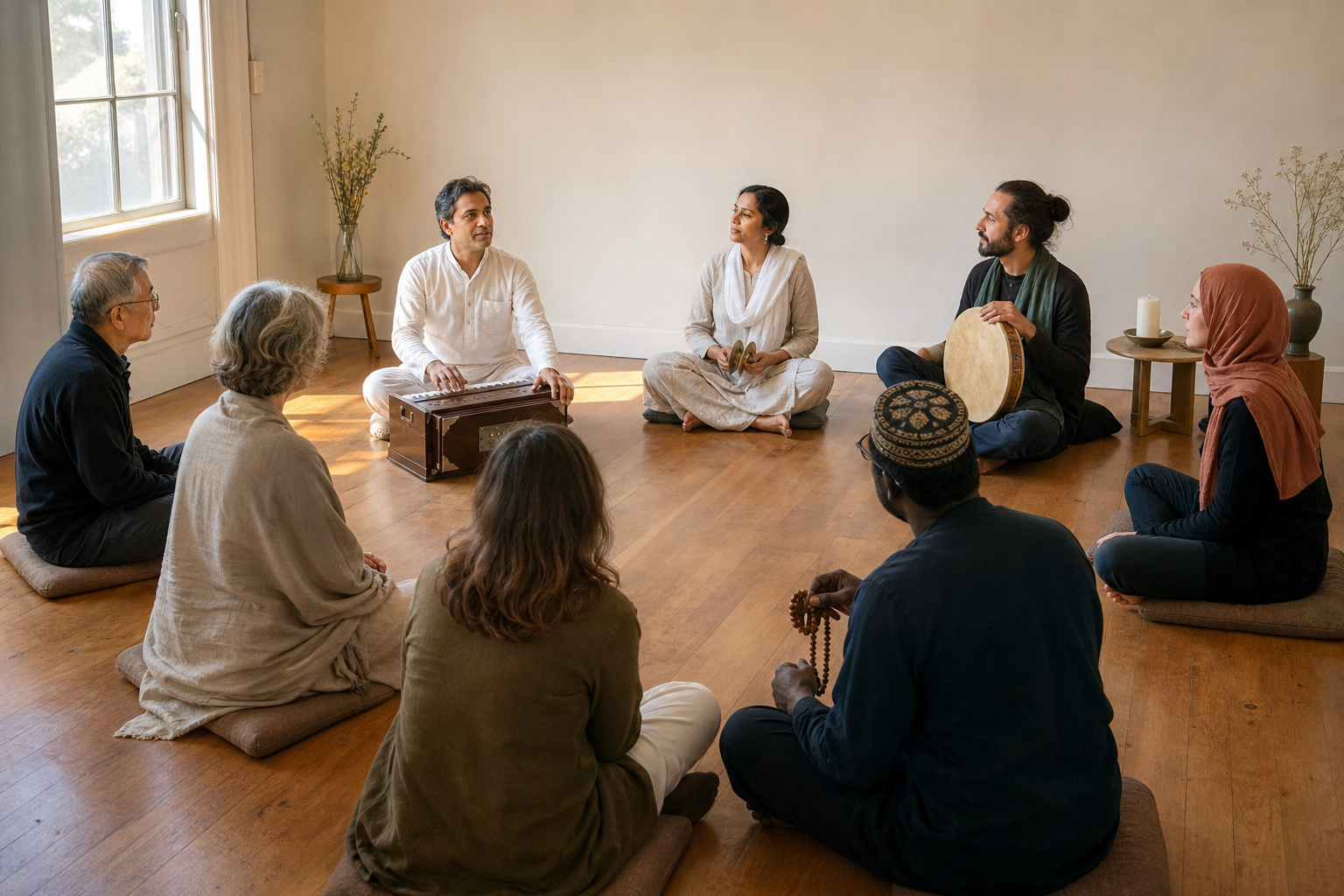
A public bhakti event may welcome Hindus from different sampradayas as well as Buddhists, Jains, Sikhs, people of other faiths, and people with no religious affiliation. Inclusion does not require telling them that all traditions teach the same doctrine. They do not. Their texts, metaphysical commitments, disciplines, and devotional cultures remain distinct.
Honest pluralism begins by naming your own practice accurately. If the kirtan is Vaishnava, say so. If a mantra belongs to a particular lineage, identify that lineage when an explanation is appropriate. A gathering can still embody compassion, learning, and mutual respect. Kirtan has already shown that it can welcome seekers across Dharmic paths without erasing their distinct identities.
Use these boundaries when preparing introductions and training volunteers:
- Explain before you compare. Tell visitors what the mantra means within its own tradition before drawing parallels with another path.
- Invite questions without forcing debate. A sincere question deserves an answer; a public doorway does not need to become an arena for proving superiority.
- Do not claim consent on behalf of guests. Participation in a melody does not authorize an organizer to describe everyone present as a follower of the lineage.
- Let people describe themselves. Do not assign somebody a religious identity or presume that a shared language implies shared belief.
- Adapt communication, not the truth of the offering. Use clear local language and culturally appropriate etiquette while remaining candid about the devotional origin and purpose of the chant.
This balance also protects bhakti from becoming a vague language of general uplift. A visitor can encounter a rooted practice more honestly when the host is neither defensive about its identity nor careless with the identities of others.
Shared service strengthens the organizing community as well. Arabic book distribution did more than place literature in people’s hands; serving together created a felt bond of spiritual kinship among participants. Build on that possibility through a debrief that includes gratitude, correction, and care for the volunteers, not just performance statistics.
Key takeaways: a public-bhakti checklist
- Write a one-sentence purpose for the gathering and use it to guide music, hospitality, and outreach.
- Tell people what kirtan is, how call and response works, and that listening is welcome.
- Rehearse the first response and the ending, not only the musically elaborate passages.
- Make the mantra audible and legible before making the arrangement complex.
- Provide literature in the languages people actually use, reviewed for both accuracy and cultural fit.
- Ask permission before offering a book, requesting contact information, or beginning an extended conversation.
- Keep donations clearly voluntary and separate from a visitor’s freedom to receive, decline, or leave.
- Name the bhakti tradition honestly while respecting the distinct identities of Hindu, Buddhist, Jain, Sikh, and other guests.
- Debrief recurring questions and moments of confusion, then change the next event accordingly.
For your next public kirtan, improve the encounter before expanding its scale. Write the welcome, rehearse a first-time participant’s path through the chant, review the literature, and assign hospitality roles. Public bhakti becomes credible one freely chosen encounter at a time.
References
- Dandavats – Proven Paths of Service: Discover the Joy of Arabic Book Distribution and Spiritual Unity
- Dandavats – Essential Bhakti Concert: Discover Unity at a Transformative Kirtan in a Listed London Theatre
