

You may accept the Advaitic teaching that the Self is already free and still wonder why your duties, rituals, and choices should matter. If liberation is knowledge rather than an achievement, does disciplined action become secondary? And if every action bears consequences, can knowledge alone really end bondage?
Purva Mimamsa and Advaita answer different parts of this difficulty. Mimamsa teaches you to take the world of action seriously. Advaita asks you not to mistake any result within that world for your final freedom. Their relationship becomes practical once you stop forcing them into a single answer.
Two schools answer different questions about reality
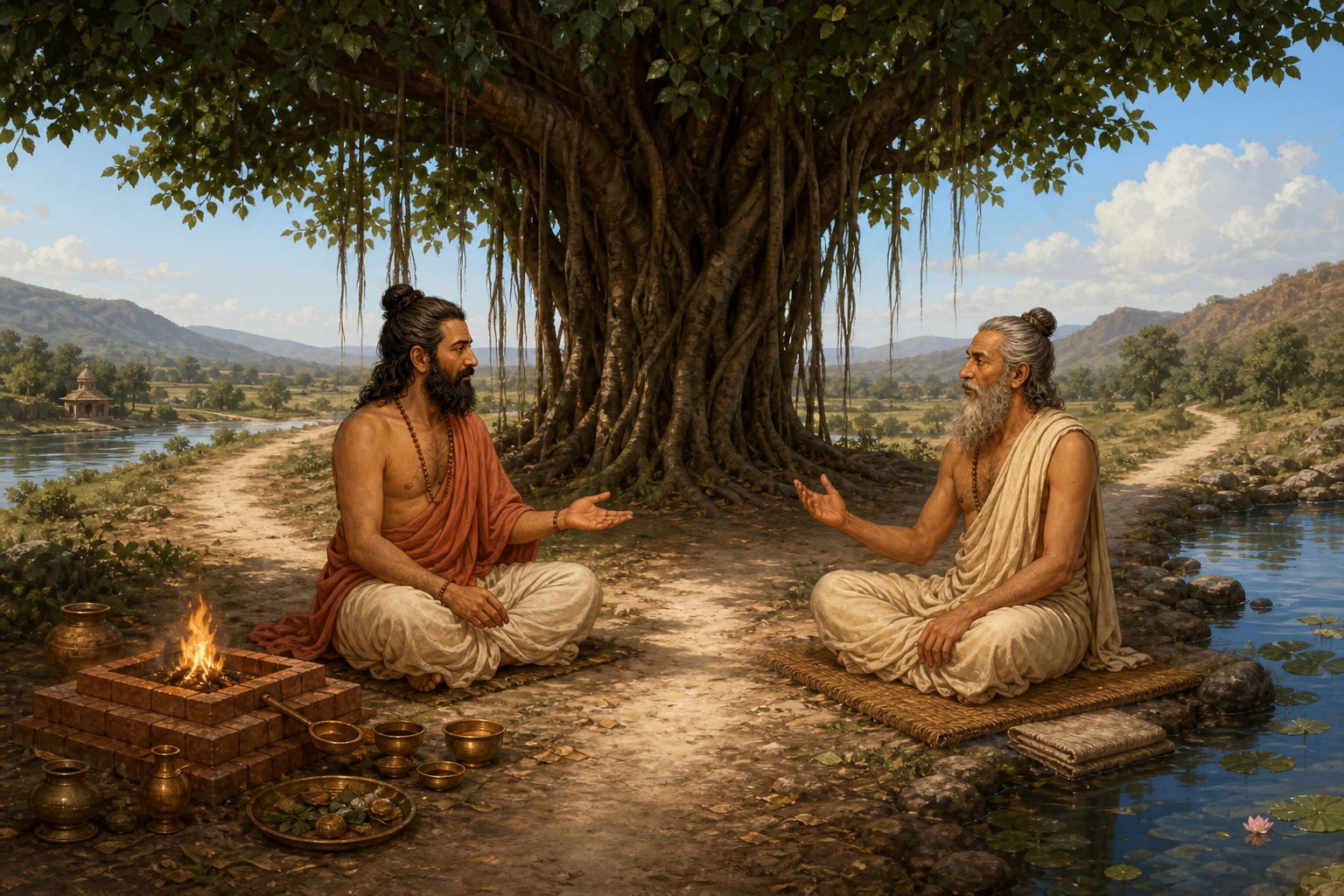
Purva Mimamsa begins with a problem you face whenever desire, convenience, and obligation pull in different directions: what is dharma, how can it be known, and why should a prescribed action produce a result that may appear much later?
The classical framework associated with Jaimini treats the Veda as an eternal and authorless means of valid knowledge. Its authority does not depend on a human composer or on a creator issuing commands. Vedic injunctions disclose duties that ordinary perception and inference cannot discover by themselves. The same framework regards the world and individual souls as beginningless, so it has no need for a first moment of creation to make moral order intelligible.
This is not a picture of a morally empty universe. Adrishta names the unseen force connected with action and consequence. Apurva names the subtle potency through which a correctly performed Vedic act can bear its appropriate fruit in the future. Classical Mimamsa therefore does not need a divine manager to intervene between every ritual and its result. The connection belongs to the order of dharma itself.
Advaita begins elsewhere. Its decisive question is not primarily, “Which action produces the desired result?” but “Who is the one who believes freedom must be produced?” The identity of Atman and Brahman means that non-dual reality is not a distant object waiting to be acquired. Bondage rests on ignorance and mistaken identification; liberation comes through knowledge that removes that error.
The difference is easiest to see when each teaching is allowed to do its own work:
| Question | Purva Mimamsa emphasis | Advaita emphasis | What you should notice |
|---|---|---|---|
| What kind of world do we inhabit? | A beginningless, dependable order in which actions have consequences | An experienced order whose apparent separations do not divide non-dual Brahman | Ordinary consequences matter even while you inquire into ultimate reality |
| What does the Veda disclose? | Dharma, especially through injunctions concerning what is to be done | The identity of Atman and Brahman, especially through knowledge | A command to act and a statement of reality do not perform the same function |
| What can action accomplish? | It generates results through the lawful connection of karma, adrishta, and apurva | It can discipline and prepare the mind, but it cannot manufacture the ever-present Self | Better action can change your condition without resolving mistaken identity |
| What is decisive for freedom? | Its distinctive strength is the valid discernment and exact performance of dharma | Knowledge removes the ignorance that makes the Self appear bound | Do not confuse desirable karmic fruit with moksha |
Calling the empirical world meaningful does not by itself settle what is ultimately real. Recognizing non-duality does not erase the order in which truthfulness, injury, ritual, obligation, and consequence are experienced. The schools place the emphasis differently, and that difference protects you from two errors: reducing spiritual life to the pursuit of better results, or using ultimate truth to excuse careless conduct.
Dharma is not disposable after you encounter non-duality
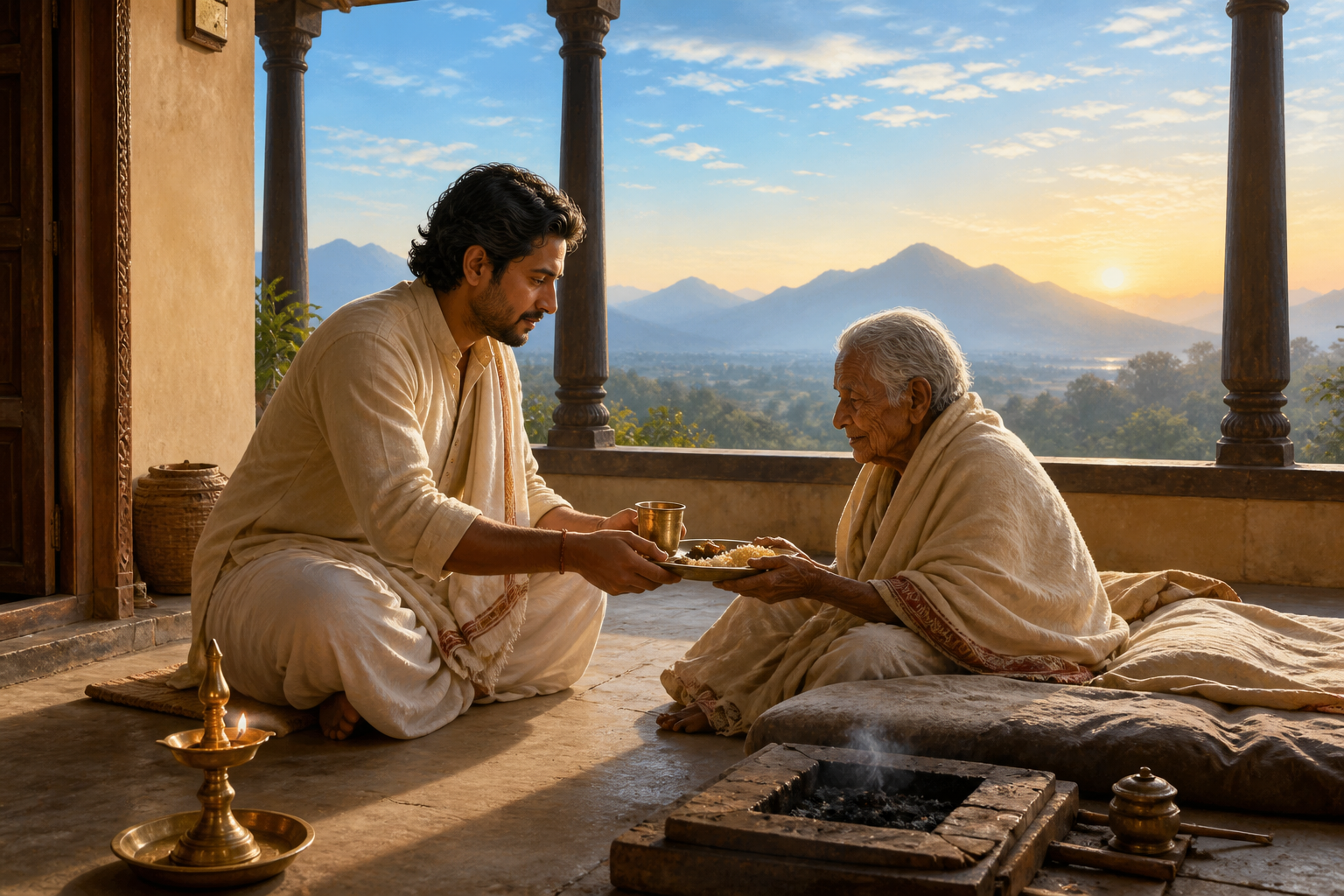
A premature reading of Advaita says, “If all is Brahman, nothing I do ultimately matters.” That conclusion confuses an intellectual slogan with realization. As long as you experience yourself as an individual making choices, other people as vulnerable to those choices, and results as pleasant or painful, dharma remains operative for you.
Mimamsa is especially valuable at this point because it resists vague good intentions. An action is not made adequate merely by attaching a spiritual feeling to it. Words, sequence, intention, discipline, and correct performance matter. In ritual life, that means learning the prescribed form rather than casually improvising it. In ordinary life, the same seriousness means discovering what your responsibility actually requires before congratulating yourself for having meant well.
Begin with the concrete obligation, not with your mood. Ask: What has been entrusted to me? What promise have I made? Who will bear the cost if I neglect it? Which part of the result is genuinely under my control? These questions prevent “following dharma” from becoming a dignified name for following preference.
Then examine your execution. Did you listen carefully, speak truthfully, prepare adequately, and complete the act you undertook? Mimamsa’s attention to precision, intention, and the dependable consequences of action makes this review more demanding than a general promise to be a good person.
This discipline also corrects a common misunderstanding about renunciation. Giving up possessiveness toward an outcome is not the same as becoming indifferent to the quality of your work. You can release the demand that a result complete you while still taking full responsibility for the action that is yours to perform.
A simple test helps. If your understanding of non-duality makes you less truthful, less dependable, or less concerned about harm, it has not yet matured into wisdom. Advaitic realization is described as flowering in compassion, equanimity, and ahimsa because the apparent many are no longer treated as wholly separate from the One. Conduct does not manufacture Brahman, but conduct reveals whether non-dual language has entered your life or remains only language.
Action can prepare you for freedom but cannot manufacture it

Mimamsa gives a rigorous account of how action reaches its fruit. Advaita introduces a necessary limit: whatever is produced by an action begins in time and is therefore conditioned. If moksha were a newly produced experience, it could also change, fade, or end. Liberation cannot be the latest item added to an otherwise incomplete self.
Vidyaranya’s fourteenth-century Panchadasi makes the point through an analysis of happiness. When you want an object, the mind is agitated by a sense of lack. When the desire is fulfilled, that agitation briefly subsides. The resulting ease is easily credited to the object, but it remains dependent on a particular desire, event, and mental condition. This is vishaya-ananda, pleasure associated with an object, not unconditioned freedom.
You can observe this mechanism without denying the legitimacy of ordinary enjoyment. The useful question after obtaining something you wanted is not, “Was this pleasant?” It is, “Did this remove the structure of wanting, or did one desire merely become quiet before another appeared?” The answer keeps temporary satisfaction from carrying a promise it cannot fulfill.
Brahmananda is categorically different. It is not an unusually intense emotion or a tranquil state prolonged forever. It is the intrinsic fullness of Brahman recognized when ignorance is removed. Nothing new is inserted into the Self. What falls away is the conviction that the Self was divided, deficient, or dependent on an external completion.
This also explains why mental blankness is not the goal. Deep sleep may suspend active desire and provide rest, yet the ordinary sense of limitation returns on waking. The absence of agitation is not identical to knowledge. Do not measure contemplation only by how peaceful, empty, or unusual it feels. Ask whether a mistaken conclusion about the Self has actually been examined and understood.
The Advaitic discipline of shravana, manana, and nididhyasana addresses that task in sequence. Shravana is systematic reception of the Vedantic teaching. Manana uses reason to resolve doubts and apparent contradictions. Nididhyasana is sustained contemplative assimilation, through which habitual identification is brought into line with what has been understood. Skipping reflection can leave you repeating inherited sentences; skipping assimilation can leave a sound conclusion unable to govern your reactions.
A steady and ethically ordered mind is therefore valuable, but its role must be stated accurately. Discipline makes the mind a clearer medium for inquiry. It does not purchase Brahman as a reward. The non-fragmented recognition sometimes called akhandakara-vritti concerns the removal of the imagined division between knower and ultimate reality, not the production of a spiritual possession.
A daily discipline that keeps karma and jnana in their places

You do not need to alternate between a life of duty and a separate life of inquiry. You need to stop assigning them the same purpose. Let dharmic action govern what you do; let Vedantic knowledge address the belief that any result can establish what you fundamentally are.
Before action, name the duty precisely. Replace “I should be helpful” with the actual commitment: the person to contact, the ritual to perform correctly, the promise to keep, or the harm to avoid. If the duty is unclear or competing obligations are involved, seek competent dharmic guidance rather than treating impulse as revelation.
While acting, give attention to means as well as ends. Do not defend carelessness by pointing to a worthy goal. Watch speech, preparation, method, and effect. This is where Mimamsa’s insistence that action has an intelligible structure becomes a living discipline rather than a theory of ritual.
After acting, separate review from possessiveness. Correct what can still be corrected and learn from what failed. Then notice the additional claim the mind makes: “This result must validate me,” or “This failure has diminished what I am.” Responsible review belongs to karma; the inquiry into that claimed diminution belongs to jnana.
When you study, identify the exact doubt. Do not merely collect statements such as “Atman is Brahman.” Ask what you currently take yourself to be, which experience appears to contradict non-duality, and whether that contradiction survives careful reasoning. This turns manana into investigation rather than repetition.
When you contemplate, do not hunt for a mood. Return to the understood teaching and observe the reflex that locates completeness in the next achievement, possession, recognition, or altered state. Nididhyasana is not a refusal of ordinary life. It is the patient undoing of a conclusion that ordinary life continually tempts you to repeat.
Use ethical change as a diagnostic, not as a trophy. Less grasping should make steadiness more available. Recognition of non-separation should make cruelty harder to justify. Equanimity should improve your capacity to perform a difficult duty, not provide a reason to abandon it. If arrogance grows alongside claims of realization, return to disciplined action, careful reasoning, and ahimsa.
Key takeaways for the path from duty to freedom
- Turn to Mimamsa when you need to understand why dharma, exact action, intention, and consequence must be taken seriously.
- Turn to Advaita when you need to understand why no finite action or pleasurable state can produce the ever-present Self.
- Keep empirical and ultimate questions distinct: your choices have consequences even while non-dual inquiry examines the assumed separateness of the chooser.
- Let action prepare the mind without asking karmic results to deliver moksha.
- Test understanding through truthfulness, responsibility, equanimity, compassion, and ahimsa rather than through spiritual vocabulary or temporary calm.
Choose one duty you are tempted to resent or evade. Perform it with Mimamsa’s precision, then examine the demand that its outcome should complete or diminish you. That single pairing gives action and knowledge their proper work: dharma orders your participation in the world, while inquiry loosens the false identity that turns participation into bondage.
References
- DharmaRenaissance Blog – Master Purva Mimamsa’s Complete Insight: Discover an Eternal, Uncreated Universe
- DharmaRenaissance Blog – Complete Guide to Advaitananda: Discover the Bliss of Non-Dual Realization in Panchadasi 13
