
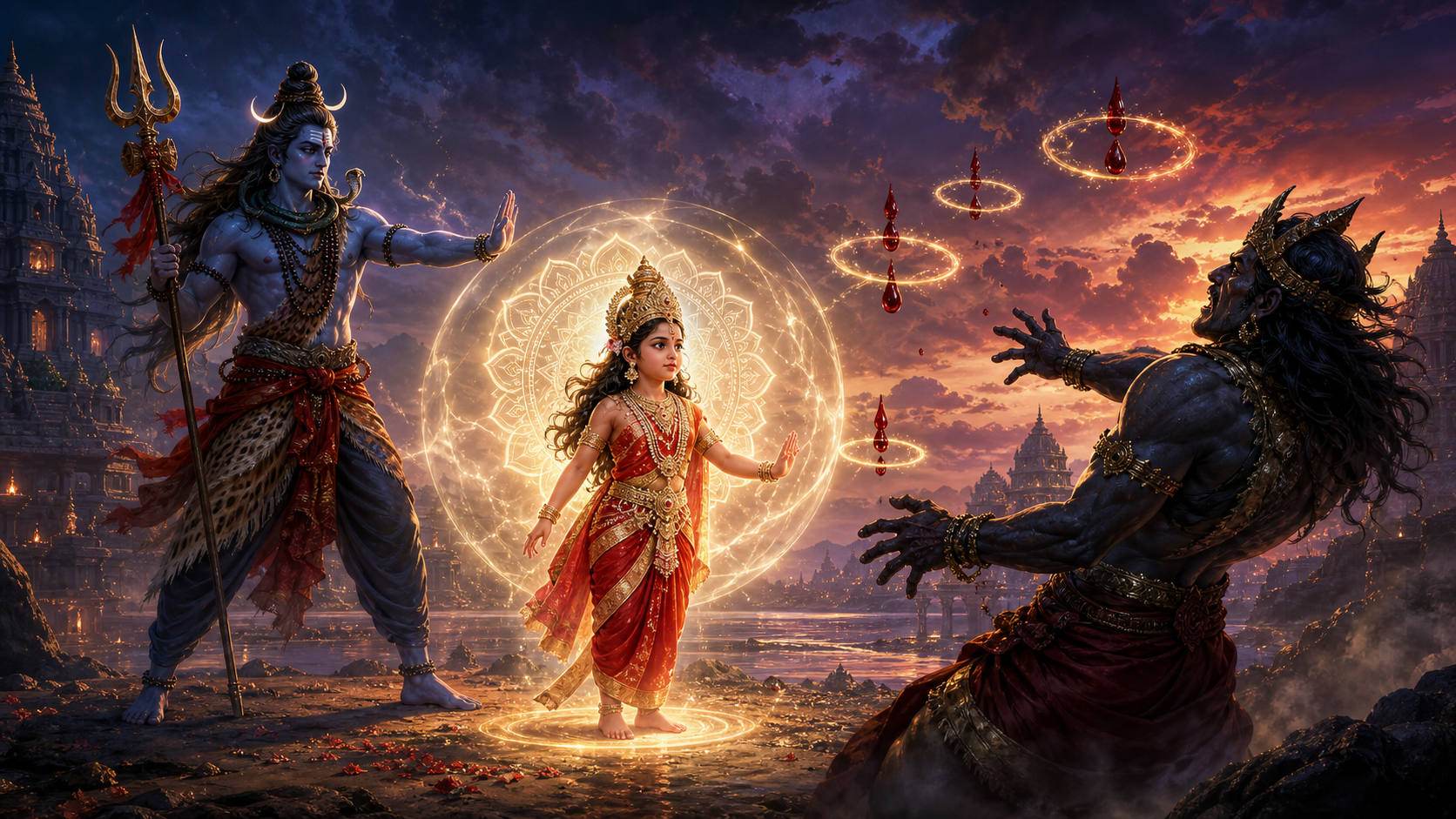
If you have heard that Goddess Bala appeared during Shiva’s war with Andhakasura, your first question is probably whether this Bala is the same deity as Bala Tripurasundari. The careful answer is that the traditions overlap theologically, but they should not be collapsed into a single, universal account.
In certain Shaiva and Shakta tellings, Bala is a youthful feminine power manifested from Shiva’s supreme consciousness during the crisis. Her role reveals the deeper point of the battle: force may strike at adharma, but clear and disciplined awareness is needed to stop disorder from reproducing itself.
Where Bala belongs in the Andhakasura battle
The Andhakasura cycle is not preserved as one flat narrative with identical characters in every recension. Its widely shared dramatic problem is the demon’s proliferating blood: when blood falls during the battle, new adversaries arise from it. An apparently successful blow therefore enlarges the conflict.
This is why the feminine powers matter. The Saptamatrikas and other goddesses appear in versions of the cycle as forces capable of containing the blood and preventing further multiplication. Bala enters certain Shaiva and Shakta interpretations as a focused, youthful shakti, complementing that work through purity of awareness, steadiness and decisive action.
You should therefore avoid two opposite errors. It is too strong to claim that every account of Andhakasura names Bala in exactly the same role. It is also too dismissive to assume that a regional or sectarian telling is meaningless merely because it differs from another recension. Hindu sacred narrative often preserves a stable theological structure while allowing names, forms and functions to develop within particular lineages.
Bala’s manifestation from Shiva does not place masculine divinity on one side and feminine divinity on the other. Shakti is the effective power through which consciousness acts. The battle makes that unity visible: Shiva confronts the demon, while divine feminine manifestations control the consequences of a conflict that otherwise keeps generating itself.
Key takeaways
- Bala appears in certain interpretations of the Andhakasura cycle, not necessarily in every version.
- Her youth signifies lucid, unburdened power rather than helplessness or immaturity.
- Her function complements the blood-containing role associated with the Matrikas.
- Her resemblance to Bala Tripurasundari establishes a meaningful theological connection, but not automatic textual identity in every tradition.
- The practical lesson is to stop conflict from multiplying, not merely to defeat its most visible expression.
Why the goddess appears as a child
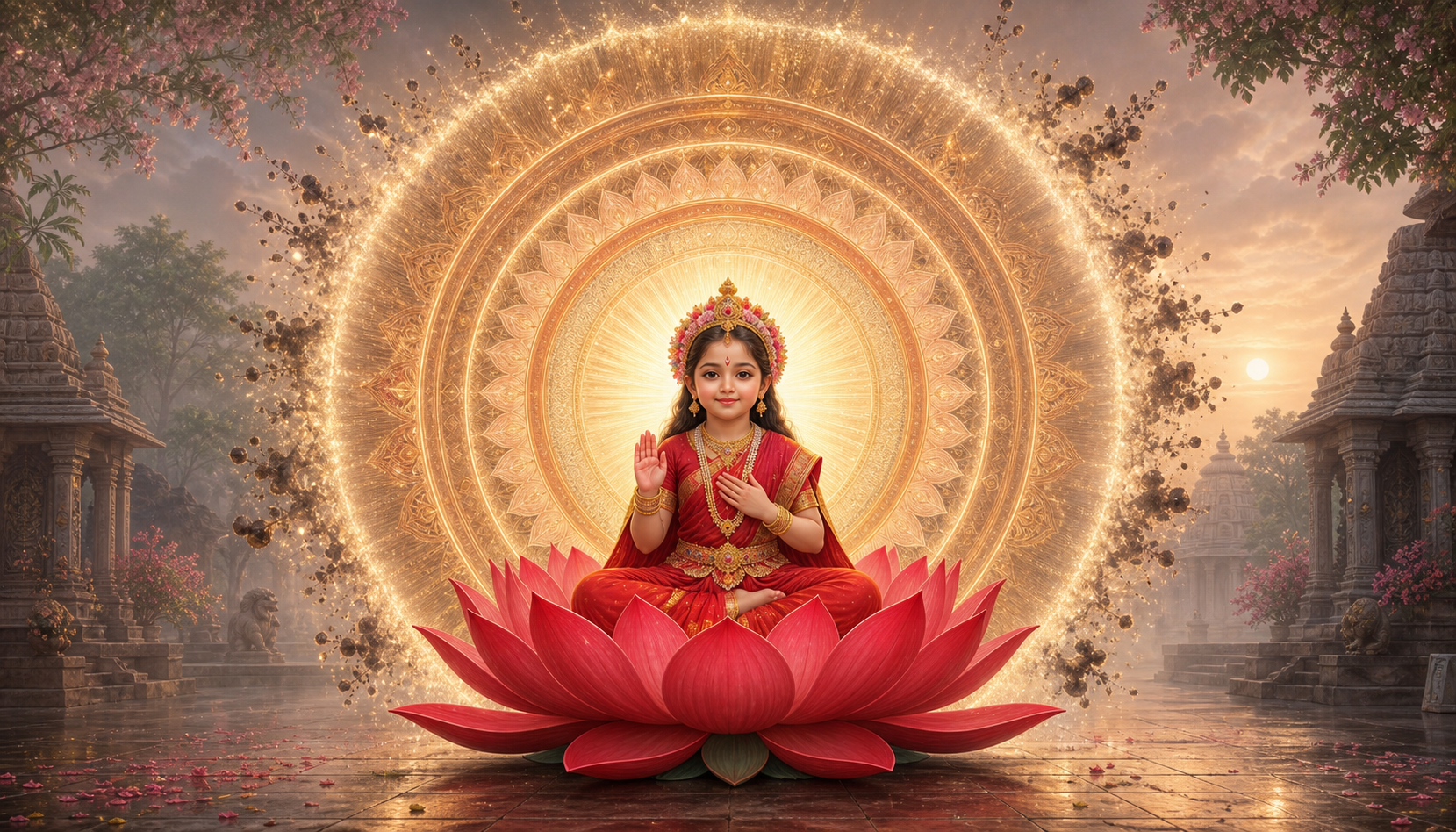
A child form can look unexpected on a battlefield. That tension is deliberate. Bala does not overcome confusion by becoming more confused, nor does she imitate the aggression she confronts. Her youth represents awareness before it has become burdened by vanity, calculation and resentment.
This is not a romantic claim that children possess complete spiritual wisdom. It is sacred symbolism. Bala joins qualities that ordinary thinking tends to separate: innocence and mastery, gentleness and command, beauty and protection. The result is a form of power that remains direct because ego has not diverted it toward self-display.
That distinction changes how you read the battle. Andhakasura’s blood makes violence reproductive. Every attack risks creating more of what it was meant to remove. Bala represents the consciousness that sees this mechanism rather than reacting only to the nearest enemy. Her power is not simply another weapon added to the field; it is the clarity that prevents action from feeding the pattern it opposes.
The image also corrects a common misunderstanding of spiritual strength. Ferocity can be dharmic when protection requires it, but intensity alone is not discernment. An angry answer may silence one accusation while producing a wider quarrel. A humiliating victory may defeat an opponent while recruiting sympathizers to the opponent’s cause. Bala asks a stricter question: will this action actually contain adharma, or will it give adharma another body?
This is why youthful clarity should not be confused with naivety. Naivety fails to perceive danger. Bala perceives danger without letting its logic govern her response. That is a demanding form of courage because it requires you to remain unclouded precisely when agitation feels justified.
How Bala relates to Bala Tripurasundari
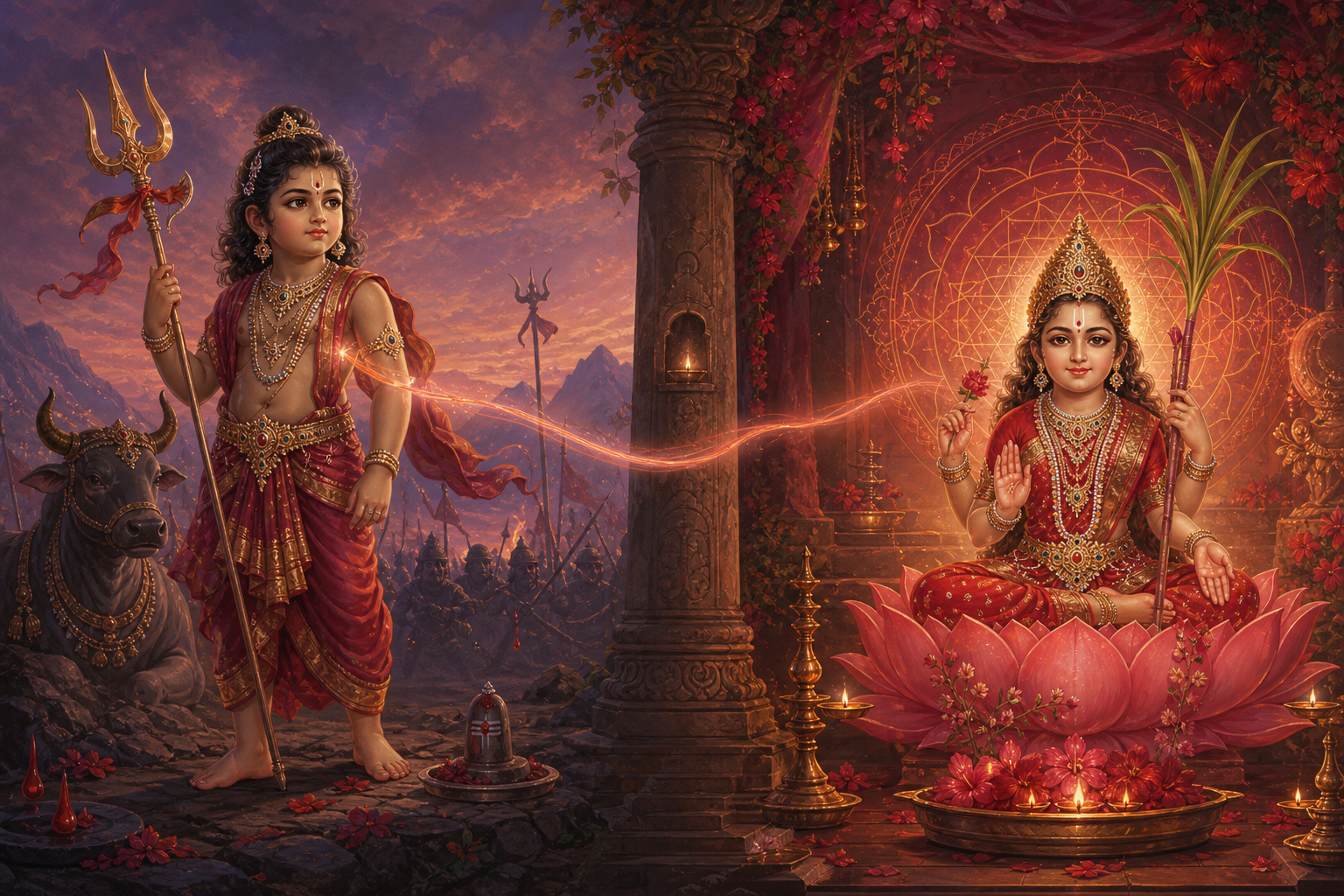
Bala Tripurasundari is the youthful form of Tripurasundari within Shakta worship. The Bala of the Andhakasura interpretive tradition shares the same central grammar: young divine radiance, spiritual intelligence, gentle authority and power untouched by ego. The connection is therefore substantial, not merely a coincidence of names.
Yet resemblance does not by itself prove that every storyteller, temple or lineage intends exactly the same identification. It is safer to speak of theological harmony unless a particular tradition explicitly identifies the battle goddess as Bala Tripurasundari. This preserves both the relationship and the diversity of Hindu practice.
The same care is needed with images. Bala may be represented with the pasha, or noose, and ankusha, or goad. She may also carry the sugarcane bow and flower-arrows associated with Tripurasundari. These implements express a refined mastery of consciousness:
- The noose gathers and holds what has become scattered. Contemplatively, it points to collecting the wandering mind.
- The goad redirects force. It signifies disciplined correction rather than uncontrolled punishment.
- The sugarcane bow associates power with the mind and desire rather than crude physical domination.
- The flower-arrows suggest that desire can be refined and aligned with dharma instead of merely suppressed or indulged.
Attributes alone, however, are not a reliable identity card. Hindu deities can share symbols, and one goddess may assume different implements in different settings. If you are trying to identify a particular murti or painting, check its name in the temple, its ritual context, the local sacred account and the sampradaya that worships it. Do not declare every youthful goddess holding a noose or flower-arrow to be the Bala of the Andhakasura battle.
This distinction is especially important when learning online. A devotional explanation may combine regional memory, Shakta theology and a familiar Puranic battle into a coherent form of worship. That synthesis can be spiritually meaningful without becoming the only permissible version of the narrative.
Use the blood-drop pattern as a practical test
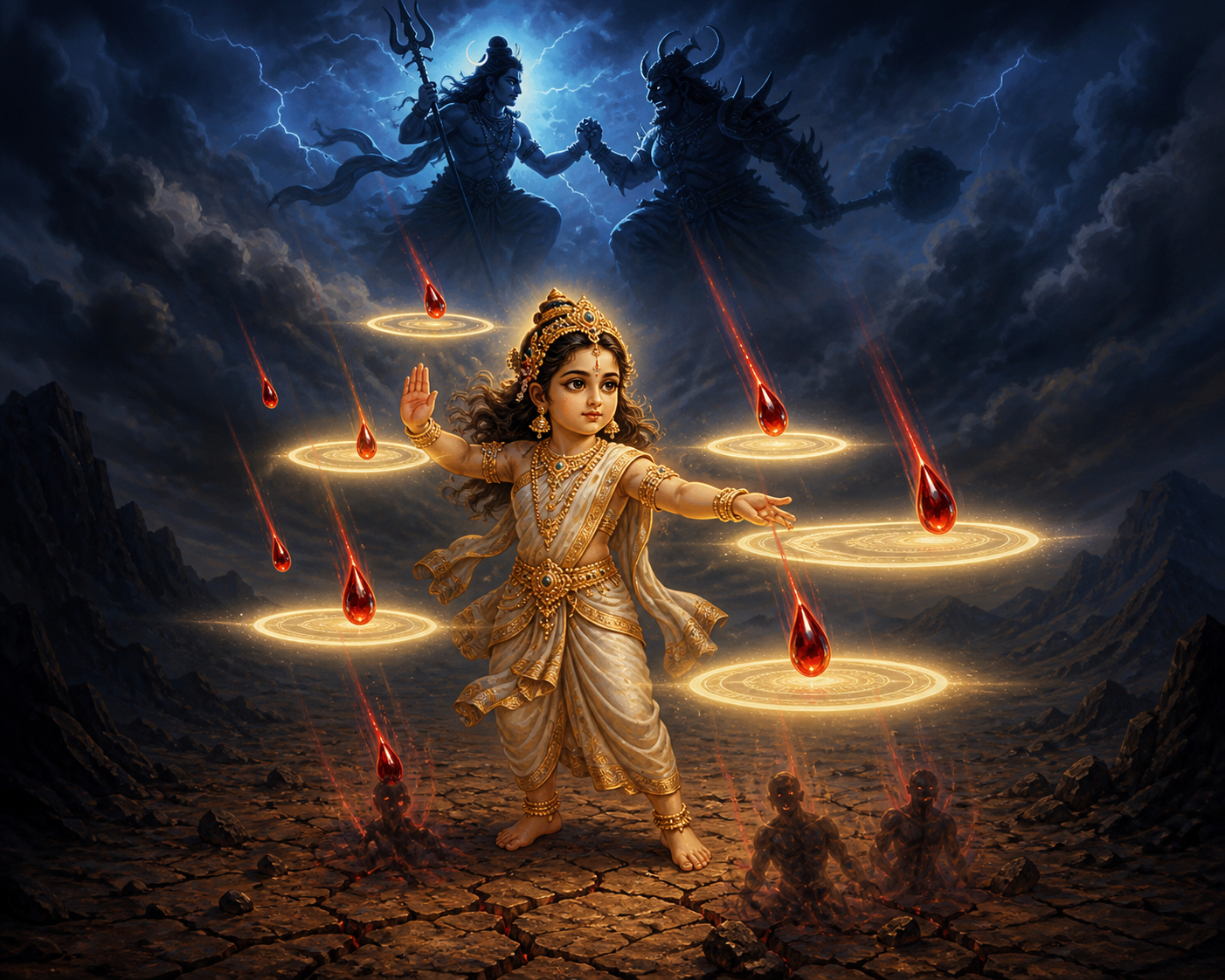
The most useful way to contemplate this tradition is to identify what we might call a blood-drop problem: a situation in which each attempt to strike the problem produces more instances of it. Online outrage is an obvious example, but the pattern also appears in family disputes, community disagreements and internal habits.
A reactive message may answer one insult while inviting several new accusations. Repeating an unverified rumor in order to condemn it may extend its reach. Fighting every anxious thought may give anxiety the mind’s full attention. In each case, the visible problem is real, but the method of opposition becomes part of its multiplication.
Before acting, use Bala’s symbolism as a sequence of discernment:
- Name the actual threat without enlarging it. Separate what happened from what you fear may happen.
- Find the multiplying mechanism. Ask what gives the problem another audience, another argument or another cycle of emotional energy.
- Contain that mechanism first. This may mean refusing to forward a rumor, moving a dispute out of public view or delaying speech until you can state the issue without insult.
- Choose the smallest action that protects dharma. Correction should be firm enough to matter but precise enough not to create unnecessary injury.
- Review the result. If your intervention generated more confusion than clarity, adjust the method rather than merely increasing its intensity.
This is not a command to remain passive. The Matrikas do not ignore the blood, and Bala does not withdraw from the field. Containment is active protection. The point is to distinguish effective firmness from reaction that feels forceful while making the field harder to govern.
You can also bring the pattern into a simple devotional practice. Settle the breath, recollect Bala’s youthful form and bring one multiplying conflict to mind. If your sampradaya has given you a Bala mantra, follow that received method. Otherwise, silent remembrance of the goddess’s name or contemplation of her form is enough for this exercise. Ask where ego, fear or the desire to win is scattering your attention. End by choosing one concrete act of containment.
That act may be measured speech, a factual correction, refusal to circulate inflammatory material, a private conversation or temporary silence while you establish what is true. The correct choice depends on the situation. The governing principle does not: do not offer fresh ground on which confusion can reproduce.
Honor shared Dharmic values without erasing differences
Bala’s poised power can help you notice ethical resonances across the Dharmic traditions. Buddhist vigilance trains attention not to be carried away by each arising impulse. Jain self-mastery joins restraint to ahimsa. Sikh tradition places courage in the service of protection and righteous action. Bala’s union of clarity, compassion and strength belongs to a recognizable civilizational horizon.
These resonances should deepen understanding, not flatten distinct paths into interchangeable versions of one doctrine. Bala remains a Hindu goddess situated within Shaiva and Shakta theological worlds. Buddhist awareness, Jain discipline and Sikh service have their own scriptures, practices and doctrinal meanings. Comparison is useful when it identifies an ethical kinship; it becomes misleading when it replaces each tradition’s own language.
The same principle applies within Hinduism. You do not have to choose between honoring Bala as a manifestation of Shiva’s shakti and approaching her through the youthful beauty of Tripurasundari. You do need to know when you are repeating a lineage-specific identification and when you are stating a motif shared more broadly.
When you next meet a conflict that seems to grow with every answer, pause before adding another blow. Look for the fallen drop: the rumor, wounded pride, public spectacle or uncontrolled impulse that keeps giving the problem new life. Contain that first. Then act with Bala’s combination of softness, accuracy and courage.
References
