
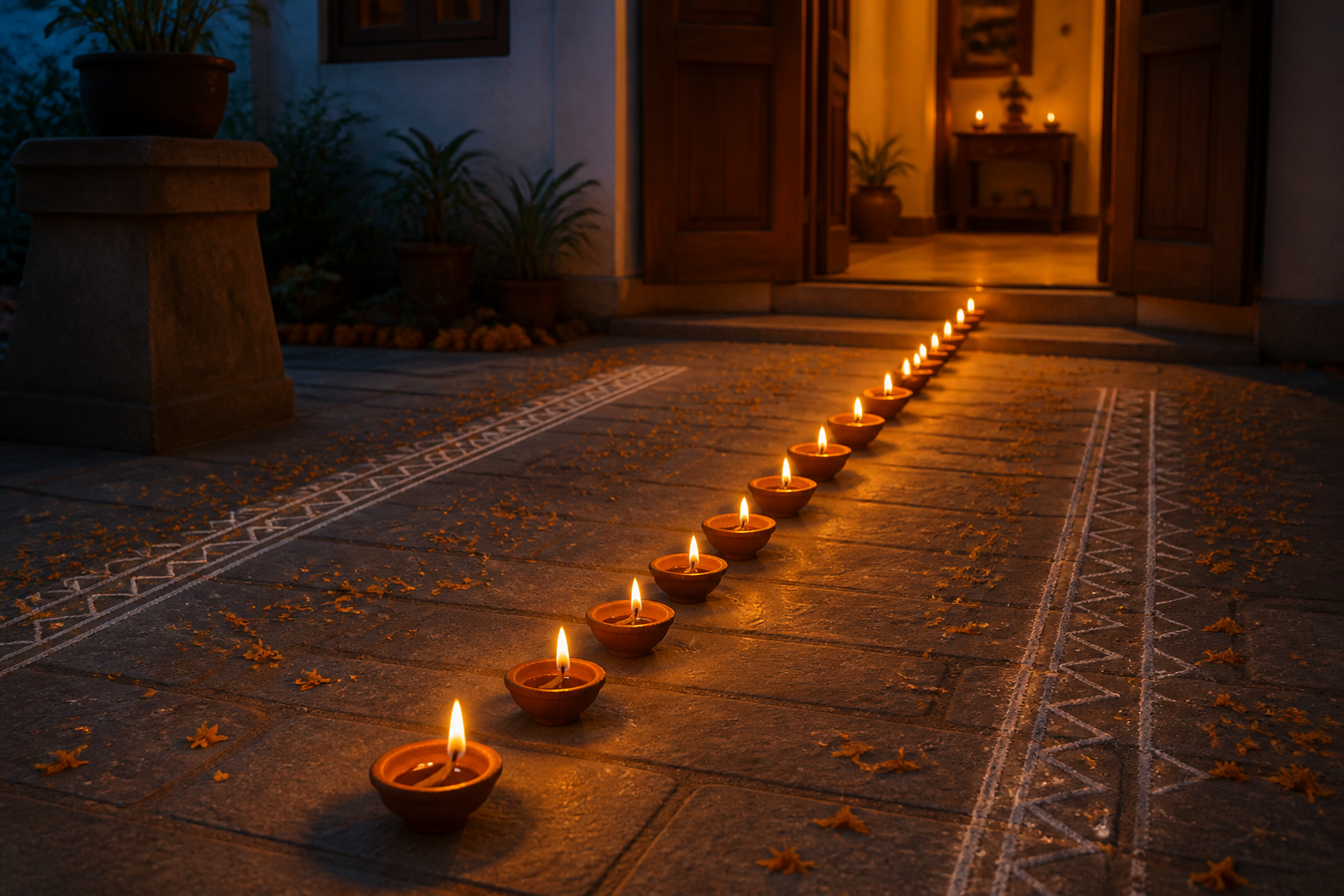
You may know why a diya is lit, yet still wonder why the lamps are placed in a line. The answer sits in the festival’s name. Once you notice Avali, the arrangement stops being decorative background and becomes part of the practice.
If you are preparing your home for Deepavali, you do not need an enormous display to express this meaning. You need a deliberate sequence: lights placed with a direction, a purpose, and enough attention that the physical row can remind you of the inner order you want to cultivate.
The suffix changes how you understand the festival
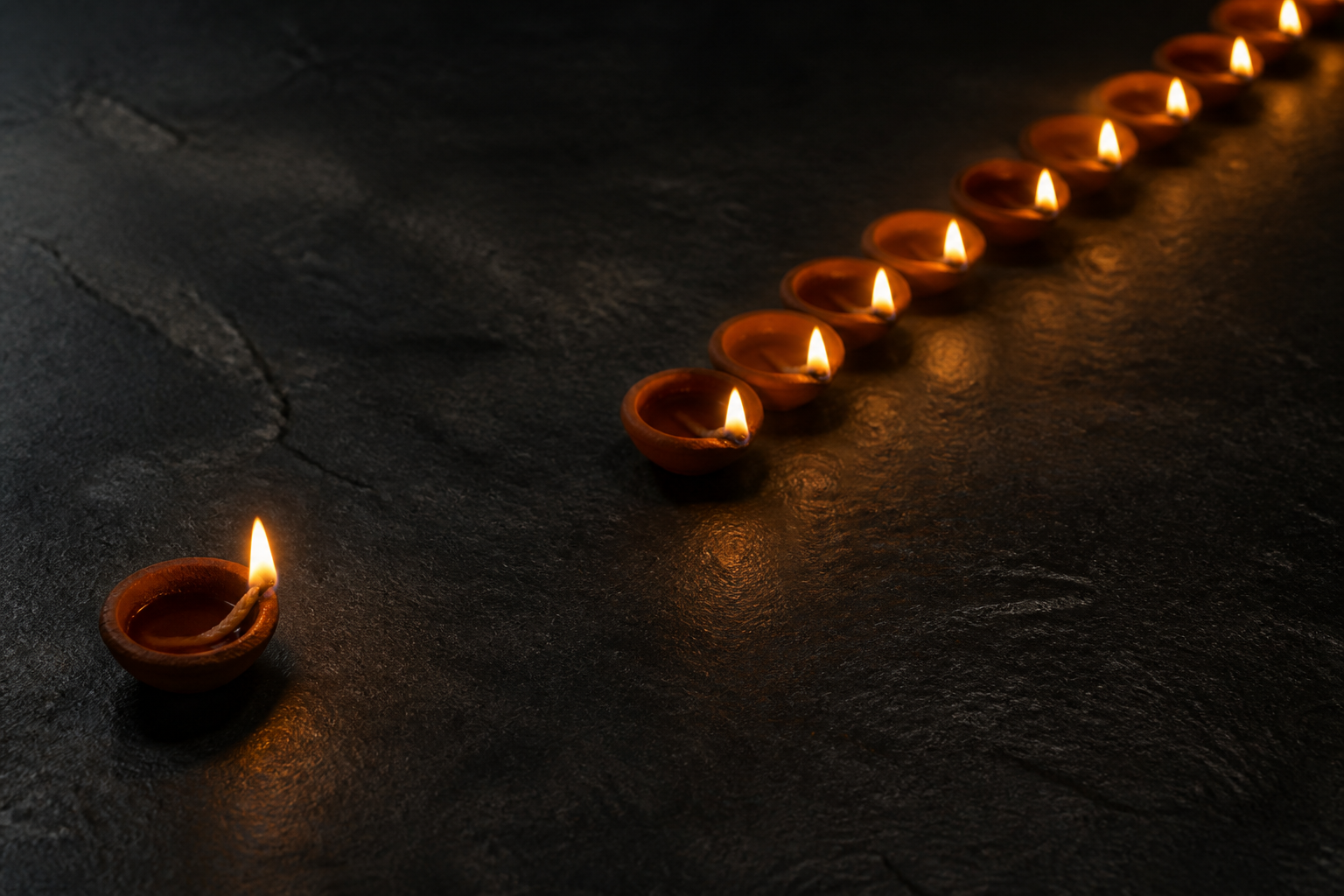
Deepavali joins dipa, meaning lamp, with avali, meaning a row, line, or series. The name therefore evokes lamps in relation to one another, not light in isolation.
The familiar expression Festival of Lights describes the visual effect. Row of lamps preserves the structure within the Sanskrit name. That distinction matters because avali introduces intention. One lamp illuminates the place immediately around it. Several lamps placed in sequence can mark an entrance, trace a path, frame a courtyard, or turn the boundary of a home into a sacred threshold.
Avali does not require every lamp to become indistinguishable. Each flame remains separate while participating in one coherent line. That makes the arrangement a useful dharmic image: individual duties, family traditions, and religious paths need not be identical in order to face a shared direction.
When you explain Deepavali to a child or a guest, begin there. Do not stop at saying that light defeats darkness. Say that Deepavali asks us to place light in an order that can guide us. That explanation accounts for both halves of the name and for what people actually do with the diyas.
A row of diyas turns illumination into direction
A scattered collection of lights can be beautiful, but a row does something more specific. It directs the eye and organizes movement. This is why entrances, windows, steps, terraces, courtyards, and pathways are natural places for an avali. The lamps make a transition visible: from outside to inside, from ordinary time to sacred time, and from obscurity toward clarity.
At a household threshold, the line can honor Agni and express readiness for auspicious presence and prosperity. Its protective meaning is symbolic: the dwelling has been prepared, its boundary has been marked, and those who approach it are welcomed by light. The ritual does not treat brightness as an accidental by-product. Placement gives the brightness a purpose.
The same pattern can become an ethical compass. One light may call you back to satya, truth; the next to dharma, right conduct; and another to daya, compassion. These are contemplative associations, not a compulsory code assigning one official virtue to every diya. Their value lies in making an abstract commitment visible and sequential.
The prayer tamaso ma jyotir gamaya, lead me from darkness to light, contains movement as well as contrast. Avali gives that movement a physical form. You do not leap from confusion to wisdom in one dramatic moment. One clear choice supports the next, just as one flame extends the reach of another.
Look at your planned arrangement and ask a practical question: where does this line lead attention? If the answer is nowhere, choose a clearer route. A short row along the main threshold may express the meaning more faithfully than many lights distributed without any discernible relationship.
How to create a meaningful avali at home
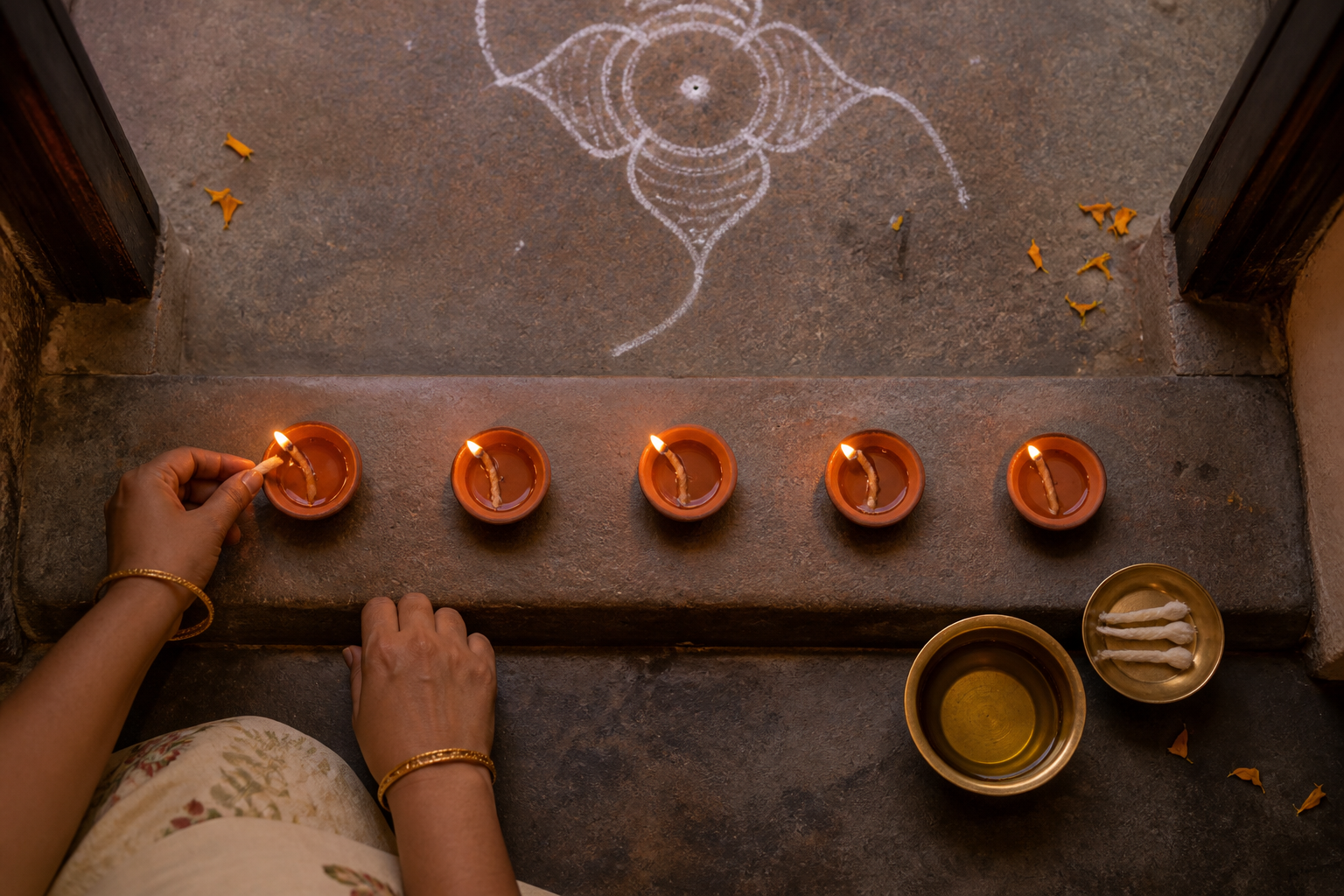
The word avali does not prescribe a fixed sacred number of lamps. It gives you the principles of plurality and sequence. Choose a count that suits your space, your family practice, and the attention you can give the flames safely.
- Choose a line with a function. Mark the main doorway, trace one edge of a courtyard, or define a safe section of a terrace or staircase. The row should reveal a threshold or direction without obstructing the route people use.
- Give the sequence an intention. You can dedicate five lamps to shraddha or faith, karuna or compassion, kshama or forbearance, dana or generosity, and maitri or friendship. Five is an available contemplative pattern, not a universal requirement. Some families may instead use the row to remember the pancha-tattva or pancha-prana.
- Prepare every diya with equal care. Earthen lamps, sesame oil or ghee according to family custom, and properly placed wicks keep the focus on a simple ritual rather than disposable decoration. Fill and position the lamps before lighting so that you are not reaching across open flames later.
- Light from one end to the other. Pause at the first lamp, recall the intention attached to it, and continue in sequence. If several family members participate, agree on the order before beginning. The calm progression is itself an enactment of avali.
- Protect people as carefully as you protect the flames. Use stable, nonflammable surfaces; keep diyas away from curtains, loose clothing, dry decorations, and crowded walking areas; and supervise children and animals. Never leave open flames unattended. If the location is windy or exposed, move the row to a sheltered, safer place rather than turning the ritual into a test of endurance.
- Carry each lamp into one action. Decide what its value will require after the celebration. Dana might become a gift to someone in need. Maitri might become a repaired relationship. Kshama might require releasing a grievance without excusing wrongdoing. A visible sequence becomes spiritually useful when it produces a sequence of conduct.
You can also use the row to examine alignment among intention, speech, and action. Ask three questions while lighting: What do I seek? What am I saying? What will I do? If the answers pull in different directions, the inner work of avali is to bring them back into one line.
Do not let scale become the measure of devotion. A modest, carefully tended row can communicate the meaning of Deepavali more clearly than an elaborate display that leaves no room for attention, prayer, or family participation.
One arrangement carries several Dharmic memories
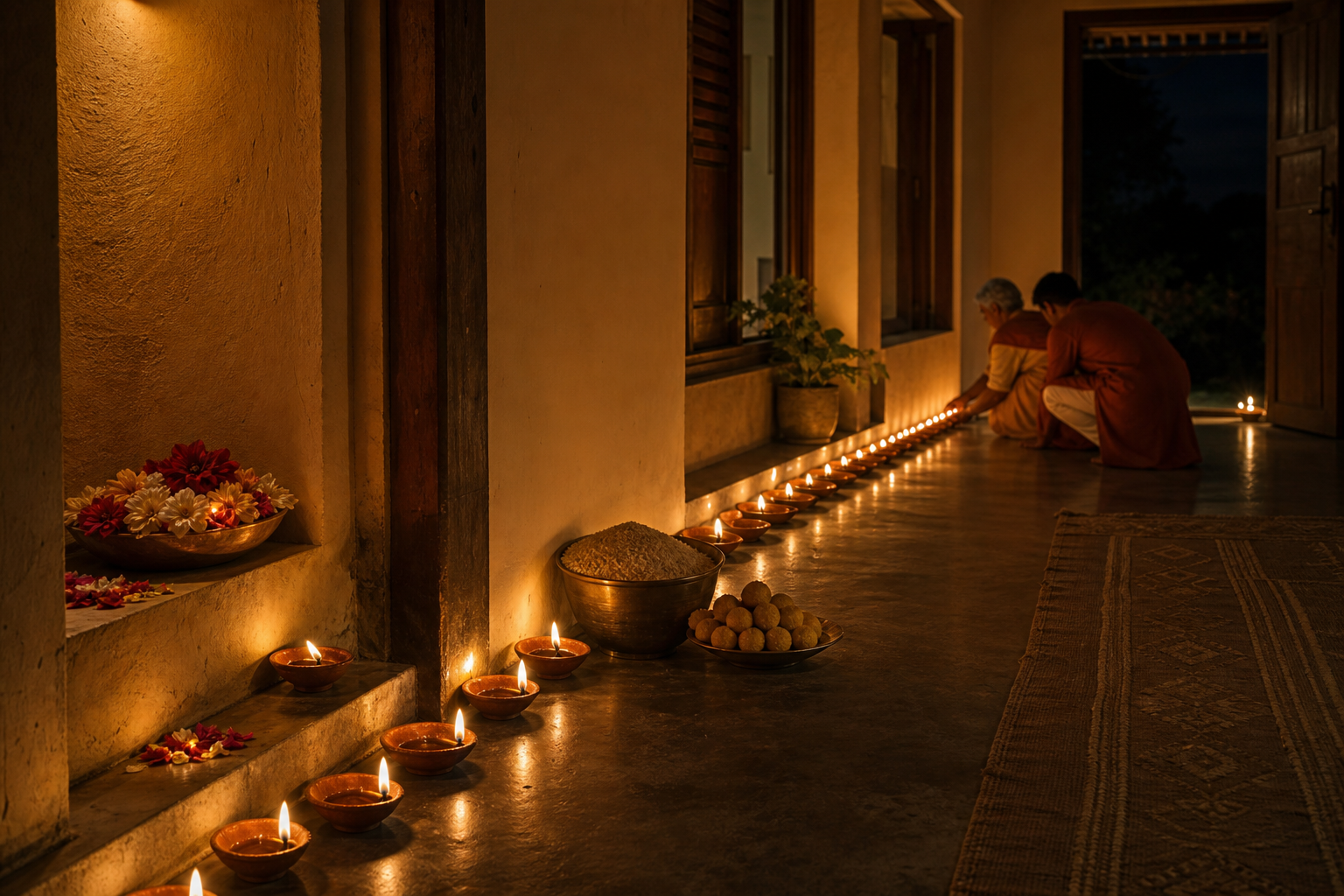
Rows of lights appear across the Dharmic family, but their presence does not erase theological differences. The shared form is most meaningful when you preserve the particular sacred memory each community places within it.
| Dharmic context | Meaning carried by the lights | What to preserve |
|---|---|---|
| Hindu Deepavali | Agni, auspicious welcome, prosperity, and movement from darkness toward clarity | The deliberate row at a threshold or along a path |
| Jain Diwali | The nirvana of Bhagavan Mahavira and the enduring light of kevala-jnana | The central place of knowledge and liberation |
| Sikh Bandi Chhor Divas | Illuminated gurdwaras expressing liberation and gratitude during the season of lamps | The distinct name, history, and emphasis on freedom |
| Tihar in Nepal | Rows of lights among Hindu and Buddhist communities, joined with familial bonds and reverence for life | The local observance and its relationships among household, community, and living beings |
The convergence is civilizational rather than doctrinal. The communities do not make identical claims, yet they recognize arranged light as a fitting vessel for remembrance, liberation, gratitude, knowledge, relationship, and sacred welcome. That is unity with texture, not uniformity imposed after the fact.
This distinction is especially useful in a school, interfaith gathering, or diaspora celebration. A clear explanation is: Avali means a row, and different Dharmic communities place distinct sacred memories within that row. That wording avoids reducing every observance to a generic slogan while still acknowledging their shared civilizational language.
The social practice reinforces the point. Preparing clay lamps, spacing them carefully, shielding the wicks, and sharing the work across generations teach patience and responsibility without requiring a lecture. In diaspora homes, the visible line can also reconnect children with a cultural memory that geography has interrupted. What matters is not copying a spectacle but transmitting the reason for the arrangement.
Key takeaways
- Avali means a row, line, or series, so arrangement belongs to the meaning of Deepavali rather than merely decorating it.
- A single diya illuminates one place; a row can mark a threshold, establish direction, and turn movement toward light into a visible practice.
- No fixed lamp count is contained in the word. Choose a manageable sequence and, if useful, dedicate its lamps to named virtues or contemplative themes.
- Jains, Sikhs, Hindus, and communities observing Tihar can share the language of arranged light without sharing one identical theology.
- The most faithful avali is deliberate, safely placed, and connected to conduct after the flames have gone out.
Before you light the first diya, choose where the line is going, what its first flame stands for, and what you will do about it the next day. Then the avali will not end at the threshold. It will begin to shape what follows.
References
