
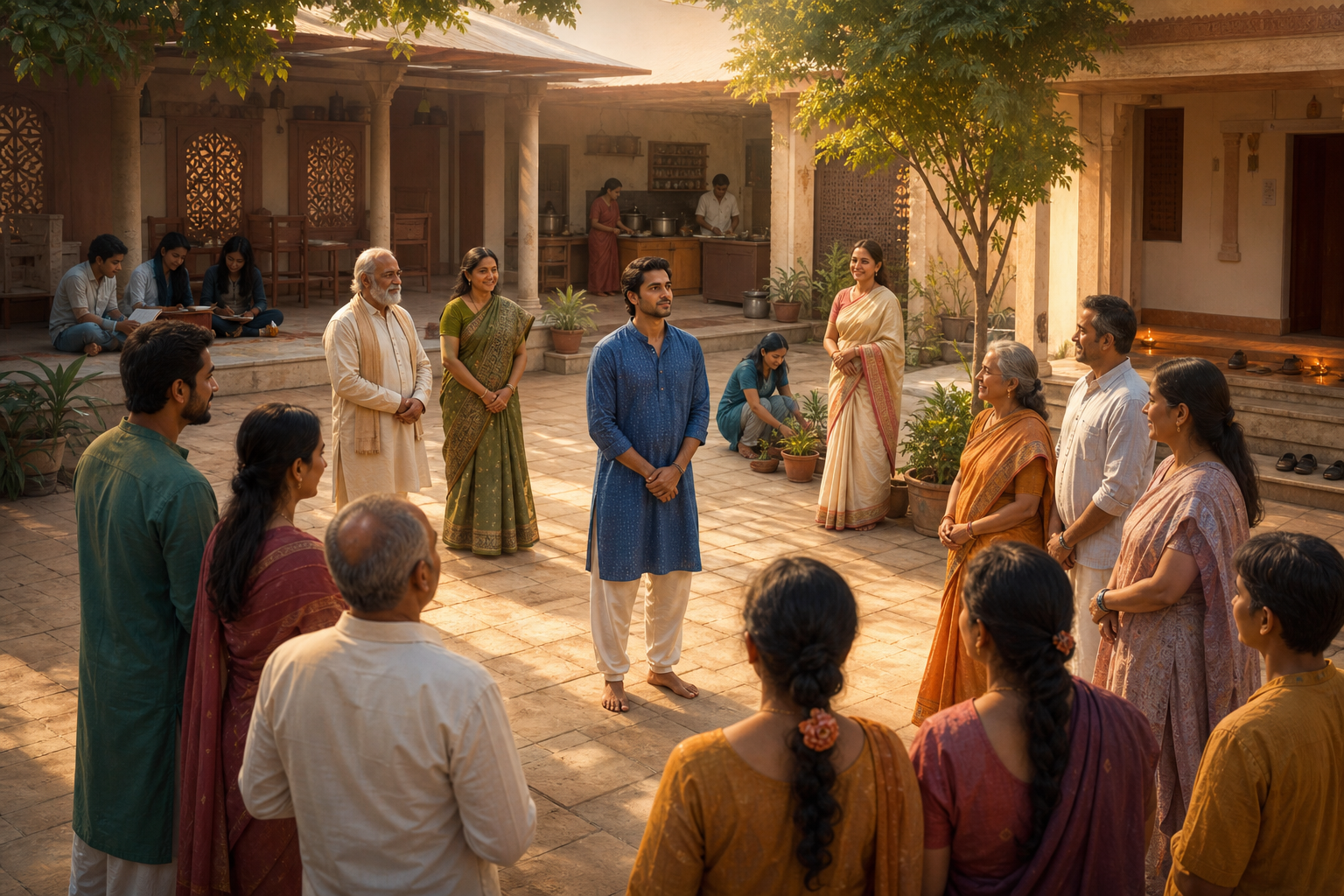
You may be trying to answer a delicate question: if a relative, friend, or member of your community wants to reconnect with an ancestral Dharmic tradition, what should a responsible community actually do? The visible rite is the simplest part. The harder work is ensuring that the choice is free, the receiving community is prepared, and belonging continues after everyone has gone home.
Do not begin with publicity or ritual arrangements. Begin with the person. Paravartana becomes durable only when a freely chosen spiritual return is matched by social acceptance, practical formation, and a place to serve. Cross-Dharmic cultural renewal supplies that wider ecosystem without asking Hindu, Buddhist, Jain, or Sikh communities to blur their distinct teachings.
Separate return, spiritual formation, and cultural renewal
Paravartana is not shorthand for every form of Dharmic engagement. It is the voluntary return of a person to a Dharmic religious home, accompanied by meaningful reintegration into a community. Someone who only wants to study family history, learn a language, visit a sacred place, or participate in seva does not necessarily seek Paravartana. That person needs an open door to cultural reconnection, not pressure to make a religious declaration.
The claim that anyone who leaves the Hindu fold can never return is not the only position found within the Dharmashastra tradition. The Devala-Smriti provided a systematic framework for purification and reintegration after coercion. Vijnaneshvara’s 12th-century exposition of the Yajnavalkya-Smriti continued to address the restoration of people subjected to external force, including women who had suffered assault. Vidyaranya later used the restoration of a Hindu seized by mlecchas as a philosophical analogy for the Atman’s essential freedom from bodily conditions.
The practical conclusion is both narrow and powerful: coercion does not destroy intrinsic dignity, and social rupture need not be permanent. Paravartana is therefore better understood as restoration than as recruitment. It repairs a relationship that force, fear, deception, exclusion, or historical dislocation had broken.
| Workstream | Question it must answer | Evidence of success |
|---|---|---|
| Paravartana | Does this person freely seek formal return to a particular Dharmic home? | The person is received without stigma and can participate as a member. |
| Tradition-specific formation | What teachings, practices, disciplines, and relationships will sustain the return? | The person knows where to worship, study, ask questions, and serve. |
| Cross-Dharmic cultural renewal | What shared institutions can strengthen civilizational memory without merging distinct traditions? | Communities cooperate in education, seva, and heritage work while retaining doctrinal integrity. |
This distinction prevents two common mistakes. Do not tell a culturally curious person that formal return is required before they may learn. Do not tell someone seeking a definite religious home that a vague pan-Dharmic identity is enough. If a person asks to enter a Hindu sampradaya, Buddhist sangha, Jain community, or Sikh sangat, connect that person to practitioners who can explain the actual path.
Ask four questions before discussing any ceremony: What does the person presently believe? Which practices do they wish to adopt or resume? Which community do they expect to receive them? What do they hope will change in daily life? The answers tell you whether the need is formal return, spiritual instruction, cultural education, social support, or some combination of the four.
Use five consent gates before arranging a ceremony

A sincere objective does not excuse a careless process. Treat the following five gates as stop-or-proceed decisions. If any gate remains unresolved, pause the ceremony and address the underlying issue.
- The request originates with the person. Ask them to describe, in their own words, what they are choosing and why. Ancestry may explain the context, but ancestry is not consent.
- The decision is free from material leverage. Food, healthcare, schooling, employment assistance, legal help, and emergency relief must never depend on a religious choice. If an organizer controls something the person urgently needs, move the discernment process to an independent and confidential setting.
- The person receives tradition-specific counsel. A generic Dharmic welcome can introduce the civilizational family, but it cannot substitute for the teachings and disciplines of the religious home being chosen. The person should understand what participation ordinarily involves and remain free to decline without losing access to community services.
- Privacy and safety preferences are recorded before invitations are sent. Ask whether the person’s name, image, family history, or ceremony may be shared. Silence is not permission. Publicity that cannot be withdrawn may expose the person to family conflict, social pressure, or unwanted political attention.
- A receiving community accepts responsibility after the rite. Name the institution, congregation, mentor, or family that will welcome the person. Identify the next gathering they can attend, the person who will answer questions, and the learning path available to them. A ceremony without a receiving community creates another form of abandonment.
The second gate deserves special attention. A serious program of cultural renewal must reduce the vulnerabilities that make people dependent on religious intermediaries in the first place. Building equitable schools, healthcare support, livelihood networks, and compassionate social safety nets is therefore part of protecting freedom of conscience, not a side project. A service-based approach to cultural continuity fails its own ethical test if assistance becomes an inducement.
Keep spiritual, social, and civic questions separate. A religious rite may express an inward commitment. Social acceptance determines whether a person can participate without humiliation. Government records, marriage questions, inheritance, certificates, and other legal matters may follow separate rules. A priest, granthi, monk, nun, volunteer, or community organizer should not promise a legal effect outside their competence. Where official status may change, obtain qualified local legal guidance before filing declarations or altering records.
Consent must also continue after the initial decision. A person may want a private rite but not a public announcement. They may welcome study but decline a speaking role. They may return while close relatives remain in another religion. Respecting those boundaries is not hesitation about Dharma. It is evidence that the community understands Dharma as responsibility rather than possession.
Make the rite the midpoint, not the finish line
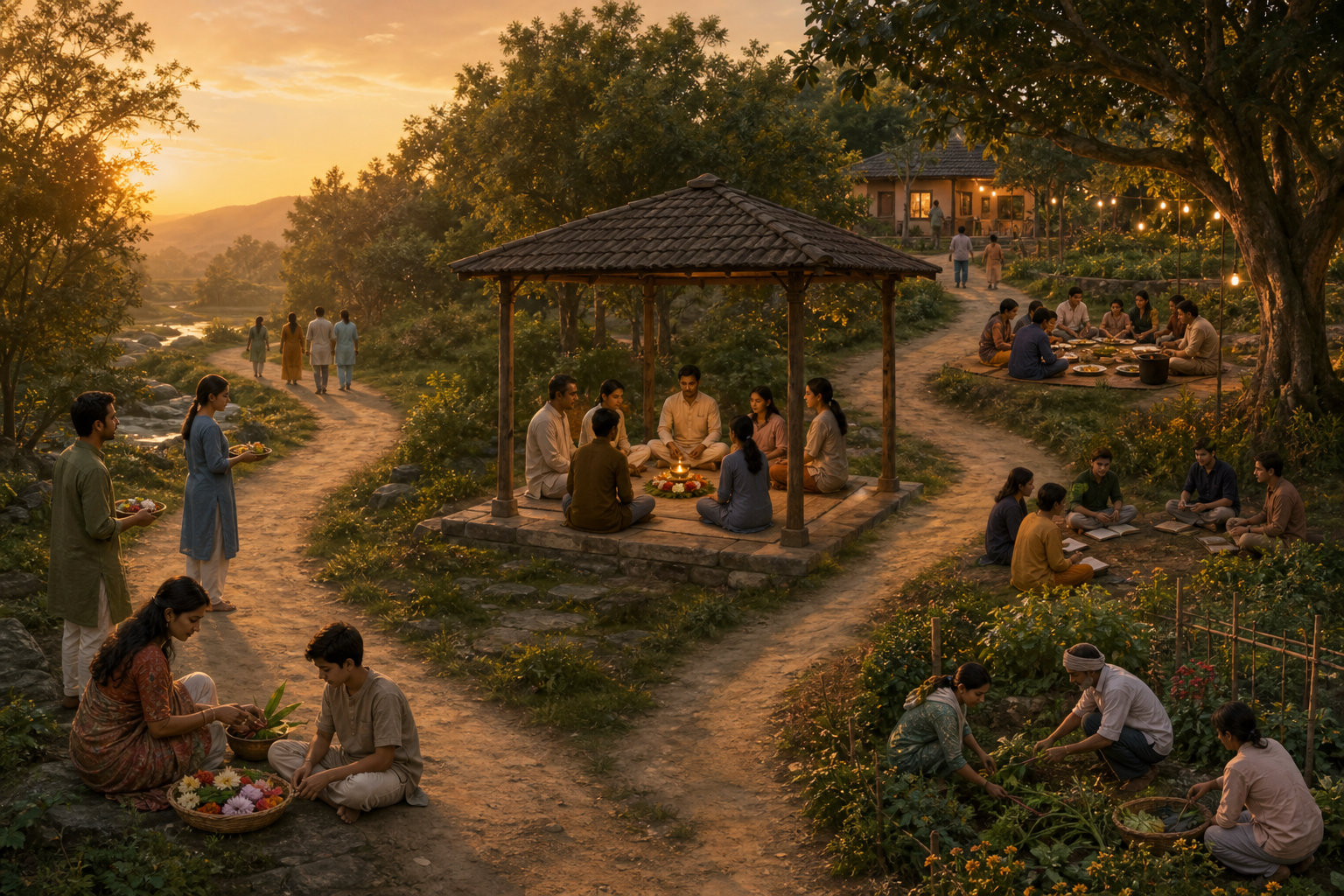
Historical Paravartana addressed social place as well as ritual condition. After the Bahmani-Vijayanagara conflict that ended in 1398 CE, released captives underwent a mass Shuddhi ceremony and were readmitted into Hindu society. Under Maratha governance, the Panditarao consulted learned authorities on difficult cases and issued prayascitta that enabled a person to return to caste and community. These Vijayanagara and Maratha precedents joined religious restoration to organized social reception.
The Malkana Rajput experience reveals the cost of separating the two. Many had retained Hindu customs after conversion and were willing to return if Hindu society would receive them, yet early 20th-century Shuddhi efforts encountered strong resistance from orthodox groups. The person may be ready long before the community is ready. If organizers ignore that imbalance, the rite can promise a home that everyday social life refuses to provide.
Before the rite
- Confirm the appropriate religious authority and the community that will receive the person. These may overlap, but do not assume that an officiant can guarantee social acceptance.
- Explain the rite in language the participant understands. Identify which actions are essential, which are local custom, and what commitments are expected afterward.
- Resolve practical questions in advance: Where may the person worship or study? How will they participate in festivals and life-cycle observances? Who can advise on food practices, family rites, marriage questions, funerary customs, and the education of children?
- Do not invent a restrictive jati placement as the price of welcome. If a historical community connection is uncertain or contested, receive the person through an appropriate broader religious and congregational relationship rather than leaving them socially suspended.
- Agree on privacy. Decide who may attend, whether photography is permitted, what records are necessary, and who may speak publicly. Use the most private workable option when the person is uncertain.
During the rite
- Let the participant affirm the decision in their own voice. Do not substitute an organizer’s political speech for the person’s spiritual intention.
- Explain significant actions rather than treating unfamiliar ritual as a test of authenticity. A returning person need not perform inherited knowledge they were never allowed to learn.
- Exclude denunciations of another religion or community. Historical memory may be spoken truthfully, but the participant should not be made an instrument of collective hostility.
- Do not turn the event into a numerical achievement. Headcounts reward spectacle, create incentives to rush consent, and reveal little about whether anyone found a durable home.
- Introduce the receiving community in the same gathering when appropriate and consented to. A visible welcome can matter more than an elaborate ritual sequence.
After the rite
Give the person a simple path into lived practice: one dependable place to gather, one sustainable rhythm of study or worship, and one form of seva they freely choose. This is more useful than handing over a large reading list or expecting instant fluency in inherited customs.
A named mentor should make contact, invite the person to ordinary community life, and answer basic questions without embarrassment. The mentor is not a monitor. If participation falls away, ask what obstacle emerged: transport, language, family tension, cost, uncertainty about ritual, or an unwelcoming interaction. Treat the answer as feedback about the community rather than evidence of disloyalty.
Respect mixed families. A person’s return does not authorize pressure on a spouse, parent, sibling, or child. Give relatives access to neutral information if they ask, preserve ordinary family bonds where safe, and refuse demands for public repudiation. Cultural renewal becomes credible when it can hold conviction and humane relationship together.
The honest measure of Paravartana is not whether the rite occurred. Ask whether the person can now worship, learn, celebrate, mourn, raise questions, and serve without repeatedly proving that they belong. When the community stops treating them as an exception, reintegration has begun to work.
Build a cross-Dharmic renewal system around everyday practice
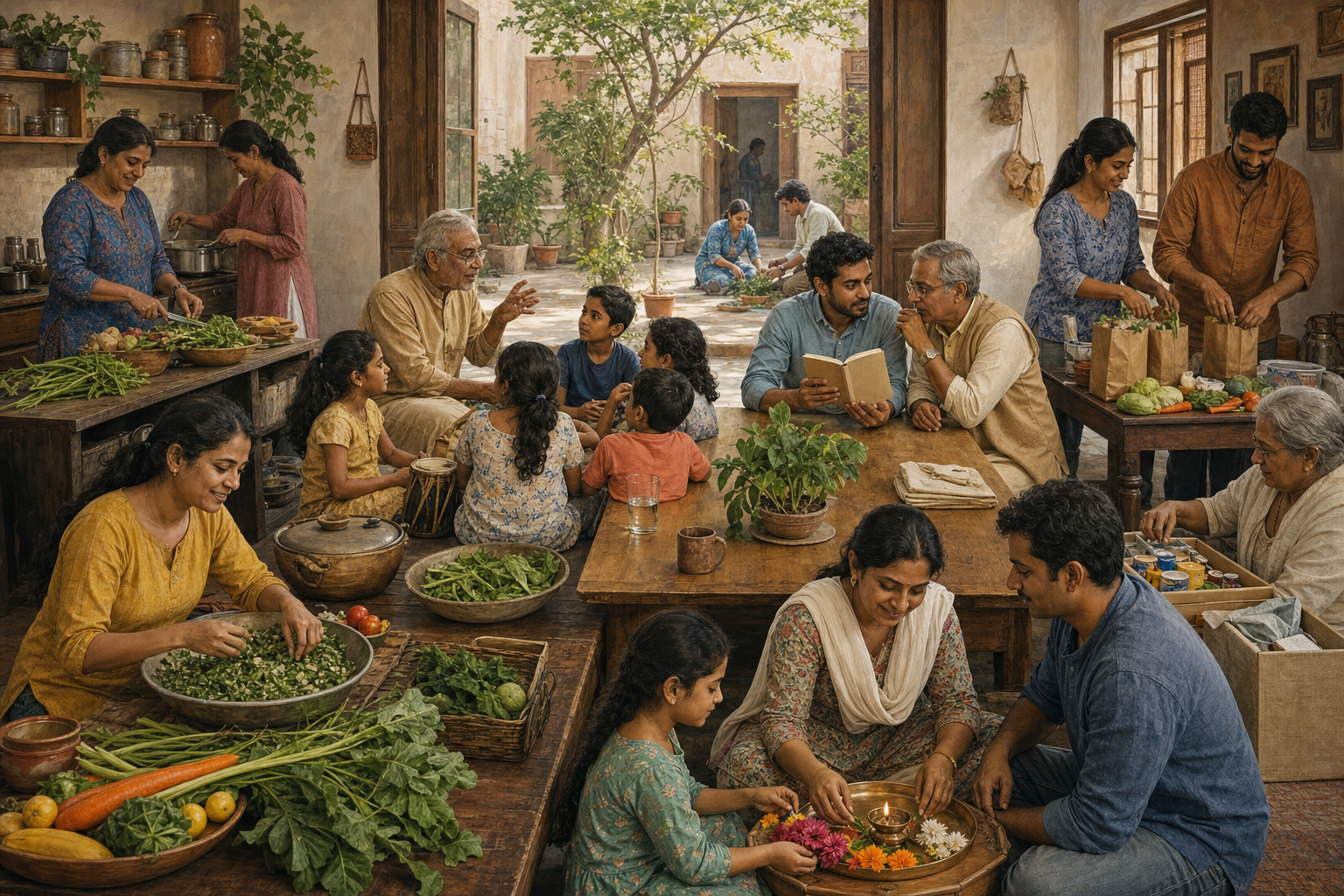
Cross-Dharmic renewal does not require four traditions to pretend they are one religion. Hindu, Buddhist, Jain, and Sikh communities have distinct authorities, doctrines, disciplines, and forms of initiation. Cooperation becomes honest when it is built on shared civilizational work rather than a manufactured common liturgy.
Dharma, ahimsa, satya, viveka, karuna, and seva provide a recognizable ethical vocabulary for cooperation across Dharmic communities. Each tradition gives these ideas its own theological and practical inflection. The aim is not to erase those differences. It is to use genuine points of consonance to strengthen character, service, memory, and mutual confidence.
The smallest workable local system
- Create a confidential Paravartana contact point. It should listen, screen for coercion, protect privacy, and refer each person to an appropriate tradition-specific authority. It should not advertise personal cases without explicit permission.
- Open a cultural learning path that requires no religious declaration. Offer language learning, civilizational history, sacred geography, literature, arts, festival education, and introductory encounters with primary teachings. This gives culturally displaced families a way to reconnect before deciding whether they seek formal religious commitment.
- Maintain a referral network rather than a universal initiation process. A Hindu seeking a sampradaya, a Buddhist seeking refuge, a Jain seeking community discipline, and a Sikh seeking life in the sangat require different forms of counsel. Cross-Dharmic cooperation should help each person reach the right door.
- Establish a service commons. Food assistance, education, medical support, environmental work, and help during hardship should be offered without a conversion condition. Participants may discover Dharmic life through seva, but service recipients must never become targets.
- Turn heritage education into stewardship. Organize site visits, documentation, clean-up, language transcription, oral-history work with consent, and support for living temples, gurdwaras, Jain institutions, Buddhist centres, libraries, and archives. The movement from reading to responsibility is where cultural memory becomes durable.
- Review belonging rather than publicity. Track whether mentors keep their commitments, whether participants return voluntarily, whether privacy breaches occur, whether exclusion remains unresolved, and whether people find meaningful study and seva. These measures expose weaknesses that a ceremony count hides.
Cultural learning is especially valuable for people who are not considering formal return. Language study, heritage education, sacred-space restoration, family dialogue, and community service can repair cultural estrangement without forcing a premature statement of belief. Literature, music, memoir, and regional stories provide a low-pressure entry because they allow a person to encounter inherited memory before entering a debate about identity.
Keep the work local enough to become habitual. A reading circle can adopt a neglected site. Families can document elders’ memories with permission. A temple, gurdwara, Jain centre, or Buddhist community can host an open language class while preserving its own religious character. Students can pair historical study with a field visit and a practical act of stewardship. Quiet actions of this kind already have force: printed cultural essays distributed in Tiruvannamalai and student visits to neglected civilizational sites show how learning can move from a page into public responsibility.
Set red lines before conflict tests them
- No coercion, deception, or material inducement in any direction.
- No public identification of a participant without specific and informed permission.
- No merged ritual that misrepresents the teachings of the participating traditions.
- No inherited trauma used as permission to humiliate present-day neighbors.
- No demand that a returning person sever safe family relationships as proof of sincerity.
- No ceremony until a receiving community has accepted responsibility for what follows.
- No service program whose benefits depend on profession of belief.
- No success metric based mainly on conversion totals, media attention, or political display.
These boundaries do not weaken cultural advocacy. They protect it from becoming the mirror image of the coercion it opposes. A confident Dharmic society can preserve memory, answer hostile claims, protect sacred institutions, and welcome return without compromising freedom of conscience.
Key takeaways
- Paravartana is a freely chosen religious return joined to real social reintegration; ancestry alone does not establish consent.
- Cultural reconnection must remain open to people who seek language, history, festivals, literature, heritage, or seva without formal religious change.
- Hindu, Buddhist, Jain, and Sikh communities can cooperate in education, service, and stewardship without flattening their doctrinal differences.
- A ceremony should proceed only after consent, freedom from leverage, informed counsel, privacy, and a receiving community are secured.
- The rite is a midpoint. Mentorship, ordinary participation, family dignity, spiritual formation, and a meaningful role in seva determine whether return becomes a living home.
- Measure belonging, continuity of practice, fulfilled community commitments, and repaired heritage rather than publicity or headcounts.
If you are beginning this work, do not announce a campaign first. Secure a trusted tradition-specific referral network, a confidential intake path, an open cultural learning program, and one service or heritage project. Then ask the person who returned whether the community still feels like home after the ceremony. Their answer is the measure that matters.
References
- The Dharma Dispatch – The Complete Dharmic Ghar-Wapsi Debate: Discover Lessons from Devala-Smriti to the Meos
- The Dharma Dispatch – Seven Years of The Dharma Dispatch: Essential Reflections and Breakthroughs in Dharmic Heritage
- The Dharma Dispatch – The Complete History of Paravartana: Discover Ghar-Wapsi from Vijayanagara to the Marathas
- The Dharma Dispatch – Complete Guide to Paravartana (Ghar-Wapsi): Discover Its Transformative Power in Modern Indian Literature
- The Dharma Dispatch – Essential Blueprint to Safeguard Dharma: Discover a Complete Strategy for Cultural Renewal
- The Dharma Dispatch – Vijaya Dasami Insights: Discover the Dharma Uniting Hindu, Buddhist, Jain and Sikh
