

If your thoughts keep circling the same decision, leaving home for a sacred place may create the distance you need. But movement alone will not renew you. A crowded itinerary can deepen your fatigue, and a temple visit squeezed between photographs and notifications can leave the central question untouched.
A Dharmic pilgrimage works differently. You travel with a sankalpa, accept some restraint, approach the sacred place as a participant rather than a consumer, and return with a duty to integrate what you noticed. This method can shape a distant tirtha-yatra or a half-day visit to a nearby shrine.
Begin with a sankalpa your return can test
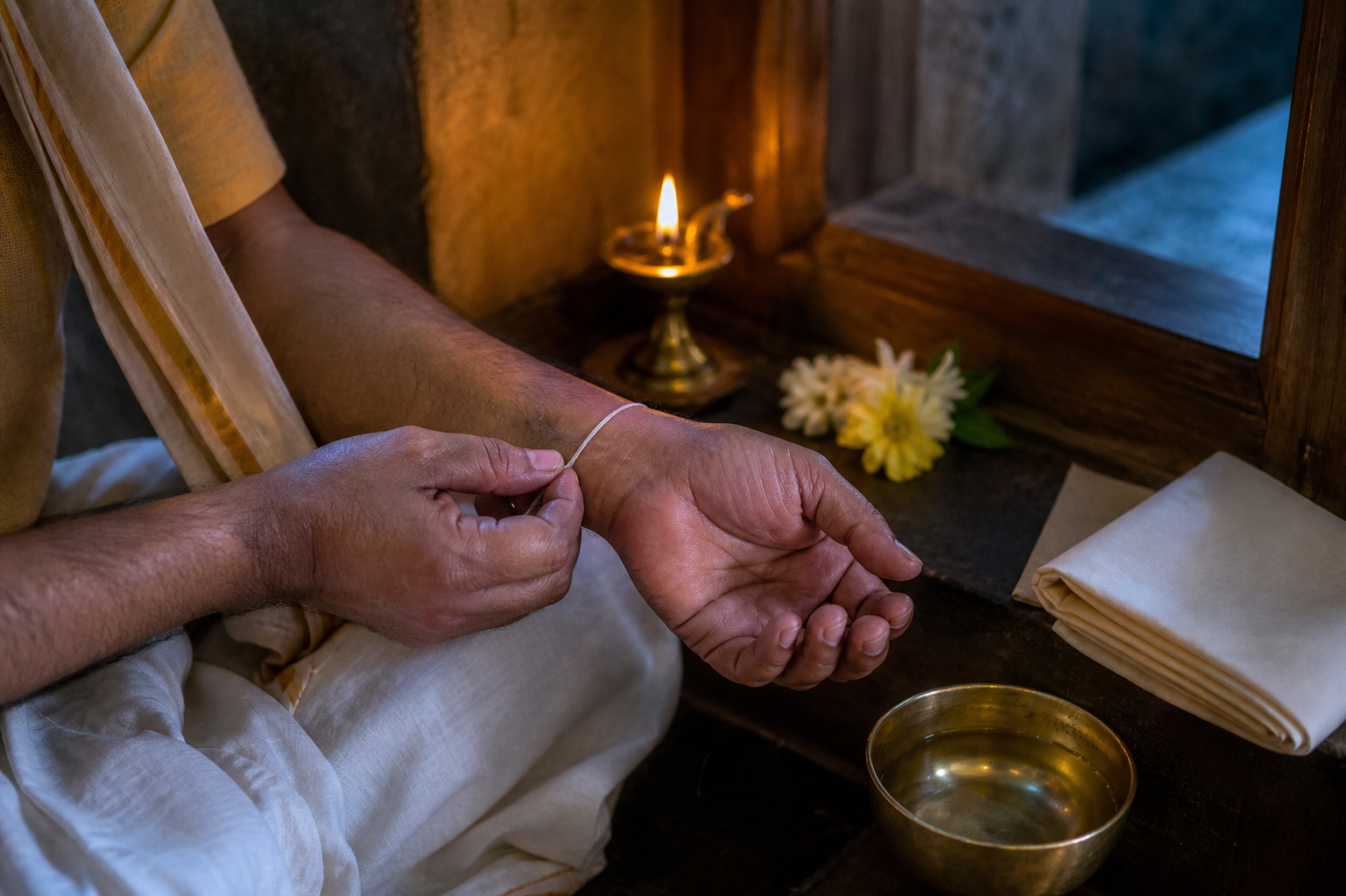
A tirtha is a crossing-place. The geographical crossing matters, but it serves an inward one: from agitation toward attention, from avoidance toward responsibility, or from attachment toward a clearer view. That is why tirtha-yatra is distinguished from travel organized mainly around consumption.
Your sankalpa gives that crossing a direction. Write it before choosing transport, accommodation, or sightseeing stops. It should identify one living question, remain within your agency, and point back toward dharma.
- Replace a vague wish for peace with a question about the obligation, resentment, fear, or attachment disturbing your peace.
- Replace a demand to know what will happen with a question about how you should act under either possible outcome.
- Replace a question about changing another person with one about the response that would preserve dignity, responsibility, and non-harm.
- Complete this sentence: During this yatra, you will examine ___ so that you can return ready to ___.
A pilgrimage is not an oracle. Do not pressure yourself to receive a sign, prediction, or dramatic answer. Your sankalpa is a discipline of attention: it tells you which recurring thoughts to observe and which evasions to stop entertaining.
Key takeaways:
- Carry one question tied to a real duty, not a general wish to feel better.
- Choose a sacred place that gives you enough distance from routine without creating unnecessary turmoil.
- Reduce baggage, entertainment, and speech so that the road itself becomes part of the practice.
- Pair darshan or prayer with silence, careful observation, and seva.
- Translate what you learn into one definite action and one sustainable home practice.
Choose the smallest journey that creates real distance
The most famous destination is not automatically the right one. A demanding journey can be appropriate when its difficulty is part of your vrata or devotional commitment. It can also become another way to postpone a conversation, overspend, or neglect people who depend on you. Choose enough distance to interrupt your habits, but not so much that managing the trip consumes the attention the pilgrimage was meant to free.
Look for four qualities:
- A living sacred place where worship, reverence, and local tradition matter more than visitor entertainment.
- A physical transition such as a walk, ascent, riverbank, forest path, or quiet road that lets your pace change before you arrive.
- A realistic period for unhurried prayer and silence after the main act of worship.
- A journey you can complete without abandoning the very duties on which you are seeking clarity.
Nachagiri Lakshmi Narasimha Swamy Temple shows how a modest journey can provide this structure. The shrine stands on a hillock at Nacharam in Telangana, about 6 kilometres from Tupran and approximately 40–50 kilometres from Hyderabad. Its accessibility makes a half-day pilgrimage possible, while the ascent, hilltop setting, darshan of Sri Lakshmi Narasimha, and open views provide distinct stages for arrival, worship, and reflection.
If quiet is central to your sankalpa, prefer a weekday. Early morning and late afternoon generally offer cooler conditions and gentler light, while weekends and major Vaishnava observances can bring more visitors. Verify current temple access and practical arrangements before leaving, because pilgrimage should cultivate attention rather than depend on avoidable confusion.
Do not treat the setting as a spiritual mood machine. Modest clothing, restrained photography, silence near the sanctum, and care with waste are not peripheral etiquette. They are the first test of whether your search for renewal includes reverence for a community and its sacred space.
Let the road train the qualities you seek
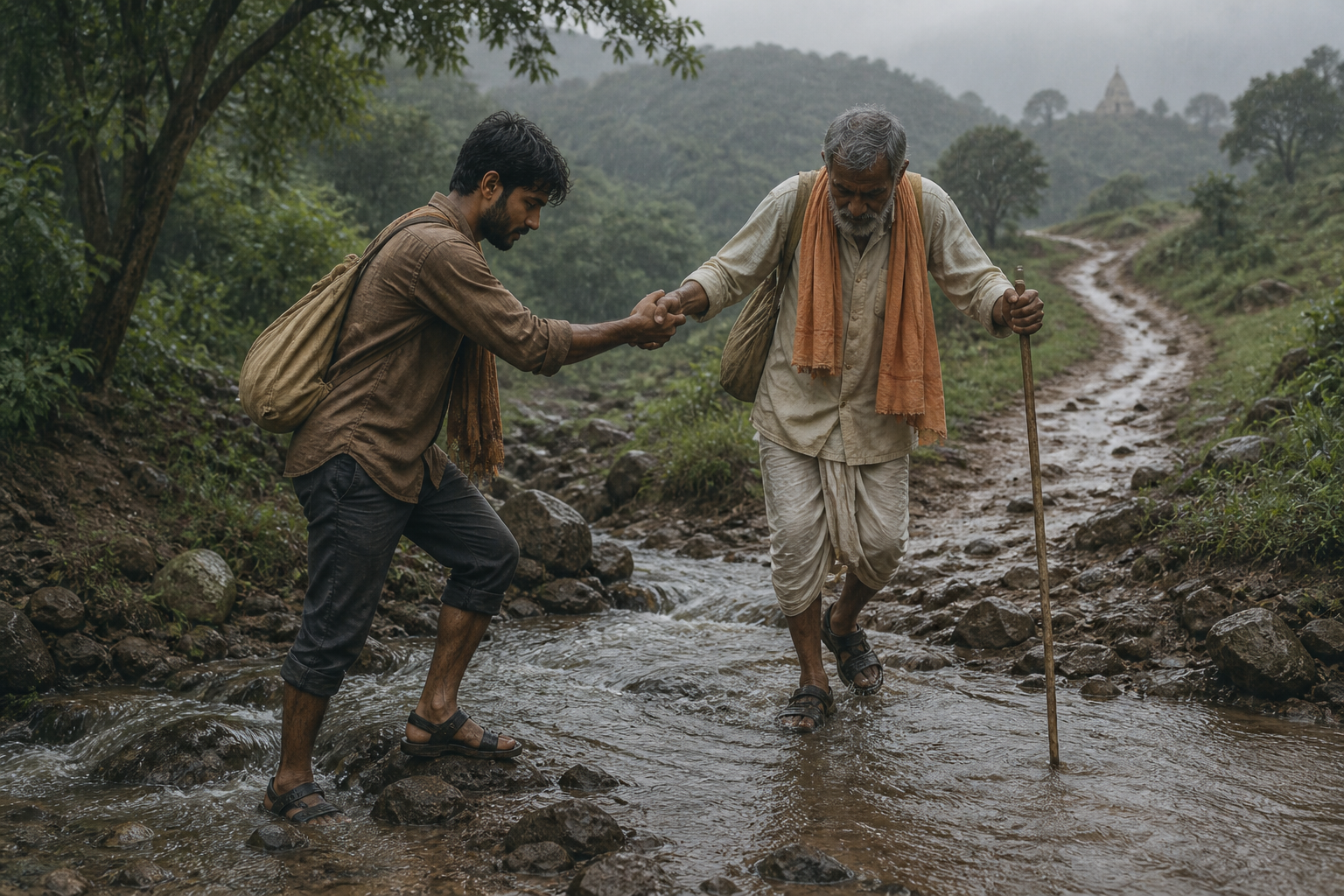
Unfamiliar surroundings can interrupt rehearsed thought and return attention to what is immediately present. Yet that opening disappears if every empty moment is filled with messages, videos, photographs, and route optimization. The Dharmic figure of the parivrajaka, or wandering seeker, points to movement used as a discipline of inquiry, not movement pursued for its own sake.
Give the road a rule. It need not be severe, but it should be concrete:
- Pack less than you normally would. Each object you omit becomes a small practice of aparigraha, or non-possessiveness.
- Keep one portion of the journey free from calls, social media, music, and casual conversation. Use it for japa, breath awareness, or silent observation.
- Walk an appropriate part of the approach when the route, your health, and local conditions permit. Let the change in pace mark the passage from ordinary travel to yatra.
- When a minor inconvenience appears, notice the urge to complain before acting on it. Travel gives you a practical field for equanimity and non-attachment.
- Carry water and necessities responsibly, minimize waste, and avoid making local people or the landscape absorb the cost of your spiritual exercise.
The often-repeated injunction Charaiveti, charaiveti, associated with the early Vedic corpus, is not a command to become permanently restless. For a pilgrim, continuing to move means continuing to inquire. You neither cling to the comfort you left nor cling to the first interpretation that appears on the road.
A shared discipline without erasing real differences
Hindu, Buddhist, Jain, and Sikh paths do not make pilgrimage identical in theology or ritual. They do, however, offer related disciplines of purposeful movement. Hindu tirtha-yatra joins journey, darshan, and inward inquiry. Buddhist wandering and pilgrimage can cultivate mindfulness and compassion. Jain practice joins careful movement with ahimsa and aparigraha. Sikh yatra is strengthened by sangat and seva. The common ground is not a claim that every path is the same; it is the recognition that restraint, attention, community, and service keep sacred travel from collapsing into self-indulgence.
Use a simple practice when you reach the sacred place
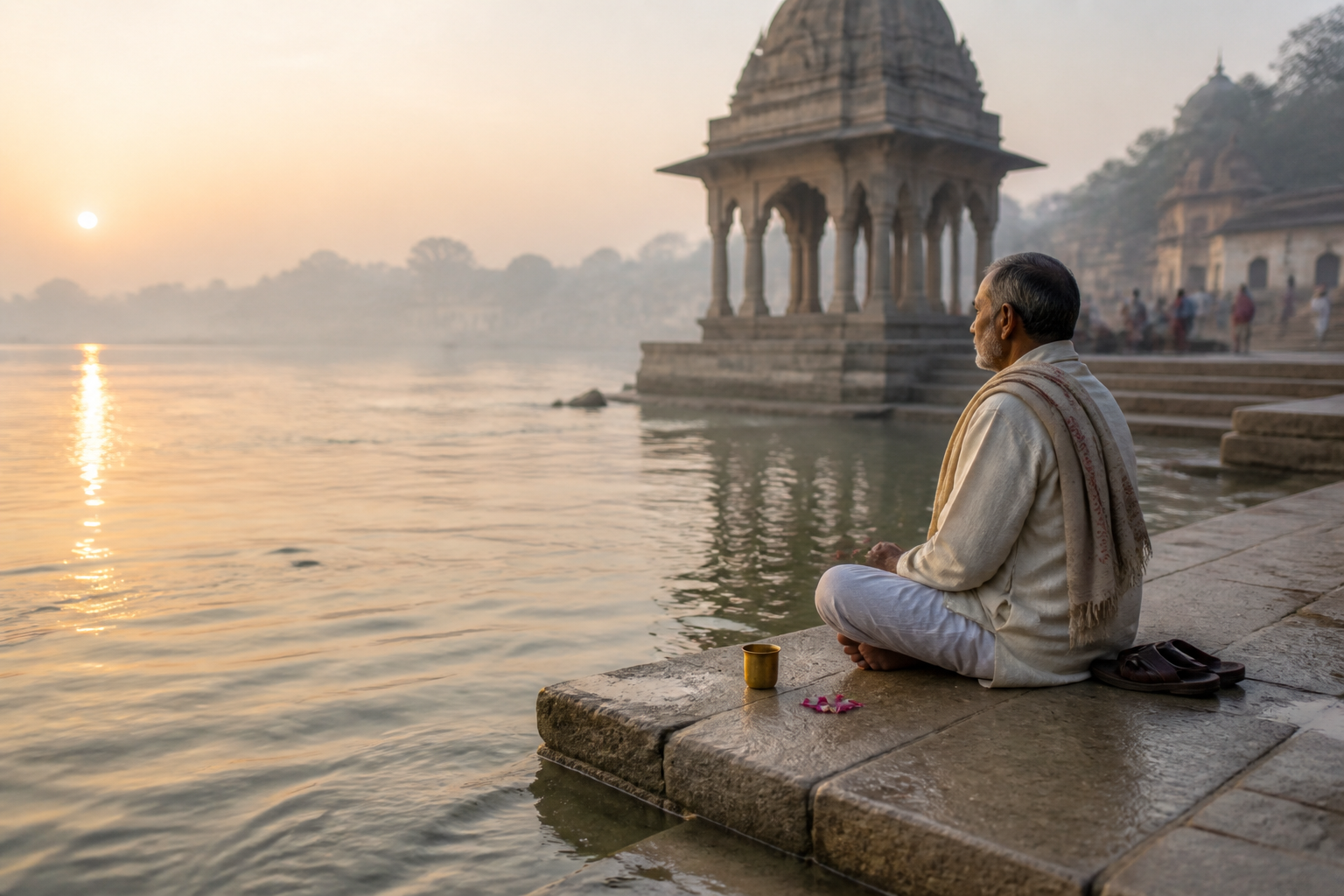
Arrival often produces the strongest temptation to rush. You want to find the entrance, complete darshan, take photographs, buy something, and move to the next stop. Reverse that momentum. Unless local arrangements require otherwise, use this sequence:
- Pause before entering. Put away your phone, settle your breathing, and recognize that you are entering a living place of worship.
- Recall your sankalpa without rehearsing the answer you hope to receive. Bring the question into awareness and then loosen your grip on it.
- Follow the customs of the place. At a Hindu temple, allow darshan, mantra, prayer, or circumambulation to be acts of relationship with the deity rather than boxes on an itinerary.
- After the central act of worship, remain quiet. Sit where this is permitted or walk slowly around the precinct. Let perception come before interpretation.
- Notice what repeatedly claims your attention. It may be gratitude, resistance, grief, an avoided duty, or the realization that your question was framed incorrectly.
- Write brief answers under three headings: What became quieter? What kept returning? What now requires action?
- Complete a fitting act of seva. Use an established opportunity when one is available, support local conservation, minimize your waste, or quietly help preserve the order of the place.
At a hill shrine such as Nachagiri, the open landscape can extend this practice. Instead of immediately turning the view into an image, stand still and look. Let the outward breadth expose the narrowness of any thought you have been repeating. Then return your attention to the deity and to the obligation contained in your sankalpa.
Do not grade the pilgrimage by whether you felt intense emotion. Tears, stillness, discomfort, distraction, and apparent ordinariness are all unreliable measures of spiritual value when considered alone. A useful yatra may console you, but it may also show you an attachment you would rather keep hidden. The better measure is what becomes more truthful in your conduct after you return.
Carry one insight across the return threshold
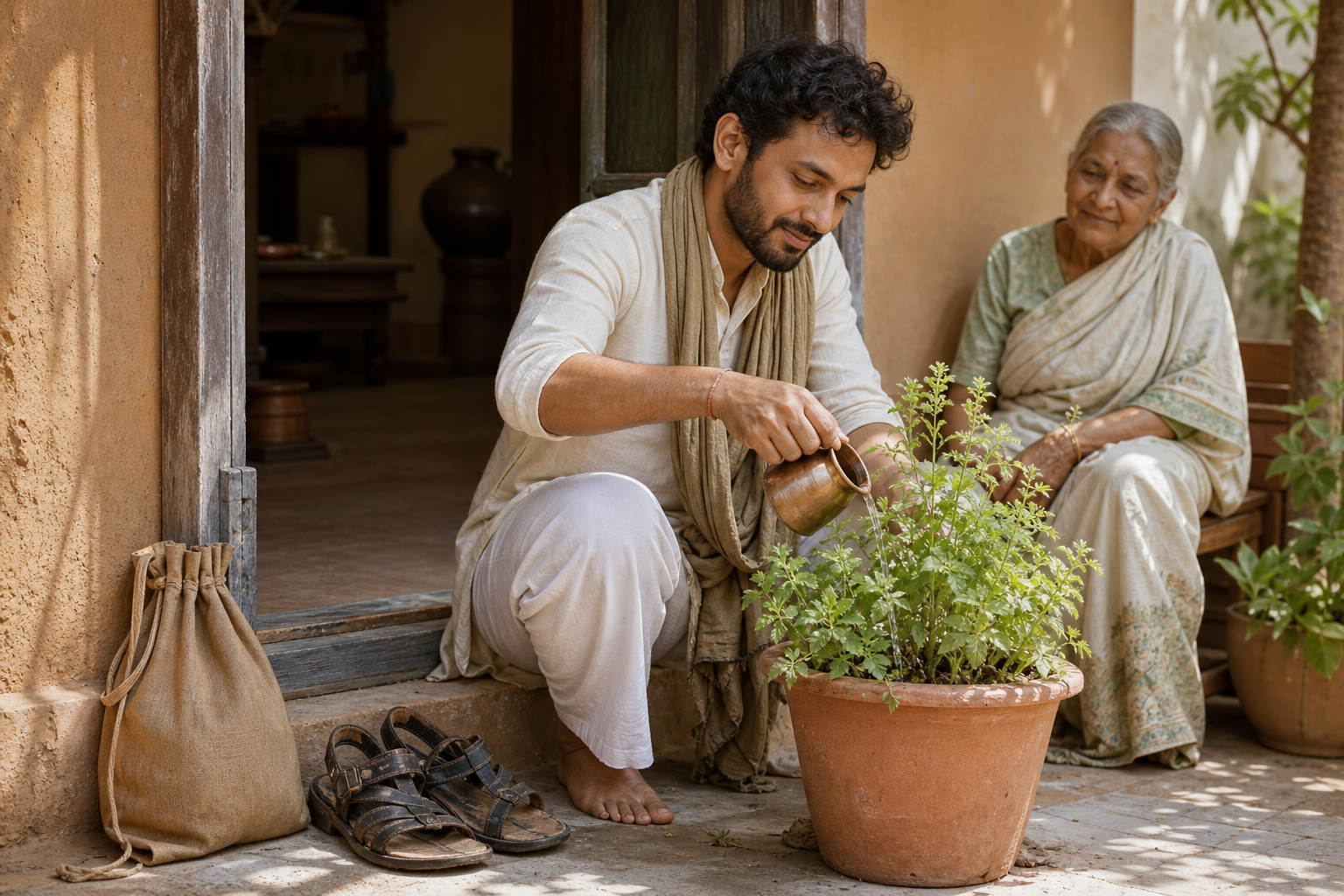
The return journey is part of the pilgrimage. Without integration, even a powerful experience becomes another memory consumed and replaced. On your first quiet evening at home, place the original sankalpa beside your travel notes and answer four questions:
- What did you assume before leaving?
- What did the journey make easier to see?
- What remains genuinely uncertain?
- Which responsibility can you now meet more directly?
Test any apparent insight before obeying it. Does it reduce harm or merely transfer discomfort to someone else? Does it help you fulfil a duty or offer a noble-sounding escape from it? Does it weaken an attachment, or simply replace one attachment with another? A sudden feeling that urges an irreversible decision deserves time, reflection, and counsel from someone trustworthy. Sacred intensity does not remove the need for discernment.
Then choose one outward action and one continuing practice. The action might be a delayed conversation, an apology, a boundary, or the completion of an obligation. The practice might be daily japa, a period of mindfulness, a regular walk without digital input, or a simplified routine that protects the clarity you found. Travel clarifies most reliably when home life is allowed to anchor the change.
Before you book anything, write the one sentence your pilgrimage is meant to test. If the destination, manner of travel, conduct at the shrine, and first action after returning all serve that sentence, you are no longer planning an escape. You are preparing to cross.
References
- DharmaRenaissance Blog — The Essential Dharmic Secret to Clarity: Discover Travel as a Proven Path to Inner Renewal
- DharmaRenaissance Blog — Discover Nachagiri Narasimha Swamy Temple: The Complete Visitor Guide to Nacharam’s Sacred Hill
