

You want to honor Mahalakshmi in a way that changes more than one evening’s altar. A clear approach is to join three acts: a manageable vrata, attentive recitation of the 108 names, and donation of usable sacred books to people who can put them into practice.
This combination keeps devotion from shrinking into either a bargain for wealth or an impersonal distribution drive. You cultivate order within your own life, strengthen remembrance of Lakshmi, and then help another household or community sustain the same discipline.
Begin with the prosperity you are asking to sustain
Lakshmi devotion is often reduced to a request for money. That is too narrow. The qualities associated with her presence include cleanliness, harmony, gratitude, generosity, responsible stewardship, and prosperity governed by right conduct. The 108 names provide a structured practice of remembrance through which those qualities can be contemplated.
Before deciding how many lamps to light or books to give, decide what your vrata is meant to correct. A useful sankalpa should connect worship with conduct. You might resolve to restore order to household finances, stop wasting food, keep the puja space clean, fulfill an overdue obligation, speak more truthfully, or set aside a realistic amount for dana. This need not replace the traditional sankalpa used in your family or sampradaya. It is a practical statement of the responsibility you are accepting.
Test your intention with three questions:
- Does it ask only for acquisition, or does it also name how you will care for what you receive?
- Can you express it through one observable action during the vrata?
- Will the proposed donation help a recipient, or is it mainly meant to display the donor’s generosity?
If the intention fails the third question, change the donation plan before beginning. Sacred-text donation is not improved merely by increasing the number of copies. A small set of accurate books placed with willing readers has more devotional and educational value than cartons left unopened.
Keep expectations proportionate. Lakshmi worship can discipline attention and reshape your relationship with resources, but it is not a financial instrument or a guarantee of a particular material result. Treat punya as the fruit of dharmic action, not as a payment that obliges the Devi to grant a transaction.
Build a vrata that your household can actually keep
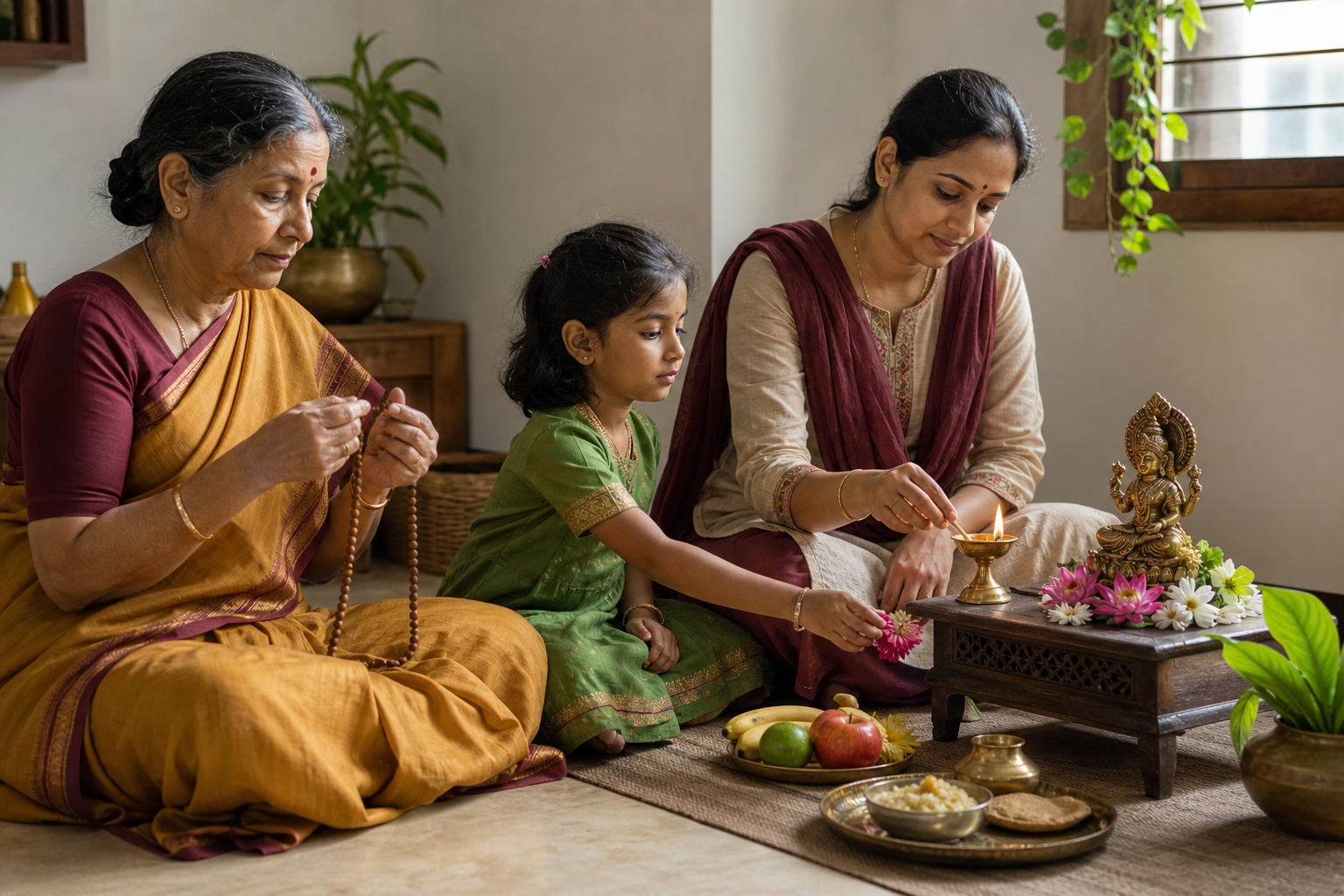
A vrata is broader than going without food. It combines intention, restraint, worship, repetition, and conduct. If your family has an inherited procedure, preserve it. If you need a simple home framework, use a sequence that can be repeated without confusion:
- Fix the scope. Choose the day or cycle before you begin. If you are observing a calendar-based vrata, confirm the dates through the regional panchang followed by your family or temple.
- Prepare the worship space. Clean it in advance and gather the lamp, flowers, grain, water, naivedya, and a readable copy of the Lakshmi Ashtottara Sata Namavali. Preparation is part of the discipline; it should not become a last-minute shopping exercise.
- State the sankalpa. Name the devotional purpose, the period of observance, and the conduct you intend to practice.
- Recite attentively. Read the 108 names at a pace that permits correct pronunciation and awareness of meaning. Do not rush simply to finish a count.
- Offer and distribute food respectfully. Complete the worship with naivedya according to your custom and share prasada without waste.
- Complete one outward act. Confirm a recipient, purchase an accurate edition, deliver the books, or help someone learn how to use them. Do not leave the seva indefinitely at the level of intention.
Margasir observances offer a well-developed regional model. Manabasa Gurubara is kept on consecutive Thursdays in Odisha and parts of coastal Andhra Pradesh. Characteristic practices include rice-paste jhoti or chita designs, a mana or grain-measuring vessel filled with paddy, lamps, seasonal offerings, traditional pitha, and readings from the Lakshmi Purana. These forms connect prosperity with the household, the harvest, food, cleanliness, and social responsibility.
Do not casually universalize a regional form. If Manabasa Gurubara belongs to your family or local community, learn its details from that living tradition and follow the applicable panchang. If it does not, you can still learn from its disciplined rhythm without presenting Odia customs as mandatory for every Lakshmi vrata.
Fasting should suit your health and household obligations. Do not skip medically necessary food or prescribed medicine to make an observance appear stricter. When food restriction is unsuitable, choose another restraint: reduce avoidable consumption, refrain from waste, simplify meals, or give up a habitual indulgence. Severity is not a reliable measure of bhakti.
Use the 108 names to move from praise to conduct
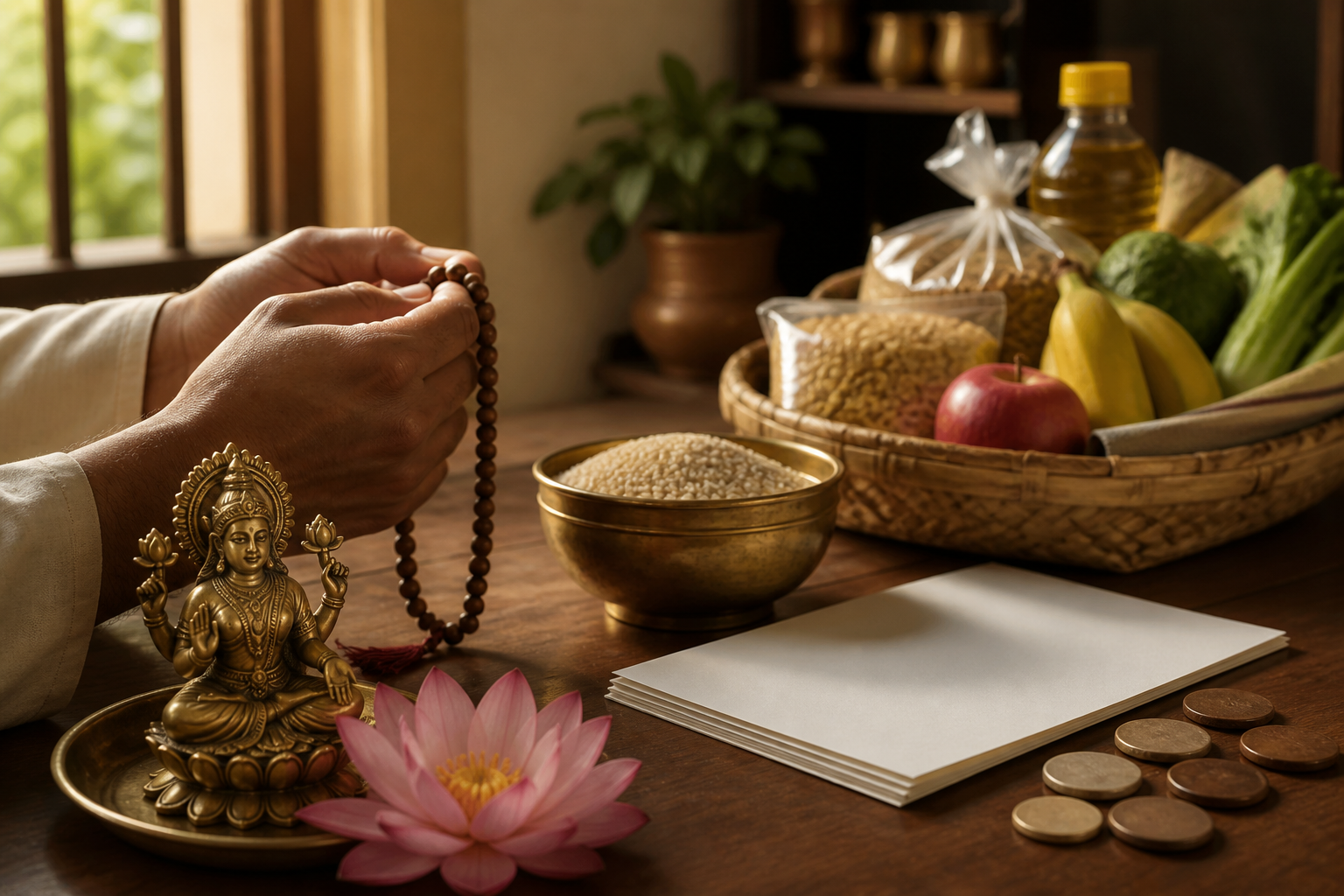
Lakshmi Ashtottara Sata Namavali is compact enough to become a regular household practice, but its purpose is not exhausted by completing 108 utterances. Namavali supports smarana, the repeated recollection of the deity and her qualities. The practical question after recitation is therefore not only, “Did I finish?” but also, “What quality did I notice, and what will it change today?”
Use a three-part rhythm:
- Before recitation: remove obvious disorder from the worship space and settle your attention. This makes cleanliness an action rather than a decorative idea.
- During recitation: follow the printed text and pause when a name or meaning draws your attention. If pronunciation is uncertain, learn gradually from a competent teacher or a reliable edition instead of replacing unfamiliar words from memory.
- After recitation: choose one corresponding act. Gratitude can become care for food; generosity can become dana; abundance can become responsible budgeting; purity can become the correction of a neglected space or habit.
A beginner-friendly edition should distinguish transliteration from translation. Transliteration helps the reader pronounce words written in an unfamiliar script; translation explains their meaning. Many readers need both. A book that supplies only one may look complete to an experienced practitioner while remaining difficult for the person receiving it.
If children or new readers are participating, give them a real role. One person can read a name, another can read its meaning, and another can prepare the lamp or flowers under suitable supervision. In households connected to Manabasa Gurubara, younger participants can also learn why grain, paddy, seasonal food, and jhoti or chita belong to the observance. Participation should transmit meaning, not merely assign decorative work.
Repetition may produce calm attention and greater clarity for some practitioners because it gives the mind a stable devotional object. Do not force a particular emotional experience. Restlessness does not invalidate the puja, and serenity is not proof that every decision made afterward is correct. The more dependable test is whether repeated worship makes your conduct more orderly, truthful, generous, and responsible.
Turn book donation into usable access to sacred learning
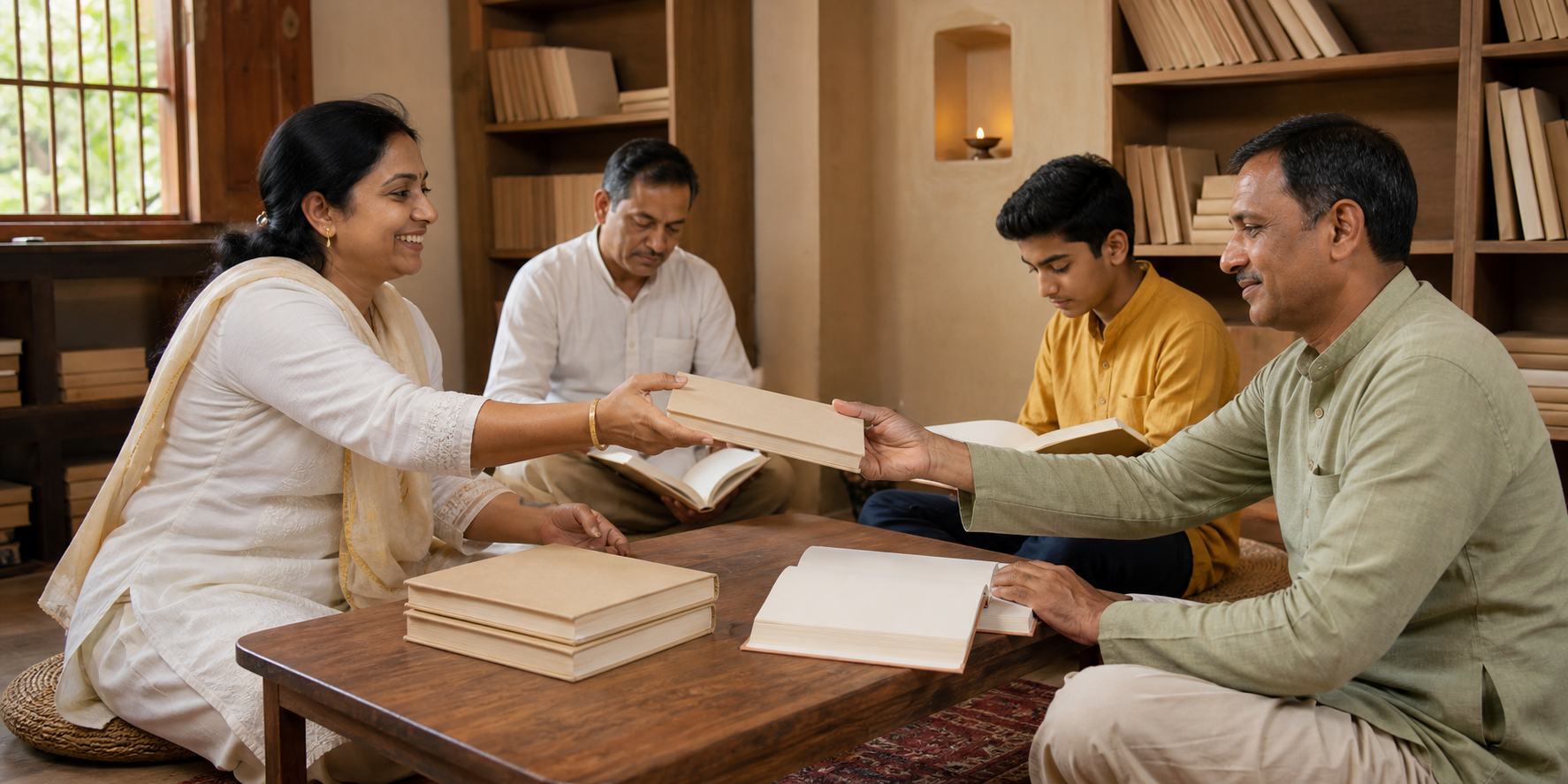
Sacred-text donation is a form of knowledge-giving only when the recipient can read, understand, preserve, or share what is given. Temples, households, libraries, study circles, and cultural centers can all be appropriate destinations, but each has different language needs, storage limits, and methods of use. Ask before purchasing a large quantity.
A recipient-first donation can be organized in five steps:
- Identify actual readers. Speak with a temple coordinator, librarian, teacher, study-group organizer, or household. Ask how many copies would be used and whether individual, shared, or lending copies are preferable.
- Confirm the reading format. Record the script, transliteration, translation language, print size, and level of explanatory guidance the intended readers need.
- Check the edition. Verify that it contains the complete 108-name sequence, is legible, and presents the material accurately. If you cannot assess accuracy yourself, ask someone qualified to review one sample copy before ordering the rest.
- Add brief use instructions. Where appropriate, include a concise note explaining what the Namavali contains, how the recipient can incorporate it into puja or study, and where to seek pronunciation help. Do not insert donor promotion into a sacred book.
- Arrange a respectful handover. Confirm when and where the books will be received. Use reusable or minimal packaging where practical, and do not leave unsolicited copies at a shrine, library desk, or community venue.
Quality matters more than ornament. Prioritize accurate text, clear printing, durable binding, useful transliteration, and intelligible translation before decorative covers. A lavish edition in an unreadable format does not serve a beginner. An inexpensive edition is suitable when it is accurate and physically usable.
Keep the donation within your means. Do not borrow money, neglect a household duty, or pressure relatives to contribute so that the offering appears larger. Aparigraha, or non-hoarding, supports sharing what can be released responsibly; it does not require financial disorder. Decide the budget before the vrata and let confirmed need determine the quantity.
The ethical setting also matters. The Lakshmi Purana is associated with dignity, inclusion, humility, and the principle that devotion and righteous conduct outweigh social markers. That makes discrimination incompatible with the spirit of a Lakshmi-centered knowledge donation. If the books are being placed through a community institution, ask whether women, younger readers, newcomers, and families without private collections will have practical access.
Comparable commitments to sharing sacred knowledge appear across the dharmic family: Buddhist Dhamma-sharing, Jain jnana-dana, and Sikh seva and reverence for Gurbani. These are not interchangeable rites or theologies. The useful common ground is narrower and stronger: knowledge should not be hoarded, sacred learning deserves care, and generosity carries responsibility toward the recipient.
Once the books have been delivered, complete the circle. Ask whether the format worked, whether more guidance is needed, and whether future copies should use another script or translation. This is stewardship, not a request for praise. The answer may also save your next donation from repeating an avoidable mismatch.
Key takeaways
- Join the vrata to one concrete improvement in cleanliness, truthfulness, generosity, household order, or responsible use of resources.
- Follow family and regional tradition where it exists, and verify calendar-based observances through the applicable panchang.
- Treat fasting as one possible restraint, not the sole measure of devotion; never override medical needs or prescribed treatment.
- Choose a Namavali edition for accuracy and accessibility: complete text, readable script, useful transliteration, clear translation, and durable printing.
- Confirm recipients and formats before buying multiple copies. Demand should determine quantity.
- Do not treat recitation or donation as a guarantee of money. Let Lakshmi devotion change how you receive, maintain, and share abundance.
Before your next Lakshmi puja, make two decisions: name the conduct your vrata will change, and contact one potential recipient for the books. Once those are clear, the ritual materials, edition, quantity, and handover can all serve the vow instead of distracting from it.
References
- DharmaRenaissance Blog – Discover the Proven Benefits of Donating Lakshmi Ashtottara Sata Namavali Books: A Complete Guide
- DharmaRenaissance Blog – Manabasa Gurubara 2025: The Complete Guide to Margasir Lakshmi Puja Dates, Rituals, and Meaning
