
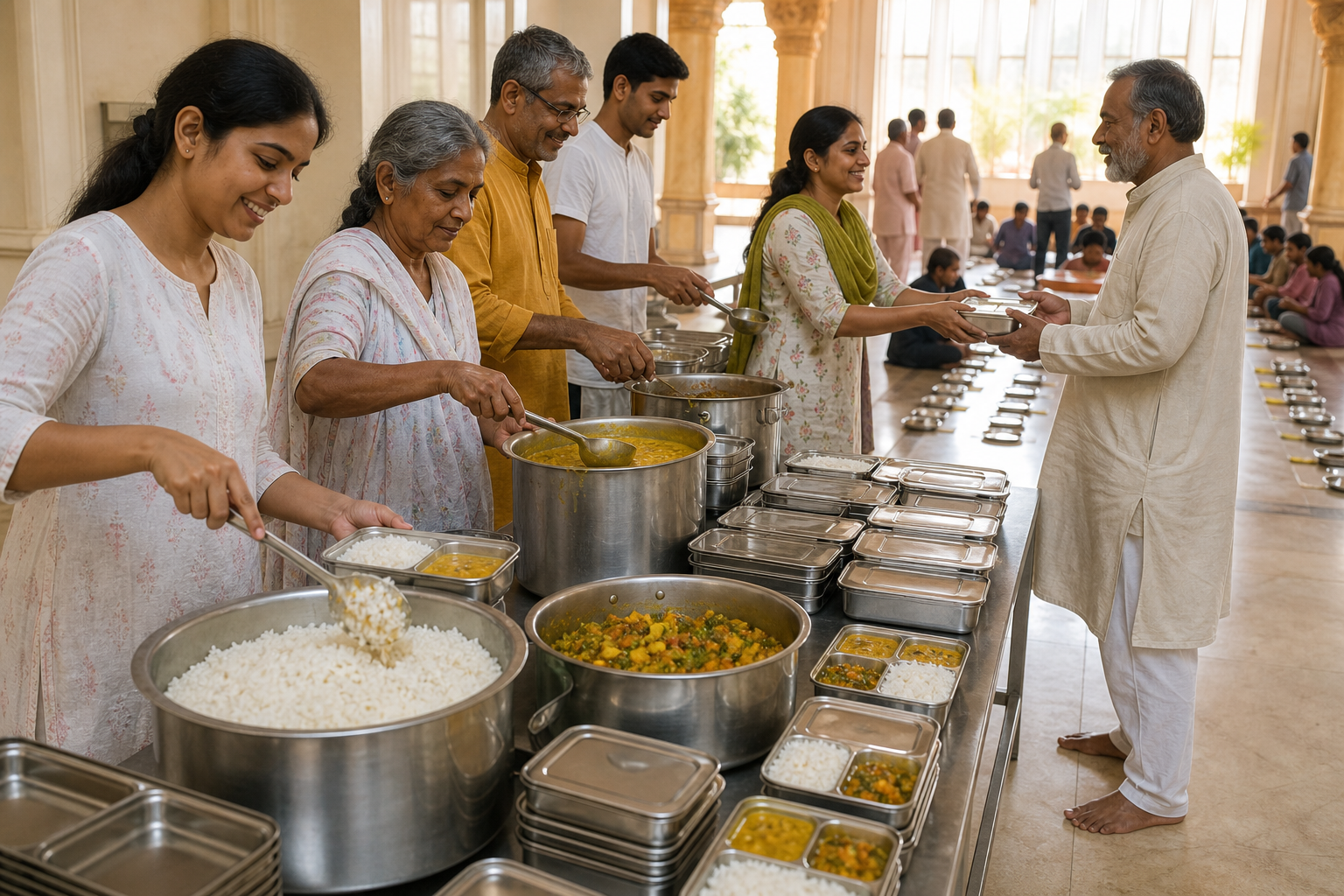
You are helping organise a temple feast, bhandara, langar, monastery meal, or community celebration. You want everyone to be welcomed, so the kitchen prepares generously. Then the final serving window closes with full vessels on one side and people facing hunger beyond the gate on the other.
The answer is not smaller-hearted hospitality. It is better-designed hospitality: realistic meal planning, mindful service, safe redistribution, dignified access, and honest accounting. When those parts are arranged before cooking begins, abundance becomes seva instead of waste.
Key takeaways
- Forecast meals by serving window and cook in batches. Do not use ritual prestige or total footfall as a substitute for expected meal demand.
- Offer a modest first portion and make another helping easy while food remains. This protects hospitality while reducing food abandoned on plates.
- Confirm a recipient, transport method, dispatch contact, and safe handoff process before the event. Surplus redistribution cannot be improvised at closing time.
- Keep untouched kitchen surplus separate from plate returns and any food whose safe handling cannot be verified.
- Record what was prepared, served, redirected, and left as residual organic material. Review the causes, not just the totals.
Put the Dharmic duties in an operational order

Dharmic food ethics begins with a person, not a waste bin. The primary duty is nourishment offered without humiliation. Waste reduction matters because it preserves food, labour, donations, energy, and the capacity to feed someone else.
Across Hindu, Sikh, Buddhist, and Jain traditions, annadanam, langar, dana, ahimsa, and aparigraha provide distinct but compatible reasons to feed people, restrain excess, and treat nourishment as duty rather than display. These practices should not be collapsed into one generic custom. Annadanam and prasadam retain their Hindu sacred meanings; langar expresses a particular Sikh discipline of equality and service; Buddhist dana cultivates generosity; and Jain ahimsa and aparigraha bring non-violence and restraint directly into decisions about consumption.
For a kitchen team, those principles can become a clear order of action:
- Feed the people who have come, with dignity and without avoidable barriers.
- Prevent predictable excess through headcounts, batch cooking, serving windows, and responsive portions.
- Redirect safe, untouched surplus through a recipient network arranged in advance.
- Send unavoidable organic residuals to composting or biogas rather than treating disposal as the default.
This sequence prevents two common mistakes. The first is using waste reduction as an excuse to make guests feel unwelcome. The second is cooking far beyond plausible demand and assuming that somebody will somehow collect the excess. Neither approach completes the duty. Seva needs warmth at the serving line and discipline behind it.
Design the whole meal before the first pot is lit

Most surplus is created before it becomes visible. Procurement assumes an inflated crowd, every dish is prepared at full scale, serving sizes vary by volunteer, and the redistribution call begins only after attendance has thinned. By then, the kitchen has little room to correct course.
Build a demand plan around serving windows
Start with expected meal demand rather than the broadest possible estimate of visitors. A person attending darshan or a cultural programme is not automatically a meal taken, and demand can change sharply across the event. Break the expected service into meaningful time windows, then connect each window to a cooking decision.
- Record the basis of the estimate. Use prior meal counts when available, current registrations or tokens, expected walk-ins, the event programme, and the length of the serving period. If the number is uncertain, mark the uncertainty instead of disguising it as confidence.
- Choose a batch-friendly menu. Decide which items must be fresh, which can be released in stages, and which can be held or transported safely. A menu that cannot respond to changing demand makes every forecast error more expensive.
- Set release points. Do not prepare every possible serving at once merely because ingredients have been procured. Authorise later batches from the live serving count.
- Name the decision-maker. One kitchen lead should decide whether to start, delay, reduce, or cancel the next batch. If everyone can order more cooking but nobody can stop it, excess is built into the system.
- Confirm the surplus route. A receiving organisation, responsible contact, transport arrangement, and backup destination should be known before service begins.
A token or meal-pass system can help smooth demand during peak festival and darshan periods, but it must remain a coordination tool. Do not let it become a gatekeeping device that excludes a hungry walk-in merely because the person did not know the local process. Keep a visible route for questions, exceptions, and people who need assistance.
Make the serving line part of waste prevention
Kitchen surplus and plate waste are different problems. Untouched food may still have a safe redistribution route. Food returned on a plate does not. Portioning therefore matters most before the serving spoon reaches the guest.
Offer a modest first portion, ask before serving optional items, and make repeat helpings easy while supplies remain. This respects both the guest who wants more and the guest who wants less. A short sign can reinforce the norm: take what you will eat, and return for more. Volunteers should use the same language so that portion mindfulness feels like a shared practice, not a reprimand.
Assign separate responsibility for the food count and the queue. The person managing crowd flow may not notice that a serving vessel is emptying faster than planned, while the kitchen may not see that the line has already peaked. A simple live tally lets the kitchen compare meals served with food released and adjust the next batch before surplus is created.
Staggered serving windows can reduce crowding and make demand more legible. They should be communicated clearly, with provision for elderly people, families with young children, persons with disabilities, workers on fixed breaks, and anyone unable to wait through a long queue. Efficiency that removes access is not an ethical success.
Make redistribution a planned service, not a closing-time rescue
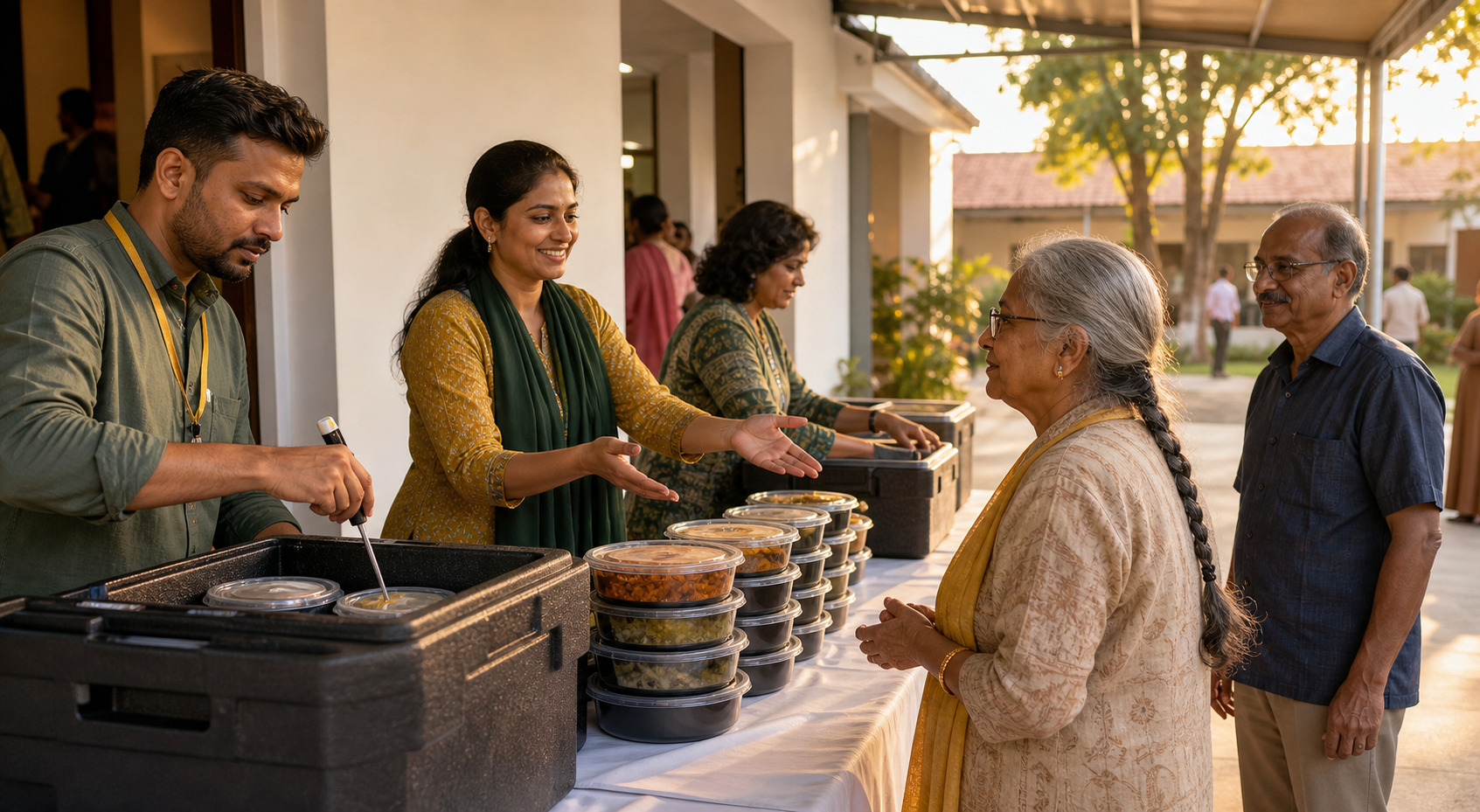
A surplus route works only when somebody owns it. A vague intention to call a shelter later is not a plan. Shelters, elder-care networks, eligible school meal programmes, relief groups, and other community kitchens have their own schedules, capacity limits, dietary needs, and food-safety obligations. Confirm what a partner can receive before placing it on the dispatch list.
For each destination, write down:
- the named contact and a backup contact;
- the kinds of prepared food the organisation can accept;
- the receiving window and likely capacity;
- whether pickup or delivery is expected;
- the containers, insulated transport, or cold-chain arrangements required;
- who records dispatch and confirms receipt; and
- what happens if the destination cannot accept the food.
Mobile prasadam vehicles can extend this network beyond the religious campus, especially where several destinations lie on a known route. Municipal agencies and civil-society groups may also help identify areas where food insecurity is concentrated. The useful question is not simply, “Who might want food?” It is, “Who can receive this particular food safely, promptly, and respectfully?”
Food safety is a hard boundary. Keep surplus intended for redistribution protected from contamination, record how it has been held, use appropriate containers and transport, and follow the applicable local requirements for holding temperatures and delivery. If safe handling cannot be established, do not let moral urgency turn uncertain food into somebody else’s risk. Separate it from the distribution stream and use an appropriate organic-waste route where available.
Dignity is another hard boundary. A recipient should not be required to perform gratitude, disclose hardship publicly, appear in photographs, or participate in worship in exchange for a meal. Explain honestly when food is prasadam or has religious significance, respect the person’s choice to accept or decline it, and preserve the sacred identity of the offering without making nourishment coercive.
When several Dharmic institutions operate nearby, coordination can reduce duplication. Temples, gurdwaras, monasteries, mutts, and community organisations can share a current recipient directory, identify gaps in delivery coverage, and coordinate procurement or dispatch where appropriate. Cooperation need not erase distinct practices. Its purpose is to prevent one kitchen from discarding food while another neighbourhood remains unreached.
Run seva as an accountable system
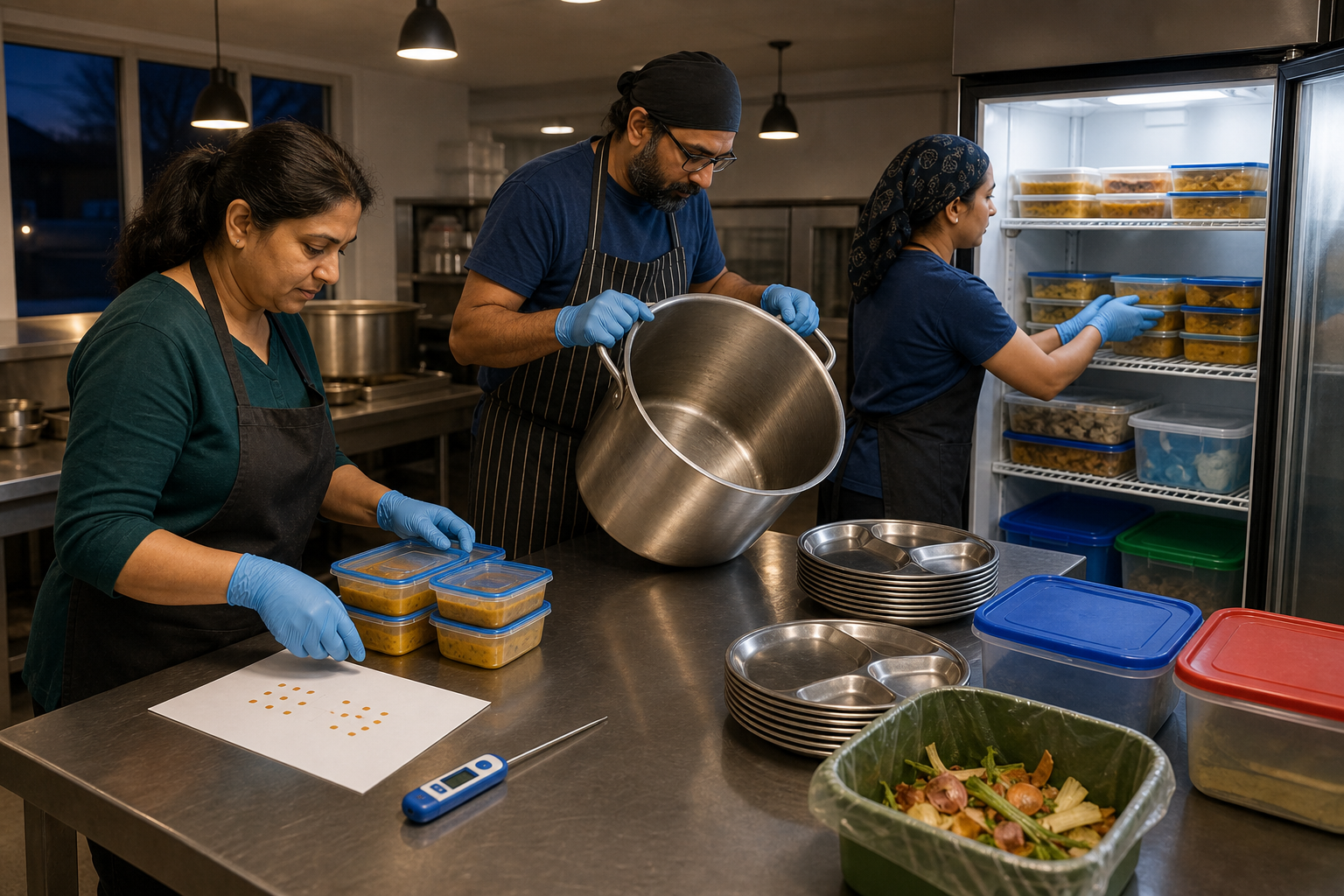
Good intentions are difficult to improve because they are difficult to question. A basic operating record gives trustees, kitchen leaders, donors, and volunteers something more useful than impressions. It shows where demand planning failed, where service slowed, where redistribution worked, and where preventable residuals remained.
| Control | Responsible role | Record | Decision it enables |
|---|---|---|---|
| Demand forecast | Meal coordinator | Expected meals by serving window and basis of estimate | Procurement and initial batch size |
| Live service count | Serving-line lead | Meals served in each window | Start, reduce, delay, or stop the next batch |
| Food-safety handoff | Kitchen lead | Holding, dispatch, destination, and receipt details | Whether surplus is eligible for redistribution |
| Surplus delivery | Redistribution lead | Food redirected and recipient confirmation | Which routes and partnerships remain reliable |
| Organic residuals | Waste-stream lead | Residual type, cause, and final route | Menu, portion, composting, or biogas changes |
Use stable definitions. “Prepared” might mean portions released from the kitchen, while “served” means portions handed to guests. “Redirected” should mean safe, untouched food delivered through the agreed process, not food merely set aside in the hope of collection. Record avoided surplus only when there is a documented baseline; otherwise the number becomes an attractive but unverifiable claim.
The totals also need interpretation. Less redirected food can be a good result if the same need was met and better forecasting prevented excess. A high redistribution total may show a strong delivery network, but it can also reveal chronic overproduction. Measure prepared, served, redirected, and residual food together so that one impressive number does not conceal a weak system.
Boards and managing committees can review these records periodically, include the results in public reporting, and audit whether the stated procedures are actually followed. The purpose is not to embarrass volunteers. It is to turn each event into better planning for the next one and to show donors that food, labour, and funds are being treated as entrusted resources.
For your next community meal, make four decisions before procurement: appoint the kitchen, counting, service, and redistribution leads; define the serving windows; confirm at least one recipient route; and prepare a single tally sheet. After service, identify the point at which surplus arose and change that planning assumption before the next event. That modest discipline is how the aspiration of a welcoming, near-zero-waste Dharmic kitchen becomes everyday seva.
References
