

You may feel drawn to Kali, Shyama, or another form of Devi and still hesitate before the imagery. Is the darkness ominous? Are the severed heads literal? Does serious worship require an elaborate Tantric ritual that you aren’t qualified to perform?
You don’t need to make the Goddess tame, and you don’t need to prove your devotion through ritual complexity. You need an ethical way to read the symbols, one devotional focus, and a practice modest enough to repeat. That combination turns Shakta imagery from spectacle into sadhana.
Read fierce imagery inwardly before applying it outwardly

Shakta iconography often holds apparently opposite truths in one form: dissolution and protection, terror and tenderness, time and maternal care. The tension is deliberate. Devi is not merely comforting the personality you already have; she is confronting whatever keeps you bound.
The name Shyama means the dark or blue-black one. Her darkness evokes the immeasurable depth from which forms arise and into which they disappear. Rather than representing moral evil, the dark radiance points toward unbounded reality. When you contemplate it, notice how quickly the mind tries to fill the unknown with fear, explanation, or fantasy. The first discipline is to remain attentive without immediately grasping for certainty.
Her garland of severed heads is likewise not a license for violence. It represents the cutting of ignorance, attachment, and egoic fixation. Read the fierce imagery as uncompromising inner transformation: what must be severed is bondage, not the dignity or life of another being.
- When you contemplate darkness, notice your demand to control what you cannot yet understand.
- When you contemplate severance, name one attachment, false identity, or recurring reaction that needs to lose its authority over you.
- When you contemplate the fierce Mother, ask where protection is required without hatred or revenge.
- When you contemplate dissolution, identify what you are keeping alive merely because it is familiar.
This inward reading should come first, but it should not reduce Devi to a psychological metaphor. In Shakta worship, she is approached as the Divine Mother and as ultimate reality, not simply as a useful image projected by the mind. Symbolism gives you a disciplined point of entry into that relationship. It does not exhaust the deity’s meaning.
The ethical test is simple. If an interpretation makes you more fascinated with domination, enemies, or occult power, it has missed the maternal center of the image. Fierce compassion cuts through bondage so that life can be protected and dharma served.
Choose one form of Devi instead of collecting practices
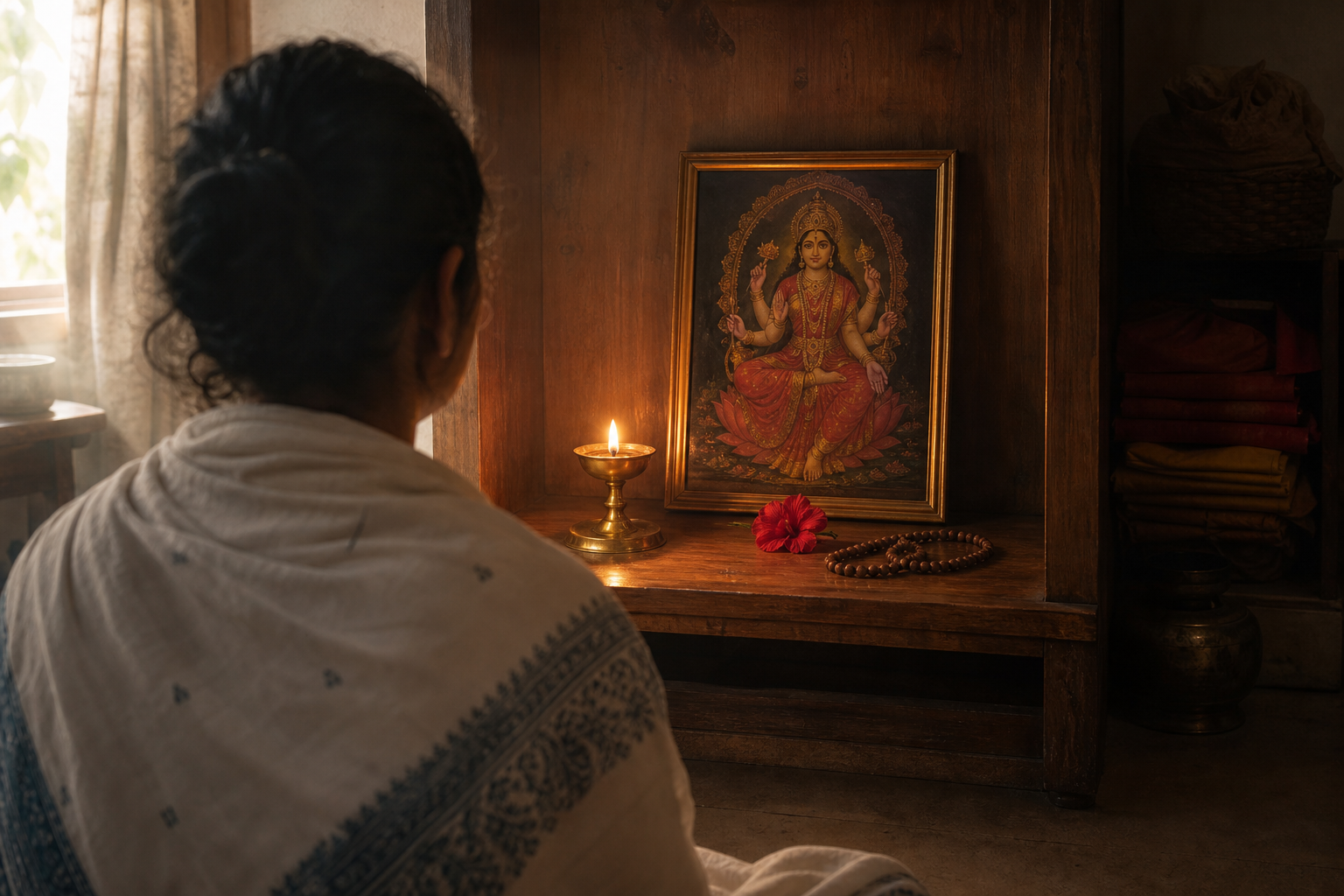
A common beginner’s mistake is to accumulate mantras, images, and correspondences before establishing any continuity. Novelty then impersonates spiritual depth. A better question is not, “Which form is most powerful?” It is, “Which relationship can I approach steadily, reverently, and without pretending to an initiation I have not received?”
Several Mahavidya orientations offer different ways of disciplining the mind. Their correspondences vary by lineage, so treat the distinctions below as aids to discernment rather than rigid assignments:
- Turn toward Tripura Sundari when restless seeking needs harmony, beauty, and concentrated attention rather than further stimulation.
- Turn toward Bhuvaneshwari when emotional constriction needs spacious awareness. Her orientation helps you notice that a difficult thought or feeling appears within consciousness but does not occupy all of it.
- Turn toward Tara when uncertainty needs compassionate guidance. Because Tara belongs to distinct Hindu and Buddhist currents, remain faithful to the method in which a particular mantra or visualization is actually transmitted.
- Turn toward Kali or Shyama when fear, avoidance, attachment, or egoic defensiveness needs courageous confrontation. Her fierceness is not an excuse to cultivate anger; it is a demand that courage become cleaner than anger.
If you already have a guru, a received mantra, or a family or temple tradition, let that living relationship govern your practice. Do not replace it with a collection assembled from disconnected instructions. If you have no such anchor, begin at the public, devotional level: one image, one short prayer or accessible mantra, one count, and one ethical intention.
Build a small daily sadhana that can survive ordinary life

Discipline is not the amount of ritual you can perform on an unusually quiet day. It is the form of practice you can maintain when work is heavy, enthusiasm is low, and nothing dramatic seems to happen. Begin with the smallest complete practice, then protect its regularity.
- Use a clean, uncluttered place. A lamp, water, a flower, or simple sattvic incense is enough; the arrangement should support attention rather than become a display project.
- Sit with a relaxed, upright spine. Use a brief, gentle asana sequence if the body is restless, then allow the breath to become steady without straining or forcing retention.
- State a clear intention. For example: “May this worship remove confusion, restrain harmful impulses, and make my conduct beneficial.”
- Bring one feature of the chosen form to mind. Do not attempt to visualize every detail. Contemplate its meaning and identify the tendency it asks you to relinquish or transform.
- Recite one mantra attentively for 27 repetitions. Keep the pronunciation, breath, and meaning from being sacrificed to speed.
- Remain silent for a short period after japa. Do not immediately reach for a phone, conversation, or another spiritual technique.
- Write one sentence naming the conduct your worship requires that day. Complete that action before returning to the shrine for the next practice.
Short formulas presented for accessible practice include the following:
- Tripura Sundari: Om Aim Hreem Shreem.
- Bhuvaneshwari: Om Hreem Shreem Bhuvaneshwaryai Namah.
- Tara: Om Tare Tuttare Ture Svaha.
- Kali: Om Krim Kalikayai Namah.
Choose one, not all four. If pronunciation, lineage, or suitability is uncertain, ask a qualified teacher or remain with a simple invocation of the Divine Mother’s name. A short public formula is not permission to reconstruct advanced Tantra. Initiated mantra variants, nyasa, yantra worship, and elaborate internal visualizations should not be improvised from fragments.
Stay with 27 repetitions until you can preserve attention and regularity. Moving to 54 is sensible only when the larger count does not make you hurry, skip days, or perform mechanically. More repetition is not progress if the practice becomes less present.
Let sacred timing support the routine, not control it
If lunar timing belongs to your practice, the Moon’s monthly transit through Mrigashira offers one useful container. Mrigashira combines Soma’s cooling quality with the discipline associated with Mars: soften emotional heat while strengthening consistency. Monday and evening practice can also support that cooling orientation.
Shyama or Kali worship has a particularly important observance on the new moon of Kartik, especially in Bengal and eastern India. A sacred night can deepen attention, but it should not trigger a sudden, unsustainable multiplication of rituals. Keep your established form and bring greater care to it.
If you do not follow astrological timing, choose a dependable ordinary time. The calendar is a support for remembrance, not an excuse to postpone worship until conditions feel cosmically perfect.
Judge the practice by your conduct after worship

The shrine reveals your intention; ordinary relationships reveal whether that intention has entered your character. If you invoke the fierce Mother but become more contemptuous, impulsive, or eager to humiliate others, ritual intensity is masking ethical failure.
Use four questions at the end of the day:
- What did I defend today: dharma, another being, or merely my self-image?
- Which attachment governed my speech even after I had named it during worship?
- Where did fear disguise itself as caution, and where did anger disguise itself as courage?
- Did my sadhana reduce harm and produce a concrete act of service?
These questions connect symbolism to dharmic action. Ahimsa prevents fierce imagery from becoming a pretext for aggression. Seva prevents contemplation from becoming self-absorption. Courage prevents non-harm from becoming passive indifference. The same practical movement toward non-attachment, compassion, service, and protective strength also creates a meaningful point of encounter among Hindu, Buddhist, Jain, and Sikh paths without pretending that their philosophies or practices are identical.
Watch for warning signs in your own approach: fixation on powers, hostility toward other paths, escalating ritual complexity, neglect of duties, or using secrecy to avoid honest questions. When these appear, do not add another mantra. Return to a simple devotional practice, restore ordinary responsibilities, and seek guidance from a trustworthy teacher grounded in a living lineage.
Key takeaways
- Read Shakta fierceness as the destruction of ignorance, egoic bondage, and fear, never as permission for cruelty.
- Choose one form of Devi according to your actual spiritual need and the tradition available to guide you.
- Begin with a clean place, gentle preparation, one intention, one mantra, 27 attentive repetitions, silence, and one action.
- Increase a count only when attention and continuity remain intact; mechanical volume is not deeper sadhana.
- Measure worship through speech, restraint, courage, non-harm, and service after you leave the shrine.
At your next sitting, choose one symbol and one habit it asks you to surrender. Keep the ritual restrained, complete the corresponding action, and return the next day. That quiet continuity is where Shakta symbolism begins to become lived sadhana.
References
- DharmaRenaissance Blog – Ultimate Mrigashira Nakshatra Sadhana: Master Mahavidya Upasana for Transformative Clarity
- DharmaRenaissance Blog – Essential Guide to Goddess Shyama: Discover the Proven Paradox of Love and Terror in Hindu Tradition
