

You may enjoy dressing carefully, arranging a beautiful place for worship, or choosing a pleasing fragrance, yet still wonder whether such attention belongs in bhakti or merely feeds vanity. Gopi bhakti does not settle that question by praising either ornament or plainness. It asks something more searching: whose happiness is your care organized around?
That question can change the way you approach far more than appearance. Clothing, speech, work, and hospitality can all become forms of seva. But an attractive choice is not devotional merely because you call it an offering. Its motive, manner, and effect must actually turn your attention toward Krishna and the well-being of those you serve.
The decisive question is not what you wear, but whom it serves

Caitanya-caritāmṛta, Adi-līlā 4.181, treats the gopīs’ love as incomparable and presents their adornment as care undertaken for Krishna’s happiness rather than personal display. Attire, ornaments, and fragrance have not ceased to be material things. What has changed is their center of gravity. They are gathered into a relationship of loving service.
This is the key to devotional aesthetics. Beauty is not automatically sacred, but neither is it automatically a distraction. The same careful appearance can serve very different desires. One person may seek approval, comparison, or control. Another may be preparing attentively for worship, receiving a guest with honor, or bringing dignity to a responsibility. The visible act does not reveal the whole spiritual meaning.
Plainness is not a guaranteed sign of humility either. A person can become proud of appearing austere just as easily as another becomes proud of ornamentation. Gopi bhakti therefore gives you a better measure than elaborate versus simple: does the act end in self-importance, or does it deepen loving attention to the Beloved?
This does not make craftsmanship or refinement irrelevant. If an act is meant to give joy, its execution matters. Carelessness does not become detachment simply because the devotee uses spiritual language. At the same time, cost and complexity are not measures of prema. An appropriate, attentive offering can be simple. Its beauty lies in how completely it serves its recipient.
Four tests that distinguish an offering from self-display

No checklist can certify the purity of a heart. These four questions can, however, expose the direction in which a choice is moving you. Use them before an act of adornment, presentation, or hospitality rather than waiting until pride or disappointment has already taken over.
- Who is the intended recipient? Name the person or Divine presence your care is meant to serve. Krishna, a deity in worship, a guest, a congregation, a family member, or a person receiving your work is more precise than the vague thought that you are doing something spiritual. If you cannot identify a recipient beyond yourself, do not rush to label the act seva.
- Would the act remain worthwhile without human praise? Ask whether you would still prepare with care if nobody complimented your appearance, taste, or effort. A desire for appreciation may arise; noticing it honestly is more useful than pretending it is absent. The diagnostic question is whether praise has become the payment you require.
- What does the act produce in you? Devotional care should make you more attentive, generous, and available for service. If it leaves you preoccupied with comparison, photographs, status, or whether others noticed, the act may have drifted from offering toward performance.
- Can the form change when service requires it? You may plan something elaborate and then discover that a simpler choice better suits the recipient, time, place, or duty. If changing course causes resentment because your preferred display will be lost, attachment to the form may have displaced love for the person being served.
The point is not to interrogate every harmless preference until joy disappears. It is to catch a common substitution: beginning with the wish to give delight, then quietly making your own recognition the main event. When you notice that shift, return to the recipient and choose again.
A repeatable way to bring aesthetics into daily seva
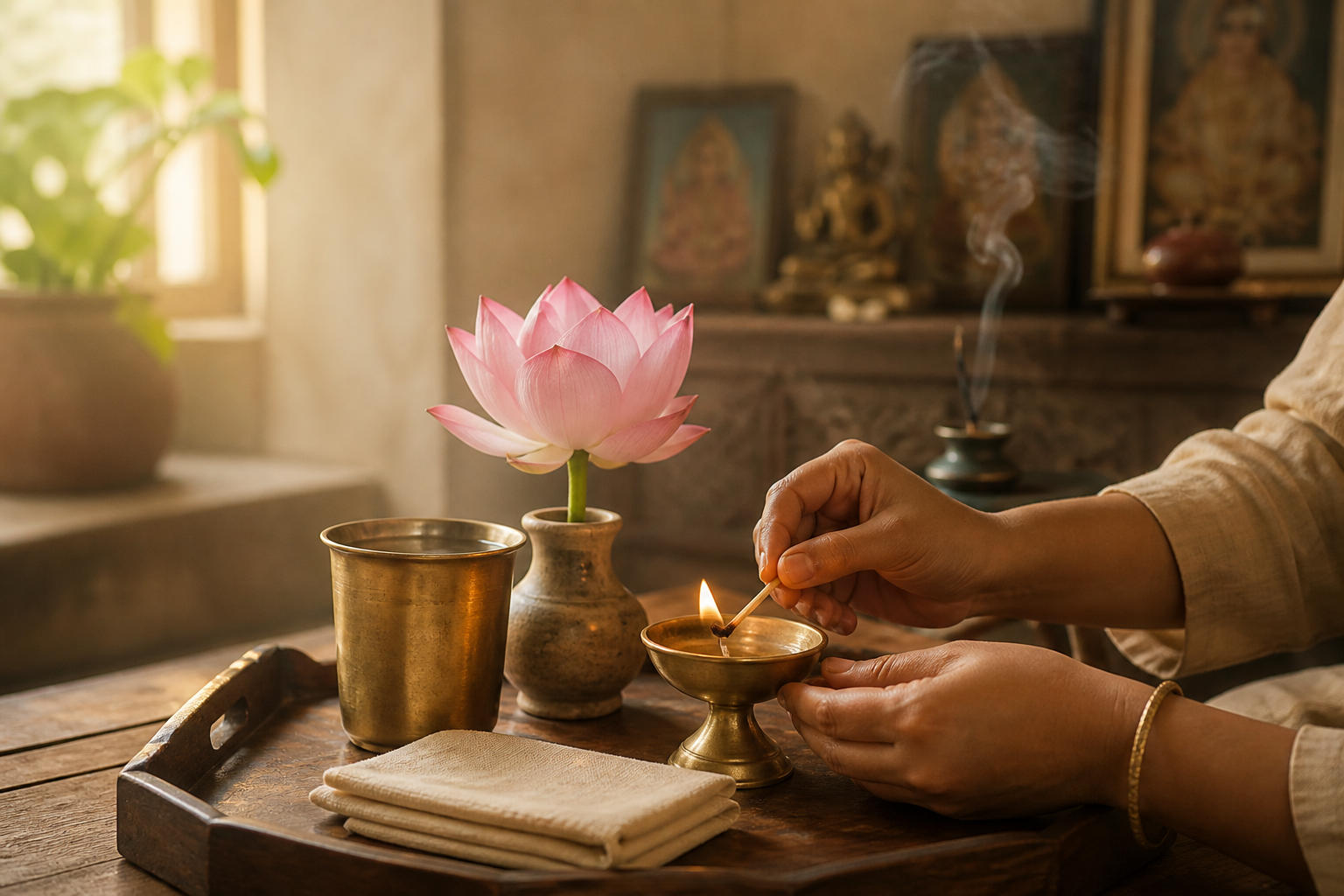
The gopīs’ example becomes practical when intention is joined to conduct. A private devotional resolution, or sankalpa, can reorient an ordinary task before habit and self-consciousness take control. The resolution should be specific enough to govern what you do next.
- State the offering. Before dressing, working, speaking, or preparing to receive someone, complete one clear sentence: May this care give joy to Krishna and benefit the person before me. Adapt the words to your own form of practice, but keep an actual recipient in view.
- Choose a fitting form. Select what serves the occasion rather than what displays the most effort. In clothing, that may mean cleanliness and appropriateness. In speech, it may mean accuracy joined with gentleness. In work, it may mean an orderly and complete result. In hospitality, it may mean noticing what will make another person feel received rather than showcasing your taste.
- Give the act undivided attention. Devotional aesthetics is not decoration pasted onto distraction. Attend to the arrangement, words, fragrance, timing, or finish that carries your care. This attention turns a vague good intention into embodied service.
- Connect beauty to usefulness. Ask what the refinement enables. Does the prepared space support remembrance? Does your manner of dress honor worship? Does your tone help another person hear a difficult truth? Does your work reduce confusion for the person who will use it? Beauty becomes hospitality when it helps another being receive care.
- Release the demand for a particular response. The recipient may not praise the offering or react as you imagined. Complete the service without fishing for reassurance. Afterwards, review whether the act made you more loving and less possessive. Use the answer to refine the next offering.
You can apply this sequence to one routine instead of trying to sacralize your entire schedule at once. Choose the act in which self-consciousness most often appears: getting ready for pūjā, arranging the altar, welcoming visitors, writing a message, or completing a visible piece of work. A focused practice will reveal your motives more clearly than a broad declaration that everything you do is for Krishna.
Self-forgetfulness is not self-neglect
The gopīs’ selflessness does not make the body, mind, or senses enemies of devotion. Their faculties and possessions are engaged in service. Self-forgetfulness means that the self is no longer treated as the final beneficiary of every beautiful act. It does not require contempt for the body, denial of personal taste, or deliberate carelessness.
This distinction protects you from two opposite mistakes. The first is assuming that neglect is spiritual simply because it looks detached. The second is assuming that any desired experience becomes devotional once the word seva is attached to it. Gopi bhakti supports neither shortcut. It asks for conscious care without self-enthronement.
Three warning signs deserve particular attention:
- Applause replaces offering. You spend more energy monitoring reactions than attending to Krishna or the person being served.
- Accumulation replaces care. Acquiring another object, garment, or ornament becomes more important than using what you already have in service.
- Perfectionism replaces love. A minor aesthetic flaw makes you harsh, impatient, or dismissive toward the very people the offering was supposed to benefit.
When one of these appears, you do not have to abandon beauty. Simplify the form, restore attention to the recipient, and complete the service without dramatizing the correction. The ability to relinquish a preferred presentation can itself become an act of devotion.
A shared dharmic discipline without erasing distinct paths

The conversion of intention into disciplined conduct has recognizable parallels across dharmic traditions. Hindu bhakti emphasizes seva and surrender. Buddhist practice cultivates mettā and karuṇā. Jain discipline joins ahiṃsā to restraint. Sikh tradition gives central importance to seva and remembrance of the Divine. These paths are not interchangeable, and their teachings should not be collapsed into a single theology. They nevertheless show how inner orientation must become visible in the way a person treats living beings.
This is useful when you speak about gopi bhakti in a religiously diverse setting. You do not need to claim that every tradition understands Divine love, selfhood, or liberation in the same way. Begin with the more precise connection: intention is spiritually serious when it disciplines action. Compassion, restraint, remembrance, surrender, and service each prevent spirituality from remaining a private feeling without ethical consequence.
Gopi bhakti contributes a distinctive insight to that wider dharmic conversation. It shows how beauty can be offered rather than possessed. The question is not simply whether something looks pleasing. The question is whether your attention, faculties, and resources have become instruments of loving communion.
Key takeaways
- Adornment in gopi bhakti is devotional when it is directed toward Krishna’s joy, not personal display.
- Neither ornamentation nor plainness proves humility; motive, attention, and effect are the better tests.
- A concrete sankalpa helps turn clothing, speech, work, and hospitality into deliberate seva.
- If praise, accumulation, or perfectionism becomes the main concern, simplify the form and return attention to the recipient.
- Self-forgetfulness means decentering personal reward, not despising the body or neglecting ordinary responsibilities.
The next time you prepare for worship, work, or the arrival of a guest, pause before making the aesthetic choice. Name whom it serves, choose the form that genuinely helps, and let go of the demand to be noticed. That small shift is where beauty begins to become seva.
References
