

If you have met the Lord of Pandharpur as Vithoba, Vitthal, Vittala, Panduranga, Mauli or Pandharinath, you may wonder whether these are interchangeable names or competing explanations. The distinction matters. In Pandharpur Bhakti, a sacred name does more than identify the deity. It tells you how to approach him.
Read these names as instructions for devotion and they become immediately practical. One teaches you to wait. Another turns family care into seva. Another makes the divine as near as a mother. Another reminds you that pilgrimage means belonging to a community, not merely reaching a temple.
Why one deity has so many sacred names
A dictionary approach asks which name is the correct one. A Bhakti approach asks what kind of relationship each name opens.
Pandharpur itself has a layered naming history. Older regional forms, local place-names and devotional usage in Marathi and Kannada do not yield one uncontested derivation. Pandhari, however, has a clear life within devotion: it is an intimate name for the sacred town, not simply a shorter entry on a map.
That difference is worth noticing. Pandharpur can name a destination. Pandhari evokes a place to which devotees belong. The recurring Vari and Palkhi traditions make that belonging visible through walking, singing, service and shared food. Villages, occupations and social backgrounds meet on the road and at the kshetra. Bhakti is therefore carried not only in private feeling but also in the discipline of moving with others.
The landscape participates in this devotional language. The Chandrabhaga, also known as the Bhima, bends beside Pandharpur in a crescent shape. Bathing, riverside kirtan and gathering at the ghats join geography to worship. If you visit, caring for the riverbank and leaving the ghat cleaner than you found it are not secondary acts. Reverence for a sacred river is incomplete when ritual attention is separated from responsibility for the place.
When you encounter any name of Vithoba, ask three questions:
- Does this name foreground a place, a form, a relationship or an action?
- What does it reveal about the way the devotee approaches the divine?
- What conduct would make the name visible in ordinary life?
Those questions keep sacred names from becoming a list to memorize. They turn vocabulary into sadhana.
Vithoba on the brick: devotion that does not abandon duty
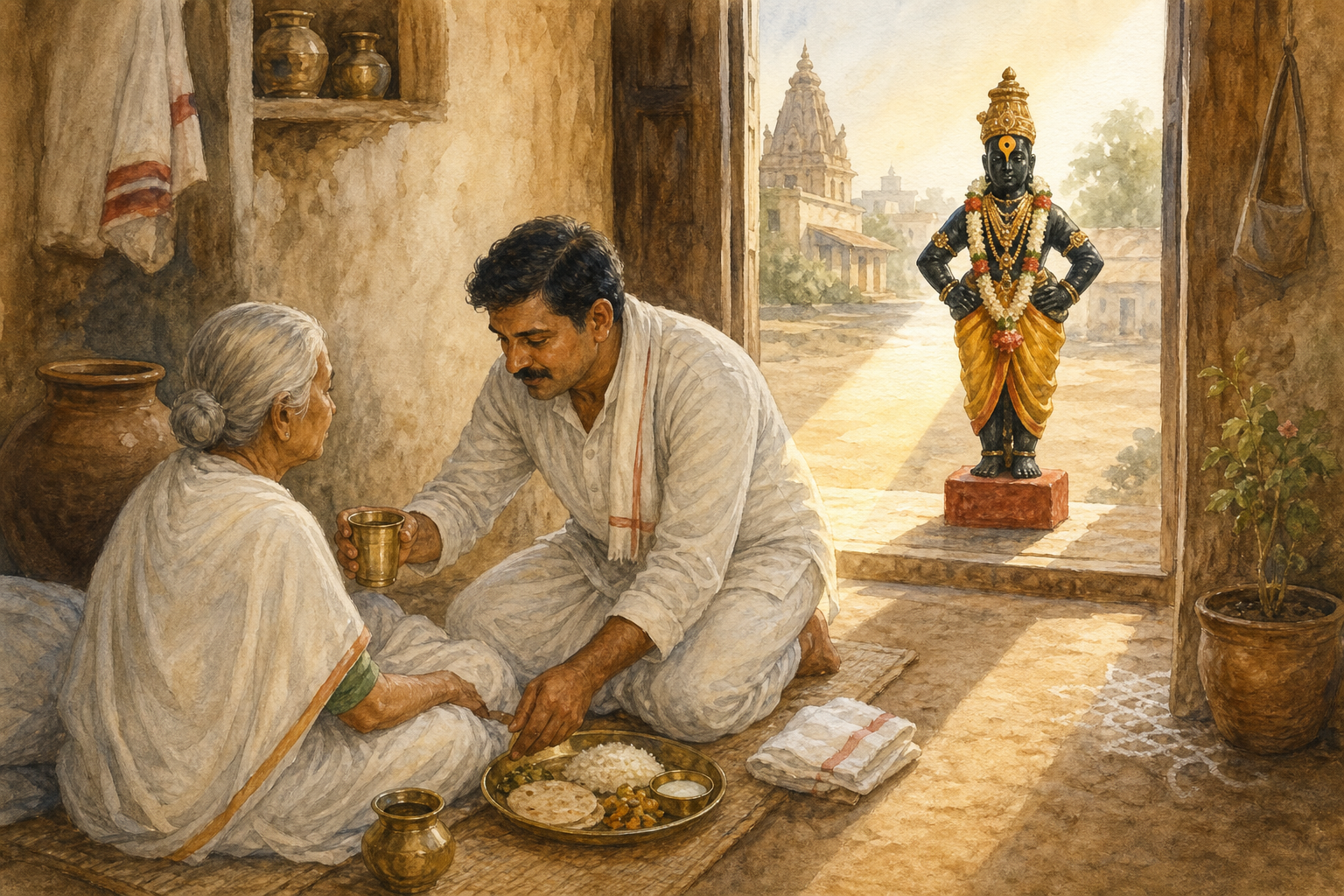
A widely received devotional explanation connects Vitthal with vit, the brick, and -ba, father. It recalls Pundalik, whose service to his parents was not cast aside when the Lord arrived. He offered a brick on which the deity could stand and wait.
The brick is theology compressed into an everyday object. It represents steadiness, divine patience and accessibility. Vithoba is not imagined as a remote ruler who demands that legitimate responsibility be abandoned for religious display. He is the God who waits while seva is completed.
This corrects a common mistake in spiritual life: treating inconvenient duties as obstacles to devotion. Feeding someone who depends on you, caring for an ageing parent, keeping a promise or completing honest work may be the place where devotion is tested. Pundalik’s example does not mean that every family demand is righteous, nor does it require tolerating harm. It means that genuine care should not be dismissed merely because it interrupts the religious activity you had planned.
The black-stone murti’s hands-on-hips posture deepens this teaching. Devotees read it as readiness, guardianship and firm presence in the lives of householders. Vithoba is steady without being distant. His waiting is active rather than indifferent.
Use the name Vitthal when prayer and responsibility appear to compete. Before asking what ritual you have missed, ask who is presently waiting for your honest care. Complete the rightful duty without resentment, then offer the act itself. That is closer to the brick’s meaning than repeating its story while neglecting the person beside you.
Panduranga: let the paradox correct shallow literalism
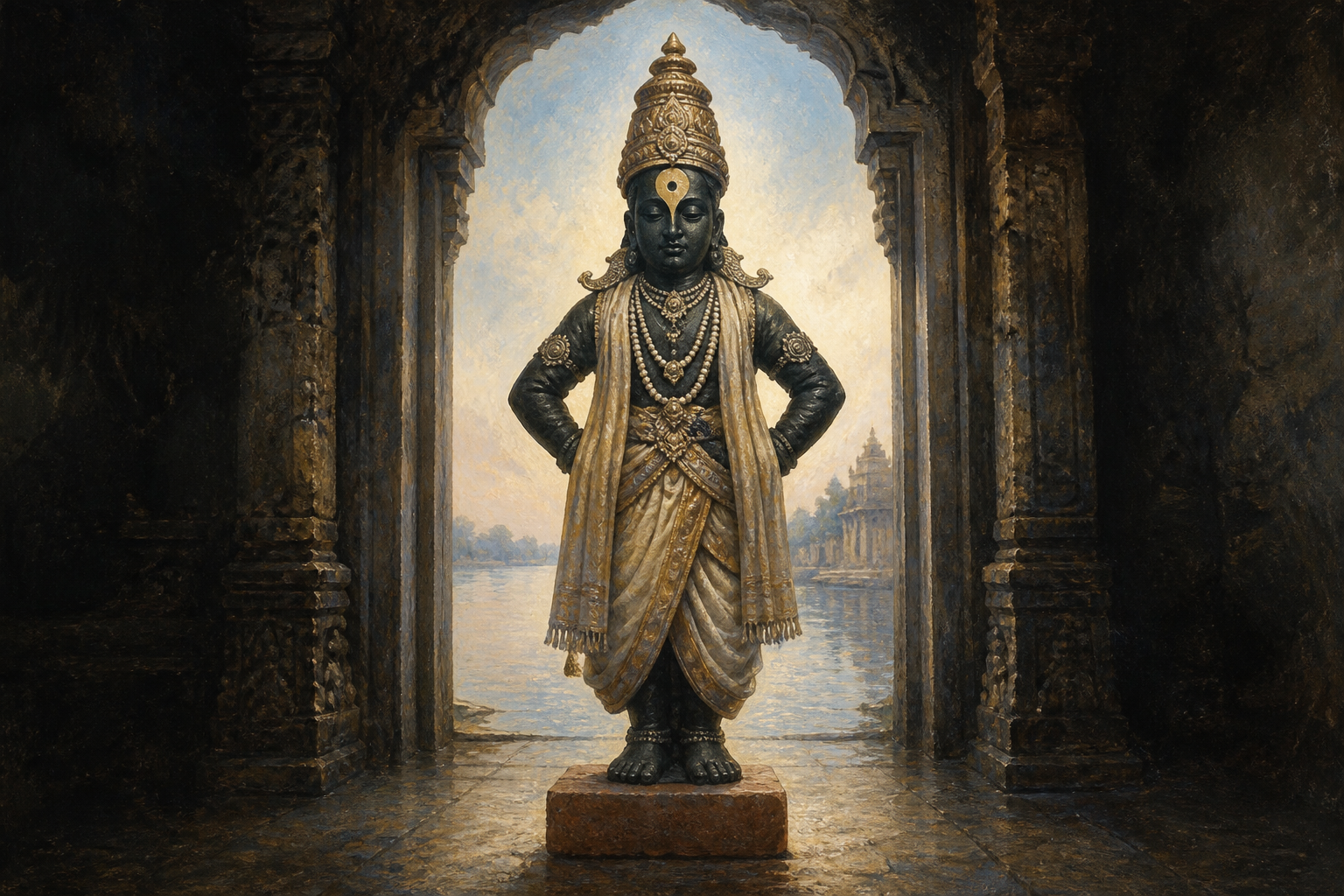
Panduranga resists a single neat explanation. One interpretation relates pandu, pale or white, to ranga, colour or hue. Other interpretations connect the name more closely to the locality and its devotional language. The uncertainty should be preserved rather than hidden behind a confident but oversimplified etymology.
The colour interpretation creates a striking tension because Pandharpur’s murti is black stone. Bhakti does not have to solve that tension as if it were a defective description. The paradox prevents the mind from reducing the deity to one visible attribute. The form gives attention a home; the name reminds attention that the divine is not exhausted by the form.
This is a useful way to contemplate Panduranga. First attend carefully to the murti as a definite, embodied presence. Notice the stance, the stone and the waiting on the brick. Then allow the name’s luminous associations to widen your attention toward compassion that cannot be confined to colour, material or category. The movement is not away from form. It is from form toward depth.
You do not need to choose between loving a particular form and acknowledging transcendence. Pandharpur Bhakti holds both together. Its intimacy is precise, yet its meaning remains larger than any literal description.
The names form a vocabulary of relationships
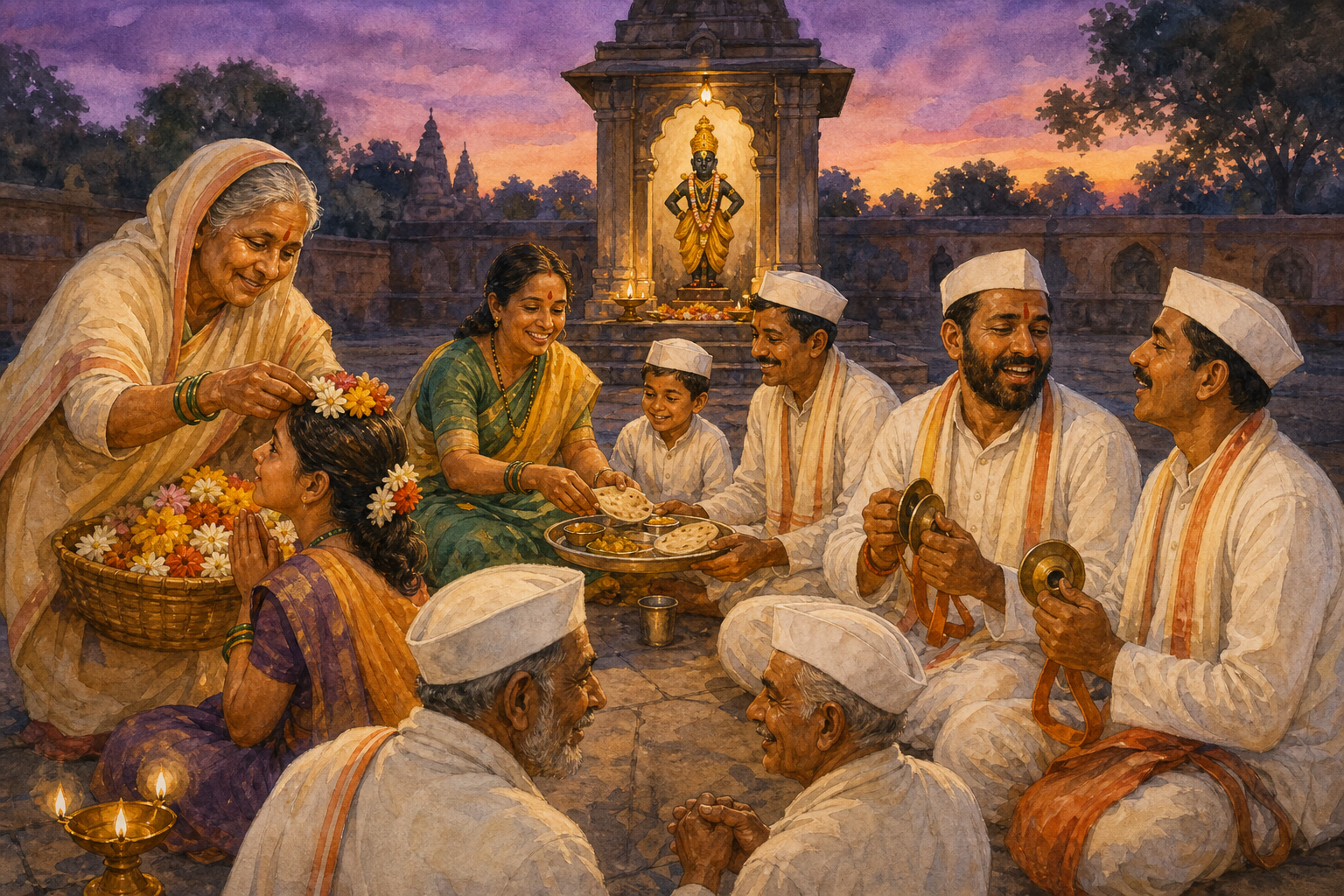
Several names become clearer when you place them beside the relationship or responsibility they foreground. They are not separate gods, nor merely decorative titles. They are different ways of standing before the same divine presence.
| Sacred name | Relationship it foregrounds | What you can practise |
|---|---|---|
| Pandhari | The sacred place experienced as home and community | Participate, share and care for the pilgrimage space instead of behaving only as a spectator. |
| Pandharinath | The Lord and guardian of Pandhari | Protect the shared conditions that allow worship, hospitality and belonging to flourish. |
| Pundalikavarada | The boon-giver to Pundalik | Treat selfless care as an offering rather than an interruption to spiritual life. |
| Mauli | The divine approached as mother | Seek refuge without pretence, then become a source of patient protection for someone else. |
| Rakhumai-Raya | Vitthal with Rukmini as Rakhumai | Practise reciprocity, fidelity and cooperation instead of imagining spiritual strength as solitary power. |
| Hari, Keshava and Krishna | Pandharpur within the wider Vaishnava inheritance | Recognize the local form as deeply rooted in a larger devotional vocabulary. |
Mauli may be the most tender of these names. It literally means mother. Calling Vithoba Mauli changes the emotional grammar of worship: the devotee is not approaching a distant abstraction but a source of shelter, protection and care. The name also makes a demand. If you receive the divine as Mauli, your own conduct should become less harsh toward those who seek safety from you.
Rakhumai-Raya directs attention toward complementarity. Vitthal and Rakhumai present divine life through relationship, fidelity and the reciprocity of energies often personified as masculine and feminine. This symbolism should not be reduced to a rigid social hierarchy. Its devotional force lies in cooperation: fullness is expressed through relationship, not domination.
Hari, Keshava and Krishna connect Pandharpur with the wider Vaishnava world. Dnyaneshwar and Tukaram carried such names through abhangas in which philosophical insight and emotional devotion meet in song. An abhanga is therefore not background music added to pilgrimage. It is a way of learning, remembering and sharing theology without separating knowledge from love.
Pandharpur’s moral vocabulary also has recognizable resonances across Dharmic paths: seva in Sikh practice, daya in Jain practice and karuna in Buddhist practice all affirm responsibility toward others. Congregational singing and recitation likewise appear in distinct forms across these traditions. Resonance does not mean sameness. Each tradition retains its own theology, discipline and history. The useful point is narrower: devotion repeatedly matures into compassion and communal responsibility.
Make one sacred name a daily discipline

You do not need an elaborate programme to begin. Use a simple pattern: one name, one meaning, one act.
- Choose the name that meets your actual condition. Use Vitthal when impatience is making you force an outcome, Pundalikavarada when care feels burdensome, Mauli when refuge or tenderness is needed, or Pandharinath when a shared space requires protection.
- Recall one precise meaning. Do not rush through a string of names. Hold one image clearly: the brick, the maternal shelter, the guardian of Pandhari or the partnership of Vitthal and Rakhumai.
- Attach the name to one visible action. Wait without hostility, complete an act of care, repair a neglected common space, share food, or make a decision cooperatively.
- Review conduct rather than mood. At the end of the day, ask whether remembering the name changed how you treated someone. A devotional feeling may come or go; the ethical act gives the practice a stable measure.
- Return the name to the community. When possible, join abhanga, kirtan, pilgrimage or service with others. Pandharpur Bhakti is intimate, but it is not meant to remain sealed inside the individual.
This method also prevents a subtle form of spiritual consumption. Collecting meanings can become another way of avoiding transformation. The purpose of learning that Mauli means mother is not merely to possess the translation. It is to approach Vithoba with trust and to make your own presence more protective. The purpose of recalling the brick is to become steadier when another person’s need interrupts your convenience.
Key takeaways
- Vithoba’s names are best read as distinct relationships and disciplines, not as rival labels.
- Vitthal and the brick place responsible seva inside spiritual life rather than outside it.
- Panduranga’s colour paradox keeps devotion attentive to form without confining the divine to a literal description.
- Mauli, Pandharinath, Pundalikavarada and Rakhumai-Raya turn care, guardianship, service and reciprocity into forms of Bhakti.
- Pandhari is encountered fully when pilgrimage includes communal song, shared responsibility and care for the sacred landscape.
The next time you say Vitthal, resist the urge to hurry through every title you know. Choose one name and carry its meaning into one duty that day. In Pandharpur Bhakti, the name moves from the lips into life when your conduct begins to resemble what you invoke.
References
