

You may revere Vāmana, Govinda, Nārāyaṇa, Varāha, or another form of Vishnu and still wonder how the forms relate. Are they separate gods, symbolic roles, or incomplete portions of one distant Absolute? And when devotees call Vishnu the protector, does that mean escape from trouble, restoration of dharma, liberation from bondage, or all of these?
The Bhagavata tradition gives you a precise way to hold these questions together. Vishnu’s manifestations remain fully divine, protection operates at more than one level, and divine rescue reaches its deepest meaning when it redirects the jīva toward surrender, service, and moksha.
Key takeaways
- Forms within viṣṇu-tattva are not finite jīvas promoted to divine status. They are divine manifestations described through the categories of svāṁśa and kalā.
- The jīva is vibhinnāṁśa: an individuated, dependent living being. This preserves intimacy with the Supreme without erasing the distinction between the worshipper and the worshipped.
- Vishnu’s protection can restore cosmic order, rescue a being in immediate danger, and sever the ignorance that sustains bondage.
- Śaraṇāgati is not passive resignation. Gajendra remembers, calls, offers, and entrusts the outcome to Vishnu.
- Bhakti becomes practical when remembrance produces courageous duty, humility, ethical restraint, and seva.
One Supreme appears as many without becoming divided

Begin with the distinction between svāṁśa-kalā and vibhinnāṁśa. In the theology associated with Srimad Bhagavatam 3.21.32, Vāmana, Govinda, Nārāyaṇa, Pradyumna, Vāsudeva, and Ananta belong within viṣṇu-tattva. These manifestations are svāṁśa-kalā forms of the Supreme. Ordinary living beings are vibhinnāṁśa.
Svāṁśa indicates a plenary divine portion. Kalā points to a particular feature, function, or mode of divine manifestation. Vibhinnāṁśa identifies the separated, individuated jīva, who remains finite and dependent. The terms do not describe several beings on one ascending ladder of spiritual power. They identify a categorical distinction between the fully divine manifestations of Vishnu and the dependent living beings who turn toward him.
This is where the English word partial can mislead you. A particular function may be manifest through a kalā, but that does not make the form a defective fraction of God. The form remains within viṣṇu-tattva. Limitation belongs to the jīva; it should not be projected onto Vishnu’s manifestations.
Use a simple reading discipline whenever you encounter a divine form. First identify the level of being: is the passage speaking about a dependent jīva or a manifestation within viṣṇu-tattva? Then identify the function being revealed: creation, preservation, protection, instruction, or another divine activity. Finally, notice the relationship the manifestation invites from the devotee. This prevents two common errors: treating Vishnu’s forms as rival deities, or dissolving their distinct names and relationships into an abstraction.
The distinction also changes your conduct. If you are vibhinnāṁśa, dependence on the Supreme is not a humiliation to overcome; it is a truth to inhabit wisely. You can worship a chosen form with full attention while honoring other forms within viṣṇu-tattva. At the same time, you cannot claim divine status as an excuse for pride, domination, or exemption from duty.
Vishnu’s protection works at several levels

Protection in the Bhagavata tradition is larger than personal comfort. It may defend the world against disorder, save a being who has exhausted ordinary strength, or remove the deeper ignorance that keeps the jīva bound. Varāha and Gajendra Moksha make these levels visible.
Varāha restores the conditions of dharma
Hiraṇyākṣa represents defiance, disorder, and spiritual forgetfulness. Varāha does not merely defeat an opponent; he protects the Earth and restores cosmic order. Protection here means bringing a disordered world back into alignment with dharma.
That gives you a demanding test for action. Before asking whether your side has won, ask whether truth, responsibility, and care have been restored. Courage mixed with arrogance can reproduce the disorder it claims to oppose. Humility used as an excuse for inaction can abandon the very duty that protection requires. The Bhagavata ideal holds courage and humility together: act firmly, but do not make yourself the ultimate center of the action.
Gajendra receives immediate protection
Gajendra faces a danger he cannot overcome through continued struggle. His appeal is not vague religious sentiment. He directs himself toward the Divine and raises a lotus with his trunk. Vishnu arrives on Garuḍa, receives Gajendra’s offering, and uses the Sudarśana Chakra to end the crocodile’s grip.
The sequence matters. Gajendra does not manufacture control over the outcome, but neither does he become spiritually inert. He recognizes his limit, remembers, calls, and offers what remains available to him. His surrender is active because attention, intention, and offering are still possible even when physical power fails.
The Sudarśana Chakra points beyond survival
The crocodile can be read as more than an external animal. It evokes the tenacity of worldly entanglement and the inner afflictions that drag awareness into a repetitive struggle. The lotus represents devotion that remains unstained even in turbulent conditions. The Sudarśana Chakra becomes the liberating force that cuts through avidyā and bondage.
This symbolic reading does not erase the rescue. It reveals why rescue and liberation are connected but not identical. Relief removes the immediate pressure. Liberation addresses the ignorance, attachment, and false self-sufficiency that keep producing bondage. When you pray for protection, therefore, ask not only for the circumstance to change. Ask to see and relinquish whatever keeps fastening consciousness to the same pattern.
Neither episode supports a bargain in which devotion guarantees a life without danger. Varāha enters conflict, and Gajendra reaches the limit of his strength before help arrives. Their situations teach you where to turn and how to act under pressure; they do not turn bhakti into a claim of personal immunity from hardship.
Śaraṇāgati is surrender of pride, not surrender of duty
Gajendra Moksha is often remembered as a story of helplessness, but helplessness alone is not the spiritual achievement. The decisive change is the direction of dependence. Gajendra stops treating his own strength as the final refuge and turns wholly toward Vishnu.
- See the limit truthfully. Surrender begins when you stop pretending that more force, more argument, or more frantic motion must solve everything.
- Gather the attention. Smaraṇa redirects the mind from the grip of the threat toward the Divine. This is not denial of the danger; it is a refusal to let danger become the highest reality.
- Offer what is still yours to offer. Gajendra has a lotus. Your offering may be an honest prayer, a neglected duty completed, an act of restraint, or service to someone affected by the situation.
- Take the dharmic action available to you. Trust in Vishnu does not cancel practical responsibility. Spiritual remembrance should accompany, not replace, the action a real danger requires.
- Receive relief as a call to transformation. If remembrance ends as soon as the pressure ends, the crisis has produced temporary dependence. If gratitude matures into study, japa, kīrtana, and seva, protection has begun to educate the soul.
This is why bhakti cannot be reduced to emotion. Its ethical signs are concrete: courage without self-glorification, humility without passivity, devotion without escape, and service without the need to control every result. If a devotional interpretation makes you less responsible for the harm around you, it has missed Varāha’s restoration of order. If it makes you rely only on personal force, it has missed Gajendra’s surrender.
The same precision helps when you speak with other Dharmic communities. Buddhist karuṇā, Jain ahiṃsā and anekāntavāda, and Sikh seva and sant-sipahi offer meaningful ethical resonances with Vaishnava protection and service. Respect does not require pretending that every tradition has identical metaphysics. Shared conduct can be honored without erasing the vocabulary through which each path understands ultimate truth.
Turn the theology into a repeatable Bhagavata practice
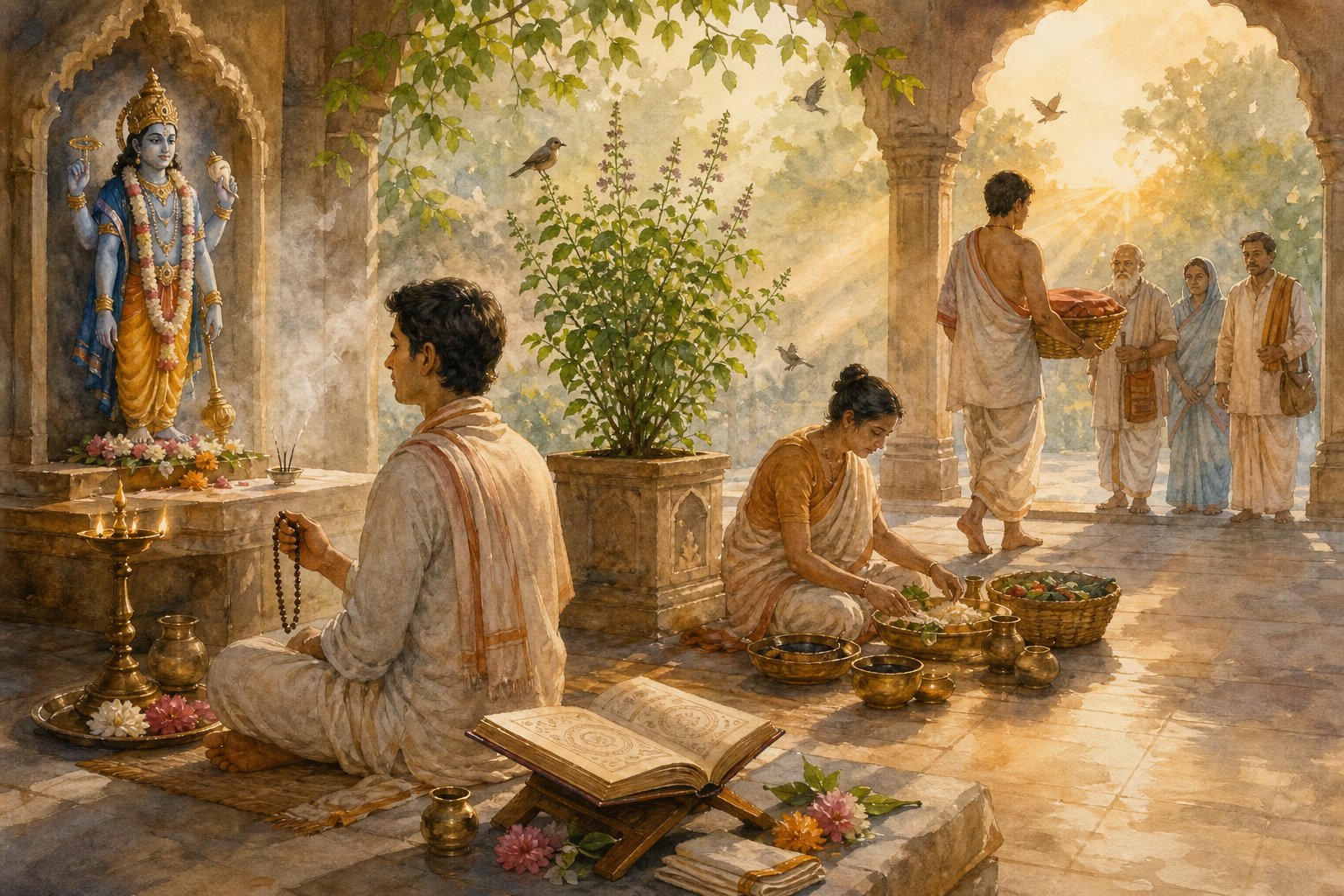
You do not need to wait for an overwhelming crisis to practise the pattern. Use it during scriptural study, japa, conflict, or any moment when fear and control begin to narrow your attention.
- Name the manifestation and the revealed function. When Varāha appears, look for the order being restored. When Nārāyaṇa, Vāmana, Vāsudeva, or another form appears, resist reducing the name to a decorative synonym. Ask what relationship and divine activity the form reveals.
- Separate the outer problem from the inner grip. Describe the circumstance plainly. Then identify the inner crocodile: fear, resentment, pride, compulsive control, or another attachment that keeps pulling your awareness back into struggle.
- Establish focused remembrance. Use a divine name, mantra, verse, or prayer already rooted in your practice. Japa, kīrtana, and dhyāna are not ways to hide from the circumstance; they steady the mind so that your response is not dictated by panic.
- Choose your lotus. Make one concrete offering connected to the situation. Serve, correct a wrong, keep a promise, restrain a harmful impulse, or complete the duty you have been avoiding. An offering becomes spiritually serious when it costs attention and changes conduct.
- Examine the fruit. Ask whether the practice is making you more humble, steady, compassionate, and willing to act for dharma. If it is producing superiority, fatalism, or indifference, return to the distinction between the dependent jīva and the protecting Lord.
A sustainable rhythm joins study, remembrance, and service. Study gives you the categories needed to recognize Vishnu’s manifestations. Remembrance keeps those categories from remaining intellectual. Seva tests whether devotion has entered your choices. Each corrects a weakness in the others: study without service can become pride, remembrance without responsibility can become escape, and service without remembrance can make the ego feel indispensable.
When you next encounter a manifestation of Vishnu, pause and ask who appears, what disorder is being confronted, and what freedom the encounter offers the jīva. Then carry one answer into action. When reverence produces clearer duty, steadier remembrance, and compassionate service, Bhagavata theology has begun to become sādhanā.
References
- Dandavats – Srimad Bhagavatam 3.21.32: Unveiling Divine Expansions and the Unity of Dharmic Paths
- Dandavats – Gajendra Moksha: Lord Vishnu’s Swift Compassion and the Timeless Path to Liberation
- Dandavats – SB 3.19.35 Deep Dive: Adikarta Dasa on Hiraṇyākṣa, Dharma, and Dharmic Unity in Alachua
