
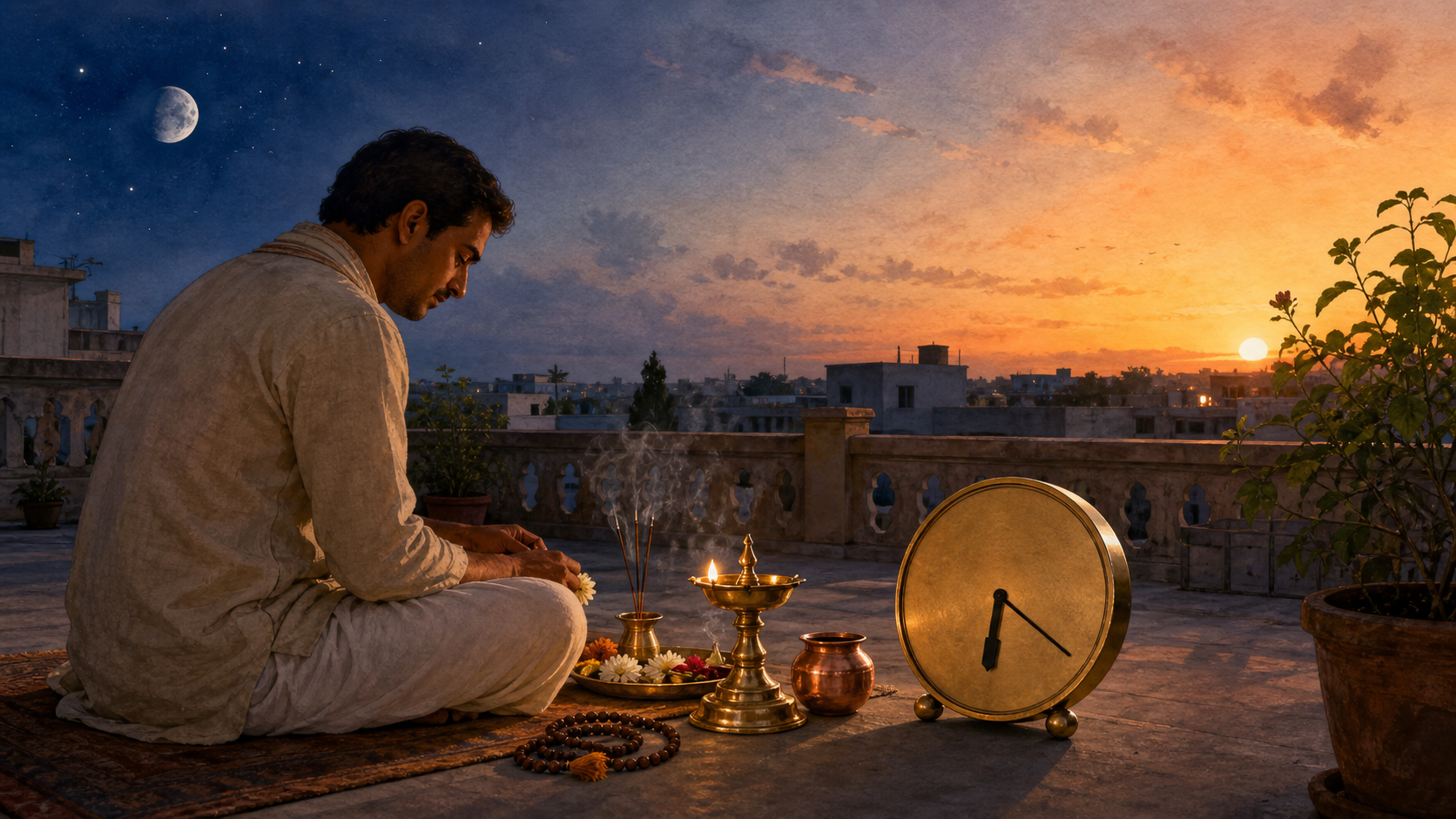
You need one practical answer from the November 11 Panchang: will your prayer, vrata, daan, or sankalpa take place during Krishna Paksha Shashti or Saptami? The answer depends on both the clock and the city in which you will perform it.
On Tuesday, November 11, 2025, Krishna Paksha Shashti continues until 6:21 AM, with Krishna Paksha Saptami beginning immediately afterward. Use 6:21 AM as the working reference supplied for the date, but do not carry it unchanged to another location. Your local sunrise, Nakshatra, Moon sign, and auspicious windows must be checked for the place where the observance will occur.
Key takeaways for November 11
- November 11, 2025 falls on a Tuesday and contains a change of tithi during the early morning.
- The working timetable places Krishna Paksha Shashti up to 6:21 AM and Krishna Paksha Saptami after that point.
- The 6:21 AM boundary identifies a change of tithi. It is not, by itself, a Shubh Muhurat.
- If your prayer must specifically occur during Saptami, begin only after the locally verified Saptami start time rather than relying blindly on 6:21 AM.
- For a formal vrata, sankalpa, daan, temple ritual, or samskara, also verify local sunrise, Nakshatra, Rashi, and the applicable muhurta rule.
Why the tithi changes while the date remains the same

A civil date begins at midnight, but a tithi follows the changing angular relationship between the Sun and Moon. Its boundary can therefore arrive at any clock time. Midnight does not reset it, and one date can contain portions of two different tithis.
That distinction matters on November 11. Under the stated timetable, an act completed before the transition belongs to Shashti; an act begun after the transition belongs to Saptami. Saying that November 11 is simply a Saptami day is convenient for ordinary conversation, because Saptami occupies most of it, but that shorthand is not precise enough for a tithi-sensitive ritual.
Do not mistake the transition itself for an auspicious window. A tithi boundary answers, “Which lunar day is operating now?” A muhurta answers a different question: “Is this interval suitable for the particular act being planned?” The second judgment may also require Nakshatra, the Moon’s Rashi, local sunrise, and the rules of your sampradaya.
Sunrise creates another important checkpoint. Some observances are assigned by the tithi prevailing at sunrise, while others require the desired tithi during a specified portion of the day or at the actual time of worship. If your vrata has such a rule, the fact that Saptami occupies most of November 11 does not settle the matter. Compare the local transition with local sunrise and then apply the rule followed by your family, temple, or lineage.
Match the Panchang precision to the practice
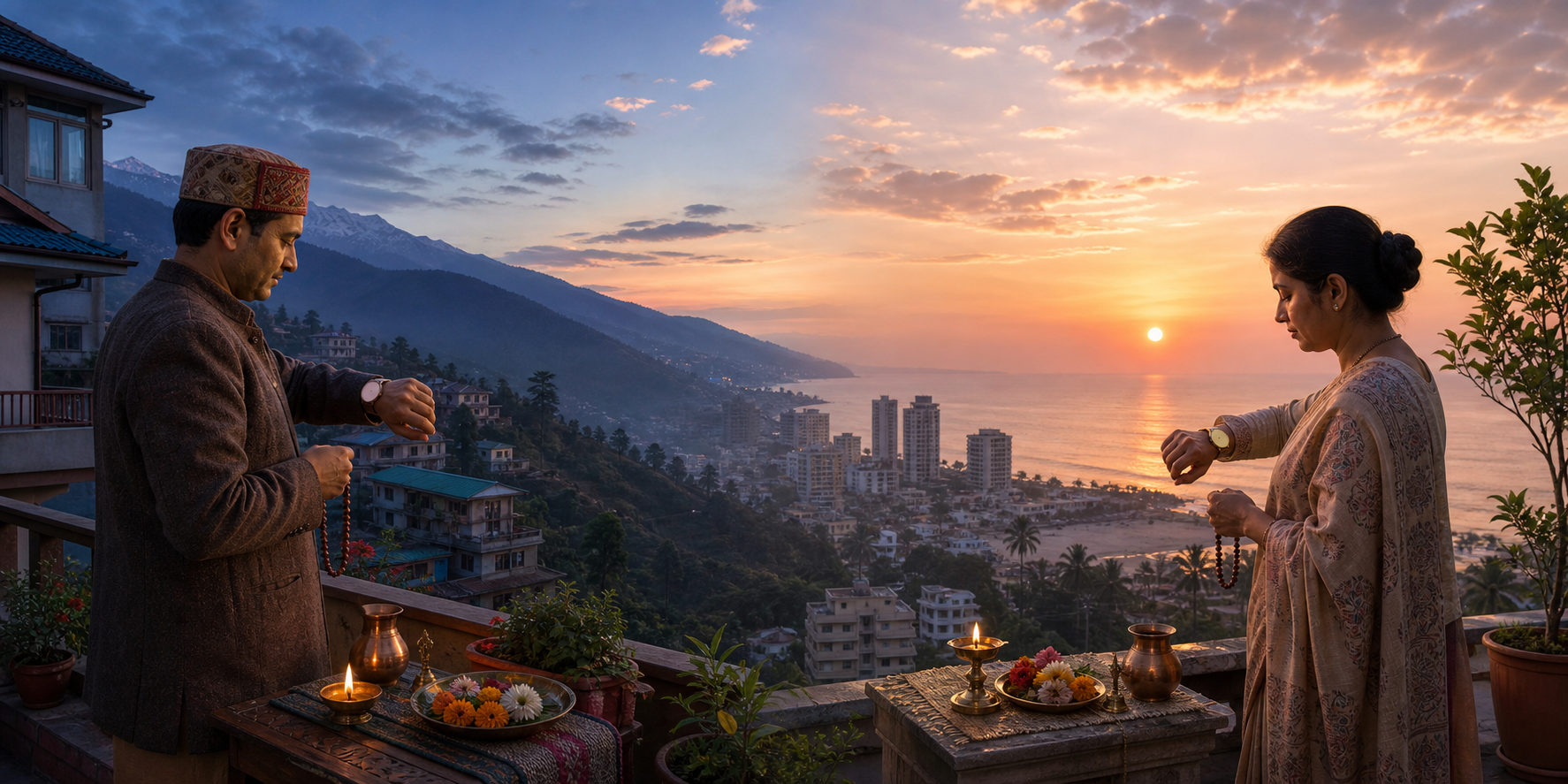
You do not need to turn every daily prayer into a complicated electional calculation. You do need more precision when the validity or naming of an observance depends on a particular tithi. Use the following distinction before deciding how much to check.
| What you are planning | Minimum useful check | What to do on November 11 |
|---|---|---|
| Ordinary home puja, japa, meditation, or scripture reading | Local date and current tithi | If you specifically want a Saptami practice, begin after the locally confirmed transition. Otherwise, keep your regular prayer time. |
| A vrata or sankalpa tied to Saptami | Local sunrise, exact tithi beginning and ending, and the observance rule | Do not decide from the date label alone. Confirm whether your tradition uses sunrise prevalence or another required interval. |
| Daan or a temple visit chosen for an auspicious period | Tithi plus the locally calculated Shubh Muhurat | Treat 6:21 AM only as a possible tithi boundary. Obtain the actual auspicious window for your city. |
| A samskara or another formally timed rite | Full local Panchang factors and guidance from the officiating priest | Confirm Nakshatra, Moon sign, sunrise, tithi, and the rite-specific exclusions before fixing the time. |
A five-step local check
- Set the location to the place where the act will actually occur. If your family is in Bharat but you will perform the puja elsewhere, use your own location rather than the family home’s city.
- Confirm that the Panchang is displaying Tuesday, November 11, 2025 in the correct local time zone. A calendar configured for another city can show a plausible but unusable clock time.
- Find the end of Krishna Paksha Shashti and the beginning of Krishna Paksha Saptami. If your local calculation does not show 6:21 AM, follow the locally calculated boundary.
- Identify the rule attached to your practice. Ask whether it merely requires Saptami at the time of worship, depends on the tithi at sunrise, or uses another part of the day.
- For a formal act, verify the remaining Panchang factors in the same local calendar and confirm the result with the officiating temple or priest. Write down the city, tithi boundary, and chosen interval together so that nobody later substitutes a time from a different location.
Avoid building one schedule from several mismatched settings. Taking a tithi endpoint from one city and a muhurta from another does not produce a more accurate answer. If two calendars disagree, first compare their selected city, time zone, sunrise, and calendrical convention. Do not average the two times. For a rite whose correctness matters, follow the regional authority or priest responsible for conducting it.
A simple dharmic plan for the day
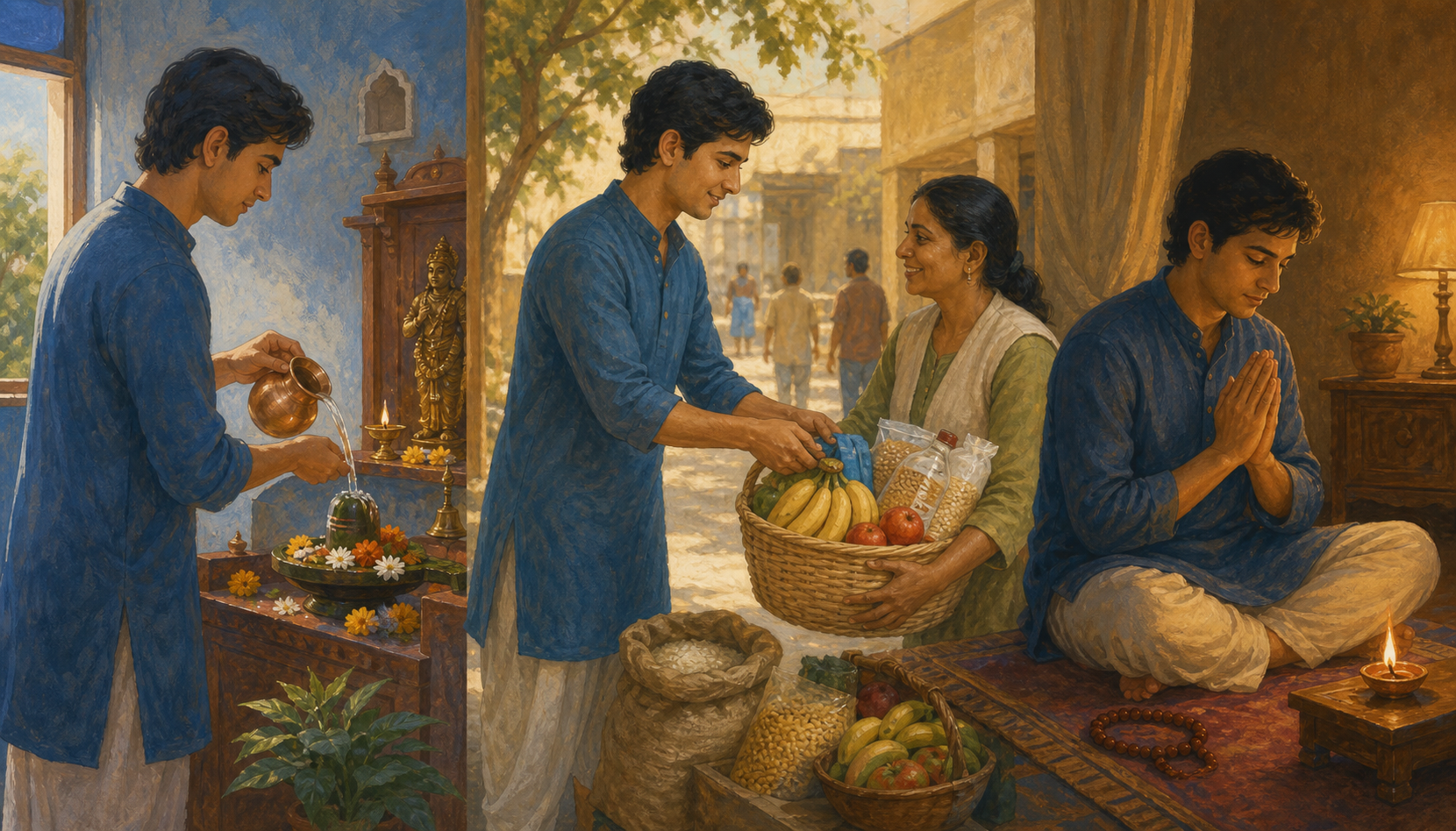
Krishna Paksha is the waning half of the lunar cycle. Its quieter cadence lends itself naturally to inward discipline, but Saptami does not impose one universal household routine. Your ishta-devata, family custom, and sampradaya remain more important than a generic online checklist.
- If you pray before the locally confirmed transition, acknowledge Shashti in any tithi-sensitive sankalpa. There is no need to hurry simply because a new tithi is approaching unless your observance specifically requires completion during Shashti.
- If you intend to observe Saptami, begin after the local boundary. Leave some room around a displayed minute rather than deliberately placing a formal act at the cutover, where rounding or a mismatched location can create doubt.
- Choose one sustainable practice for the Saptami portion of the day: a fixed period of japa, quiet meditation, attentive scripture study, or daan according to your means and tradition.
- If you visit a temple, distinguish its opening or seva schedule from an astrological muhurta. Confirm both separately when the timing matters.
- If your sankalpa names the tithi, use the tithi prevailing at the actual place and time of the ritual. Do not copy wording prepared for a relative in another time zone.
The lunar rhythm can also remind us of kinship across Dharmic traditions without erasing their differences. Hindu, Buddhist, Jain, and Sikh communities each preserve their own disciplines, calendars, and forms of remembrance. Shared respect for cyclical sacred time is meaningful; it does not make their ritual rules interchangeable. Honour unity by observing your own maryada carefully and respecting how others observe theirs.
Mistakes that create avoidable Panchang confusion
- Copying 6:21 AM into every city. Panchang timings depend on location and local sunrise, so a clock time detached from its calculation is not portable.
- Calling the tithi transition a Shubh Muhurat. The change tells you when Saptami begins; it does not establish that the same minute is suitable for every purpose.
- Using the tithi that occupies most of the date for a pre-transition ritual. Under the working timetable, an early act before the boundary is still in Shashti.
- Checking only tithi for a major ceremony. Nakshatra, Rashi, sunrise, and rite-specific rules may change the usable interval even when the desired tithi is present.
- Scheduling exactly at the displayed transition. A listed minute may conceal finer calculation detail, while a wrong city setting can shift the boundary altogether. Choose a clearly post-transition time when Saptami is required.
- Treating family customs as interchangeable. A general Panchang supplies astronomical timing; your lineage or officiant determines how that timing is applied to a particular vrata or samskara.
Before November 11, set your actual city, verify the Shashti-to-Saptami transition, and decide whether you are planning an ordinary devotional practice or a rule-bound rite. For home japa or study, choose a calm period after local Saptami begins. For a formal vrata, sankalpa, or samskara, confirm the full local calculation before fixing the time.
References
