
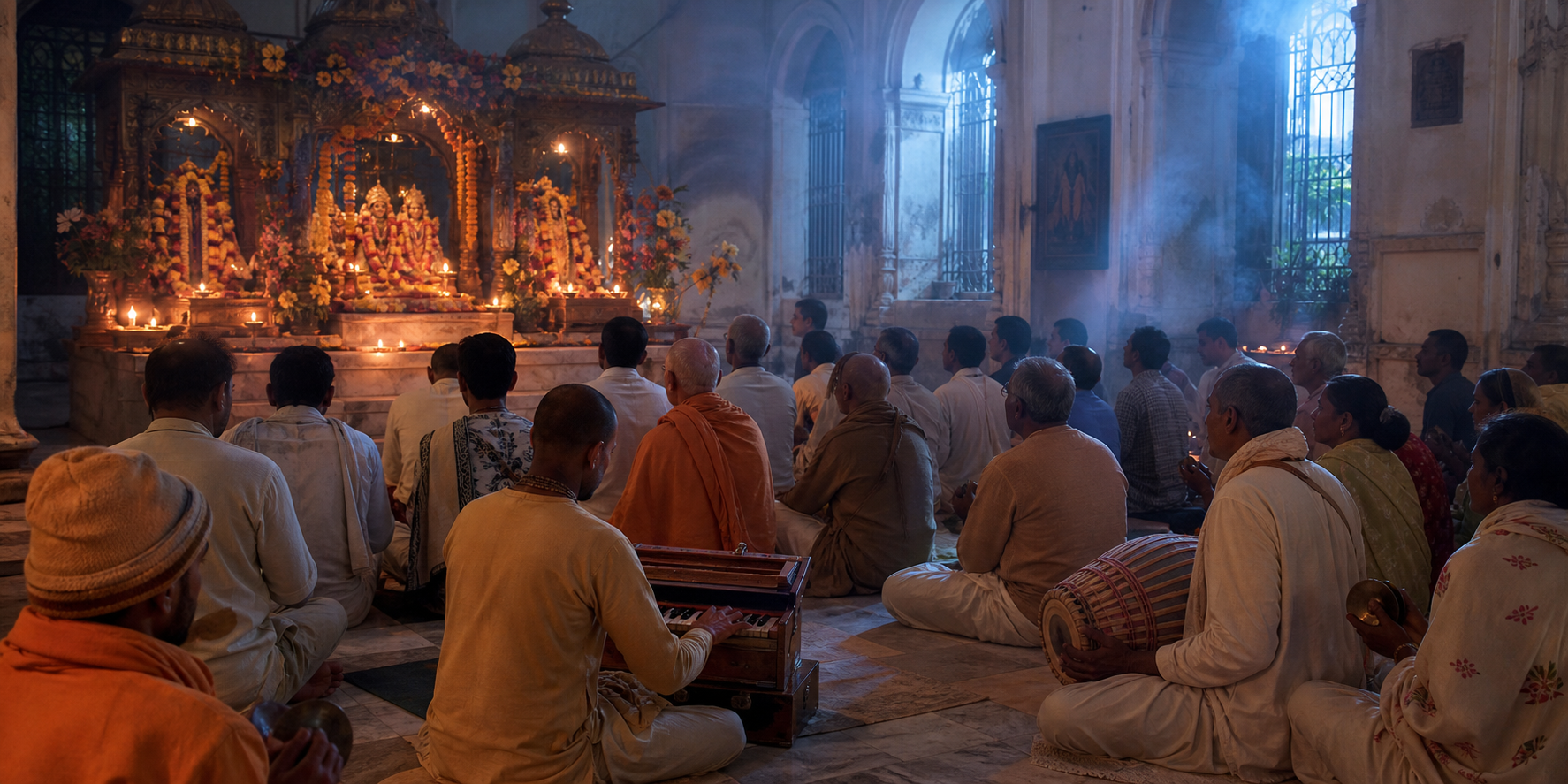
You are standing in the temple before sunrise, lyrics in hand, wondering whether your voice is good enough to join the singing. Or perhaps you have been asked to lead and now face a harder question: how do you carry the congregation without turning worship into a performance?
The answer is not to ignore musical skill, and it is not to chase musical brilliance. Devotional singing in Mangal Arati works when accurate words, clear pronunciation, a dependable rhythm, and sincere remembrance serve one purpose: helping everyone offer attention to the Deity. That standard gives both the hesitant newcomer and the experienced singer something concrete to practise.
Treat your voice as seva, not as a performance
A concert asks whether the singer held the audience. Mangal Arati asks whether the singing helped the gathered devotees remain present in worship. The difference changes how you judge a voice, choose a melody, recover from an error, and decide who should lead.
Bhava, the devotional disposition carried into the song, is central. It does not mean manufacturing an emotional display. It means directing the mind toward prayer, offering the words rather than merely reciting them, and resisting the desire to attract admiration. Recordings of A.C. Bhaktivedanta Swami Prabhupada show how spiritual intention can communicate beyond vocal ornament or technical display. You do not need to imitate his voice. You need to understand the priority his singing reveals.
This does not make technique irrelevant. Singing is counted among the traditional sixty-four arts, and Krishna is described as learning it in the kula of Sandipani Muni. Indian classical training can require decades of disciplined practice. Those facts should correct two opposite mistakes: treating sacred music casually because it is devotional, and treating technical mastery as the purpose of the rite.
Sincerity without preparation can leave the congregation struggling to recognize the words or response. Technique without devotion can make the singer the emotional centre of the room. The useful middle path is trained simplicity: prepare carefully, then let the preparation disappear into service.
You can test your own mood with a plain question: if nobody praised your singing afterward, would the offering still feel complete? If the answer is uncertain, do not withdraw from singing. Redirect the intention before you begin.
Prepare the words, melody, rhythm, and mind

The most avoidable problems begin before the first note. A singer remembers a familiar version from another temple, assumes the repetitions will be obvious, or concentrates on melody while mispronouncing the prayer. In a communal rite, those are not private errors. They make everyone else hesitate.
Use this preparation sequence whether you are leading at a temple or singing at a home altar:
- Confirm the local sequence. Obtain the exact lyrics used by the temple or household, including the order of prayers, repeated lines, and expected responses. Do not assume that the version you know is the version being followed.
- Speak the text before singing it. Read each line slowly at a conversational pace. Mark any word you cannot pronounce confidently and learn it from a practitioner trusted by that community. A decorative melody cannot repair unclear sacred words.
- Fit the melody to the text. Practise where each phrase begins, resolves, and passes to the congregation. If you lead, choose a comfortable vocal range in which you can complete every line without strain. A pitch that displays your upper register may exclude many people from the response.
- Stabilize the pulse. Rehearse the basic beat without adding acceleration or elaborate variation. If percussion is present, agree on the opening pace and the point at which each response enters. The congregation should not have to guess whether the tempo has changed.
- Arrive a few minutes early. Put the lyrics where you can read them, settle the breath, and recall whom the singing is for. Accurate lyrics, clear pronunciation, steady rhythm, and fidelity to the established sequence are part of reverent practice, not technical details separate from devotion.
If you have limited preparation time, protect the essentials in this order: correct text, correct sequence, stable rhythm, singable melody, ornamentation. Ornamentation comes last because it contributes least when the foundation is uncertain.
At home, simplicity can be an advantage. Use a melody you can sustain quietly and repeat consistently. If you are still learning, keep the words visible instead of testing your memory during worship. Memorization is valuable when it frees attention for remembrance; it is counterproductive when anxiety about the next line consumes that attention.
Lead and respond so the whole room can pray

Good congregational singing is not measured by what the lead singer can execute alone. It is measured by whether the congregation can enter, answer, and remain together. The lead establishes a shared path; the response completes it.
If you are leading
- Begin clearly enough that the first words and tonal centre are recognizable. An uncertain opening forces the musicians and congregation to negotiate the melody during the prayer.
- Finish each call before expecting the response. Keep the phrase length predictable, especially when newcomers are present.
- Pronounce consonants and long words distinctly. Volume cannot substitute for articulation.
- Use ornamentation only when it preserves the words, pulse, and response pattern. If a flourish makes the congregation enter late or abandon the line, it is not serving this setting.
- Keep your attention on the worship. Do not scan the room for approval or treat every quiet moment as space that must be filled.
- If you make a minor musical error, recover at the next stable beat. Do not let embarrassment become more disruptive than the mistake.
A gentle voice does not mean an inaudible one. Lead with enough clarity to be followed, but do not compete with bells, drums, or other singers simply by increasing volume. When the room grows louder, clearer phrasing and steadier timing usually help more than force.
If you are responding
- Listen through the entire lead phrase before answering. This prevents you from carrying a familiar but different version over the actual lead.
- Return the same words and basic melodic shape. Mangal Arati is not the moment to establish a competing melody from another tradition or temple.
- Clap in time if clapping is customary, but first locate the pulse. Confident clapping on the wrong beat unsettles the group more than quiet listening.
- Keep the lyrics available until the words are secure. Looking down briefly is better than replacing an uncertain line with indistinct sound.
- If you do not know a prayer, listen for one cycle and join the next response. Participation does not require pretending that you already know the form.
This is how open participation and discipline support each other. You do not need to be the leader to make a real offering. Attentive responses, steady clapping, and willing listening help create the common devotional field that congregational singing requires.
Choose a leader without confusing devotion and gatekeeping
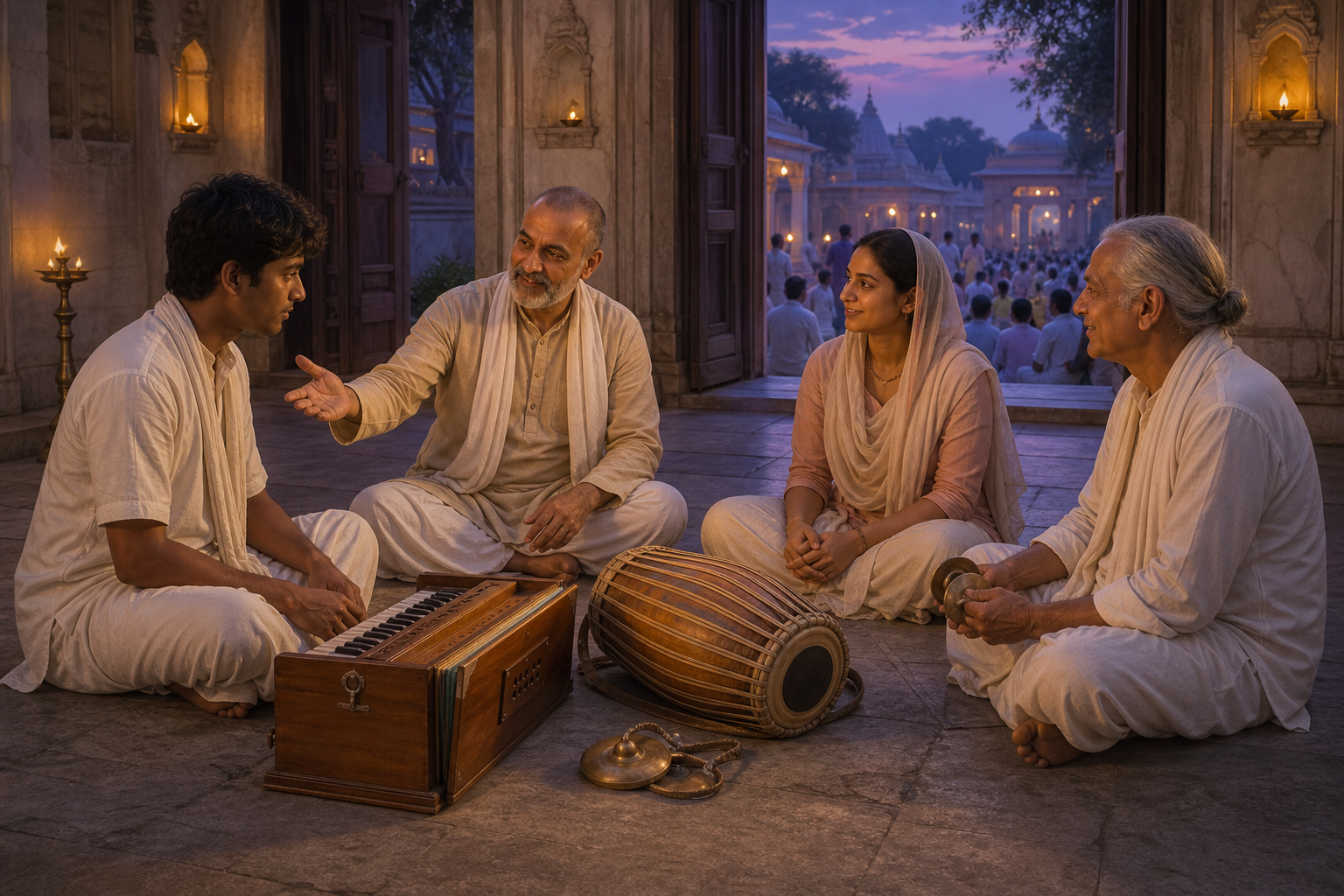
When a temple must choose between a sincere practitioner and a polished singer who has no devotional intention, Mangal Arati gives priority to the practitioner who understands the offering. But that comparison should not become an excuse for preventable disorder. The strongest choice is a devotee who is willing to develop reliable musical and liturgical competence.
Before assigning the lead, ask five practical questions:
- Does this person know the exact words and sequence used here?
- Can this person hold a steady rhythm and a range the congregation can answer?
- Will this person follow the temple’s established form rather than impose a personal performance style?
- Does this person receive correction without making the worship about status?
- Does this person understand that leading is service to the Deity and the gathered community?
Initiation requires careful handling. Many Vaishnava lineages entrust direct ritual contact with the Deity to initiated pujaris, and some communities apply a related standard when selecting people for prominent liturgical roles. That does not establish one universal rule for every Mangal Arati singer. The pujari’s ritual duties, the kirtan leader’s role, and the congregation’s open response are distinct forms of participation. Follow the standards of the temple authority responsible for that worship rather than inventing a stricter or looser rule on the spot.
The same care is needed when speaking across Dharmic traditions. Sikh kirtan during Amrit Vela, Buddhist morning chanting, and Jain pratikraman each retain their own theology and discipline. They should not be presented as interchangeable versions of Mangal Arati. What can be recognized across them is a shared esteem for disciplined attention, humility, and spiritually directed practice around dawn. The common value is not identical liturgy; it is the decision to begin the day by placing the mind under a sacred discipline.
Key takeaways for your next Mangal Arati
- The purpose is to serve the Deity and support communal remembrance, not to display the singer.
- Bhava means devotional orientation, not dramatic emotion or musical carelessness.
- Verify the temple’s lyrics, order, repetitions, and pronunciation before leading.
- Keep the pitch singable, the rhythm steady, and the response pattern easy to recognize.
- Choose leaders for sincerity and dependable preparation; musical skill and devotional intention should mature together.
- Join as a responder without self-consciousness: listen first, follow the established lead, and keep the shared pulse.
- Respect local rules about ritual and leadership instead of turning one community’s custom into a universal qualification.
At your next Mangal Arati, choose one correction you can make before the lamps are raised. Verify the words, resolve one uncertain pronunciation, or practise holding the refrain at a steady pace. Then arrive early enough to quiet the impulse to perform.
When the singing begins, give the prayer your full voice without making the voice the centre. That small shift, repeated morning after morning, is how musical discipline becomes seva and how a roomful of separate singers begins to worship as one community.
References
