
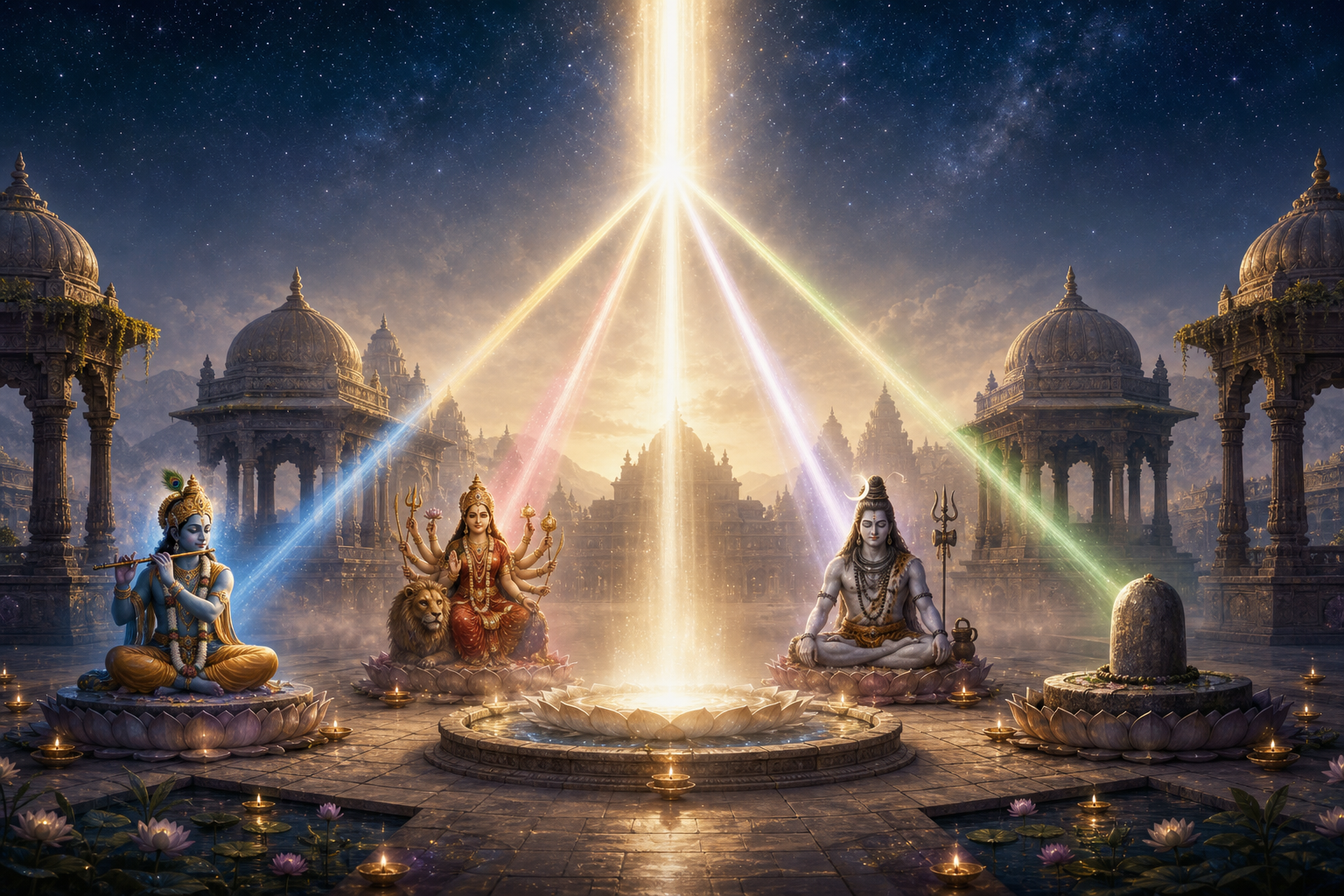
You may be devoted to Krishna, Devi, Shiva, the formless Absolute, or a particular guru and still wonder whether honoring other paths weakens your own. The question becomes sharper when someone argues that eternal truth must have only one authorized name, doctrine, or historical expression.
Dharmic thought offers a more precise answer than either exclusivism or the vague claim that all religions are the same. You can affirm truth, remain rooted in a chosen path, and respect several forms of spiritual access at once. The key is to distinguish what is eternal, what is plural, and what it means for the transcendent to become present within time.
Keep three claims apart: eternal, plural, and manifest

Many religious arguments become confused because three different claims are treated as if they were interchangeable. A principle can be timeless without every institution that teaches it being timeless in the same way. Several paths can disclose truth without making every claim equally accurate. The Divine can become accessible through a form without being confined to that form.
In this sense, Sanatana Dharma points to enduring principles rather than ownership of truth by one doctrinal formulation. Dharma, truth, compassion, self-discipline, and liberation are not made eternal by a community declaring them so. A community calls them eternal because it recognizes that they exceed a particular generation, language, institution, or teacher.
- Eternity concerns the ground of truth. Ask which principle is being called timeless: reality itself, dharma, consciousness, moral order, or a historically formed institution.
- Plurality concerns access to truth. Ask whether different dispositions, practices, and philosophical standpoints can lead people toward genuine realization without being identical.
- Manifestation concerns the presence of truth. Ask how what transcends time can teach, guide, or become worshipfully available within time.
This distinction prevents two opposite mistakes. The first turns a sincere commitment into a monopoly: because our path conveys eternal truth, only our path can convey it. The second dissolves discernment: because truth can be approached in many ways, every belief and practice must be equally sound. Neither conclusion follows.
Ekam sat vipra bahudha vadanti.
Rig Veda
The insight is often rendered as truth being one while the wise speak of it in many ways. Its practical force lies in both halves. Many expressions do not require many unrelated ultimate realities, while oneness does not require one compulsory vocabulary. Before debating an eternal claim, therefore, ask whether the speaker is defending the reality of truth or claiming exclusive possession of it. Those are not the same position.
Dharmic plurality preserves differences instead of erasing them

Plurality is useful only when it allows traditions to remain recognizable. Saying that every deity, guru, Tirthankara, bodhisattva, and sacred teaching is really the same thing may sound inclusive, but it overrides the way communities understand themselves. Respect begins by letting each tradition use its own categories.
- Hindu traditions make room for distinct relationships with the Divine through Ishta, the form or focus suited to a seeker’s disposition. This does not reduce worship to personal preference. A chosen form normally carries a discipline, lineage, body of teaching, and way of life.
- Jain Anekantavada treats reality as many-sided and human judgments as limited by standpoint. It encourages you to qualify a claim before turning it into an absolute. It does not require you to pretend that contradiction, carelessness, and disciplined insight are indistinguishable.
- Buddhist upaya, or skillful means, recognizes that teaching must meet beings according to their conditions and capacities. That is a principle of compassionate adaptation, not permission to translate Buddhism wholesale into the theology of another tradition.
- Sikh teaching directs attention to Ik Onkar, remembrance of the One, and sarbat da bhala, the welfare of all. The Gurus illuminate the path through lived wisdom and bani. Recognizing a resonance with other Dharmic traditions does not require recasting the Gurus in terminology foreign to Sikh self-understanding.
These traditions therefore need not share one metaphysical system to inhabit a related civilizational ethos. Anekantavada, upaya, Ishta, Ik Onkar, and sarbat da bhala each discipline the human tendency to absolutize a partial standpoint. Their methods differ, but each directs attention away from egoic triumph and toward truth, restraint, compassion, or service.
When you compare two paths, identify the level at which a similarity appears. They may share an ethical commitment without sharing a theology. They may share a contemplative method without defining liberation in the same way. They may honor compassionate teachers while assigning those teachers different metaphysical roles. This one habit prevents most careless claims about all Dharmic religions teaching exactly the same thing.
Divine manifestation makes transcendence approachable

The Hindu idea of avatar addresses a particular question: if the Supreme exceeds finite form, how can human beings encounter divine guidance in history? The word is formed from roots conveying descent. The descent makes the transcendent compassionately accessible without implying that the Infinite has been reduced to a finite object.
This is why Nirguna and Saguna must not be treated casually as two rival gods. Nirguna points toward the Absolute beyond limiting qualities and conceptual capture. Saguna names the Divine as knowable, relatable, and worshipful through attributes and forms. Advaita, Visishtadvaita, and Dvaita do not explain the relationship in precisely the same way. Their disagreement is real, and it demonstrates that philosophical plurality exists within Hinduism as well as among different Dharmic traditions.
The Bhagavad Gita 4.7-8 associates divine manifestation with periods in which dharma declines and destructive forces rise. The purpose is not spectacle. Manifestation protects dharma, confronts disorder, and gives embodied instruction. Rama and Krishna matter not only because teachings are placed in their speech, but because their narratives force the devotee to consider duty, courage, loyalty, discernment, action, and consequence under pressure. Shaiva and Shakta traditions provide other modes through which divine presence, power, and guidance are understood.
A form, name, mantra, murti, or sacred narrative should therefore be approached as a site of relationship rather than a measurement of the Divine’s size. The Infinite does not become small merely because a devotee can address it intimately. Accessibility is the point of manifestation, not evidence of metaphysical exhaustion.
When you encounter a claim about an avatar or divine form, replace the blunt question of whether it is merely literal or merely symbolic with four better questions:
- What relationship does this tradition claim between the manifest form and ultimate reality?
- Which disorder, moral crisis, or spiritual limitation does the manifestation address?
- What does the form ask the devotee to practice, remember, or become?
- Does the tradition present this manifestation as a genuine presence of the Divine, an exhaustive confinement of the Divine, or something else?
These questions keep devotion and philosophy connected. They also clarify why manifestation does not refute eternity. If timeless wisdom could never become present through language, persons, stories, or inward discernment, finite beings would have no access to it. The temporal form is the means of encounter; it is not necessarily the boundary of the Real.
Use the framework when a real disagreement appears
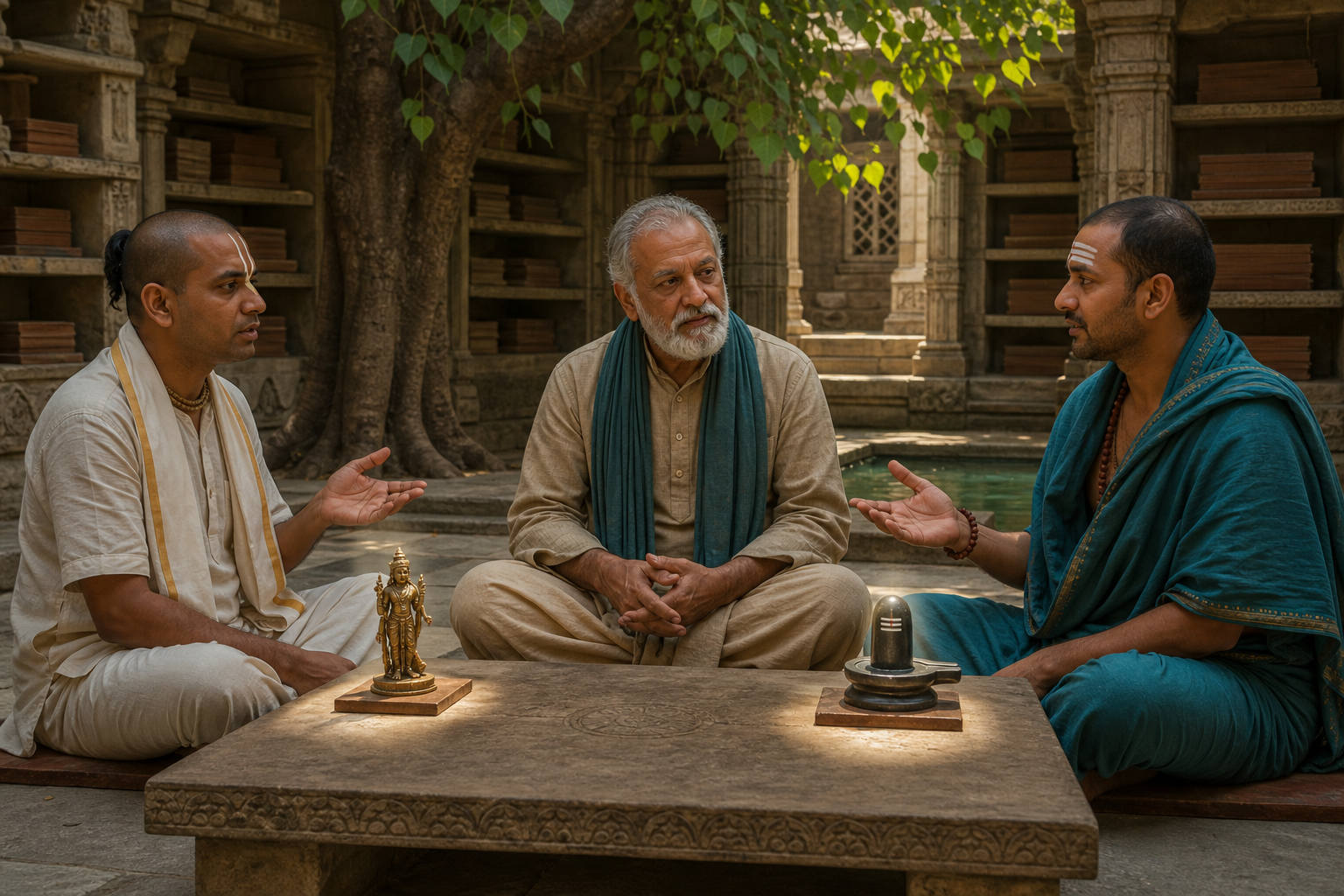
Consider a family in which an elder performs traditional puja, a younger member practices Buddhist meditation, another relative attends Sikh kirtan, and someone else is deeply influenced by Jain ahimsa. Harmony will not come from forcing everyone into one blended ritual. It will come from knowing which differences need to be preserved and which values permit shared life.
A workable conversation follows five steps:
- State your commitment without universalizing it. Say that a form is central to your sadhana, family, or sampradaya. Do not quietly change that personal or lineage-based claim into the assertion that every sincere seeker must approach the same form.
- Locate the disagreement. Determine whether you differ about ultimate reality, a method of practice, the authority of a teacher, ritual participation, or ethical conduct. A disagreement about ritual need not become a declaration that the other person has no access to truth.
- Preserve proper names and meanings. Use avatar for the Hindu doctrine of divine descent, Tirthankara for the Jain way-maker, bodhisattva for the Buddhist ideal of compassionate commitment, and Guru as Sikh tradition understands the term. Similar moral functions do not make the categories interchangeable.
- Examine the fruit of practice. Look for greater truthfulness, self-restraint, courage, compassion, service, and freedom from ego. Character alone does not settle every metaphysical question, but a claim to spiritual superiority that produces contempt deserves scrutiny.
- Set a boundary against coercion. Pluralism asks you to respect another person’s sincere path; it does not ask you to accept ridicule, forced participation, deceptive conversion, or the erasure of your own tradition. Dialogue requires reciprocity.
The same method works in public discussion. If someone says that only one religion can be eternal, ask what eternal means in the sentence. If the answer refers to truth itself, other traditions may also participate in that truth. If it refers to an unchanged historical institution, the claim needs a different kind of argument. If it means that one revelation has exhausted the Infinite, the burden is greater still: a human formulation is being treated as coextensive with reality.
At an interfaith gathering, do not begin by announcing that every tradition is secretly identical. Let participants explain their own sacred terms. Choose cooperation where the ethical ground is genuinely shared, such as service, non-violence, care for the vulnerable, or disciplined self-examination. Leave metaphysical differences visible. Peace built on accurate understanding is more durable than peace built on polite misdescription.
Key takeaways for evaluating a spiritual claim
- An eternal principle is not the same thing as an eternally exclusive institution.
- One reality can support several modes of access without making every proposition equally true.
- A chosen deity or path can command complete devotion without requiring contempt for every other form.
- Avatar describes divine descent within Hindu theology; related Dharmic ideals should be respected without being collapsed into it.
- Pluralism is strongest when it combines intellectual humility with careful distinctions and ethical accountability.
- The practical test is not whether differences disappear, but whether people can pursue truth without coercion, caricature, or surrendering discernment.
The next time you hear an absolute religious claim, pause before either accepting or dismissing it. Identify the eternal principle, the historical expression, the claimed mode of access, and the conduct that follows. That small act of discrimination lets you remain firmly rooted while meeting another path without fear or confusion.
Then bring the framework into practice. Honor your Ishta or discipline with greater steadiness, learn another tradition’s vocabulary from within its own boundaries, and refuse the easy move from deep conviction to exclusive ownership of the Infinite.
References
- DharmaRenaissance Blog – Why Calling One Faith Eternal Is Misguided: Dharmic Wisdom on Plurality and Peace
- DharmaRenaissance Blog – Eternal Truth in Time: How Hindu Avatars Restore Dharma and Inspire Inner Freedom
