
If one calendar marks Vishnu Saptami on a particular date while another appears to place Margashirsha differently, you don’t have to choose one as correct and dismiss the other. First identify the lunar tithi in your local panchang. Then check which month system the calendar follows.
For the 2025 observance, November 27 was the broadly accepted civil date for Margashirsha Shukla Saptami, though local calculations could produce differences in timing. That distinction between a civil date and a lunar tithi is the key to reading the calendar correctly and planning a meaningful observance.
Start with the tithi, not the printed month name

Vishnu Saptami is observed on Shukla Paksha Saptami, the seventh lunar day of the waxing fortnight, during Margashirsha. These are the two coordinates you need: the fortnight and the tithi. A Gregorian date such as November 27 is the convenient civil label, but the tithi is the ritual basis.
A tithi can begin or end between two midnights. It may therefore touch parts of two civil dates, and panchangs prepared for different locations can show different transition times. This is usually the reason for an apparent disagreement. It isn’t evidence that one household has lost the tradition.
Use this sequence whenever you need to confirm Vishnu Saptami:
- Select a panchang calculated for the city where you will perform the observance, not merely for your country or time zone.
- Open the Shukla Paksha portion of Margashirsha and locate Saptami.
- Record when Saptami begins and ends locally rather than copying only the large Gregorian date printed above it.
- If the tithi spans two civil dates, follow the convention used by your family sampradaya or the temple where you worship.
- For a formal vrata or temple programme, also confirm the relevant muhurta and any nakshatra requirements with the officiating priest.
This method keeps an online festival list in its proper place. It can alert you to the likely date, but your local panchang settles the timing. If family worship and temple worship fall on different civil dates because their authorities apply different conventions, you can respectfully follow each in its own setting.
Why two Margashirsha calendars can both be right

Margashirsha is also written as Margasheersh, Margashira, Margasira and Agrahayan. A spelling change usually causes little difficulty. The more important distinction is whether your calendar follows the Purnimanta or Amanta month system.
In the North Indian Purnimanta convention, a lunar month runs from the day after one Purnima to the next Purnima. Margashirsha is counted as the ninth lunar month in this system. In 2025, Margashirsha ran from November 6 through December 4 in regions including Uttar Pradesh, Madhya Pradesh, Bihar, Jharkhand, Chhattisgarh and Himachal Pradesh.
Many western and southern calendars use the Amanta convention. Because the lunar month boundary is reckoned differently, the same stretch of civil time can be displayed under Karthika or Margashira in ways that initially seem inconsistent with a North Indian calendar. The lunar sequence hasn’t become contradictory; the calendars are grouping its days under different month boundaries.
When you compare calendars across regions, therefore, don’t begin with the question, Which month name is printed here? Begin with three narrower questions: Which convention is being used? Where does Shukla Paksha begin in that convention? When does Saptami prevail at my location? That prevents a month-label difference from becoming an unnecessary dispute about the festival itself.
Let Margashirsha shape the observance
Margashirsha isn’t merely a box around Vishnu Saptami. It gives the day its devotional atmosphere. In Bhagavad Gita 10.35, Sri Krishna declares, māsānāṁ mārgaśīrṣo ‘ham: among the months, he is Margashirsha. That association makes the month especially suitable for remembrance, scriptural recitation, disciplined conduct and quiet devotion.
The practical lesson is steadiness. A demanding ritual performed in haste is less aligned with the month than a manageable practice you can carry attentively. Choose a period of prayer you can protect from distraction. Keep your speech measured, your food sattvik and your commitments realistic. Let the discipline continue beyond the minutes spent before the altar.
Vishnu Saptami also carries a notable Hari-Hara emphasis. Lord Vishnu and Lord Shiva may be worshipped together, not as competing claimants but as divine forms whose veneration can coexist within Sanatana Dharma. Tulsi is offered to Vishnu and bilva leaves to Shiva. Vishnu Sahasranama may be recited alongside a Shiva stotra or another hymn received through your tradition.
This doesn’t require you to erase the distinct theology of a Vaishnava or Shaiva sampradaya. Hari-Hara harmony is not achieved by pretending every practice is identical. It is expressed by honouring your chosen form of the divine without turning devotion into hostility toward another dharmic path.
The same restraint matters when speaking about Buddhism, Jainism and Sikhism. Their doctrines and ritual forms should not be collapsed into a single system. Yet compassion, disciplined practice, inner purification and seva provide genuine points of ethical kinship. On Vishnu Saptami, you can embody that kinship through respectful conduct and service rather than making exaggerated claims of sameness.
A practical Vishnu Saptami observance at home
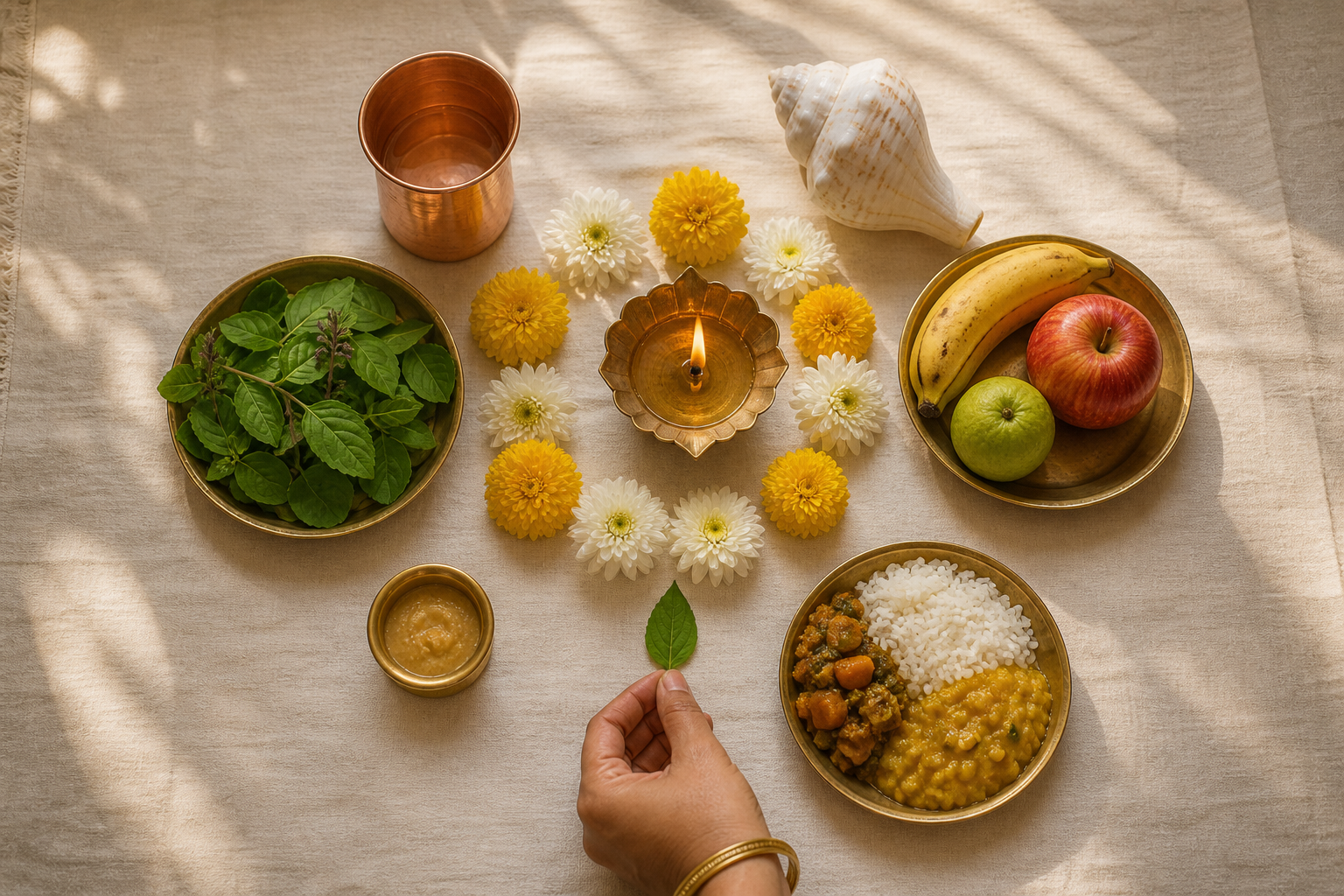
You don’t need to reproduce a temple programme in your living room. If you know the Shodashopachara method and it belongs to your practice, you can offer its sixteen forms of hospitality to the deity in the prescribed manner. If you haven’t learned that procedure, a shorter observance performed carefully is a sound choice.
- Confirm the local tithi in advance. Check it before purchasing offerings or promising relatives a fixed time. If the tithi crosses two dates, resolve the convention with your temple or family elder before the day begins.
- Prepare a calm worship space. Clean the home altar and arrange the images or murtis of Vishnu and Shiva according to your established practice. Gather the lamp, tulsi, bilva leaves, chanting text and naivedya beforehand so that the puja isn’t repeatedly interrupted.
- Light the deepam. Dawn or dusk is commonly used for lamp-lighting. Choose the period that falls within the locally confirmed observance and that you can keep without rushing.
- Make the appropriate leaf offerings. Offer tulsi to Lord Vishnu and bilva leaves to Lord Shiva. Keep the offerings distinct and reverent instead of treating them as interchangeable decorations.
- Recite one complete text attentively. Vishnu Sahasranama is an established choice for Vishnu worship. You may also include a Shiva hymn. If time is limited, choose a shorter stotra you can finish with attention rather than beginning several recitations you cannot sustain.
- Offer sattvik naivedya and share prasadam. Prepare something appropriate to your household tradition, offer it before eating and share it without waste. If your family maintains a specific vrata, follow its inherited food discipline; don’t invent a severe fast merely because no family rule was specified.
- Carry the worship into dana or seva. Support a community need, help someone in practical difficulty or contribute through an institution you trust. The amount matters less than making generosity part of the observance rather than an afterthought.
If you are observing with children or relatives new to the practice, explain two things before beginning: why the local tithi matters and why Vishnu and Shiva are being honoured together. Those explanations give the ritual a structure they can remember. A list of actions without their meaning is much harder to carry into the next generation.
Temples may conduct fuller puja sequences and collective chanting. If you attend, check whether the announced date and time were calculated for the temple’s location. You can keep a simple lamp and recitation at home even when the principal community observance takes place at the temple.
Key takeaways
- Vishnu Saptami is Margashirsha Shukla Saptami: the tithi, fortnight and local calculation matter more than a date copied from a generic calendar.
- November 27 was the broadly accepted date in 2025, but local panchang timing could vary.
- Purnimanta and Amanta calendars place lunar month boundaries differently, so different month labels do not automatically mean different lunar observances.
- A simple home practice can include a deepam, tulsi for Vishnu, bilva leaves for Shiva, focused stotra recitation, sattvik naivedya and prasadam.
- The Hari-Hara dimension asks you to preserve your own sampradaya while refusing needless rivalry within the dharmic family.
- Dana and seva turn the inward discipline of Margashirsha into conduct that benefits someone beyond your household.
Before the next Margashirsha begins, save a reliable local panchang, ask your temple which calendar convention it follows, and decide which recitation you can complete attentively. That small amount of preparation will leave Vishnu Saptami free for worship instead of last-minute calendar confusion.
References
- DharmaRenaissance Blog — Vishnu Saptami 2025: Auspicious Date, Sacred Puja, and the Timeless Unity of Vishnu–Shiva
- DharmaRenaissance Blog — Margashirsha Month 2025 Dates & Significance: Sacred Timelines, Rituals, and Unity
