
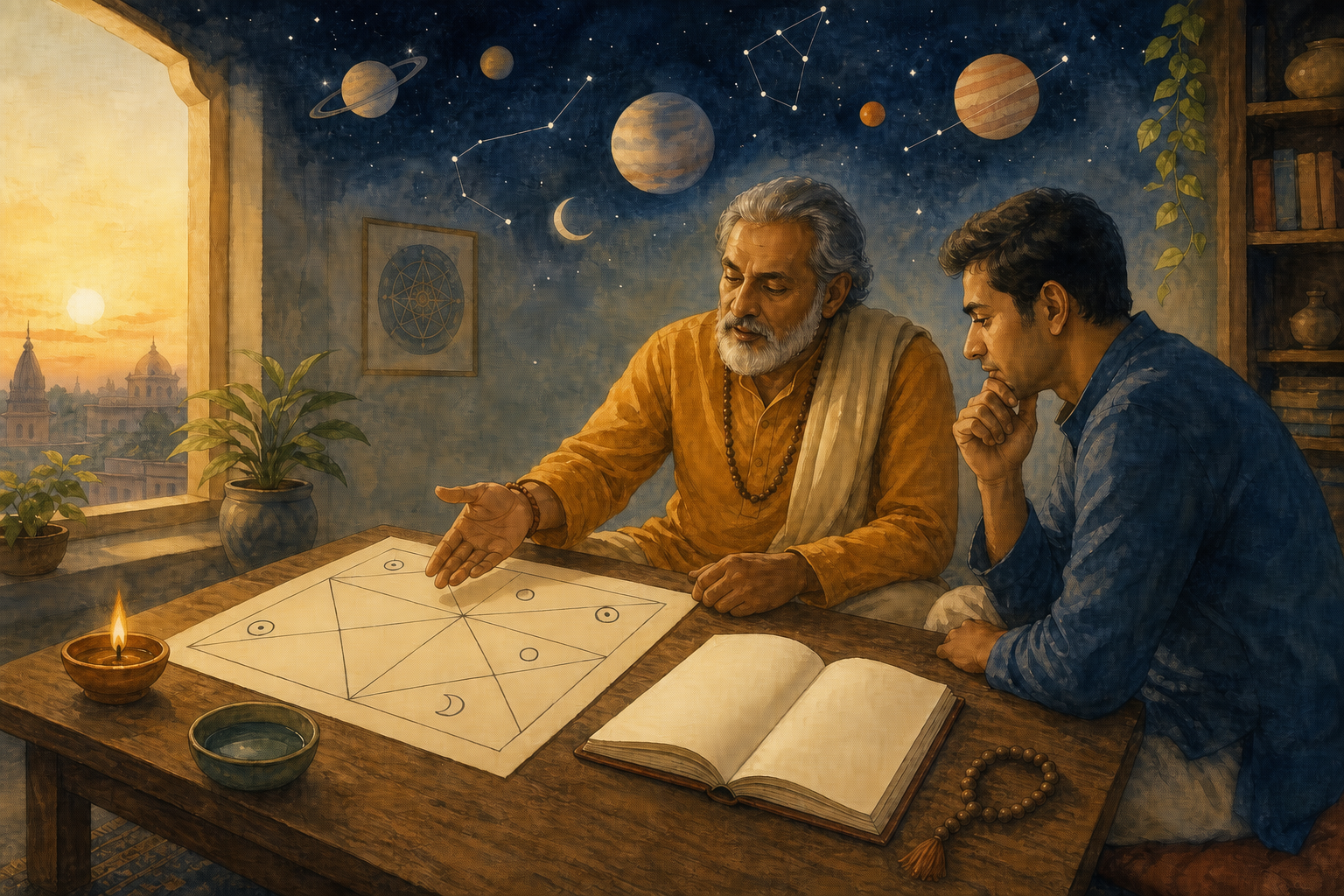
You may have opened your Jyotisha chart because one placement frightened you: a planet in the 8th or 12th house, a weak lord, or a word such as debilitation. The common mistake is to turn that one symbol into a verdict about your health, marriage, livelihood, or spiritual worth.
A useful reading does something more demanding. It places the symbol inside the whole chart, separates capacity from pressure, and ends with an action you can actually practise. This method will help you move from an alarming placement to a proportionate interpretation and then to a remedy grounded in conduct, routine, seva, and sadhana.
Begin with the question your life is actually asking
Do not begin by asking whether a planet is good or bad. Begin with the recurring pattern you are trying to understand. A vague question produces a vague reading, while a sharply framed question tells you which chart factors and remedies deserve attention.
- Name the area of friction: sleep, speech, spending, work, relationships, study, service, or resistance to change.
- Separate a repeating pattern from a single difficult incident. Astrology should not be used to give cosmic importance to every bad day.
- Write down what is observable. Instead of saying, “Mercury is harming me,” note, “I answer messages late at night, sleep poorly, and make unplanned purchases.”
- Identify what is within your control. You may not control every circumstance, but you can control a communication window, an expense record, a devotional practice, or the way you respond to another person.
This first step protects you from fatalism. It also prevents symbolic language from masquerading as a medical, psychological, or financial diagnosis. Persistent insomnia, substance dependence, severe anxiety, or dangerous financial distress calls for qualified professional help. A chart may support self-reflection, but it cannot determine treatment, prove causation, or replace evidence-based advice.
Read the chart in four passes, not one dramatic glance

Pass one: use the Lagna as the organising frame
The Lagna gives you the chart’s starting orientation. The 1st house is especially important because it belongs to both the Kendra and Tricona groups, linking identity and vitality with both worldly anchoring and dharmic direction. Interpret the ascendant as a framework for tendencies, not as a complete personality label.
Consider Vrishabha Lagna, or Taurus rising. Its useful expression includes patience, consistency, aesthetic sensitivity, and the ability to build durable results. Its pressure points can include resistance to rapid change, attachment to comfort, and possessiveness. A responsible reading holds both sides together: steadiness is the capacity, inflexibility is the possible distortion, and gentle adaptability is the practical response.
This capacity-pressure-response format is more useful than declaring that a Lagna is fortunate or unfortunate. For Taurus rising, the remedy need not be a dramatic attempt to become a different person. Protect the routines that support stability, but introduce flexibility where attachment has begun to dictate decisions. Yoga, pranayama, meditation, mindful consumption, and time with art, music, fragrance, or nature can support the Venusian need for harmony without turning comfort into avoidance.
Pass two: identify the house family and its overlaps
The house groups are not a simple ranking from lucky to unlucky. They tell you how an area of life tends to operate and what kind of response it may require.
| House family | Houses | Primary field | Question to ask |
|---|---|---|---|
| Kendra | 1, 4, 7, 10 | Identity, foundations, relationships, and social contribution | Which life pillar is carrying the placement? |
| Tricona | 1, 5, 9 | Purpose, learning, foresight, and the unfolding of merit | How does this support or complicate dharmic direction? |
| Dhushta Sthana | 6, 8, 12 | Challenge, transformation, discipline, and release | What pressure must be met consciously rather than feared? |
| Upachaya | 3, 6, 10, 11 | Skills, service, work, effort, and networks that develop over time | What could improve through sustained practice? |
Overlap matters. The 6th house is both a challenging house and an Upachaya. It may bring friction, duty, or conflict, yet it can also reward disciplined problem-solving. The 10th is both Kendra and Upachaya, joining a central life pillar with development through sustained work. The 1st is both Kendra and Tricona, making the condition of the self inseparable from both practical agency and purpose.
These overlaps correct two common misreadings. A Dhushta Sthana placement is not automatically ruinous, and an Upachaya placement is not an instant promise of success. The former asks how difficulty can be transformed; the latter asks what you are prepared to strengthen over time. Even a difficult planet in an Upachaya may become constructive when effort is consistent and ethically directed.
Pass three: assess condition before predicting expression
A planet’s house placement tells you where a theme may appear. It does not tell you, by itself, how well the planet can express that theme. Check the conditions that support, redirect, or strain it:
- Sign dignity: Is the planet exalted, in its own sign, in moolatrikona, or debilitated? Dignity describes strength and fit, not moral goodness.
- Condition of the house lord: Where is the relevant lord placed, and what support or pressure does it receive?
- Aspects and conjunctions: Which planets reinforce, restrain, agitate, or redirect the placement?
- Functional role: Does the planet govern supportive or challenging houses for this particular Lagna? A planet cannot be interpreted identically for every ascendant.
- Modifying states: Retrogression, combustion, and planetary maturity can change how straightforwardly a planet expresses itself.
- Technical strength measures: Shadbala, Vargabala, and Digbala can help quantify forms of strength, but none should become a standalone verdict detached from the full horoscope.
If you are consulting an astrologer, ask to see this chain of reasoning. “Mercury is in the 12th” is an observation, not a completed interpretation. A careful practitioner should be able to explain the house, its lord, Mercury’s dignity, relevant aspects or conjunctions, and the Lagna-specific functional role before recommending a remedy.
Pass four: write a balanced interpretation sentence
Force yourself to state the reading in one balanced form: “This placement can support this capacity when well directed; under strain, it can produce this recurring pattern; these chart conditions modify it; this is the least harmful action that addresses the pattern.”
That sentence makes exaggeration harder. It leaves room for both a planet’s constructive and difficult expression. It also exposes an interpretation that has no practical bridge between symbolism and life. If the astrologer can name only danger, or offers a costly object without explaining the behavioural pattern it is meant to address, the reading is incomplete.
Match the remedy to the mechanism, not to your fear

A practical remedy should engage the same faculty that appears disordered. Troubled speech calls for disciplined speech and listening. Unplanned expenditure calls for a visible ledger. Disturbed rest calls for a calmer sleep environment and a more deliberate evening routine. Attachment to comfort calls for mindful consumption and manageable experiments in flexibility.
Use a remedy ladder, beginning with what changes conduct and ending with what serves as a symbol:
- Ethical conduct: Begin with satya, ahimsa, sobriety, responsible consumption, and keeping commitments. Conduct is the part of a remedy that no ritual can perform on your behalf.
- Daily structure: Give the relevant planetary faculty an orderly channel. Use a sleep routine for rest, a ledger for expenditure, communication windows for messages, or a stable schedule for study and work.
- Seva: Direct attention beyond the self. Supporting students, giving food, participating in langar, planting trees, or serving a community can turn an inwardly repetitive pattern into useful participation.
- Contemplative or devotional practice: Mantra japa, meditation, pranayama, study, or a temple visit can train attention and deepen intention. The practice should reinforce the ethical change, not compensate for refusing it.
- Symbolic support: A colour, prayer cloth, clean garment, or altar object can act as a reminder. Its value lies in recalling the discipline it represents; it should not be treated as a mechanical purchase of guaranteed results.
Do not start every remedy at once. Choose one behavioural practice that directly addresses the recurring problem, then add one devotional or service practice if it is sustainable. A large remedy programme may feel impressive for several days and then disappear. A small discipline that remains visible in your weekly record is more useful.
The same principle applies to challenging houses. A 6th-house emphasis may call for reliable routines, service, and patient problem-solving. An 8th-house emphasis may require responsible engagement with change, legacy, study, and matters that cannot be controlled by denial. A 12th-house emphasis may call for planned expenditure, healthy solitude, contemplative practice, and the conscious release of habits that drain attention.
Be cautious with expensive gemstones or irreversible decisions based on a single placement. A gemstone recommendation requires chart-wide judgement because strengthening a planet is not automatically desirable for every Lagna. Never stop medicine, leave treatment, accuse a spouse, end a relationship, or make a major financial commitment because one astrological factor was described as adverse.
Ethical restraint, truthful speech, meditation, compassion, and seva have resonances across Hindu, Buddhist, Jain, and Sikh life, although each tradition retains its own theology and forms of practice. This shared ground makes a remedy more than an attempt to escape an unpleasant prediction. It becomes a way to cultivate clearer conduct within the dharmic path you actually follow.
A worked example: Mercury in the 12th house

Mercury in the 12th house is a useful test of this method because it can easily attract a frightening, one-sided interpretation. The 12th house concerns rest, contemplation, expenditure, solitude, and release. Mercury concerns thought, language, learning, and exchange. Their combination may support imagination and intuitive reflection, while its strained expression may include overthinking, irregular sleep, scattered communication, or unplanned spending.
That is a field of tendencies, not proof that Mercury caused a symptom. It is also not permission to predict illness, addiction, loss, or harm to a spouse. The responsible question is narrower: where do thought and communication leak into rest, expenditure, secrecy, or isolation, and which habits would give those faculties a cleaner channel?
Build the remedy around observable habits
- Protect rest: Keep the sleep space uncluttered and restful. Move messages and calls into defined communication windows so the mind is not waiting for the next exchange throughout the night.
- Make expenditure visible: Maintain a weekly ledger. Mark each outflow as planned or unplanned. The purpose is not self-punishment; it is to make a 12th-house theme concrete enough to manage.
- Practise attentive speech: Let the other person finish, paraphrase what you understood, and correct misunderstandings without defensiveness. This is especially useful when a partner has been feeling unseen or unheard.
- Keep intoxicants out of the remedy: Traditional Lalkitab guidance treats alcohol as an aggravating influence for this placement. If avoiding alcohol is difficult because dependence is present, seek qualified addiction support rather than relying on willpower, mantra, or astrological explanation alone.
- Give imagination a constructive channel: Use meditation, pranayama, wisdom study, journaling, or quiet creative work so that solitude becomes reflective rather than ruminative.
Add a modest Wednesday observance if it fits your path
A traditional Budha observance can sit beside the behavioural remedies. In the early morning on Wednesday, recite Om Bum Budhaya Namah with steady attention and follow it with a few quiet minutes. You might support a student with learning materials, offer a green item in charity, or plant a tree. A visit to a Vishnu or Ganesha temple, clean green attire, or an emerald-toned prayer cloth can serve as a symbolic reminder of clarity and humility.
You do not need to perform every gesture. Choose the observance that is sincere, accessible, and compatible with your practice. The test is whether the Wednesday ritual strengthens clear speech, responsible expenditure, learning, and inward quiet during the rest of the week. A colour or mantra cannot cancel late-night impulsiveness while the behaviour remains deliberately unchanged.
Track the remedy at the level where it can work
Review your ledger each week and record a few concrete indicators: whether you followed the sleep routine, how many purchases were unplanned, how often messages escaped their scheduled windows, and which conversations required repair after a misunderstanding. This does not prove or disprove an astrological mechanism. It tells you whether the remedy is changing the habit it was chosen to address.
If the pattern improves, continue the practice without turning improvement into a grand prediction. If it does not improve, examine whether the remedy matched the real problem and whether specialist support is needed. Sleep disruption, anxiety, addiction, and uncontrolled spending can have causes that require clinical or financial expertise.
Key takeaways
- Start with a recurring life question, not with the most frightening word in the horoscope.
- Read the Lagna, house family, house lord, planetary condition, aspects, conjunctions, and functional role before reaching a conclusion.
- Treat Kendra, Tricona, Dhushta Sthana, and Upachaya as operating contexts, not as a simple scale from good to bad.
- Write every interpretation as capacity, possible distortion, modifying conditions, and practical response.
- Choose remedies that address the mechanism: speech with better speech, expenditure with a ledger, rest with a calmer routine, and attachment with mindful flexibility.
- Put ethical conduct before objects. Seva, sadhana, and symbols should reinforce behaviour rather than replace it.
- Use qualified medical, psychological, addiction, legal, or financial help whenever the real-world problem falls within those professions.
Take out your chart and write a five-line note: the question you are asking, the Lagna’s central capacity, the relevant house family and any overlap, the planet’s actual condition, and one remedy you can track. Do that before watching another prediction or buying an astrological object. Your next reading will be calmer because it will have to answer to both Jyotisha and observable conduct.
The purpose is not to make every difficulty disappear. It is to meet a tendency with greater awareness, steadier action, and less fear. That is where chart interpretation becomes a dharmic practice rather than a sentence imposed by fate.
References
- DharmaRenaissance Blog — Vrishabha Lagna (Taurus Ascendant): Grounded Traits for Timeless Calm and Daily Harmony
- DharmaRenaissance Blog — Mercury in the 12th House: Lalkitab Remedies for Peaceful Sleep, Clear Speech, and Inner Balance
- DharmaRenaissance Blog — Decode Horoscope House Strength: Kendra, Tricona, Upachaya, and Dhushta Sthana for Life Clarity
