
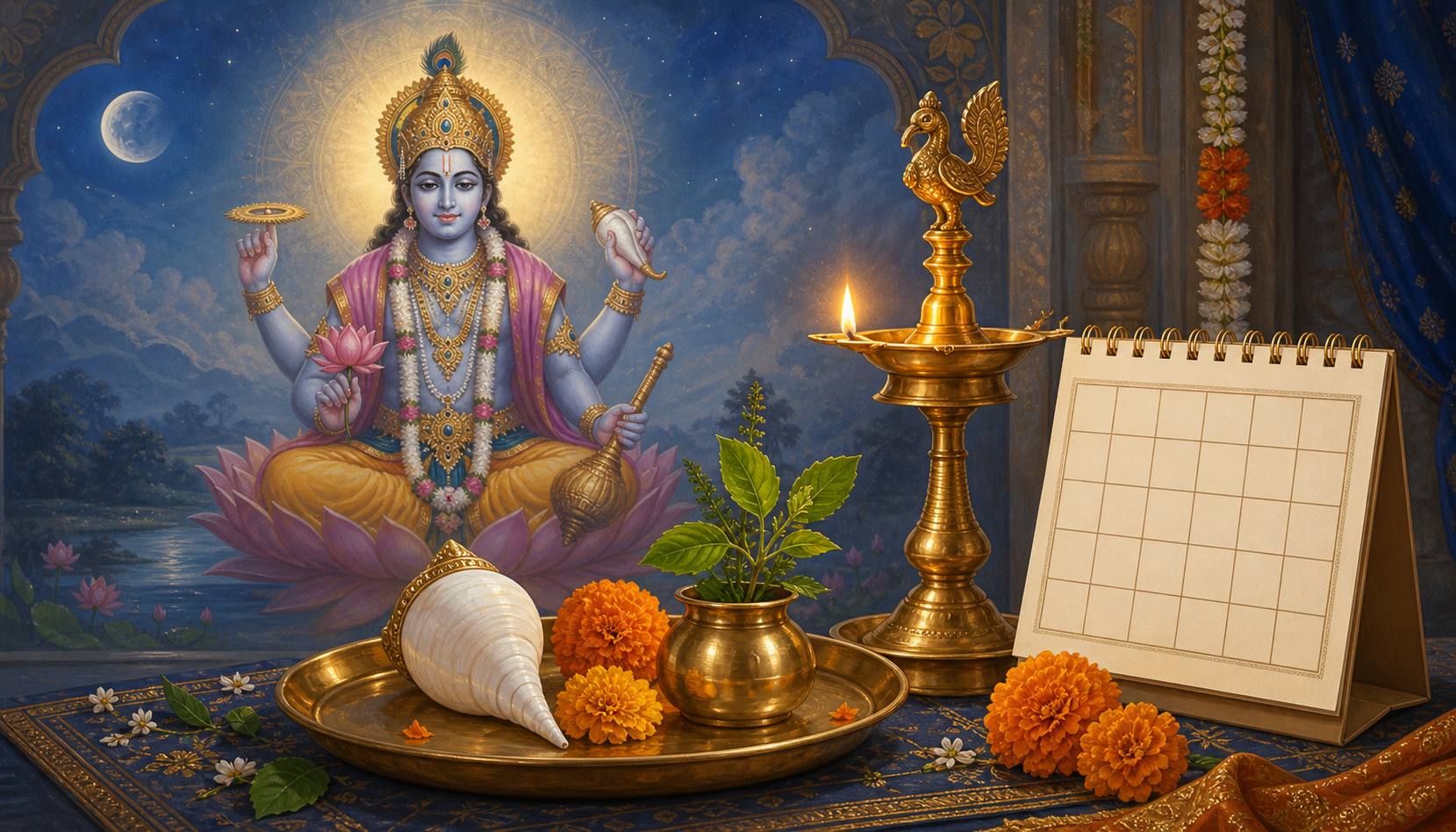
If you are trying to plan Margashirsha observances for your household, the first difficulty is usually not the puja itself. It is deciding which calendar applies, which date to reserve, and how much practice you can sustain without turning an auspicious month into an exhausting checklist.
For the North Indian Purnimanta calendar, use November 6 to December 4 as the 2025 Margashirsha window and mark November 27 for Vishnu Saptami. Then verify the Saptami tithi and worship period in a reliable Panchang calculated for your location. Once those anchors are settled, you can build a simple month of prayer, study, disciplined food, and seva around them.
Settle the calendar system before choosing your dates

In the Purnimanta system followed widely in Uttar Pradesh, Madhya Pradesh, Bihar, Jharkhand, Chhattisgarh, and Himachal Pradesh, Margashirsha 2025 runs from November 6 through December 4. A Purnimanta month begins after one full moon and concludes with the next full moon. Margashirsha follows Kartik and precedes Pausha in this reckoning.
You may also hear the month called Margasheersh, Margashira, Agrahayana, Aghan, or Margasira masam. These names can refer to the same sacred season in conversation, but the underlying calendar system still matters. Amanta calendars, which are more common in parts of South India, place the month boundaries differently. Do not combine the Purnimanta date range from one calendar with festival calculations taken from another.
A lunar tithi is not identical to a midnight-to-midnight civil date. It can begin or end during the day, and its application to a vrata may depend on local sunrise and the custom followed by your temple or sampradaya. A location-free date is useful for reserving the day; it is not enough for choosing an exact muhurta.
Before putting an observance on the family calendar, check these four items:
- Whether your household follows Purnimanta or Amanta reckoning.
- The Panchang location, which should match your city or the place where the puja will occur.
- The local beginning and ending times of the relevant tithi.
- Any temple, family, or sampradaya rule that determines when the vrata is observed.
If a printed calendar, a phone calendar, and your temple announcement appear to disagree, compare those four details before assuming that one is wrong. They may be applying different regional or sectarian conventions.
Build a Margashirsha discipline you can actually maintain
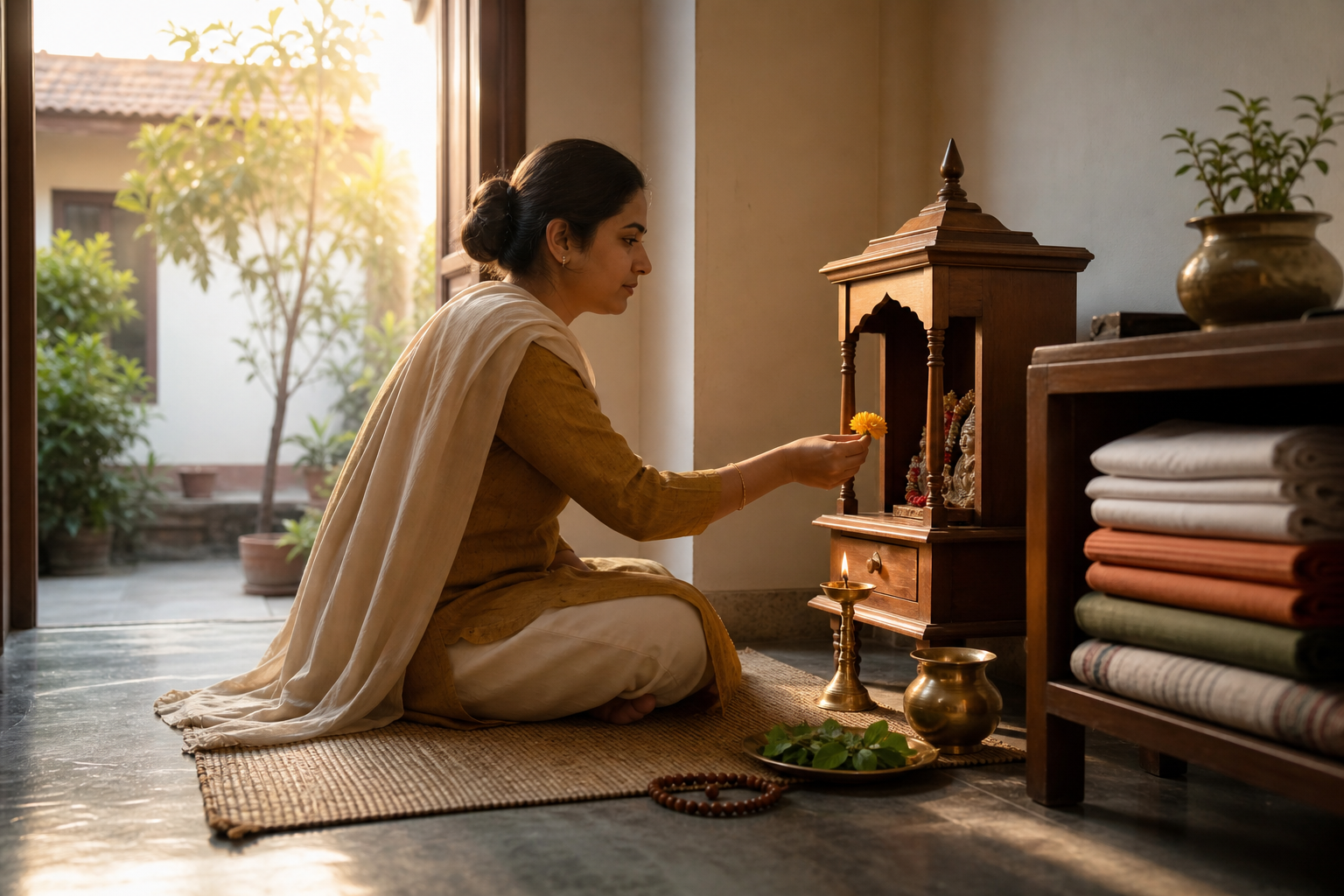
Bhagavad Gita 10.35 gives Margashirsha special prominence through the phrase masanam margasirso ‘ham. The practical response is steadiness. A modest discipline kept throughout the month is more coherent than filling the calendar with elaborate intentions that disappear after the opening days.
Plan the month in three layers:
- A daily anchor: choose a fixed place in your routine for morning prayer, mantra, silent contemplation, or study of a wisdom text. Keep the form simple enough to continue on working days.
- Specific observances: enter the vratas and tithis your family actually follows. Margashirsha commonly includes Mokshada Ekadashi and Gita Jayanti, but their local dates should be checked in your regional Panchang rather than copied from a calendar prepared for another place.
- An outward practice: connect personal devotion with charity, annadana, community kirtan, satsang, or another concrete act of seva. Decide what you will do and when; an undefined intention to help is easy to postpone.
Some regional traditions add Thursday prayers, household Lakshmi upasana, or special satsang readings. Treat these as living regional practices, not as compulsory rules for every Hindu household. If your family already has an established Margashirsha custom, preserve its continuity before adding practices gathered from elsewhere.
Sattvic food can support the month’s discipline by making restraint part of ordinary life rather than limiting it to one festival. Decide in advance what your household will avoid or simplify. A clear, modest rule is easier to honour than an undefined promise to eat more spiritually.
Observe Vishnu Saptami on November 27 with a clear sequence
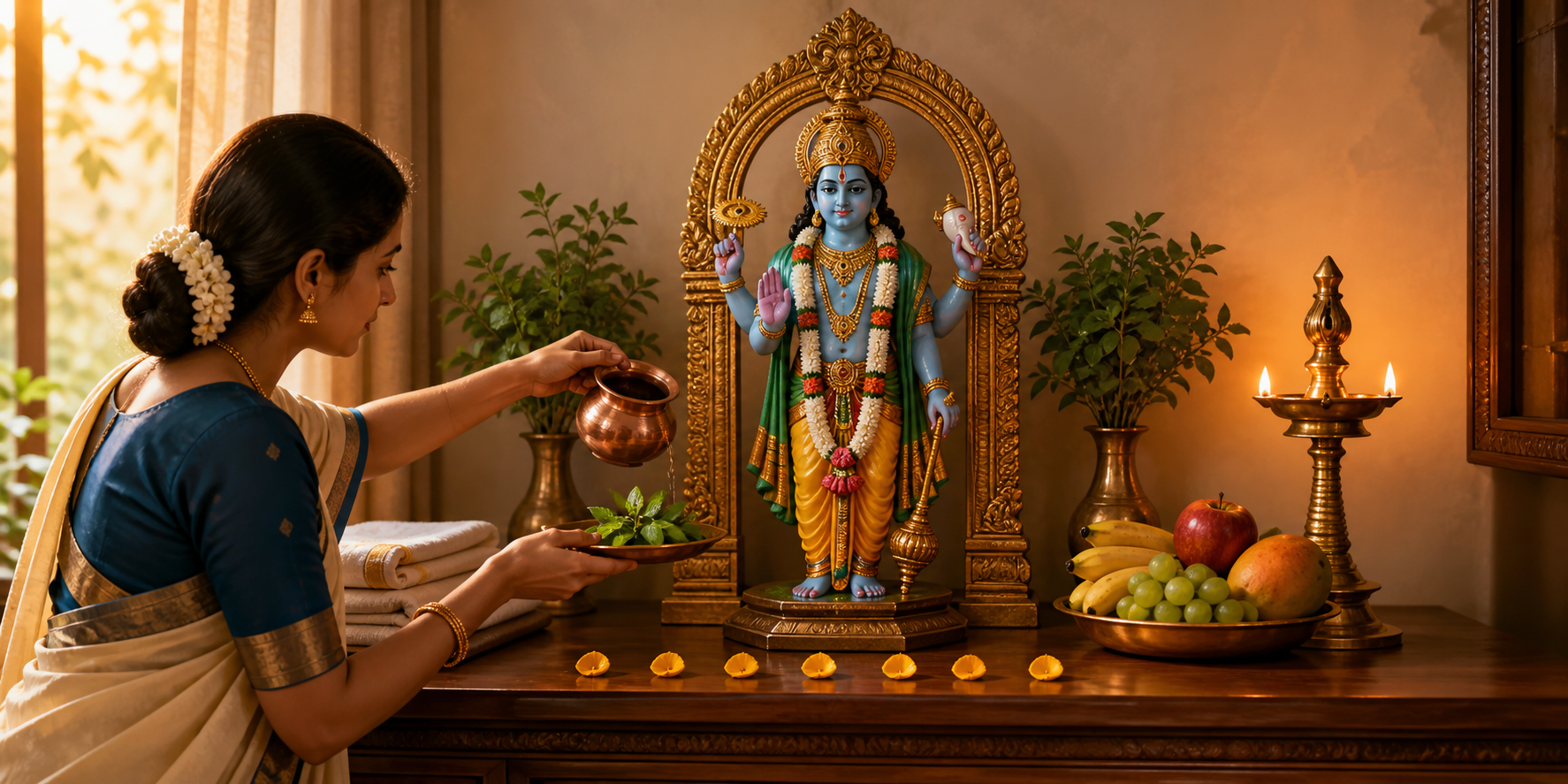
Vishnu Saptami is observed on Shukla Paksha Saptami, the seventh lunar day of the bright fortnight. In 2025, the observance falls on November 27. Use that date as your planning anchor, but consult the local Panchang before fixing the puja period because the Saptami tithi and recommended muhurta can vary by location.
If your family or temple has a learned Shodashopachara procedure, follow that established method. For a household that needs a simpler observance, the following sequence keeps the essential elements together without pretending to replace a lineage-specific liturgy:
- Confirm the local tithi. Record the applicable Saptami period and the time your household will gather. This prevents a last-minute argument over competing calendars.
- Prepare the worship space. Arrange a clean place for the deity, a lamp, water, flowers, incense, naivedya, and the leaves used in your tradition. Gather everything before beginning so the worship can proceed without repeated interruptions.
- State the purpose of the vrata. Bring one intention to the observance: clarity in dharmic action, greater self-discipline, harmony within the family, or devotion expressed through service. A specific resolve gives the day a direction beyond completing ritual actions.
- Make the offerings attentively. Light the lamp and incense, then offer water, flowers, and naivedya according to your household procedure. Tulsi leaves may be offered to Vishnu. Where Shiva is reverentially included, Bilva leaves provide the corresponding expression of worship.
- Give time to recitation. Vishnu Sahasranama, mantra japa, or another hymn received through your tradition can form the verbal heart of the puja. Follow it with silent contemplation instead of ending immediately after the last recitation.
- Carry the vrata into action. Complete the observance with charity, annadana, or another planned act of seva. If food was offered, share it respectfully rather than allowing the naivedya to become an isolated ritual gesture.
Many devotees fast, while others keep a sattvic diet. Fasting is not the only way to make the day disciplined. If abstaining from food could interfere with your health or medication schedule, do not improvise a fast; seek appropriate medical guidance or adopt the sattvic-food option. The vrata should cultivate responsible self-mastery, not disregard a genuine health need.
If time is limited, preserve the core rather than rushing through a larger ceremony: verify the tithi, make a sincere offering, recite or chant with attention, sit quietly, and perform one act of service. Simplicity is useful when it protects concentration rather than becoming an excuse for carelessness.
Let Shiva-Vishnu unity change the character of the day

In traditions that honour Shiva alongside Vishnu on Vishnu Saptami, the paired worship expresses the insight that the divine reality is not exhausted by sectarian names. Offering Tulsi to Vishnu and Bilva to Shiva makes that insight visible without erasing the forms, symbols, and disciplines proper to each tradition.
This does not require you to invent a composite ritual or claim that every Hindu school teaches the same theology. Unity is not sameness. Follow your inherited procedure with integrity while refusing to turn devotion into rivalry. If members of a family have different Vaishnava and Shaiva attachments, the day can accommodate respectful remembrance without forcing either person to abandon a cherished form of worship.
You can make the principle concrete in three places:
- At home: let children help arrange a lamp, flower, or leaf, and explain what the offering means. Give them one task they can complete with care rather than making them passive spectators.
- In the community: connect collective puja or kirtan with annadana, charity, or practical service. Shared work gives religious harmony a visible consequence.
- In conversation: describe your family’s observance as your received path, not as the only legitimate form. Devotional confidence does not need contempt for another sampradaya.
The same care is needed when speaking about Hinduism, Buddhism, Jainism, and Sikhism together. Their ritual calendars and doctrines remain distinct. What can be affirmed without flattening those differences is a shared civilizational regard for compassion, truthfulness, self-discipline, ethical living, meditation, and seva. Vishnu Saptami belongs to a Hindu ritual setting; its ethic of disciplined devotion and mutual respect can still strengthen a wider Dharmic culture.
Key takeaways
- In the North Indian Purnimanta system, Margashirsha 2025 extends from November 6 through December 4.
- Vishnu Saptami falls on November 27, 2025, but local tithi and muhurta details must be verified in a city-specific Panchang.
- Do not mix Purnimanta month boundaries with observance dates calculated under an Amanta calendar.
- A sustainable Margashirsha plan needs a daily devotional anchor, locally verified festival dates, and a definite act of seva.
- A practical Vishnu Saptami observance can include a lamp, water, flowers, incense, naivedya, Tulsi for Vishnu, Vishnu Sahasranama or mantra japa, and silent contemplation.
- Where Shiva is included, Bilva offerings can express Shiva-Vishnu harmony while each form of worship retains its own integrity.
- If fasting is unsuitable for your health, a sattvic diet and disciplined conduct provide a responsible way to keep the vrata.
Your next step is simple: open the Panchang for the place where you will worship, record the November 27 Saptami period, and choose the daily practice and act of seva you will keep during Margashirsha. Put those decisions on the family calendar before gathering puja materials. That small act of preparation allows the month to become a lived discipline rather than a sequence of dates noticed too late.
References
- DharmaRenaissance Blog — Vishnu Saptami 2025: Auspicious Date, Rituals, and the Profound Unity of Shiva-Vishnu
- DharmaRenaissance Blog — Margashirsha Month 2025 (Margasheersh Mahina): Dates, Significance and Regional Guide
