
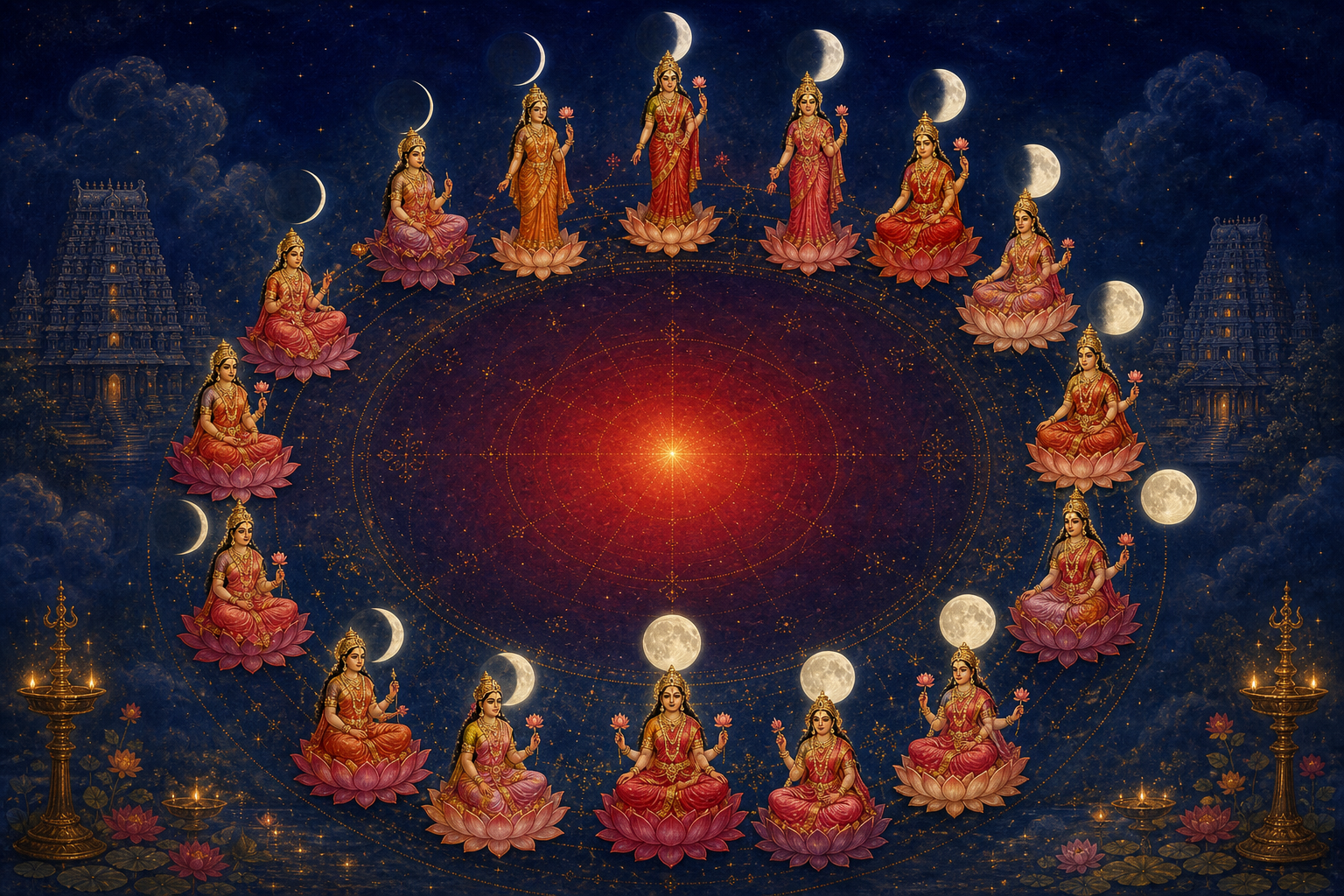
You may have encountered the Nitya Devis as a list of unfamiliar goddess names and wondered what you were actually supposed to understand. Is this a lunar calendar, a set of independent deities, a ritual sequence, or a philosophical teaching about time?
The clearest answer is that the Nityas are fifteen lunar goddesses within the Srividya tradition. Their deeper purpose is to reveal time itself as an expression of Devi. Once you grasp that principle, the number of goddesses, their lunar ordering, and the wider sixteenfold language stop looking like disconnected pieces.
Change does not displace the eternal

The word nitya means eternal or perpetual. That can appear puzzling when the Nityas are associated with lunar time, because the moon presents itself through change. Its visible condition does not remain fixed.
That tension is the teaching. Srividya does not ask you to choose between the eternal and the changing. The changing phase is not outside divine reality, while the eternal is not a distant realm reached only after time has been escaped. Devi is encountered through ordered change without being reduced to any one passing appearance.
This corrects a common reading mistake. If you treat each Nitya merely as a supernatural personality assigned to a date, you miss the structure holding the group together. The sequence concerns the relation between differentiated moments and the undivided divine presence expressed through them.
When you meet a description of a Nitya, ask three questions before trying to memorise details:
- What form of change or temporal differentiation is being contemplated?
- What remains continuous while that particular form appears and passes?
- How does this individual manifestation belong to the complete order rather than standing alone?
Those questions keep the theology in view. They also prevent a catalogue of deities from replacing the insight the catalogue was meant to communicate.
The lunar sequence makes time visible
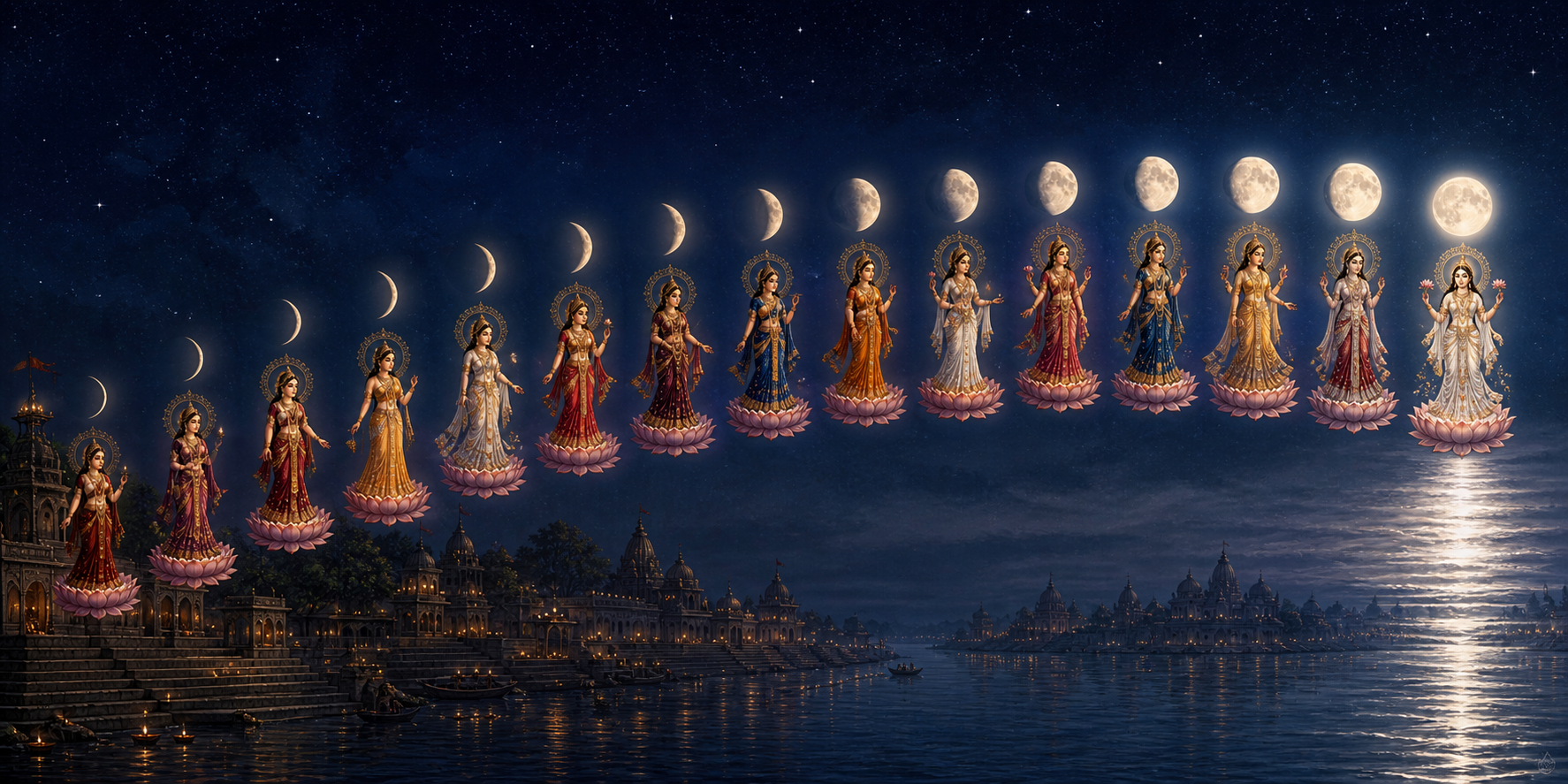
Clock time is easy to imagine as an empty container. Minutes and hours seem identical until events fill them. Lunar time feels different because change is visible. Increase, fullness, withdrawal, concealment, and return belong to a recurring order that can be watched rather than merely calculated.
The fifteen Nityas give that ordered change a divine vocabulary. They do not simply add religious labels to portions of a calendar. They teach you to notice that no moment is spiritually vacant. Difference exists, but difference does not mean separation from Devi.
This is also why sacred geometry and temporal sequence belong naturally together in Srividya. A sequence shows distinction through succession: one position follows another. Geometry can hold differentiated positions within one intelligible whole. One mode teaches movement; the other teaches relationship. Both resist the idea that reality is a pile of unrelated moments.
You can apply this insight without pretending to perform an initiated ritual. When a period of life is expanding, contracting, obscured, or changing direction, resist calling one condition sacred and another spiritually useless. The Nitya framework asks a sharper question: what form is divine presence taking here, and what does this moment require you to notice?
That does not mean every event is pleasant or that discernment becomes unnecessary. It means transience is not evidence of divine absence. A form can pass without reality becoming empty.
Why the tradition can speak of both fifteen and sixteen
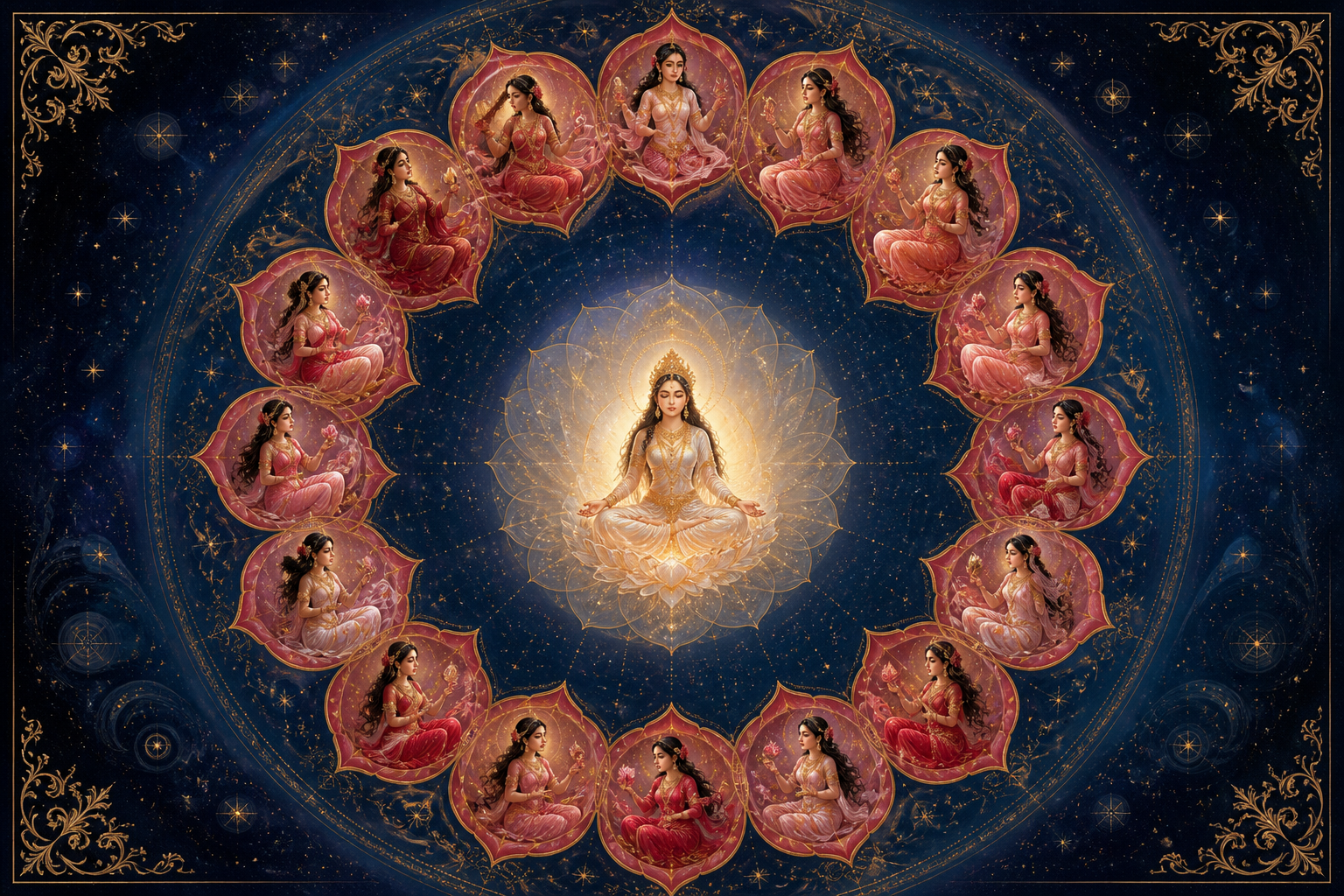
The count of fifteen identifies the articulated lunar goddesses. The wider language of sixteen expresses the completeness within which that differentiated sequence is understood. The two numbers answer different questions: one counts the ordered manifestations, while the other directs attention to the wholeness that contains and completes the order.
This is not unusual in Dharmic thought. A system may enumerate manifested parts and also acknowledge an inclusive principle that is not merely another part sitting beside them. If you count only the differentiated expressions, you obtain one number. If you include the completeness from which the sequence derives its unity, the language changes.
Use the distinction between a manifest count and an inclusive count. It is more useful than trying to force every presentation into one flat list. When you encounter fifteen in one explanation and sixteen in another, check what is being counted before concluding that the accounts contradict each other.
- Does the count include only the distinct lunar manifestations?
- Does it also include the totality or completion of the sequence?
- Are both explanations operating at the same theological level?
- Are they following the same ritual and teaching context?
This approach matters beyond arithmetic. The sixteenth perspective keeps you from mistaking the many forms for isolated powers. The fifteen remain differentiated, but their differentiation is held within unity.
Study the Nityas without turning fragments into ritual
There is an important difference between understanding Srividya theology and performing formal Srividya worship. A public explanation can help you understand the conceptual structure. It does not automatically supply the context, instruction, or authority required to reconstruct a tantric practice.
A responsible beginning has four parts:
- Learn the governing idea first. Hold together eternity, lunar change, differentiated manifestation, and completeness before concentrating on isolated attributes.
- Keep interpretation tradition-specific. Do not immediately translate every Nitya into a modern personality type, psychological mood, planetary forecast, or goddess from another system.
- Separate contemplation from formal worship. Observing change and reflecting on sacred time can prepare your understanding, but it should not be represented as Nitya puja.
- Seek instruction within a qualified Srividya lineage before adopting mantras, ritual diagrams, or detailed procedures. Context determines how such elements belong together.
For a simple preparatory exercise, observe the moon across several evenings. In a notebook, make three columns: changing appearance, continuity, and response. Record what visibly changed, what remained continuous through the change, and how your own judgement of the moment shifted. Do not attach an unfamiliar Nitya name or mantra to the exercise. Its purpose is only to make the central question concrete: how can change be real without exhausting the reality that appears through it?
Also resist two shortcuts. The first is reducing the Nityas to decorative goddess imagery. The second is treating them as instruments for gaining control over time. The teaching is more demanding than either shortcut. It changes the standpoint from which you experience time: you are not standing outside a dead sequence of moments, trying to dominate it; you are learning to recognise an ordered manifestation of Shakti.
Key takeaways for reading the Nitya tradition
- The Nityas are fifteen lunar goddesses within the Shakta Tantric tradition of Srividya.
- Nitya means eternal, so the system deliberately joins enduring divine reality with visibly changing lunar time.
- The lunar sequence is not merely a schedule. It makes differentiation, recurrence, appearance, and withdrawal available for contemplation.
- Fifteen counts the articulated lunar manifestations; sixteenfold language points to their completion within an inclusive wholeness.
- Theology can be studied publicly, but formal ritual should not be assembled from isolated names, diagrams, or instructions.
- The most useful first question is not what a Nitya can give you, but what her place in the sequence reveals about time and Devi.
The next time you encounter a list or image of the Nityas, pause before collecting names. Mark what is changing, what gives the sequence its unity, and whether the explanation is counting manifestations or completeness. That small discipline will take you closer to the Srividya vision than memorisation without structure.
References
