
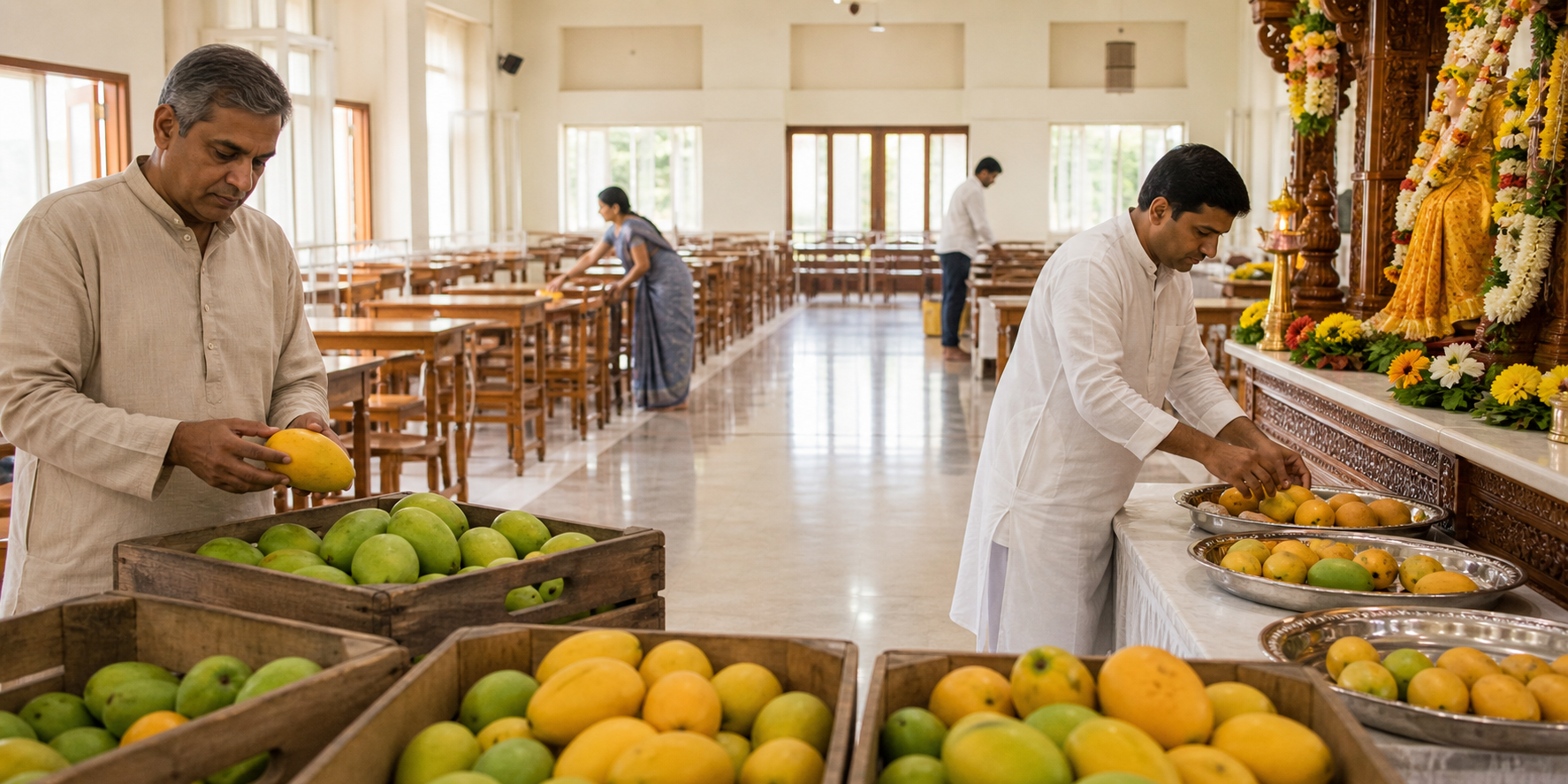
You have been asked to help prepare a mango festival, and the visible part sounds simple: arrange mangoes, welcome devotees, and serve everyone well. The difficult part is making worship, food handling, volunteer movement, decoration, and hospitality work as one event.
A Mango Festival begins well before the first guest arrives, with devotees setting up the space and its materials. Treat that preparation as seva in its own right. A disciplined setup protects the sanctity of the offering, reduces waste, and lets volunteers give their attention to people rather than preventable confusion.
Define the festival before you order the mangoes
Do not begin with a shopping list. Begin with a one-page festival brief approved by the event lead, the authorised temple representative, and the kitchen or food-service lead. These people answer different questions, and all three sets of answers affect the setup.
Your brief should settle the following points:
- The devotional centre: Decide whether the programme includes a formal offering, a deity decoration, a mango display, darshan, congregational singing, a discourse, or another observance. Record who may place and remove items in the sacred area.
- The promise to guests: State whether people are coming primarily for worship, a community meal, mango tasting, cultural celebration, or a combination. This determines where queues form and what volunteers must explain.
- The attendance basis: Separate confirmed registrations, invited groups, volunteers, and possible walk-ins. Do not treat hoped-for attendance as confirmed attendance, but do not let a registration list become the only plan for public arrivals.
- The food format: Decide which mangoes will remain whole, which will be cut, and which will enter prepared dishes. Each format needs different tools, surfaces, containers, and serving arrangements.
- The authority chain: Name the person who can approve ritual changes, the person who controls food release, and the person who manages the public floor. Volunteers should never have to guess whose instruction takes priority.
- The closing plan: Decide in advance what may happen to offered fruit, unused ingredients, prepared food, decorations, crates, and waste. Leftovers are not a problem to postpone until everyone is tired.
If deity service is part of the festival, obtain the temple’s instructions before designing the display. Do not assume that an attractive arrangement is ritually suitable, that every fruit may be handled by every volunteer, or that display fruit may automatically enter the kitchen afterward. The authorised temple representative should decide those boundaries.
Write one sentence at the top of the brief that describes success. For example: the worship proceeds according to temple protocol, every served item remains under safe food controls, guests can move without obstruction, and usable fruit has a planned destination. When someone proposes a late addition, test it against that sentence.
Give every mango a defined path through the event
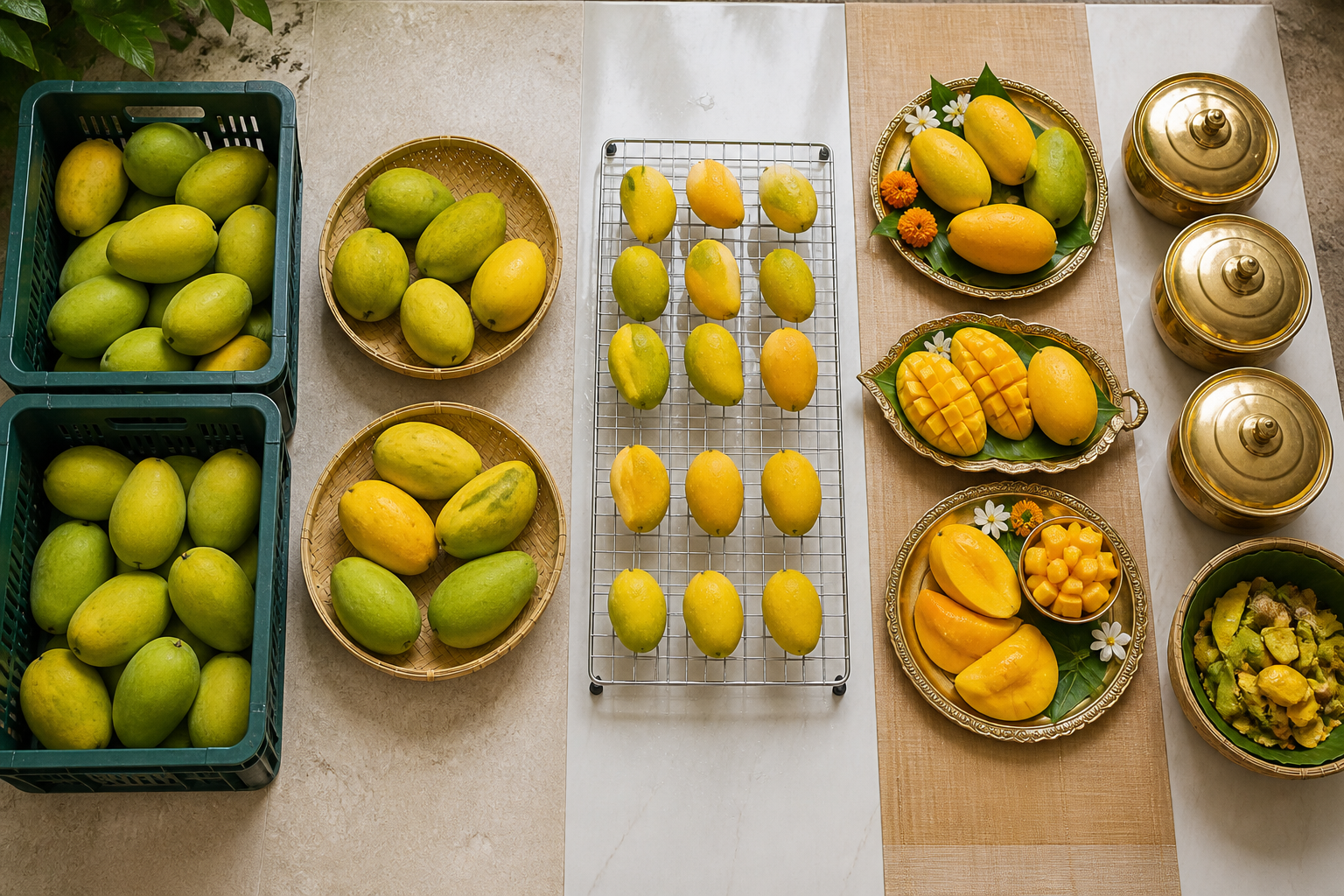
A crate described only as “mangoes” is an invitation to mishandling. Assign fruit to a path when it arrives, mark the container clearly, and let only the responsible lead move it to another path.
| Fruit path | What belongs there | Who releases it |
|---|---|---|
| Offering | Fruit accepted for the formal devotional use defined by the temple | Authorised temple representative |
| Kitchen and serving | Fruit accepted for cutting, cooking, plating, or public distribution | Kitchen or food-safety lead |
| Display and decoration | Fruit and materials reserved for the approved visual arrangement | Decoration lead working within temple instructions |
| Reserve | Usable fruit held back for an agreed shortage or replenishment trigger | Festival coordinator with the relevant path lead |
For procurement, maintain a simple ledger with four states: promised, received, inspected, and assigned. A donor’s good intention does not make promised fruit available for planning. Base the working quantity on what has actually been received or on purchases that the coordinator has confirmed.
Inspect incoming fruit at one controlled station rather than letting crates disperse through the venue. Mark the intended path and the observed condition. Firm fruit generally tolerates display and slicing better; softer ripe fruit can be directed to preparations that do not require neat pieces, provided the kitchen lead accepts it. Remove leaking, spoiled, or otherwise unsuitable fruit from usable stock immediately so that it is not returned to circulation by mistake.
Keep the offering, display, unprepared kitchen stock, and ready-to-serve food physically distinct. If fruit becomes prasada after an offering, ask the authorised temple representative how it may be cut, combined, distributed, or carried away. Sacred status does not remove the need for safe handling, and food-service convenience does not override temple protocol.
Exact requirements for storage temperature, holding time, kitchen access, and public service depend on local food-safety rules and the facilities available. Assign a competent person to apply those requirements. At minimum, use clean hands, clean tools, stable cutting surfaces, protected containers, and separate serving utensils. Keep cut fruit under the required controls and away from public handling. If the team cannot verify that a prepared item remained safely handled, do not serve it; uncertainty is not a reason to expose guests to foodborne illness.
Label every prepared dish with its ingredients and keep its utensil with that dish. Do not promise that a food is suitable for a dietary restriction unless the kitchen can support that statement through its ingredients and handling. Clear information lets guests make their own decisions without putting an untrained volunteer in the role of medical adviser.
Design the site around movement, not decoration
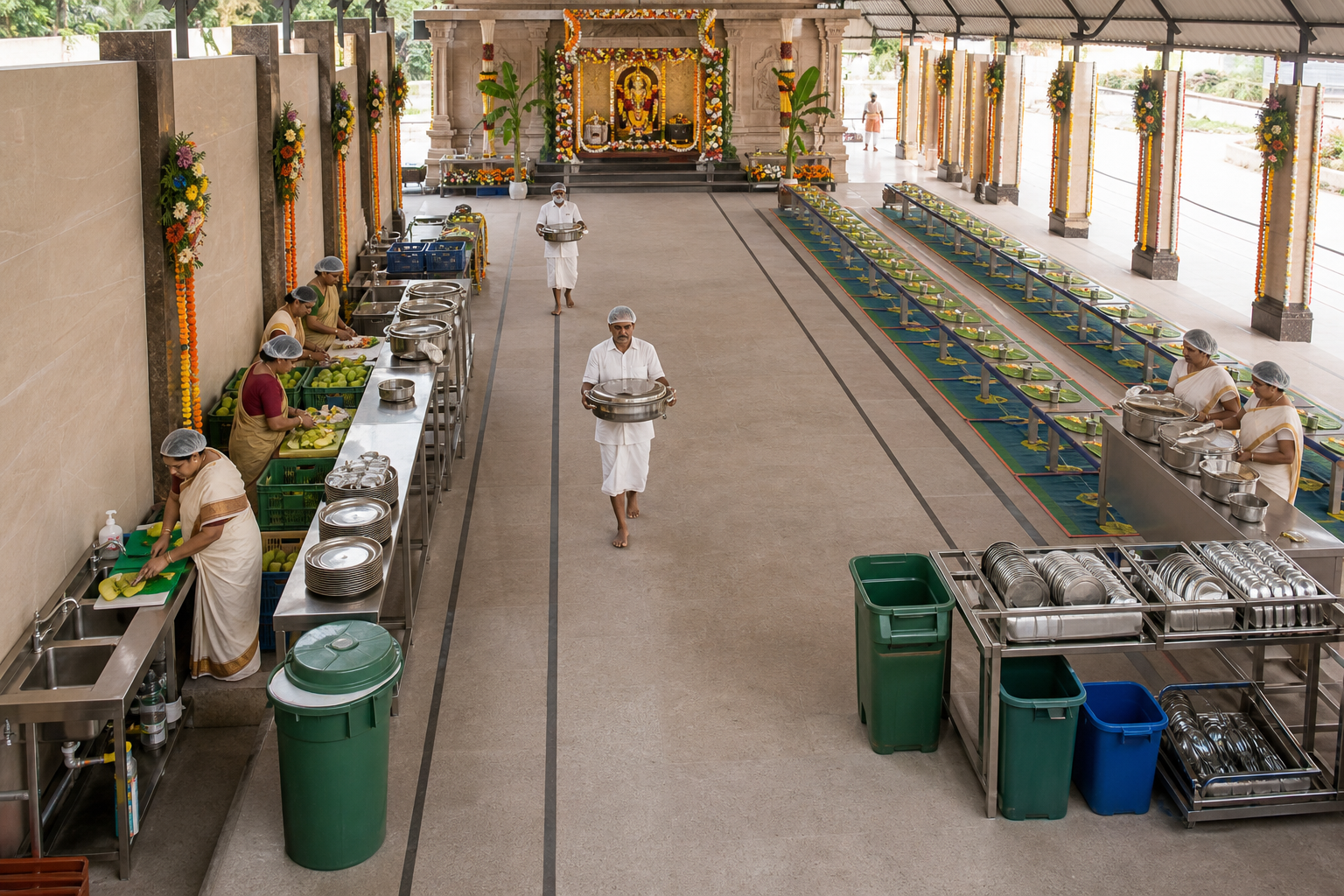
Draw a floor plan before carrying tables into the venue. It can be a plain sketch, but it should show the guest route, sacred boundary, volunteer route, kitchen access, service point, waste point, hand-cleaning facilities, storage, emergency access, and photography position. Walk the route as though you are a first-time visitor who does not know where to remove footwear, join a queue, receive prasada, or exit.
Arrange the public flow in the order guests will encounter it:
- Arrival information and any venue-specific instructions
- Footwear or personal-item area, where applicable
- Darshan, worship, or programme seating
- Mango display or cultural interpretation
- Food queue and serving point
- Eating area, water, and waste collection
- A clear exit that does not cut back through the serving queue
Protect the sacred and working areas from traffic that does not belong there. A photography spot should not obstruct darshan. A decorative arch should not narrow an emergency route. Kitchen volunteers carrying knives, trays, or hot vessels should not cross the public queue. Electrical cables should not run unprotected through wet preparation or serving areas. Place absorbent materials and cleaning supplies wherever juice or water is likely to reach the floor, and clean spills as soon as they appear.
Build the equipment list by function, not as one long collection of objects:
- Worship: Only the approved plates, cloths, stands, vessels, and decorative materials specified by the temple team.
- Fruit intake: Ledger, labels, markers, clean trays, inspection surface, assigned crates, and a defined place for rejected or questionable fruit.
- Preparation: Stable cutting boards, suitable knives, food-safe containers, cleaning materials, protective covers, ingredient labels, and separate utensils for each dish.
- Public service: Tables, queue markers, readable signs, serving utensils, covered replenishment containers, waste receptacles, and supplies for promptly cleaning spills.
- Closeout: Containers for approved leftovers, labels for their destination, cleaning tools, inventory sheet, and keys or access information needed to return the venue.
Assign one named lead and one backup for each critical function: festival coordination, worship liaison, fruit intake, kitchen safety, food service, guest flow, cleaning and waste, and communications or photography. The backup is not an extra supervisor. That person needs enough information to continue the work if the lead must leave the station.
Give each volunteer a small job card or message containing four things: where to report, whom to follow, what completion looks like, and what the volunteer may not decide alone. A decoration volunteer, for example, may arrange approved materials in an assigned area but may not move an offering or alter the sacred boundary without permission.
Keep children and untrained helpers away from knife work, wet-floor response, heavy lifting, electrical equipment, and restricted worship spaces. Give younger volunteers low-risk tasks under adult supervision, such as welcoming guests, carrying signs, sorting unused paper goods, or helping at an information point.
Rehearse the festival as a sequence of handoffs
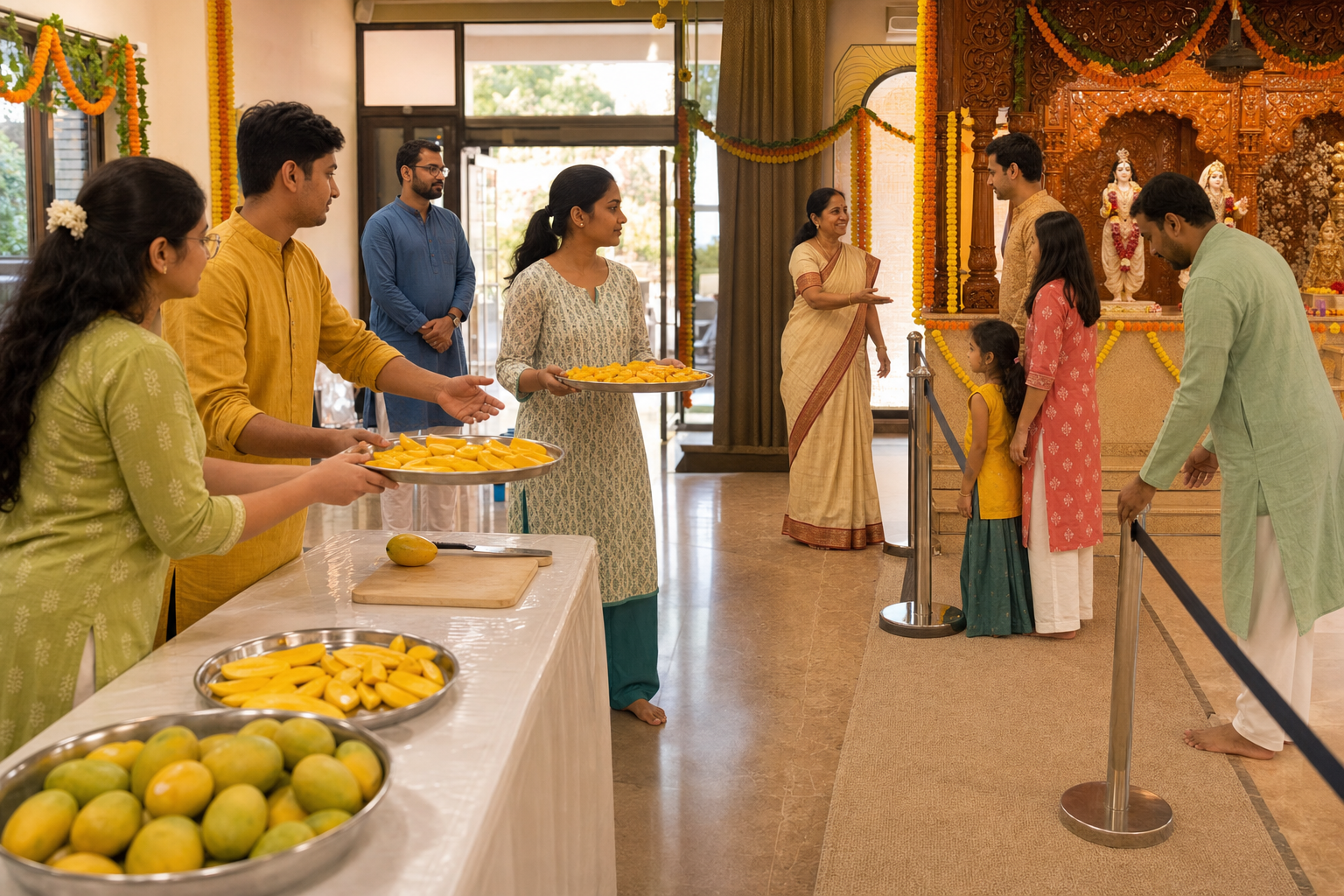
A checklist of objects will not reveal where responsibility disappears. Rehearse the event as a chain of handoffs, with the receiving person confirming each one.
- Receive and inspect: Donations and purchases arrive at the intake station. Accepted fruit is labelled by path; unsuitable fruit is isolated.
- Release the venue: The site lead confirms that tables, routes, emergency access, cleaning facilities, and restricted areas match the floor plan.
- Prepare the devotional area: The worship liaison confirms that only approved people and materials enter the sacred setup.
- Prepare food: Kitchen stock moves into the controlled preparation area. Prepared dishes are covered, labelled, and held under the applicable food-safety requirements.
- Brief volunteers: Leads state the guest route, restricted areas, escalation contacts, spill response, food-release authority, and the procedure for a lost child or medical concern.
- Open to guests: The floor lead confirms that the entrance, worship area, display, serving route, and exit are ready. Service starts only after both ritual and food-release requirements have been met.
- Replenish deliberately: The service captain requests prepared food from the kitchen instead of allowing volunteers to enter storage and take it independently. Reserve fruit is released only for its agreed purpose.
- Close and hand back: The team accounts for remaining fruit, routes leftovers according to the approved plan, cleans every work area, removes signs and decorations, and obtains venue handover confirmation.
During the rehearsal, ask what happens if a promised donation does not arrive, more fruit arrives than the kitchen can process, a ritual segment takes longer than expected, a queue blocks a passage, a volunteer lead is absent, the weather affects an outdoor area, or an item loses safe handling control. Put a name and fallback beside each scenario.
Do not solve a ritual delay by pressuring the worship team. Hold service, keep food under proper controls, and give guests a simple update. Do not solve a shortage by quietly raiding offering or display stock. The relevant leads must authorise any change of path. Do not redistribute prepared food when its handling history is uncertain.
End the event with a short operational debrief while the details are still clear. Record what ran out, what remained unused, where a queue formed, which instruction volunteers misunderstood, and what equipment was missing. Preserve that page with the floor plan and role list. The next festival then begins with working knowledge rather than memory.
Key takeaways
- Approve the devotional purpose, guest promise, food format, authority chain, and leftover plan before requesting fruit.
- Assign every mango to an offering, kitchen, display, or reserve path when it arrives.
- Keep sacred protocol and food-safety control distinct, with a named lead responsible for each.
- Draw and walk the guest route before decorating; queues, work traffic, and emergency access must not compete for the same space.
- Brief volunteers on both their task and the decisions they are not authorised to make.
- Rehearse handoffs and fallback decisions, then retain the debrief for the next celebration.
Your first move is a brief planning meeting with the festival coordinator, authorised temple representative, kitchen lead, and floor lead. Leave with one approved purpose, four fruit paths, a sketched floor plan, and names beside every critical decision. Once those are settled, the colour and generosity of the celebration can emerge without sacrificing order, safety, or reverence.
References
