

Your japa has become irregular, schoolwork is piling up, and every devotional account on your phone seems to belong to someone more disciplined than you. You want bhakti to steady you, but guilt has turned it into another test you think you are failing.
A bhakti self-care approach for teenagers begins with a better aim: learn how to live these years with devotion and discernment, rather than merely enduring them. Self-care here does not mean escaping your duties. It means caring for your body, attention, relationships, and spiritual life so that you can meet those duties honestly.
Ask what needs care before demanding more discipline

A tired body, a frightened mind, a wounded friendship, and a spiritual doubt do not need the same response. If you call all of them laziness, you will probably reach for more pressure when you need rest, conversation, safety, repentance, or practical help.
Before judging your devotion, pause and ask:
- What am I actually feeling: tired, angry, afraid, lonely, jealous, numb, ashamed, or confused?
- What happened just before this feeling became strong?
- Have I neglected a basic need such as sleep, regular food, water, movement, privacy, or an honest conversation?
- Is there something I need to repair, such as an apology, an unfinished duty, or a boundary I failed to state?
- What is the smallest dharmic action that remains within my control?
This check is not self-absorption. It stops you from giving a spiritual label to every ordinary human need. You do not need a complete explanation of karma before admitting that something hurts. Nor do you need to feel calm before praying. Anger, confusion, and grief can be brought honestly into bhakti.
Try a plain prayer rather than a polished one: “I am upset, I do not understand this, and I want help choosing my next right action.” Sincerity gives you somewhere real to begin.
Build a minimum practice for difficult days

A minimum practice is a floor, not a measure of your spiritual worth. Its purpose is to keep the relationship alive when concentration, time, or energy is limited. On an ordinary day, follow the fuller practice taught by your family, teacher, or sampradaya. On a difficult day, use a form small enough that you can approach it without pretending.
- Arrive. Put the phone out of reach. Sit or stand quietly until you can notice where you are.
- Check the body. Before calling yourself spiritually weak, notice whether you are exhausted, hungry, unwell, or overstimulated.
- Choose one devotional act. Repeat the mantra you have been taught, sing a familiar bhajan or shabad, offer a simple prayer, read a short sacred passage, or remember the divine name used in your tradition.
- Say what is true. Name the worry, mistake, gratitude, or decision that you are bringing into prayer.
- Return to your next duty. Bhakti should help you re-enter schoolwork, family responsibility, rest, or repair with greater honesty.
Attach this practice to a cue that already exists, such as washing in the morning or putting your phone away at night. A cue removes the daily argument about when to begin.
Write a personal practice card with these entries:
- Cue: the event that reminds you to begin.
- Minimum: the devotional act you can keep on a hard day.
- Full practice: what you normally do when time and energy allow.
- Repair: how you return after missing practice.
- Support: the person you will tell if your struggle continues.
If you miss a day, return at the next cue. Do not invent a punishment or an extreme catch-up routine. If you have taken a formal vow about a practice, ask the teacher responsible for that vow how to repair it; do not guess from social media. On easier days, you can do more without moving the minimum upward and making tomorrow harder.
Do not turn devotion into another scoreboard
School gives you marks. Apps give you streaks. Communities may praise visible service. Those signals can organise behaviour, but they cannot measure the depth of your relationship with the divine.
A devotional streak can remind you to show up; it cannot tell you whether you are loved, pure, accepted, or spiritually advanced. A polished altar photograph does not reveal the person’s doubts, family support, available time, or private conduct. Public enthusiasm is not the same thing as inner maturity.
If tracking helps, record only what can guide your next decision:
- Did I show up for the practice I intended?
- What helped me pay attention?
- What repeatedly interrupted me?
- What adjustment would make tomorrow more realistic?
Do not use the record to rank yourself against friends. Its job is to reveal patterns. If late-night scrolling repeatedly weakens morning practice, change where the phone charges. If an overloaded service schedule leaves schoolwork unfinished, reduce the commitment before resentment takes over.
Your responsibility as a student is not an enemy of spiritual life. At the beginning of the school week, place examinations, assignment deadlines, family duties, worship, and community service on the same calendar. When they collide, speak early. Borrowing work, lying about an unfinished assignment, or sacrificing needed sleep to preserve a public image of seva does not become dharmic because a religious activity is involved.
Let community support you without surrendering boundaries
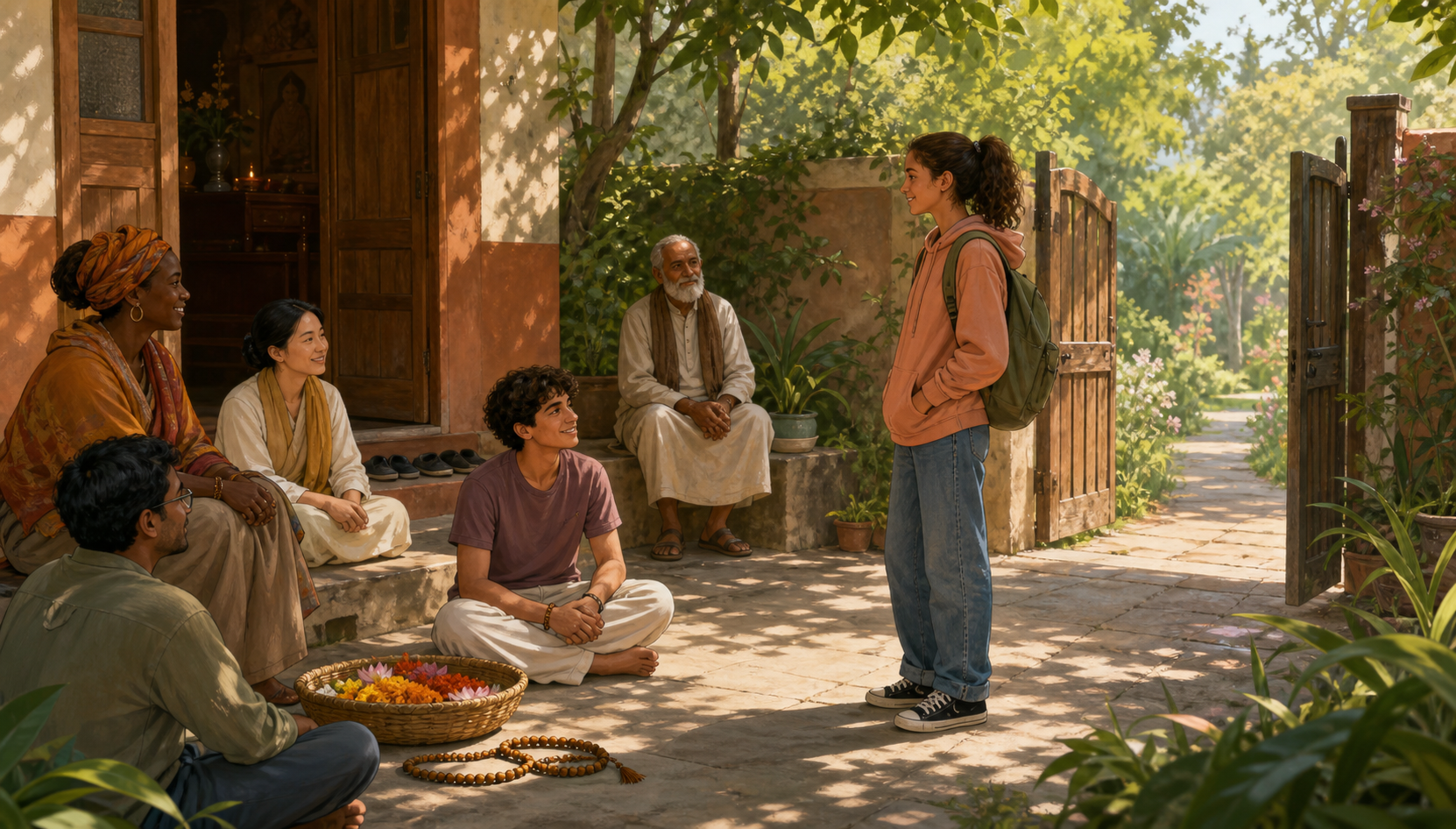
Bhakti grows through relationship. You may need family, friends, a temple or gurdwara community, and a trustworthy teacher. Healthy community gives you room to ask questions, admit limits, and seek help without making you prove your devotion first.
When you need to set a boundary, use direct language:
- “I want to keep serving, but this responsibility is too much alongside school. Can I take a smaller role?”
- “I need you to listen before giving me a spiritual explanation.”
- “I am not comfortable keeping this conversation secret from my parent, guardian, or another safe adult.”
- “I do not feel safe with that person, and I will not meet them alone.”
Respect for elders does not require silence about unsafe conduct. No teacher, volunteer, relative, or older student should use ideas such as surrender, obedience, karma, or seva to override your bodily boundaries or demand secrecy about behaviour that frightens you. Tell a safe adult outside the immediate situation. That may be a parent or guardian, another relative, a school counsellor, a doctor, or the person responsible for safeguarding in the community.
Bhakti can remain beside professional care, but it must not replace it. If distress keeps you from managing ordinary life, or you are dealing with panic, self-harm, thoughts of dying, abuse, or immediate danger, tell a trusted adult plainly and seek qualified help. If you might harm yourself or someone is threatening you, do not remain alone; contact local emergency services or ask a safe adult to do so now. Prayer can accompany that action. It is not a reason to delay it.
Questions teens ask about bhakti self-care
What if I do not feel anything during prayer or japa?
Do not manufacture an emotion to prove devotion. Show up honestly, keep the practice you can keep, and notice whether tiredness, distraction, resentment, or doubt needs attention. “I feel nothing, but I am here” is a more truthful offering than performed enthusiasm. If numbness is spreading across the rest of your life, tell a trusted adult rather than treating it only as a spiritual problem.
Is rest just laziness or tamas?
Look at the pattern and the result. Rest supports your return to a reasonable duty. Avoidance repeatedly pushes the duty away while leaving you no more able to face it. Ask what kind of rest would actually restore you, decide when you will return, and then check whether it helped. If exhaustion continues despite ordinary care, speak with a parent, guardian, doctor, or other qualified professional.
What if my family follows a different practice from the one that interests me?
Separate curiosity from commitment. You can learn respectfully without declaring that everyone around you is wrong or making a secret formal commitment you do not understand. Ask what the practice means, where it comes from, what obligations it carries, and who is accountable for teaching it. Involve a safe parent, guardian, or trusted elder where possible. If raising the subject at home could put you in danger, seek help from another safe adult before confronting anyone.
How should I judge a teen bhakti course or group?
Look beyond attractive language. A trustworthy programme should explain who leads it, what tradition informs it, what participants will do, how questions are handled, and which adult is responsible for safety. It should not promise to cure mental-health conditions, demand secret contact, shame you for stepping back, or pressure you to hide participation from every safe adult. Its workload should leave room for school, family duties, sleep, and appropriate professional care.
Tonight, choose one existing cue, one minimum devotional act, and one trustworthy person you can approach when the minimum is not enough. Write them down before putting away your phone. Tomorrow, practise without grading your worth. Let that small act become a doorway back into attention, duty, and honest relationship.
References
