
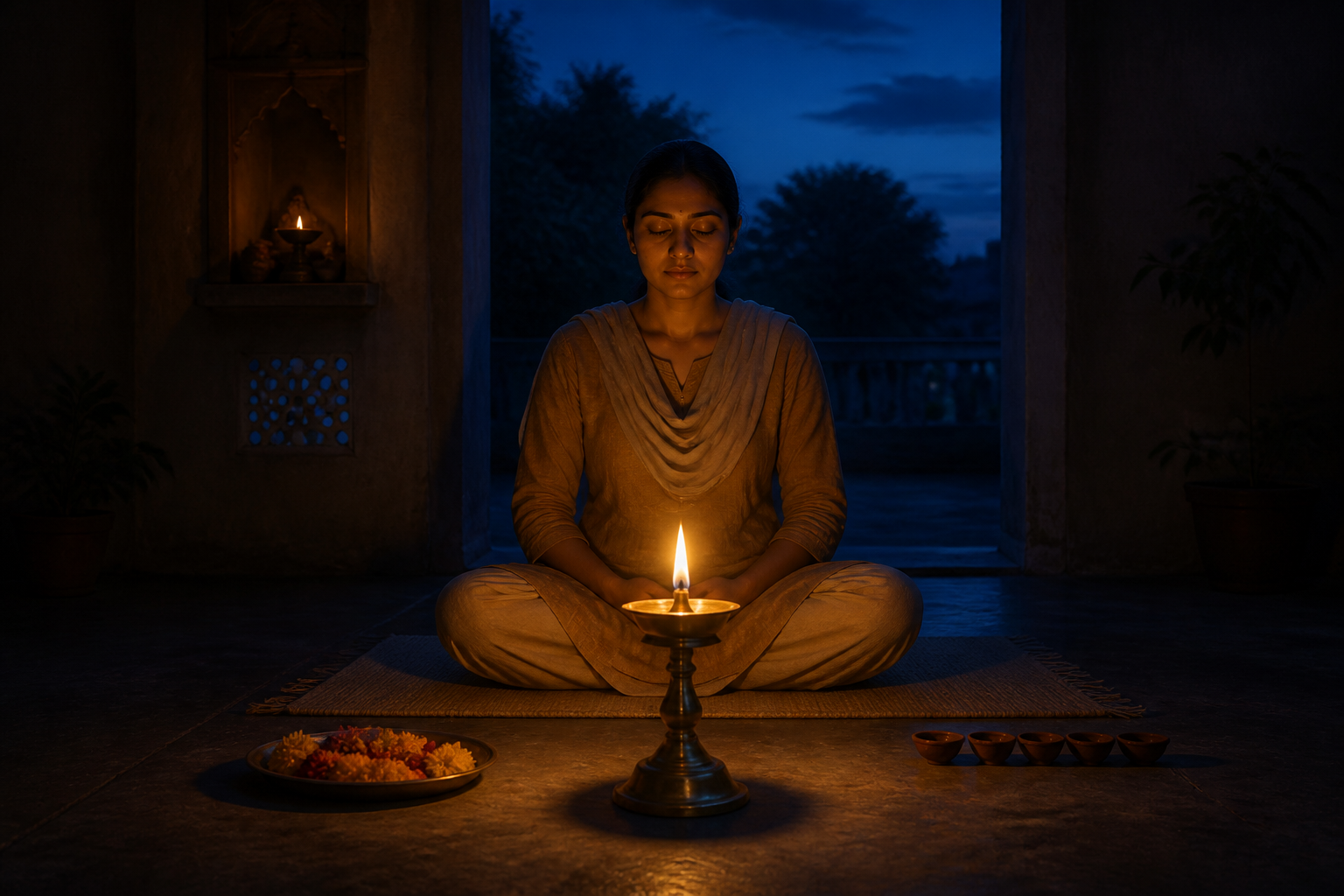
You light a deepam during Karthika, fold your hands, and watch the flame settle. Then a practical question arises: what should this inner illumination change after the wick has burned down?
You don’t need to manufacture a mystical vision. The visible lamp can lead you through a disciplined movement from worship to attention, and from attention to conduct. Patanjali’s Jyotismati practice gives that movement a precise contemplative form.
The outer lamp gives your mind a direction
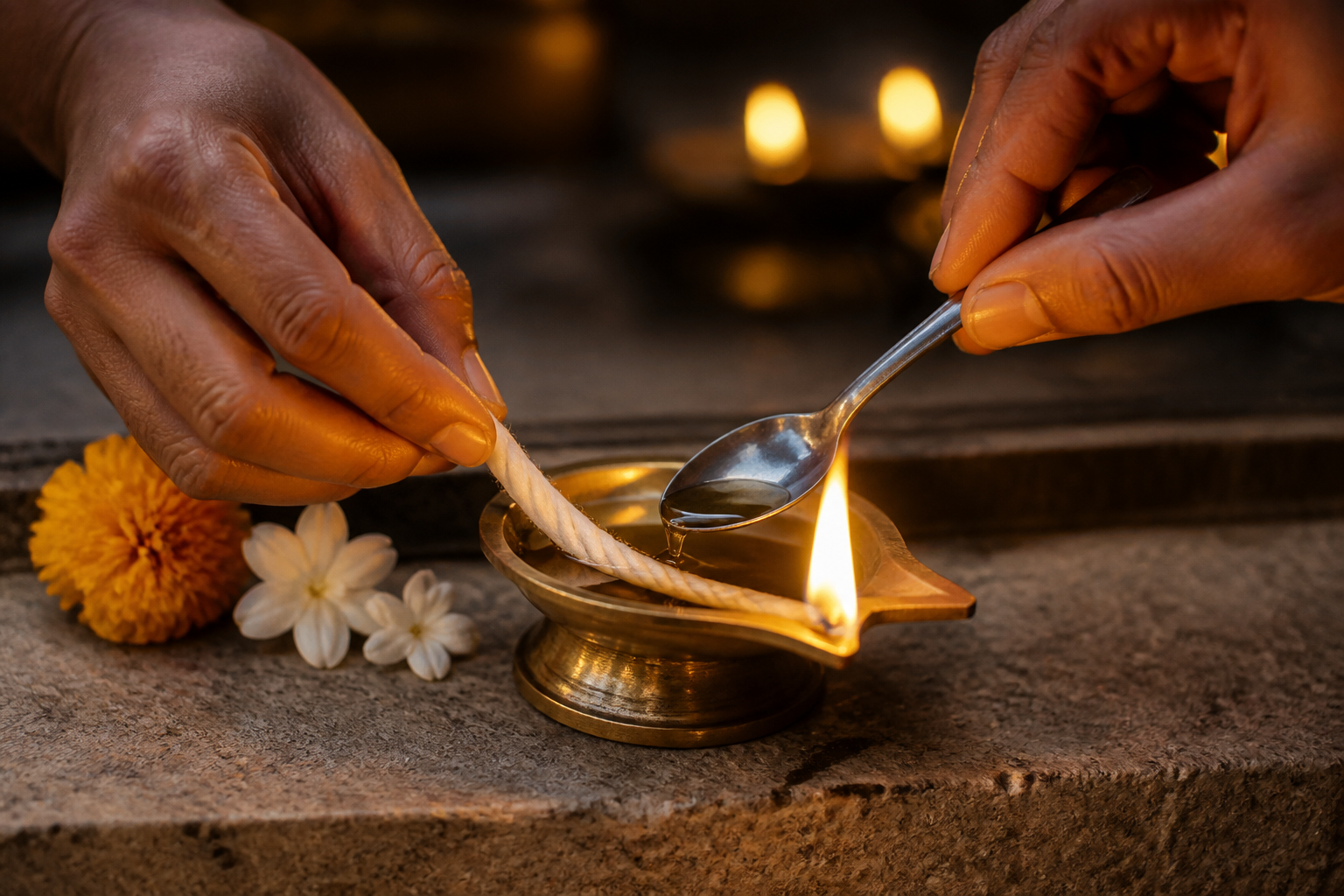
A Karthika deepam is not merely an ornament carrying a philosophical message. Preparing the lamp, placing the wick, offering ghee or oil, lighting the flame, and sitting before it bring the body, senses, memory, and intention into the same act. That is why Karthika lamp worship is associated with inner illumination, gratitude, and renewal.
The flame gives scattered attention a visible centre. Sankalpa gives that attention a direction. Devotion gives the discipline warmth. Remove attention, and the lighting can become mechanical. Remove devotion, and the exercise can become a dry concentration technique. Karthika worship holds the two together.
Collective Deepotsavam adds another dimension. Your lamp stands among other lamps without losing its own flame. Personal remembrance becomes communal worship, while courtesy, cleanliness, restraint, and shared silence become part of the offering. Inner light is therefore not a private possession. It should make your presence less disruptive and more beneficial to those around you.
The language of luminosity also travels across the Dharmic family without erasing important differences. Buddhism speaks of luminous mind, Jain practice refines awareness through samayik and dhyana, and Sikh tradition honours the divine jot. These are not interchangeable doctrines, but they reveal a recognisable civilizational intuition: ignorance binds, clear seeing liberates, and awakened awareness must shape how we live.
For your own observance, begin with the setting. Use a clean, stable deepam, keep the area uncluttered, and place the flame where it cannot be knocked over. If you plan to close your eyes, make sure another responsible person is watching the lamp or extinguish it safely first. Reverence includes responsibility for the space in which you worship.
Jyotismati shifts attention from the flame to awareness
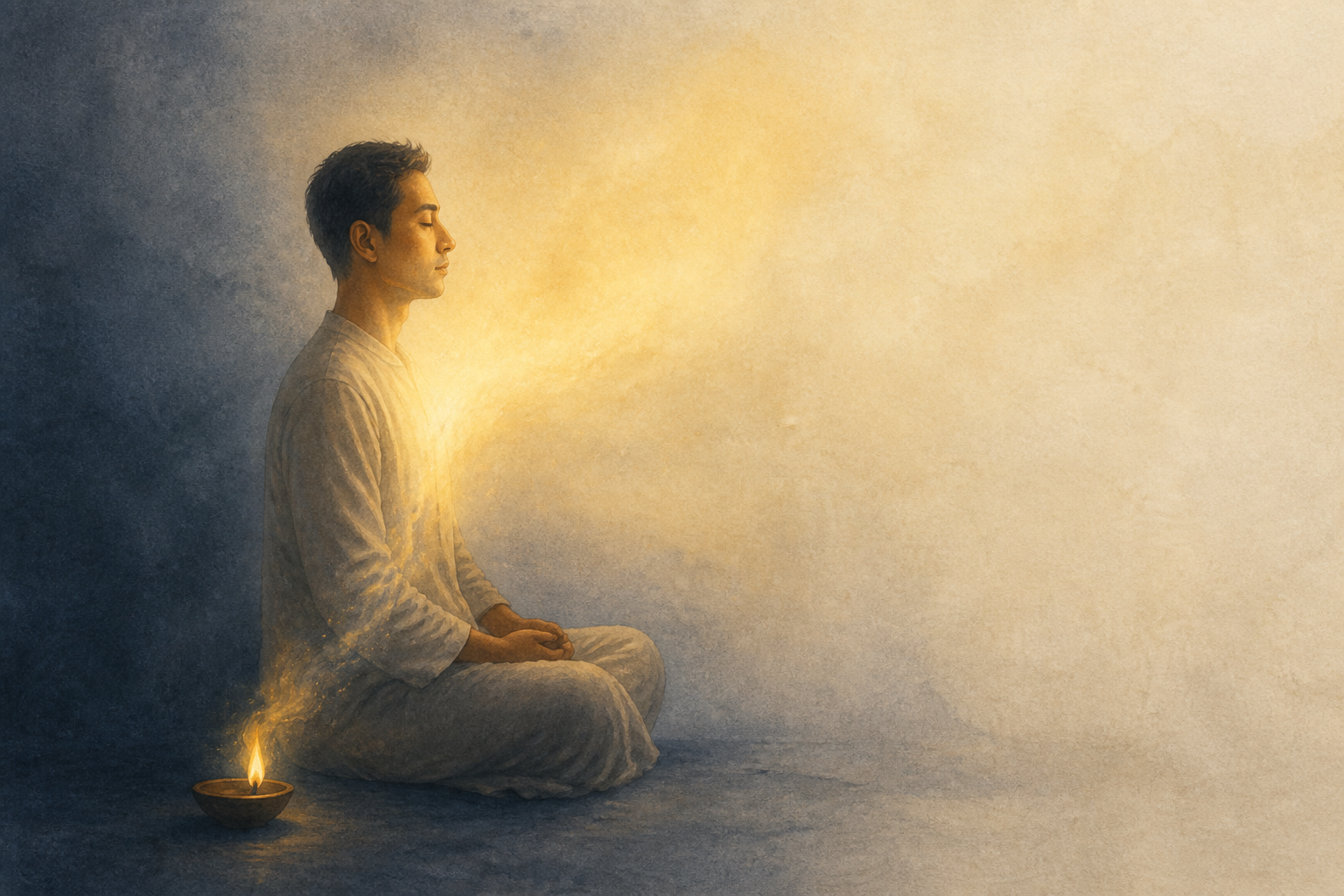
Yoga Sutra 1.36 offers the compact instruction vishoka va jyotismati: the mind may be steadied through contemplation of a luminous, sorrowless awareness. Jyoti means light, while jyotismati conveys that which is filled with or possessed of light. Here light is not limited to something seen by the physical eyes. It names a clear mode of knowing in which experience can be recognised without immediate agitation or judgement.
The surrounding sutras matter. Patanjali gives several supports for stabilising citta: maitri, karuna, mudita, and upeksha in Sutra 1.33; attention to the breath in 1.34; Jyotismati in 1.36; and further contemplative options through 1.39. The word va, or or, is important. Jyotismati is a valid doorway, not a compulsory visual test that every practitioner must pass.
This corrects a common misunderstanding. Inner-light practice does not require you to see a brilliant colour, a perfect flame, or a supernatural form behind closed eyelids. If an image arises naturally, let it remain gentle. If no image appears, attend to the lucid quality by which you already know the breath, a thought, a feeling, or the surrounding silence. The aim is steadiness, not spectacle.
Vishoka, or sorrowless, also should not be turned into a demand that you stop feeling grief. Emotional suppression makes the mind less transparent, not more. In practice, sorrowless awareness is the untroubled capacity that can notice sorrow without becoming identical to every thought surrounding it. You are not declaring that pain is unreal. You are learning to see it without adding denial, self-condemnation, or needless mental struggle.
The difference between the outer and inner lamp is therefore precise. The deepam is a sacred object before you. Jyotismati is the luminous quality of awareness with which you know the object and your own responses to it. The first gathers attention; the second refines attention. Used together, they allow Karthika symbolism to become actual sadhana.
A Karthika practice that joins puja and meditation
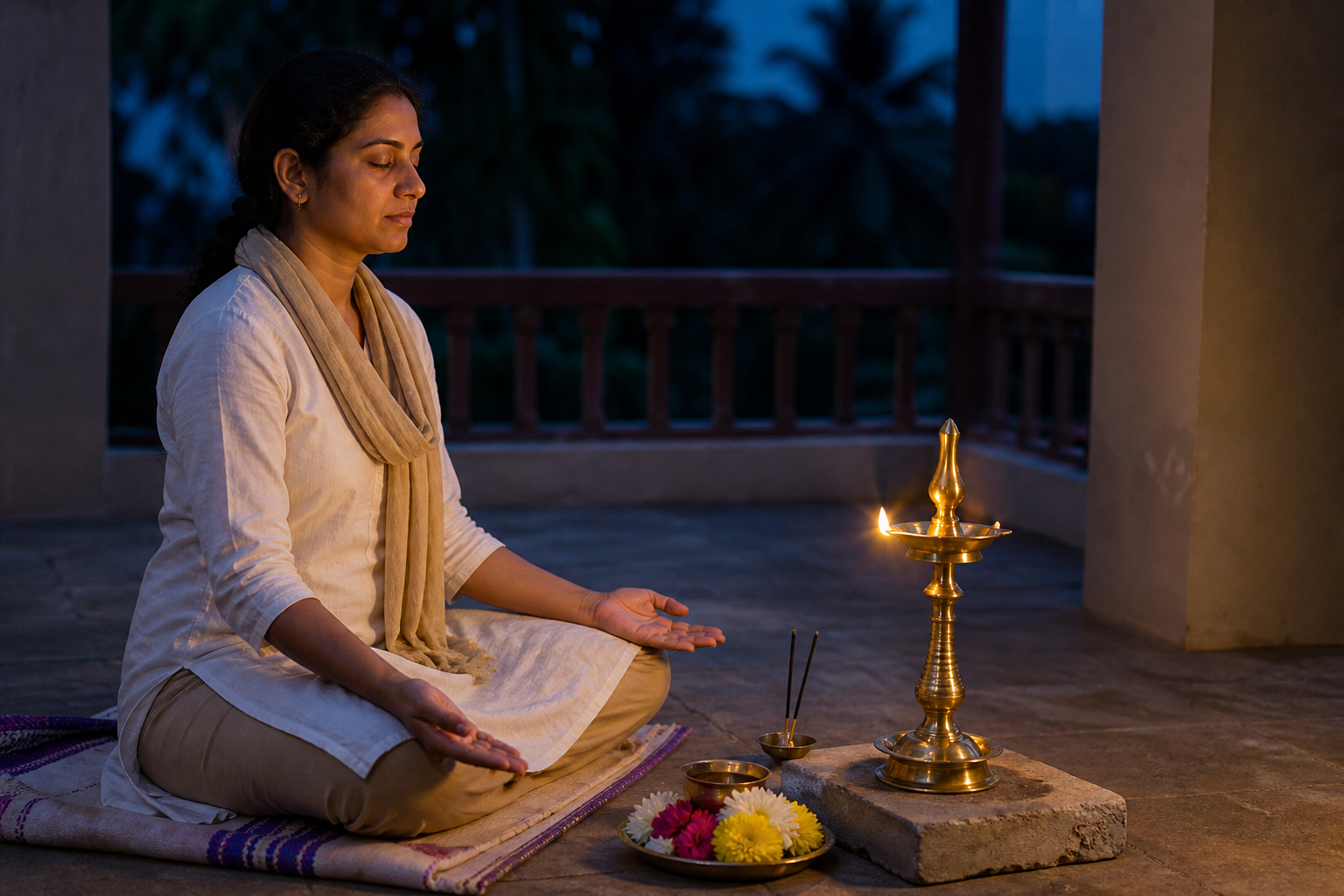
The sequence below is a practical bridge, not a claim that Patanjali prescribed a Karthika lamp ritual. Retain the mantras, deity forms, and customary offerings of your own sampradaya. The contemplative steps begin after the lamp has been offered.
- Prepare the place before preparing the mind. Set the deepam securely, reduce avoidable noise, and put away anything that you expect will interrupt you. Physical order does not create meditation, but preventable disorder repeatedly pulls attention outward.
- Give your sankalpa a practical direction. Instead of asking vaguely for light, connect illumination with a quality you need to embody. You might silently intend: May this worship clarify my seeing and make my conduct kinder. Keep the intention simple enough to remember after the practice.
- Light the deepam as worship. Offer your familiar prayer, nama, or sloka. Let the lamp remain connected to Bhagavan, your ishta devata, and the sacred meaning of Karthika. Do not reduce the deepam to a concentration prop.
- Let the visible flame collect attention. Rest your gaze softly rather than staring or straining. Notice the flame’s brightness and steadiness, the movement at its edge, and the quiet created by staying with a single object. When the mind wanders, return without rebuke.
- Settle through the breath. Allow breathing to become unforced and even. Patanjali places breath awareness among the direct supports for quieting mental disturbance. You do not need an elaborate pranayama pattern here; the immediate purpose is to reduce agitation before turning inward.
- Move from visible light to Jyotismati. Close or lower the eyes only when the open flame is safely supervised. Let attention rest in the heart-space, or recognise a subtle radiance pervading awareness. Do not squeeze the forehead, hold the breath, or try to paint a brighter mental picture. Look for clarity without strain.
- Return gently whenever thought takes over. First recognise that attention has wandered. Feel the breath, recover the sense of quiet luminosity, and remain there again. This repeated return is abhyasa. The return matters more than how long the preceding distraction lasted.
- Complete the worship through conduct. Before rising, recall your sankalpa and choose a corresponding action: fulfil a neglected duty, correct an unfair judgement, speak without needless harshness, offer practical help, or restore order to a shared space. Carrying clarity into action keeps meditation from becoming spiritual self-absorption.
If you practise with family, preserve both the shared and inward dimensions. Complete the common prayer and namasmarana first. Then allow a quiet interval in which each person can sit according to capacity. The practice does not become deeper merely because it is longer or more austere. A sincere period of collected attention followed by dharmic action is more useful than forcing everyone through an elaborate routine.
If visualisation is difficult for you, do not abandon the method. Replace the search for an inner picture with attention to transparent knowing. Notice a thought arise, remain briefly, and pass. Notice that awareness can reveal the thought without being damaged by it. That unforced lucidity is closer to the purpose of Jyotismati than an impressive image pursued with tension.
Measure the light by conduct, not visions
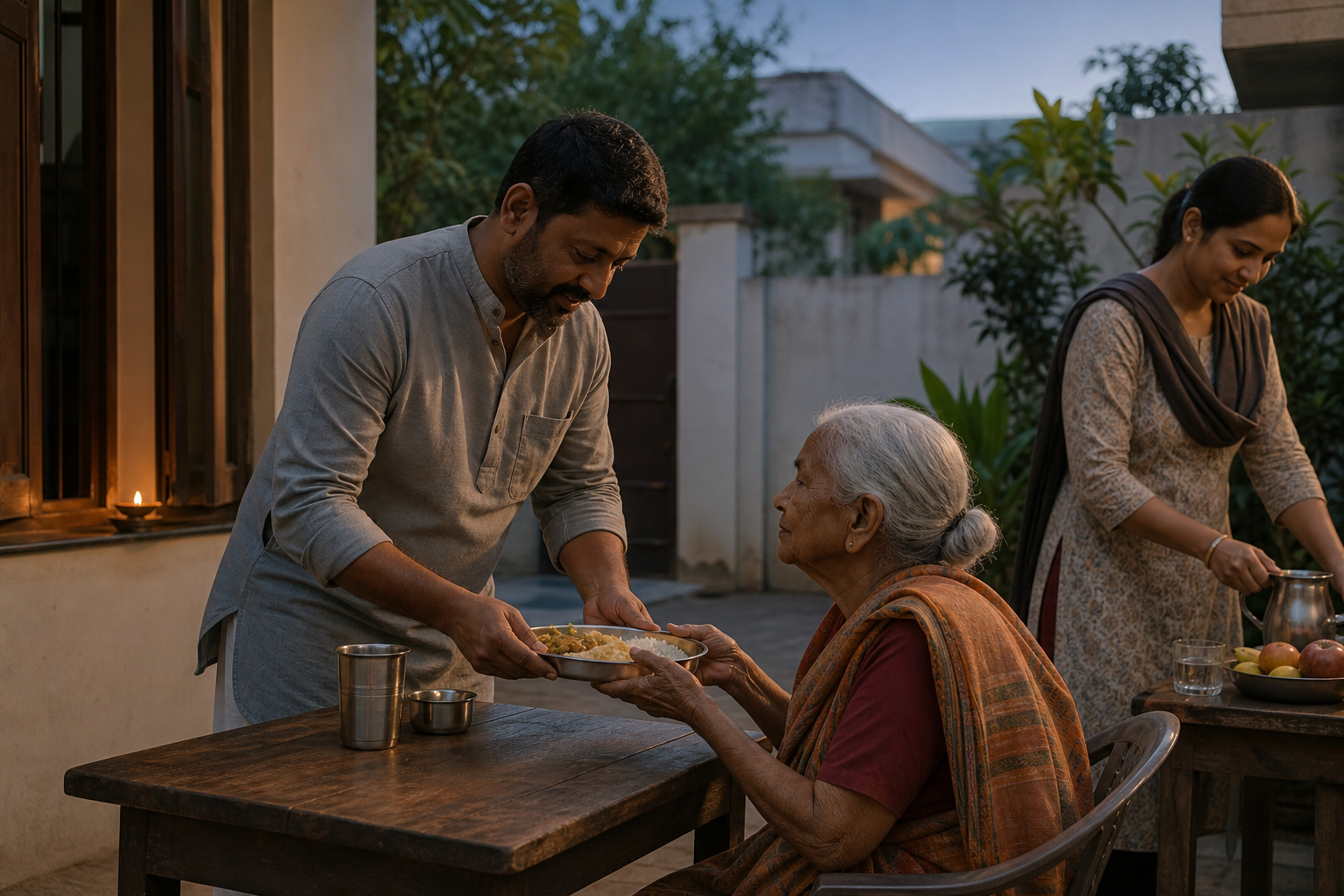
The most reliable sign of practice is not unusual brightness during meditation. It is a clearer interval between impulse and action. You begin to notice irritation before turning it into speech. You distinguish what happened from the story you immediately built around it. You see when a devotional intention has become an excuse for pride. These are ordinary moments, but they are where illumination acquires ethical weight.
Do not chase intensity. A dramatic experience can occur without producing steadiness, while a quiet practice can gradually make the citta more sattvic. If you spend the sitting judging whether the light is vivid enough, the imagined result has displaced the discipline.
Do not use sorrowless awareness to deny sorrow. The practice asks whether awareness can remain clear in the presence of a difficult state. It does not require cheerfulness, nor does it make ordinary human grief a spiritual failure. When emotion is present, notice it honestly and avoid building a false devotional performance around it.
Do not separate private calm from public dharma. A serene sitting followed by contempt, carelessness, or avoidable harm has not completed the movement symbolised by the deepam. Knowledge should dispel confusion; compassion should affect behaviour. The lamp belongs in your decisions as much as in your shrine.
Do not dismiss communal worship as spiritually inferior. Solitary meditation and collective Deepotsavam train different dimensions. One reveals the movements of your own mind. The other asks you to participate with humility, order, and consideration. A mature Karthika observance makes room for both.
After each practice, ask a few direct questions. Did you return from distraction without hostility toward yourself? Did you see a motive that had previously remained hidden? Did your sankalpa alter a real choice? Is someone else likely to experience more patience, honesty, or care because you sat before the lamp? These questions keep the language of inner light accountable.
With repetition, Jyotismati can support the one-pointedness that matures toward dharana and dhyana. But repetition should remain intelligent. When attention is highly restless, begin with breath. When the heart feels constricted by another person’s success or suffering, work with maitri, karuna, mudita, or upeksha. When awareness is naturally quiet and bright, rest with Jyotismati. Patanjali’s range of methods lets you respond to the actual condition of the mind rather than forcing a preferred technique.
Key takeaways for your next Karthika deepam
- The outer lamp gathers your senses, devotion, memory, and sankalpa around a visible sacred centre.
- Yoga Sutra 1.36 presents Jyotismati as contemplation of luminous, sorrowless awareness for steadying the mind.
- Inner light does not depend on producing a visual phenomenon; unforced clarity is enough.
- Breath can serve as the transition between attending to the flame and resting in inward luminosity.
- Sorrowless awareness means clarity without added agitation, not denial of grief or pressure to appear cheerful.
- The practical test is conduct: clearer judgement, gentler return from distraction, and action aligned with dharma.
At your next Karthika worship, follow the movement all the way through. Light the deepam with devotion, settle the breath, rest in quiet luminosity, and leave the shrine with a specific dharmic action still in mind. Complete that action before the next worship. This is how a seasonal symbol becomes abhyasa and how the lamp continues to shine after its visible flame is gone.
References
- DharmaRenaissance Blog – Karthika Deepotsavam 2025 in Tirupati: Radiant Lamp Ceremony, Timings, Live Telecast
- DharmaRenaissance Blog – Jyotismati in Patanjali’s Yoga: Awaken the Inner Light for Clarity, Calm, and Focus
