

You may be trying to answer two questions at once: Which spiritual practice is truly yours, and what do you owe the family whose life made yours possible? Jyotish can help you separate those questions before reconnecting them in a disciplined way.
The chart is most useful here as a map of attention, not a verdict. It can direct you toward a fitting form of sadhana and expose neglected ancestral responsibilities. It cannot absolve you of ethical judgment, prove that your family is cursed, or turn worship into a transaction for obtaining better planetary results.
First separate personal calling from inherited obligation
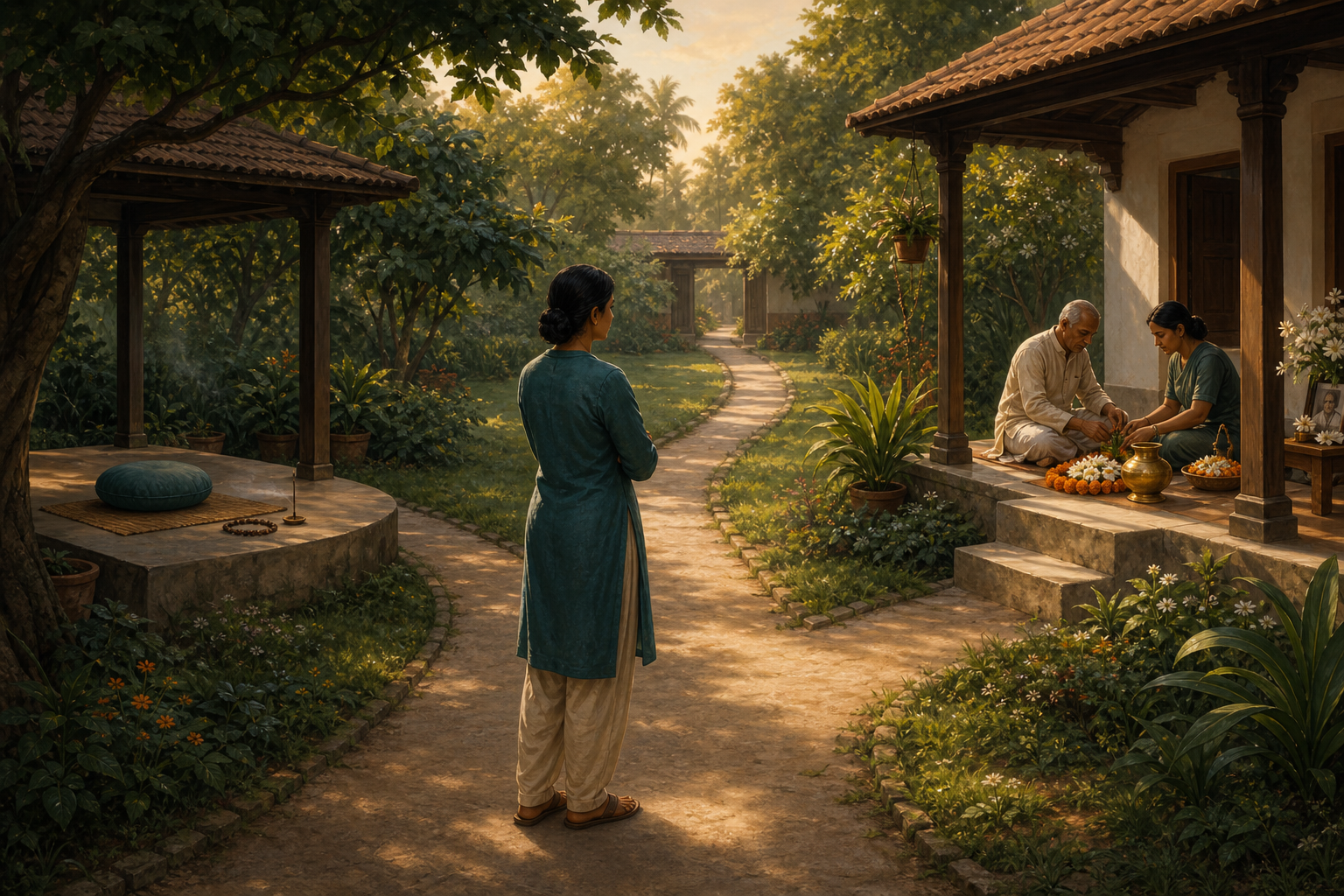
Personal dharma asks how you should cultivate clarity, devotion, self-command, and service. In the Pancham Bhava approach, the fifth house and its lord help describe the devotional capacity you are being asked to develop. This is not necessarily a career prediction or a command to abandon the sampradaya in which you were raised.
Ancestral dharma asks a different set of questions. Have your elders been treated with dignity? Are the dead remembered with gratitude? Is inherited wisdom being preserved without preserving inherited harm? Are children receiving the care, education, and moral formation that previous generations were meant to pass forward? Pitru Runa is most constructive when understood as ethical and spiritual responsibility toward the lineage, not as a supernatural accusation.
The two forms of dharma support one another. Personal sadhana develops the steadiness required for difficult family duties. Ancestral responsibility prevents spirituality from becoming a private refuge that leaves real obligations untouched. Confusing them creates predictable mistakes: choosing an Ishtadevata solely to fix a family problem, or performing an ancestral rite while refusing an overdue conversation with a living parent.
Key takeaways
- Use the fifth house and Panchamesh to investigate your style of devotion, mantra, study, and disciplined practice.
- Use the ninth house, Sun, and Ketu as prompts for ancestral reflection, not as automatic proof of Pitru Dosha or family guilt.
- Let a chart indicate where to inquire; let conduct, family history, and present duties determine what must actually be repaired.
- Keep Kula Devata and inherited tradition in view even when your personal Ishta or contemplative emphasis differs.
- Pair every symbolic remedy with an ethical action that benefits a living person, the wider community, or the continuity of the family.
Read the fifth house as a discipline, not a deity lookup

A practical Pancham Bhava reading begins with the Lagna. Locate the fifth house, identify the sign occupying it, and find that sign’s lord, the Panchamesh. The fifth house is associated in this approach with purva-punya, mantra-shakti, devotion, and the capacity for focused sadhana. The qualities of its lord can therefore suggest how devotion becomes stable in your life.
- Confirm the Lagna. If the recorded birth time is doubtful, acknowledge that uncertainty before drawing conclusions. A shifted Ascendant can change both the fifth and ninth houses.
- Identify the Panchamesh. This gives you the graha whose qualities form the starting point for reflection.
- Read the quality before naming a form. Ask what discipline the graha demands: steadiness, compassion, courage, study, wisdom, gratitude, perseverance, or another corresponding virtue.
- Choose a practice that develops that quality. Japa, vandana, meditation, svadhyaya, satsang, and seva are not interchangeable decorations. Select the one you can perform sincerely and consistently.
- Test the result through conduct. A fitting practice should gradually improve attention, restraint, compassion, and reliability. Intensity without ethical improvement is not evidence of alignment.
The graha does not have to be converted immediately into a rigid deity assignment. Begin with its developmental demand:
| Graha emphasis | Quality to cultivate | Possible expression in sadhana |
|---|---|---|
| Sun | Steadiness and responsibility | Regular worship joined to accountable action |
| Moon | Compassion and calm | Gentle contemplation, care, and emotional discipline |
| Mars | Courage and tapas | Demanding but ethical discipline directed away from anger |
| Mercury | Study and articulation | Svadhyaya, careful mantra recitation, and teaching with precision |
| Jupiter | Wisdom and discernment | Satsang, scriptural learning, and guidance rooted in humility |
| Venus | Gratitude and refinement | Reverent worship, beauty offered without vanity, and generous conduct |
| Saturn | Perseverance and service | Patient practice and seva to people who are neglected or vulnerable |
Suppose the Panchamesh points toward Saturnine perseverance. The useful conclusion is not that suffering itself is holy. It is that your practice may need regularity, humility, and service more than spiritual novelty. If Mercury carries the emphasis, collecting teachings is not enough; careful recitation, comprehension, and truthful speech become part of the sadhana. If Mars is prominent, tapas must produce courage and self-command rather than aggression dressed in sacred language.
Rahu or Ketu influencing the fifth can make spiritual exploration unusually intense or disruptive. That is a reason to seek qualified guidance before adopting transformative practices, not a reason to fear the nodes. Avoid teachers who turn a complicated placement into an urgent sales pitch for a ritual.
The Pancham Bhava method is also not the only Jyotish approach to Ishtadevata. Karakamsa-based and twelfth-house assessments exist in classical practice. Different schools may therefore reach different symbolic emphases. Treat the fifth-house reading as a strong lens on devotional capacity, especially mantra and focused practice, rather than pretending that one shortcut has ended every interpretive question.
Your family tradition remains evidence too. If your household has long served a Kula Devata, do not discard that relationship because a chart reading appears to point elsewhere. Personal Ishta and Kula Devata can occupy different but compatible places: one may focus your inward practice while the other maintains gratitude, belonging, and continuity.
Examine ancestral indications without manufacturing fear
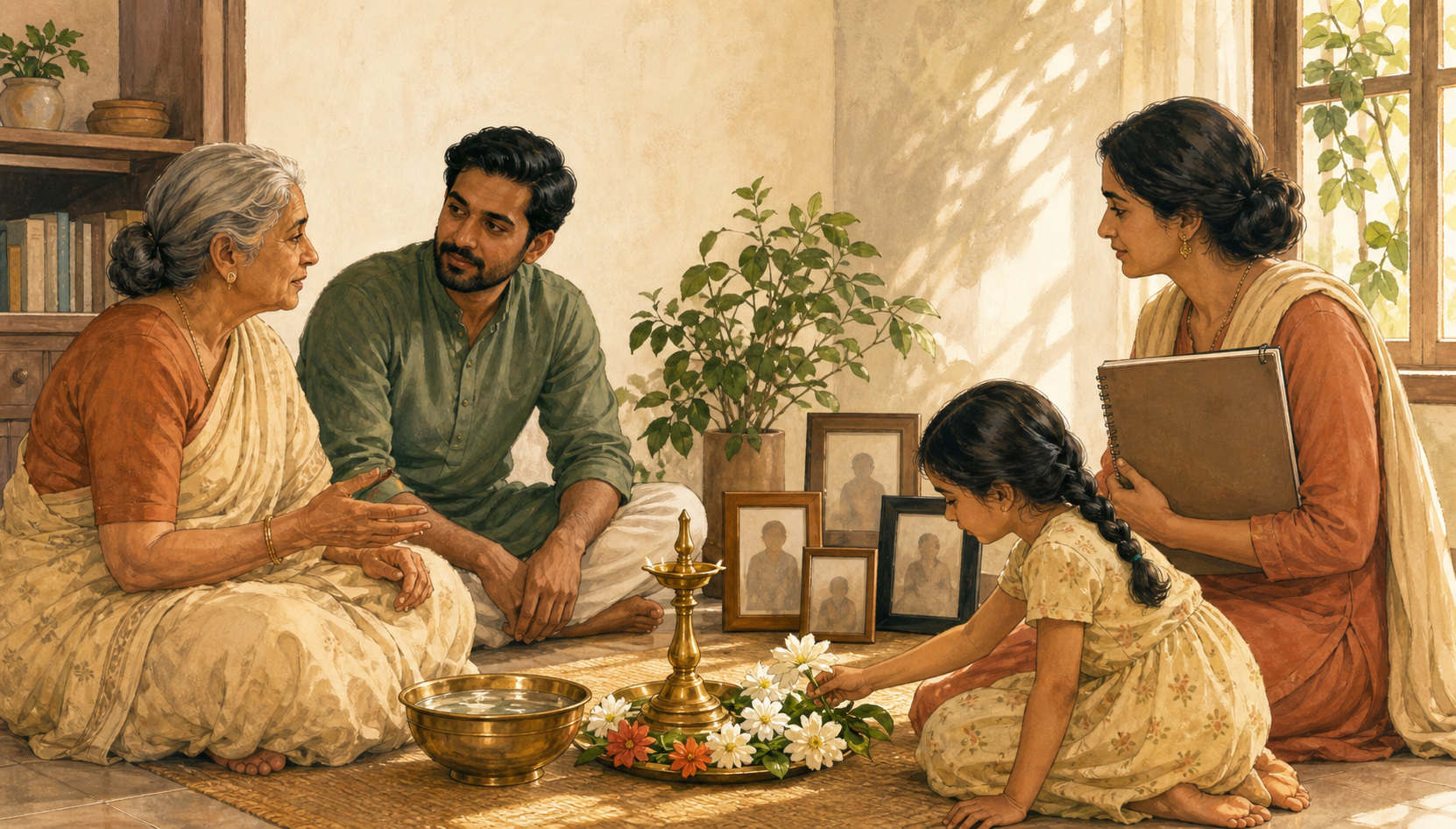
Some Jyotish schools examine ancestral themes through the ninth house, the Sun, and Ketu. These factors must be read contextually. No single placement proves that an ancestor is angry, that a family is cursed, or that every difficulty involving children comes from Pitru Runa.
That restraint matters because ordinary grief, illness, estrangement, poor decisions, and social conditions can all produce family distress. A symbolic reading becomes harmful when it replaces direct investigation. If a child is unwell, seek appropriate healthcare. If recurring conflict includes trauma or abuse, qualified counseling may be needed. A puja or act of charity can accompany responsible care; it must not substitute for it.
Use ancestral indicators to begin a family audit grounded in observable life:
- Remembrance: Do you know the names, places, occupations, struggles, and virtues of recent generations, or has the family story disappeared through neglect?
- Living elders: Is an elder being ignored while the family spends freely on ceremonial observance? Material care and respectful attention are ancestral duty in the present tense.
- Unresolved wrongs: Does the family repeat secrecy, contempt, addiction, violence, abandonment, or discrimination? Honoring ancestors does not require defending their harmful conduct.
- Children and successors: Are education, health, moral formation, and trustworthy mentorship being treated as shared responsibilities?
- Continuity of practice: Have family observances been abandoned thoughtfully, or merely through indifference? If a practice can no longer be performed as before, can its ethical purpose be preserved in another responsible form?
- Gratitude in action: Does remembrance benefit anyone beyond the person performing it?
Traditional Hindu responses can include Shraddha, remembrance, and seva toward elders. Their ethical force becomes clearer when ritual is joined to concrete care. Record an elder’s oral history. Support a child’s education or healthcare. Offer food, assist someone in need, plant a tree, contribute to a community kitchen, or support a healthcare initiative in an ancestor’s name. These actions give gratitude a durable social form.
Comparable ethical work appears across the wider Dharmic family without making the traditions identical. Sikh practice places seva, community welfare, and remembrance of the Divine at the center of conduct. Buddhist maitri and karuna can interrupt inherited hostility. Jain Pratikraman and Samayik cultivate accountability and reflective restraint. Choose practices within your actual tradition, with appropriate guidance, rather than combining sacred forms as though they were interchangeable techniques.
Reconciliation also needs a boundary. Gratitude for life received does not require renewed exposure to an abusive relative, denial of wrongdoing, or pressure on a victim to forgive on demand. Where direct contact is unsafe, ancestral dharma may take the form of truthful remembrance, professional support, protection of the next generation, and service performed without reopening the path to harm.
Build a two-track dharma practice you can sustain

Once you have examined both fields, turn interpretation into a modest rule of life. Do not begin with a crowded remedy list. Begin with one repeatable personal discipline and one visible ancestral responsibility.
- Write the personal question. Complete this sentence without naming a deity: “My sadhana most needs to cultivate…” Use the Panchamesh to sharpen the answer, but choose a quality you can recognize in conduct.
- Select the devotional anchor. This may be your established Ishtadevata, Kula Devata, a Buddha or Tirthankara within your tradition, or remembrance of Ik Onkar through Naam. The form should be religiously coherent for you, not selected merely because a planetary correspondence looked convenient.
- Name the ancestral responsibility. Write an action with an identifiable beneficiary: call an isolated elder, document family history, arrange practical care, mentor a younger relative, repair a neglected observance, or support community welfare in an ancestor’s memory.
- Connect practice to behavior. If your sadhana emphasizes compassion, identify the family relationship in which impatience must change. If it emphasizes responsibility, identify the promise you have delayed keeping. If it emphasizes study, preserve and verify the family knowledge that is in danger of being lost.
- Review fruits rather than omens. Look for clearer judgment, steadier practice, better-kept duties, reduced cruelty, and more truthful relationships. Do not make every coincidence into confirmation from a graha or ancestor.
A simple written record can keep this honest. Note the chart factor being considered, the virtue it appears to demand, the practice chosen, the family duty chosen, and the observable change you expect in your own behavior. This separates disciplined interpretation from mood and helps you notice when a remedy is producing fascination but no dharmic fruit.
When a practice stalls, diagnose the ordinary obstacle first. The mantra may be too complex to maintain, the schedule unrealistic, the family action too vague, or the conflict beyond what one person can resolve. Adjusting the form is not a failure of faith. Dharma expressed consistently in a smaller action is more credible than an elaborate vow repeatedly abandoned.
Know what you must not outsource to the horoscope
Jyotish can organize reflection, but you remain responsible for the interpretation you act upon. A chart cannot make repentance unnecessary, declare one sibling solely responsible for the lineage, or justify controlling a child’s spiritual life. It cannot tell you to neglect medical, psychological, legal, or financial realities in favor of ritual.
Be especially cautious when an astrologer treats family distress as proof of a hidden ancestral offense, promises that a purchased remedy will remove all consequences, or insists that questioning the diagnosis will worsen it. A responsible consultation should explain the method being used, distinguish indication from certainty, respect your sampradaya and family context, and translate symbolism into ethical action rather than fear.
Your next step can be small and exact. Identify the Panchamesh, write down the virtue it asks you to strengthen, and choose a practice consistent with your tradition. Then identify one unfinished duty to the living, the dead, or the generation following you. Perform both without bargaining for an omen. That is where a Jyotish reading begins to become dharma.
References
- DharmaRenaissance Blog – Discover Your Ishtadevata by Lagna: Pancham Bhava Guidance to Deepen Sadhana and Peace
- DharmaRenaissance Blog – Pitru Runa Explained: Causes, Family Signs, and Dharmic Paths to Healing
