
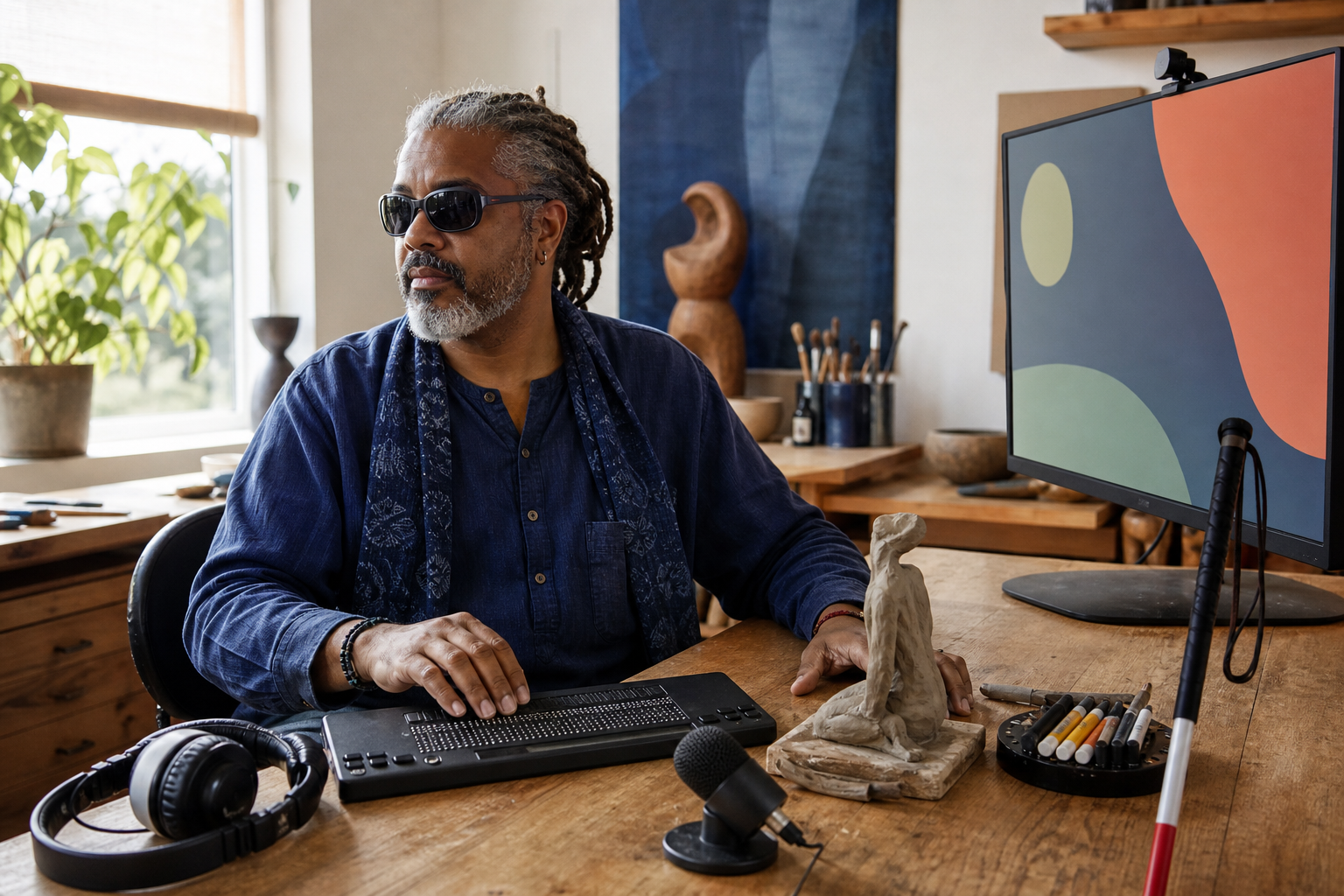
If declining vision has made you wonder whether your life as a writer, filmmaker, artist, or teacher is ending, begin with an honest distinction: some familiar methods may no longer be workable, but your vocation is larger than those methods. The loss is real. The conclusion that you have nothing left to contribute is not.
Your task now is to protect your health, identify what your work has always been for, and rebuild the process around the faculties and relationships available to you. That may mean exchanging visual speed for careful listening, solitary control for trusted collaboration, and effortless navigation for an intentionally accessible workflow. None of those exchanges makes the work less yours.
Name what is changing – and what is not
Vision loss can affect more than the ability to read a screen or inspect an image. It can interrupt routines that once felt automatic. It can change how quickly you work, how independently you complete a task, and how other people respond to your authority. If your identity has been tied to visual skill, the change may feel like the loss of the self who knew how to make things.
Do not force that experience into a cheerful story. Grief is not evidence that you have failed at acceptance. It is a proportionate response to losing a valued capacity and an accustomed way of moving through the world.
At the same time, do not ask grief to define the full boundary of your future. A documentary filmmaker living with moderate-to-advanced macular degeneration in both eyes continued to write, teach, and mentor by shifting toward screen readers, text-to-speech, listening, memory, and dialogue. The visual method changed. The deeper work of witnessing, shaping meaning, and helping others find their voices remained available.
Make that distinction concrete with a purpose audit. Use a document you can access comfortably, a voice recorder, or another method that does not strain your remaining sight.
- Complete the sentence My work exists to… Name the effect you want to have on another person, not the medium you use.
- List the essential acts within your work. They may include listening, questioning, remembering, arranging, explaining, encouraging, witnessing, or making decisions.
- List the tasks that genuinely require visual information. Be specific: selecting a frame, reading an interface, checking typography, judging contrast, or following a cursor.
- For each visual task, choose whether it can be translated into sound, described in words, handled with assistive technology, or shared with a trusted collaborator.
- Identify what must remain under your direction. Assistance with access should not quietly become authority over your creative choices.
A filmmaker may no longer inspect every frame but can still determine the question a scene must answer, the emotional sequence of an interview, the rhythm of speech, and the ethical limits of the edit. A teacher may not see every detail of a student’s work but can still test whether the student understands the intention, structure, and effect of that work. Purpose survives when you define it accurately.
Keep medical decisions in their proper place. Diagnosis, injections, medication, and changes in symptoms belong with qualified eye-care professionals who know your condition. Meditation, acceptance, and adaptive tools may help you live and work with vision loss, but they do not replace medical care or promise that remaining sight will be preserved.
Build the workflow for ears, memory, and trust
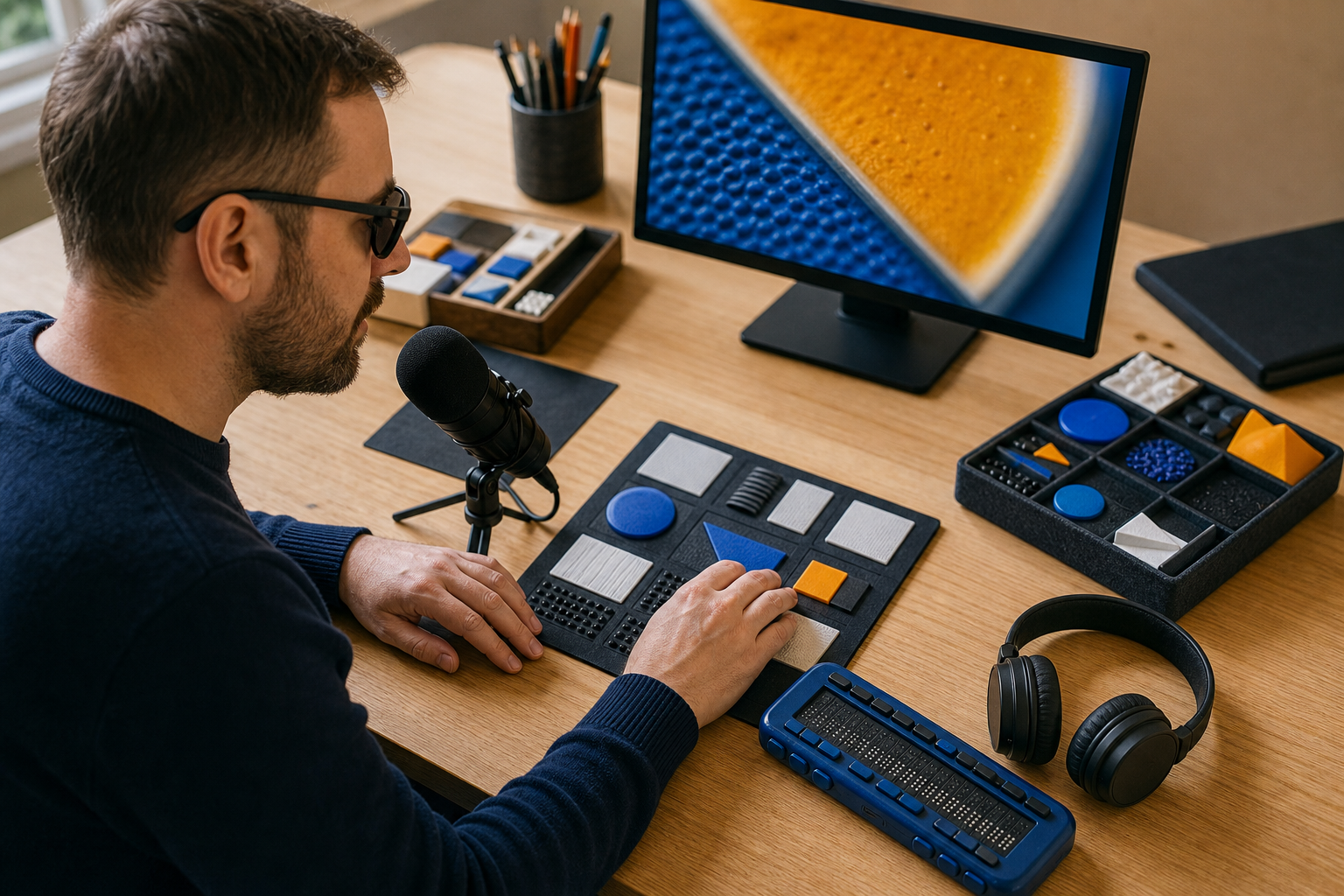
An accessible creative process cannot be an emergency workaround added after the old process fails. It needs to become the normal route through the work. Screen readers, audio cues, and text-to-speech are not merely conveniences; they can become part of the craft itself.
A screen reader helps you operate an interface and hear its text and controls. Text-to-speech lets you listen to a draft as language. The distinction matters. One helps you reach the work; the other helps you evaluate it. When both are configured around familiar keyboard commands and predictable file structures, less energy is spent finding the material and more can be spent shaping it.
Use a sound-centered production loop:
- Start with a plain verbal structure. State the central question, the intended audience, and the sequence of sections or scenes before polishing individual lines.
- Work in small, named units. Clear headings, descriptive filenames, and stable folders reduce the memory burden of locating material through assistive technology.
- Listen before you refine visually. After drafting a passage, hear it from beginning to end. Notice where attention breaks, where a sentence is overloaded, and where the emotional movement becomes unclear.
- Revise through cadence and breath. A sentence that looks polished may still be difficult to follow when spoken. Listening exposes repetition, missing transitions, and false emphasis.
- Separate meaning from visual finish. Complete the argument, narrative, or lesson before asking someone to verify layout, colour, framing, or other visual details.
- Give collaborators a defined brief. Ask for observable information rather than a general judgement. For example: describe what is visible, identify what draws the eye first, report whether text is cut off, or compare the current layout with the approved version.
This process may be slower than the one you used before. Slowness is not automatically a defect. When every word must survive being heard, speed loses some of its authority. The useful measure becomes whether the work is clear, coherent, and true to its purpose.
A critique method that does not depend on sight
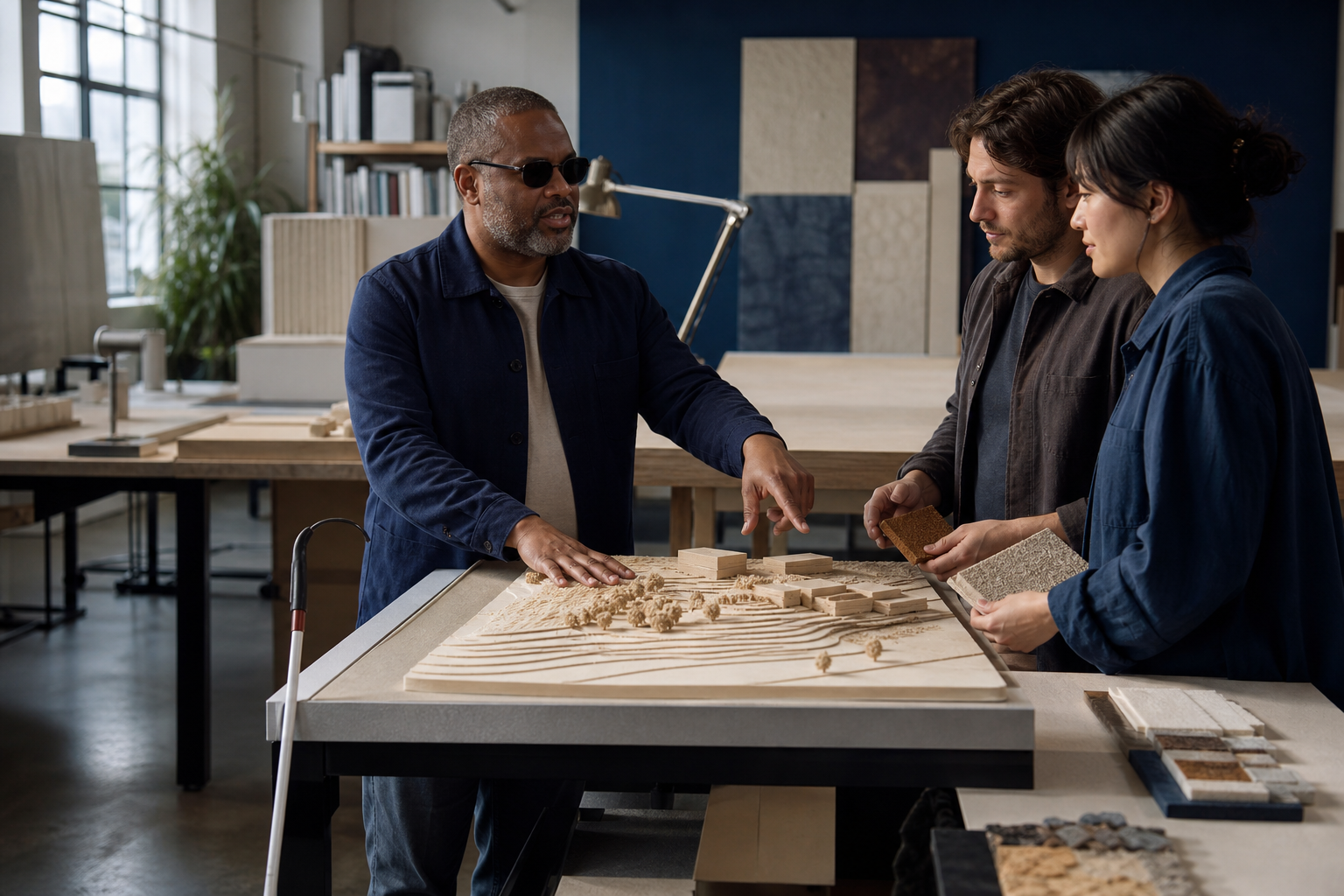
If you teach, mentor, or direct other creators, replace silent visual inspection with a structured conversation. Ask the creator to describe the work before defending it. Then use questions that reveal whether the decisions are intentional:
- What should the audience understand or feel first?
- What changes from the beginning to the end?
- Which element carries the central meaning?
- Where are you uncertain about the effect?
- What would be lost if a particular visual element were removed?
Listen for the difference between a deliberate choice and a choice the creator cannot explain. Visual fluency can conceal weak intention; spoken description often exposes it. This makes dialogue a demanding form of critique, not a diluted substitute for seeing.
There are still limits. If a course or project requires precise assessment of colour, spatial composition, focus, or visual continuity, arrange an accessible second channel for that information. A qualified collaborator can describe what is present while you retain responsibility for the standard, the questions, and the final judgement. Naming that division openly protects both accuracy and your authority.
Make access the default form of seva
Disability is intensified when ordinary systems assume that everyone can see small text, identify an icon, aim a pointer, and interpret a silent visual change. A routine task such as ordering groceries can become a prolonged drain on energy and agency when menus are unlabeled, contrast is weak, buttons are inaccessible, or the path cannot be completed with a keyboard.
That burden is easy for a sighted designer to miss because the page may look clean and function perfectly with a mouse. The failure appears only when someone tries to complete the whole task through another mode. Accessibility therefore has to be tested as a path, not admired as an intention.
If you publish, teach, run a community organisation, or manage a temple website, examine one essential task from beginning to end. Check whether:
- Typography remains readable when enlarged and maintains strong contrast with its background.
- Menus, fields, links, and buttons have names that communicate their purpose.
- Every essential action can be reached and completed with a keyboard.
- Headings and controls are presented in a form a screen reader can interpret.
- Information carried by an image is also available in words.
- Instructions identify the actual action instead of relying on location, colour, or phrases such as the button over there.
- A person can recover from an error without needing to see a fleeting visual message.
Then ask a blind or low-vision user what works for them. Do not seize the keyboard, move their belongings, or take over a task merely because they pause. Assistance that removes control can reproduce the exclusion it is meant to solve. Offer a specific form of help and wait for consent.
If you are the person requesting access, make the request operational. Instead of saying only that a file or website is inaccessible, name the blocked action and the usable alternative: I need the text in a format my screen reader can navigate; Please label these buttons by function; Describe the visual change in words; or Send the feedback as text rather than annotations that cannot be announced. Precision gives another person something they can correct.
Sikh seva offers a helpful ethical frame here. Service is not pity directed downward; it is practical work that respects another person’s dignity. Accessible design does the same. It removes avoidable obstruction so that a person can participate as a creator, teacher, student, customer, or devotee rather than being reduced to a problem requiring special treatment.
Let dharma hold grief without denying it
Dharmic practice is most useful in vision loss when it helps you meet reality without pretending that reality is painless. It becomes harmful when impermanence is used to silence grief, non-attachment is confused with indifference, or karma is invoked to blame a person for disability.
The traditions offer distinct disciplines rather than one interchangeable message:
- Buddhist reflection on impermanence asks you to see that every conditioned form changes. It does not require you to call the change good. It helps loosen the demand that life must retain one form before meaning is possible.
- Hindu teachings on non-attachment can help separate dedicated action from possession of a particular outcome or identity. You can remain devoted to creative work without insisting that it must always be performed through the same faculty.
- Jain anekantavada disciplines the belief that one viewpoint exhausts the truth. Visual perception is one way of encountering a work, not the only way meaning can be known, described, remembered, or shared.
- Sikh seva turns compassion into participation. It asks communities to do the practical work through which another person can continue to contribute.
These teachings do not erase the difference between seeing and not seeing. They challenge the harsher assumption that a changed body has ended the possibility of insight, relationship, or worthwhile action.
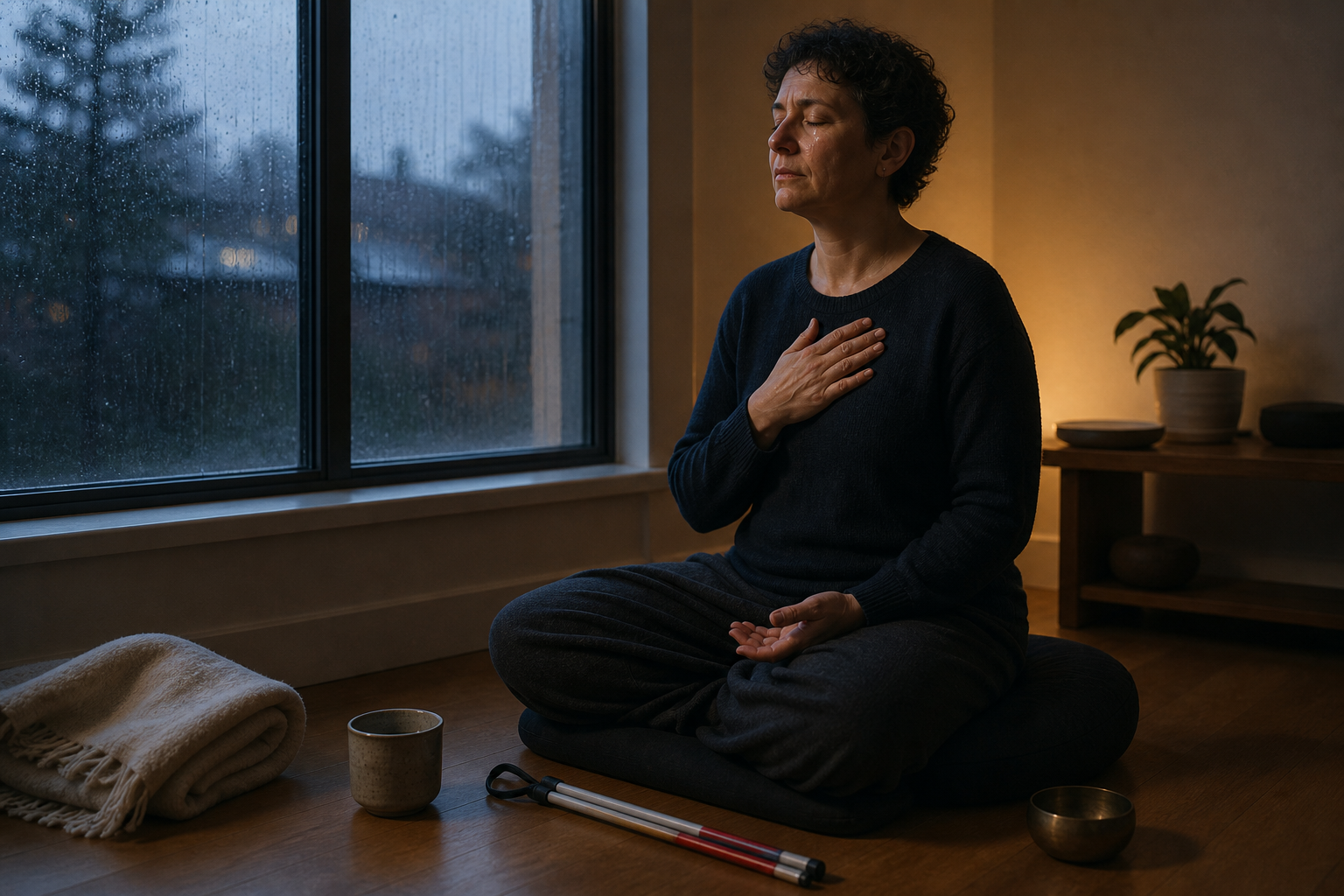
When grief rises, use a simple contemplative sequence. Name the loss without correcting yourself. Name what remains available in this moment: voice, hearing, memory, judgement, curiosity, relationship, or the ability to ask for help. Choose the next meaningful action that fits your present capacity. Then make any request for assistance exact.
This is abhyasa – steady practice rather than a demand for instant serenity. Some days the next action may be a paragraph, a lesson, or a conversation. On another day it may be rest. Equanimity does not mean producing at the same rate under every condition.
Contemplative practice also has limits. If grief becomes overwhelming, disrupts basic functioning, or leaves you feeling unsafe, seek qualified mental-health support or emergency help where you live. Spiritual discipline and professional care can coexist; neither needs to impersonate the other.
Key takeaways for your next creative project
- Keep medical care with qualified professionals, and treat adaptive practice as support for living and working rather than a substitute for treatment.
- Define your vocation by the human purpose it serves, not by the sensory method you previously used to fulfil it.
- Build screen readers, text-to-speech, audio review, predictable file structures, and precise collaboration into the normal workflow.
- Use spoken intention, structure, and emotional effect as serious criteria for critique and teaching.
- Request assistance in terms of a blocked action and a usable alternative, while keeping creative decisions under your direction.
- Practise non-attachment without denying grief. A changed capacity can alter the form of your work without emptying it of meaning.
- Treat accessibility as seva: remove barriers early enough that a person can participate with dignity and agency.
Choose one unfinished piece of work. State what it is meant to give another person, identify the first visual barrier in its production, and replace that barrier with an accessible route or a clearly bounded collaboration. Do that before deciding whether the work – or your creative life – is beyond reach.

References
