
You may know that a situation is wrong and still not know what dharma asks of you next. Should you oppose it sharply, withdraw from the quarrel and build an alternative, or accept responsibility and work through rules? Acting too softly can protect adharma. Acting with unbounded force can reproduce it.
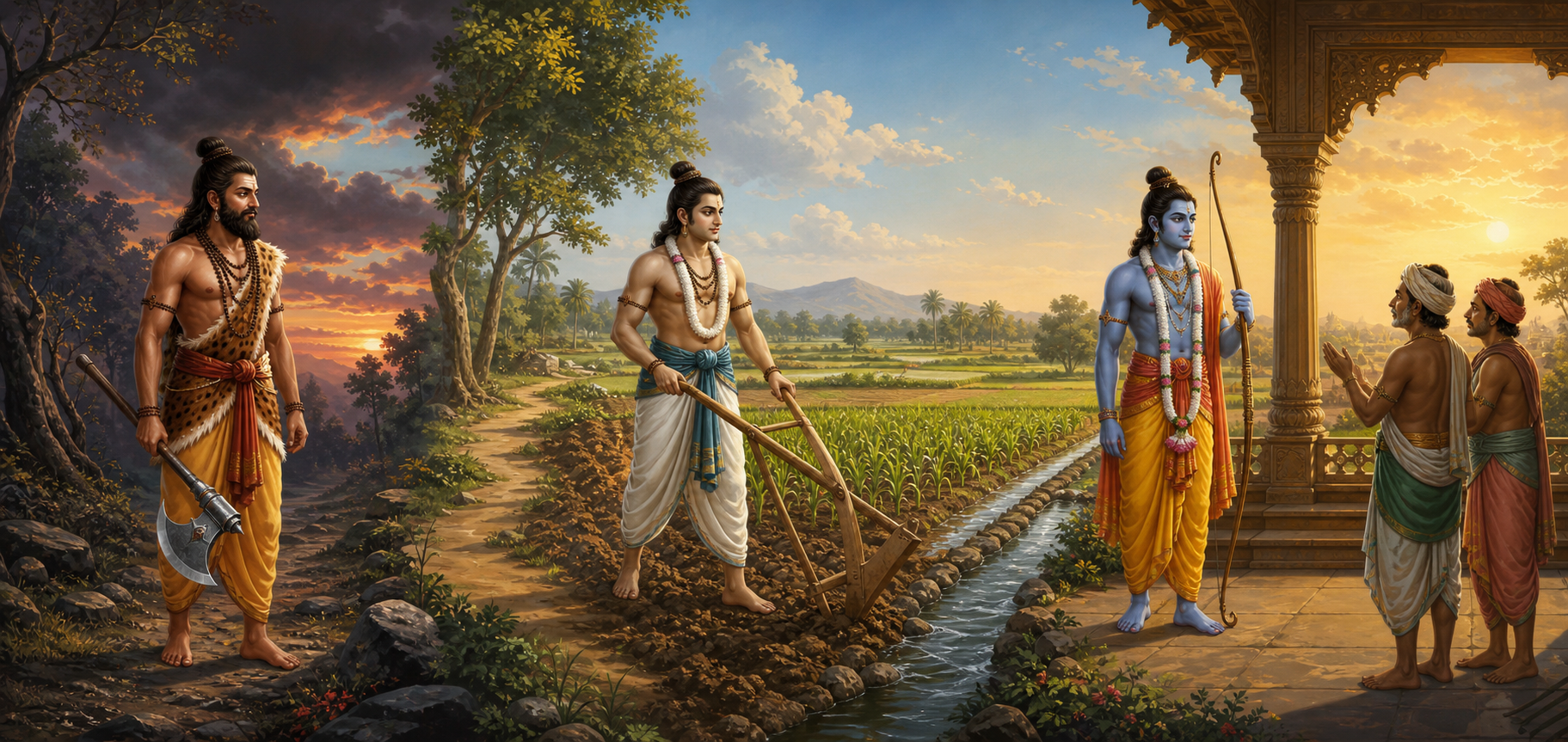
Parashurama, Balarama, and Sri Rama give you a practical way to distinguish those tasks. Parashurama represents the force that breaks an entrenched wrong. Balarama turns strength toward cultivation, restraint, and continuity. Sri Rama binds authority to maryada, the ethical boundary that makes power answerable. This is not a historical timetable. It is a map for deciding what kind of dharmic action a moment requires.
The three Ramas answer three different questions
The three forms should not be reduced to strong, stronger, and strongest. Each corrects a different failure. Parashurama confronts the wrong that has become protected by habit or power. Balarama asks what will sustain life after the confrontation. Sri Rama asks whether the resulting order is just, humane, and binding on its leaders.
| Rama form | Central image or discipline | Dharmic task | Question to ask | Characteristic distortion |
|---|---|---|---|---|
| Parashurama | The axe and raudra, or fierce moral energy | Cut through the protection surrounding entrenched adharma | What must be stopped? | Anger becomes an identity, and retaliation continues after the breach has ended |
| Balarama | The plough, disciplined strength, and restraint | Cultivate stable, fair, and sustainable life | What must now be built and maintained? | Neutrality becomes avoidance, or routine begins protecting unfairness |
| Sri Rama | Maryada, fidelity, and responsible authority | Make strength answer to truth, duty, and just order | What rule should bind everyone, including me? | Order becomes a slogan through which rulers exempt themselves |
This sequence exposes two common mistakes. The first is force without cultivation: a wrong is defeated, but nothing trustworthy replaces it. The second is order without courage: rules sound noble, but nobody will defend them when they become costly. Dharma requires both capacities, then places both under ethical restraint.
You also need not place yourself permanently in one column. A family, institution, community, or civilization may require all three modes in the same struggle. The useful question is not which avatar resembles your temperament. It is which work remains unfinished.
Parashurama: let anger identify the breach, not choose the punishment
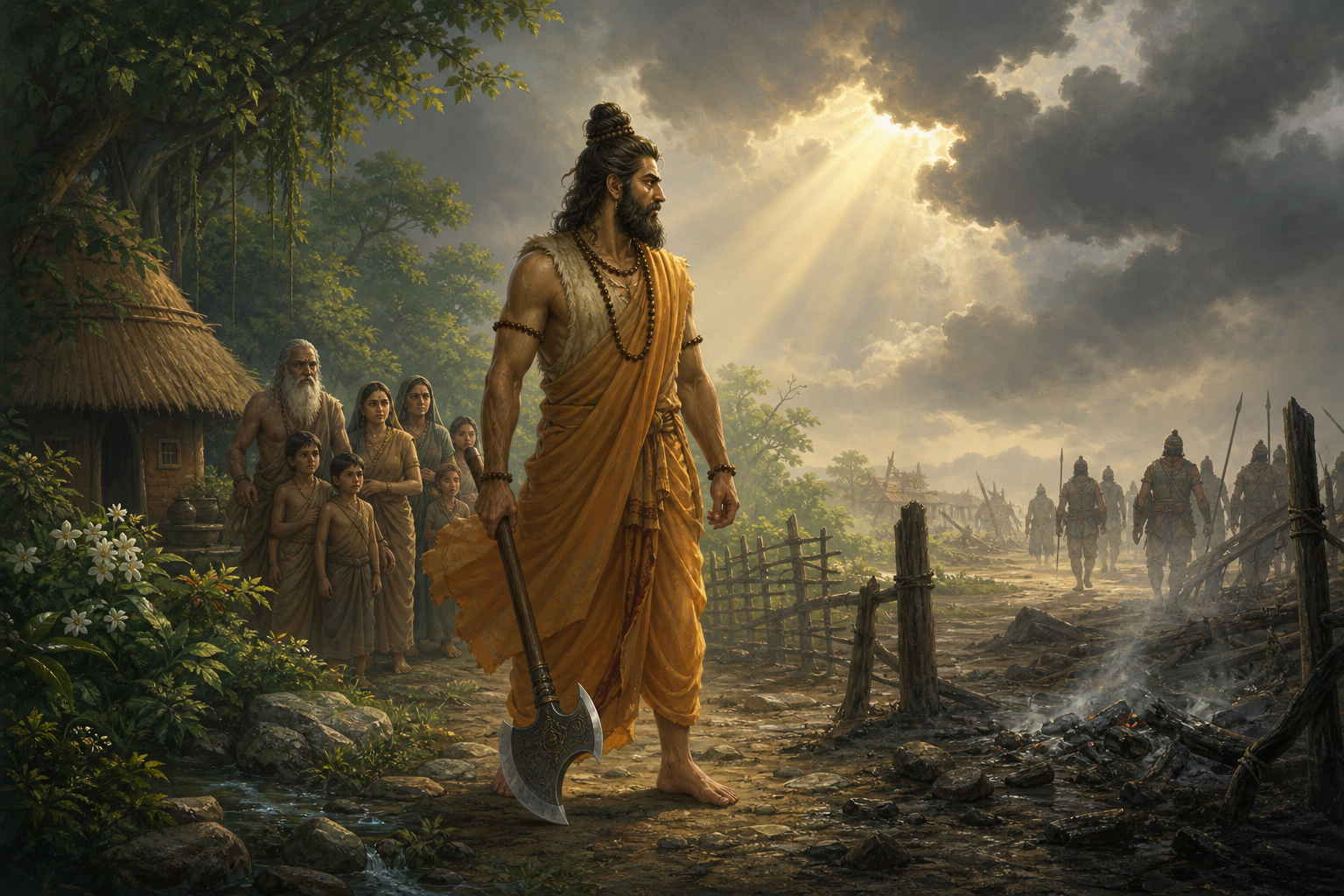
Parashurama embodies raudra, the fierce energy that refuses to coexist comfortably with moral decay. His axe signifies a clearing action. It cuts where inertia, privilege, fear, or false harmony has allowed adharma to harden.
That symbolism is easily misread. Parashurama does not make every angry person righteous, and the axe does not turn private fury into permission for violence. Anger can alert you to humiliation, betrayal, exploitation, or cowardice. It cannot by itself determine who is guilty, what response is proportionate, or when the confrontation should end.
Before acting in the Parashurama mode, impose four boundaries on yourself:
- Name the act, not an enemy class. Describe the breach precisely enough that a fair-minded person could examine it. Collective blame converts moral clarity into indiscriminate hostility.
- Name the good being defended. Your aim may be truth, safety, equal treatment, fidelity to a commitment, or the integrity of a Dharmic institution. If you can name only the person you oppose, anger has displaced dharma as your centre.
- Choose the smallest action that decisively interrupts the wrong. A clear refusal, disclosure, removal of an unfair privilege, correction of a rule, or withdrawal of cooperation may do more than theatrical aggression.
- Decide what repair would end the confrontation. If no correction, apology, restitution, changed rule, or restored boundary could satisfy you, you are no longer pursuing a remedy. You are preparing endless punishment.
Suppose a community body quietly applies one standard to insiders and another to everyone else. The Parashurama task is to expose and stop the unequal practice. It is not to humiliate every person associated with the body. The target is the protected breach. Once that breach is removed, remaining in a permanent state of combat becomes a new disorder.
This gives you a clear transition point: Parashurama has completed his work when the wrong can no longer continue in its previous form. At that moment, the axe must give way to the plough.
Balarama: build the field that force cannot sustain
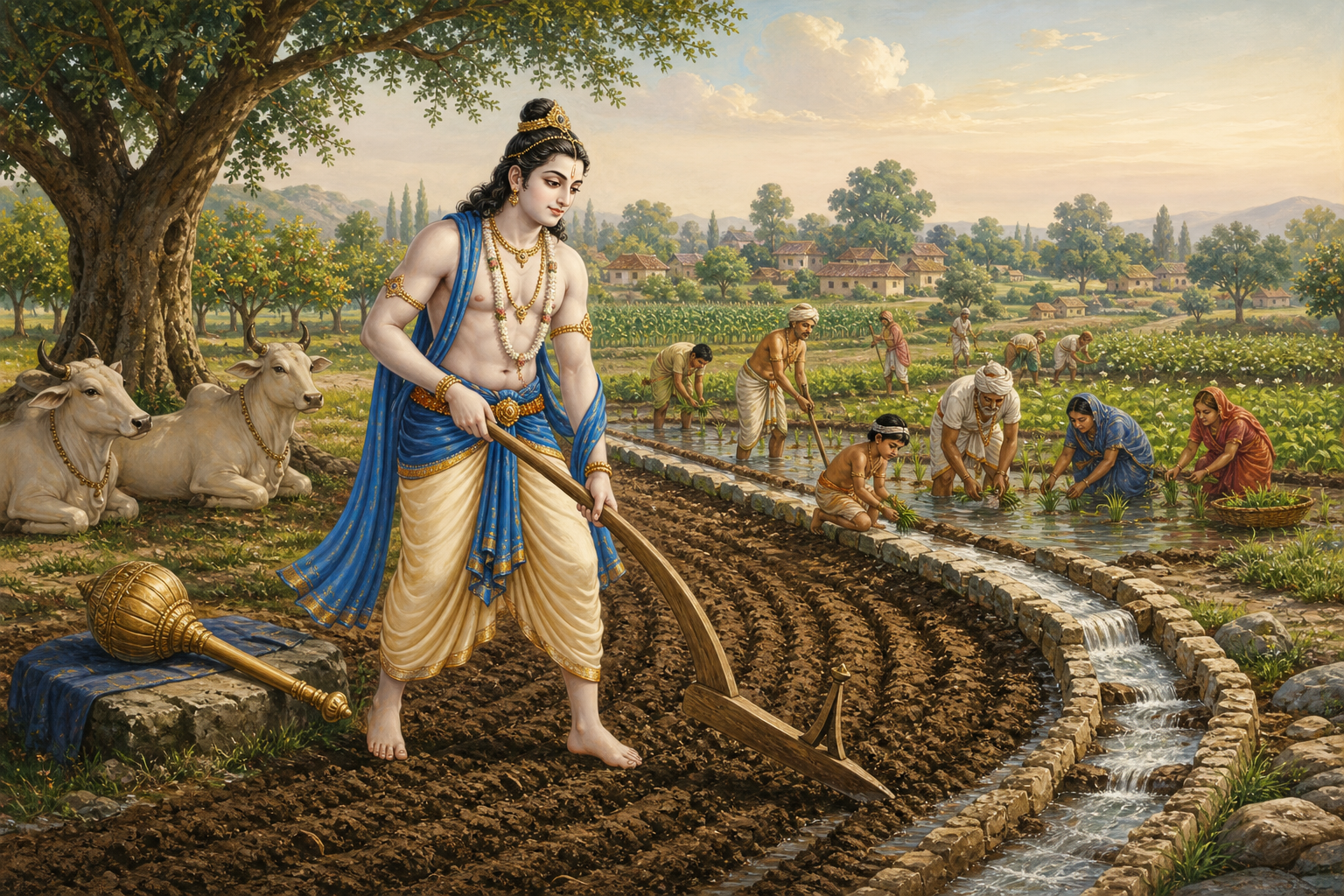
Balarama is Halayudha, the bearer of the plough. The image moves strength away from destruction and toward cultivation. A plough still cuts, but it cuts to prepare the ground. Its value appears through food, continuity, shared work, and the patient conversion of land into a place capable of sustaining life.
This is the neglected middle of reform. Removing a corrupt custom can happen in a dramatic moment. Replacing it with a fair process requires repeated duties, named responsibilities, maintenance, and restraint. If the new arrangement works only while its founder is angry and present, nothing stable has been built.
Balarama’s neutrality during the Kurukshetra conflict and his preference for pilgrimage over partisanship express another dimension of strength: the ability not to be captured by every camp. Yet neutrality is not automatically virtuous. You must distinguish restraint from evasion. Restraint refuses a role that would deepen disorder without serving dharma. Evasion uses balance as a respectable name for avoiding an inconvenient duty.
The cultivation test
After opposing a wrong, inspect the replacement with these questions:
- Can ordinary people understand the new practice without depending on the person who led the confrontation?
- Is the recurring work assigned to a role, or is everyone assuming that somebody else will carry it?
- Are burdens and benefits distributed fairly enough that resentment will not quietly recreate the old problem?
- Is there a calm way to correct mistakes, or will every disagreement reopen the original battle?
- Does your neutrality preserve a fair process, or does it shelter someone who remains free to cause harm?
In a family, the Balarama move may be a dependable division of care rather than another argument about who failed last time. In a temple or cultural organization, it may be written criteria, rotating responsibilities, transparent records, and a regular method for hearing concerns. In personal practice, it is abhyasa: the repeated discipline that turns a moment of insight into character.
Cultivation is not less courageous than confrontation. It asks you to exchange the emotional clarity of opposition for the slower accountability of stewardship. That is precisely why many movements remain trapped in the Parashurama stage: fighting the old order provides a clearer identity than maintaining a better one.
Sri Rama: bind power before you exercise it
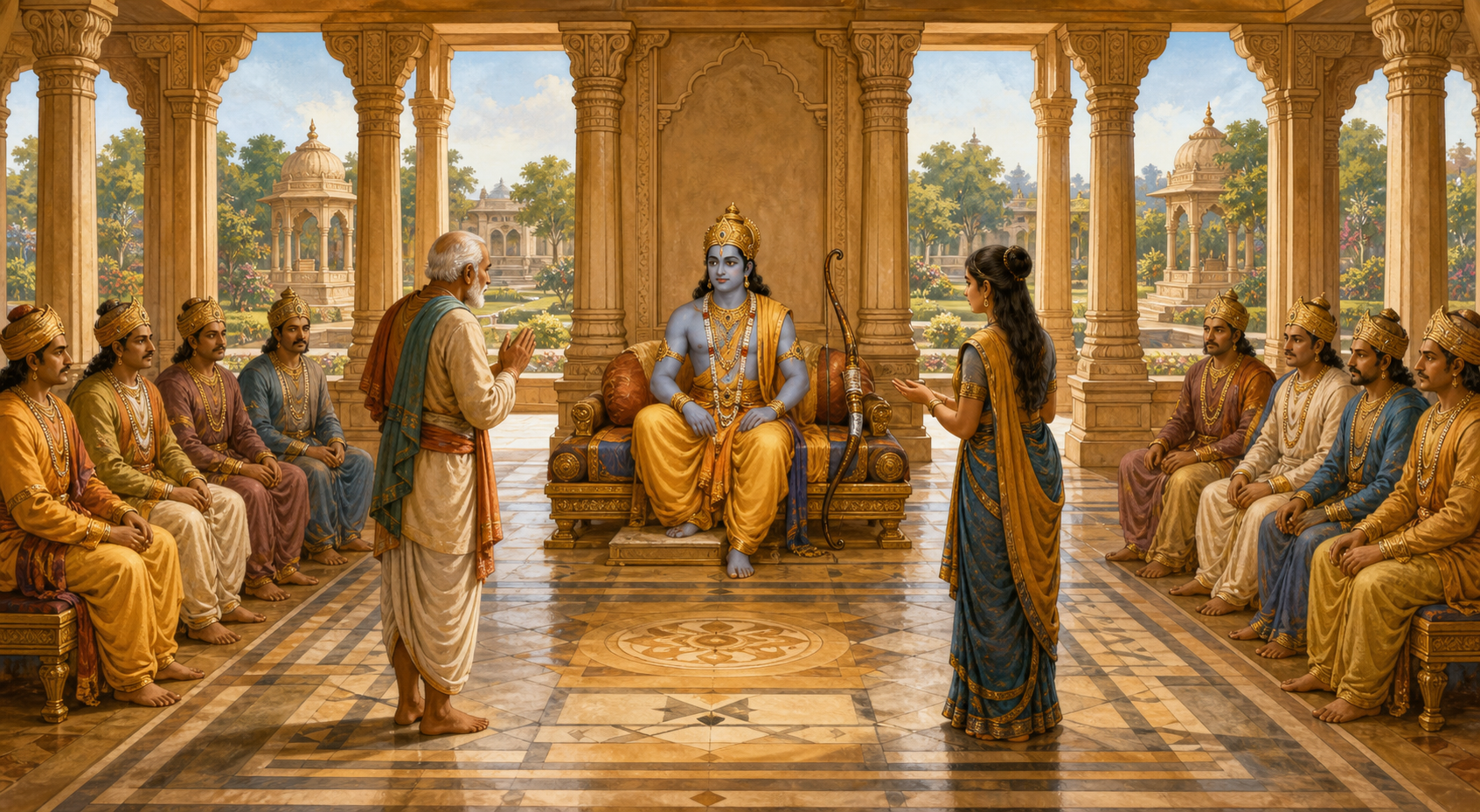
Sri Rama completes the movement as Maryada Purushottam. In the Ramayana, valor is inseparable from truthfulness, fidelity to vows, and responsibility. Strength is no longer justified merely because its objective is good. Its manner, limits, and consequences must also remain within dharma.
Maryada is more demanding than good manners. It is a boundary accepted before convenience tells you to ignore it. A leader governed by maryada does not first decide the desired outcome and then invent a principle to defend it. The principle must be stated clearly enough to constrain the leader as well as the opponent.
A decision test for responsible authority
When you hold authority as a parent, teacher, employer, organizer, elder, or public representative, test an important decision in this order:
- State the duty. Identify the person, institution, promise, or common good for which you are responsible.
- State the rule before naming the preferred winner. If your principle changes when your ally and opponent exchange places, it is probably partisanship rather than maryada.
- Disclose the personal cost or benefit. A decision deserves greater scrutiny when the person making it gains status, comfort, control, or protection from it.
- Consider the affected person’s dignity. A necessary correction need not become humiliation. Humane treatment is part of just order, not an optional softness added afterward.
- Accept the same restraint. Authority becomes credible when its holder bears the limits imposed on others.
- Leave a path for correction. Accountability should allow an error to be acknowledged and repaired without requiring the entire institution to defend its prestige.
This is the inner foundation of Rama Rajya as a civilizational ideal. Just governance is not merely efficient administration or victory by a righteous faction. Public order depends on rulers and citizens cultivating order within themselves. Authority becomes responsibility; courage serves protection; fidelity prevents expedience from swallowing principle.
That does not mean treating every impulsive promise as an eternal command. The lesson is disciplined fidelity: do not use power, pressure, or changing convenience to escape obligations you knowingly accepted. A vow matters because it limits the self that made it.
Put the sequence to work on one live conflict
Choose one conflict in which you currently feel anger, responsibility, or uncertainty. Do not begin by deciding which person is Parashurama, Balarama, or Sri Rama. Treat the three names as stages of work and write down what each stage requires.
- Define the adharma. Complete this thought in concrete terms: a specific act is harming a specific good. Avoid labels that claim to explain an entire person’s character.
- Find the Parashurama action. Identify the bounded refusal, disclosure, correction, or withdrawal that can actually interrupt the breach.
- Set the moral perimeter. Decide what you will not do even if provoked: dehumanize, spread an unverified claim, punish uninvolved people, or continue after a fair remedy has been achieved.
- Design the Balarama replacement. Name the routine, responsibility, resource, or fair procedure that must exist after the confrontation ends.
- Apply the Sri Rama rule. Express the governing principle in terms that bind your side too. Make the decision understandable without relying on your status or presumed virtue.
- Review the handoffs. If anger is still needed to keep the arrangement working, cultivation is incomplete. If a stable arrangement protects unfairness, courage is missing. If leaders can ignore the rule, maryada has not yet been established.
Consider a volunteer organization facing favoritism. Its Parashurama work is to name and stop the partial decision. Its Balarama work is to create intelligible criteria, assign responsibility, and make the process repeatable. Its Sri Rama work is to ensure that the same criteria govern senior members, newcomers, friends, and critics. Skipping any stage produces a predictable failure: silence, recurring chaos, or selective justice.
The sequence does not require every conflict to escalate. Sometimes the decisive cut is a firm no. Sometimes cultivation means declining a partisan struggle and preserving a space where reconciliation remains possible. Sometimes maryada requires accepting an outcome you dislike because the fair rule matters more than victory.
Where the wider Dharmic family meets
This progression also gives you a careful way to recognize shared Dharmic values without pretending that distinct traditions teach identical doctrines. Buddhist kshanti, or forbearance, emphasizes mastery under pressure. Jain ahiṁsā and samyak-charitra keep non-harm and right conduct at the centre of moral life. The Sikh sant-sipahi ideal joins spiritual discipline to the courage required for protection.
These are resonances, not interchangeable formulas. The practical common ground lies in the ethical function: strength must be governed, restraint must not become cowardice, and conduct must serve more than the ego of the actor. When speaking across Dharmic traditions, compare those functions. Do not erase their different metaphysics, histories, disciplines, or sacred vocabularies merely to produce an easy slogan of unity.
Key takeaways
- Parashurama represents bounded moral force: identify the breach, stop it decisively, and refuse indiscriminate retaliation.
- Balarama represents cultivated strength: replace the defeated wrong with fair routines, shared responsibility, and sustainable institutions.
- Sri Rama represents authority under maryada: state the rule, accept its limits, protect dignity, and hold leaders to it.
- The three forms are a diagnostic sequence, not a rigid chronology or a ranking of personalities.
- A complete dharmic response stops what must stop, builds what must endure, and binds power to justice.
Before your next difficult decision, ask which task is actually waiting. If harm is being protected, make the bounded cut. If the ground has been cleared, cultivate it. If you now hold authority, accept the rule that should govern it. The ascent from force to righteousness happens through those handoffs, one decision at a time.

References
