

If missing meditation, journaling, exercise, or a healing practice can spoil your opinion of yourself for the day, your routine is no longer merely supporting you. It has become a tribunal. Every unchecked box seems to testify that you are undisciplined, unhealed, or falling behind.
You do not have to choose between relentless self-repair and giving up on growth. A Dharmic alternative begins with dignity in the present, then keeps only the forms of effort that reduce harm, deepen clarity, and help you participate in life. The aim is not less sincerity. It is sincerity without self-punishment.
Find the accusation hidden inside your healthy routine

A practice does not become wholesome simply because it carries a wholesome name. Meditation can cultivate awareness, or it can become surveillance. Journaling can clarify experience, or it can become a daily search for defects. Exercise can care for the body, or it can serve as punishment for eating, resting, or failing to meet a target.
The decisive question is not, Is this generally considered a good habit? It is, What relationship with myself is this habit creating? Once every quiet moment becomes an audit, self-improvement has turned into self-criticism. The language may still sound positive, but the working assumption is that your present self is unacceptable.
Look for these signs in the routine you have now:
- The omission test: Missing a practice feels like a verdict on your character rather than an ordinary change of plan.
- The aftertaste test: You finish the activity feeling inspected, ashamed, or preoccupied with doing it better next time.
- The expansion test: Each method generates another method. Meditation leads to tracking, tracking leads to analysis, and analysis leads to more material about how to meditate correctly.
- The rest test: Unstructured time produces guilt because it cannot be counted as healing, learning, fitness, or spiritual progress.
- The life test: You are spending so much attention on becoming ready for life that you have less attention for relationships, work, worship, beauty, play, and service.
Make a plain inventory of your current practices, including podcasts, books, trackers, affirmations, dietary rules, spiritual commitments, and exercises. Beside each item, write support, pressure, or both. Keep what reliably supports you. Pause what functions mainly as pressure. Modify what is mixed until its supportive purpose is clear.
This is not an argument against discipline. A valuable practice can be inconvenient, demanding, or emotionally uncomfortable. The distinction is whether difficulty is held within dignity. Healthy discipline asks you to return after a lapse. Coercion tells you that the lapse reveals what is wrong with you. A useful test is simple: can you miss this practice today and still regard yourself as worthy of care?
Do not abruptly abandon medication, a clinician-directed exercise, a recovery commitment, or a safety plan because it feels burdensome. Tell the relevant professional that the routine has begun to feel punitive and ask how it can be adjusted safely. Persistent exhaustion, severe anxiety, hopelessness, or difficulty managing sleep, work, relationships, or basic care also warrants qualified medical or mental-health support. A gentler spiritual rhythm can accompany such care; it should not replace it.
Use Dharmic principles to change the motive, not just the schedule
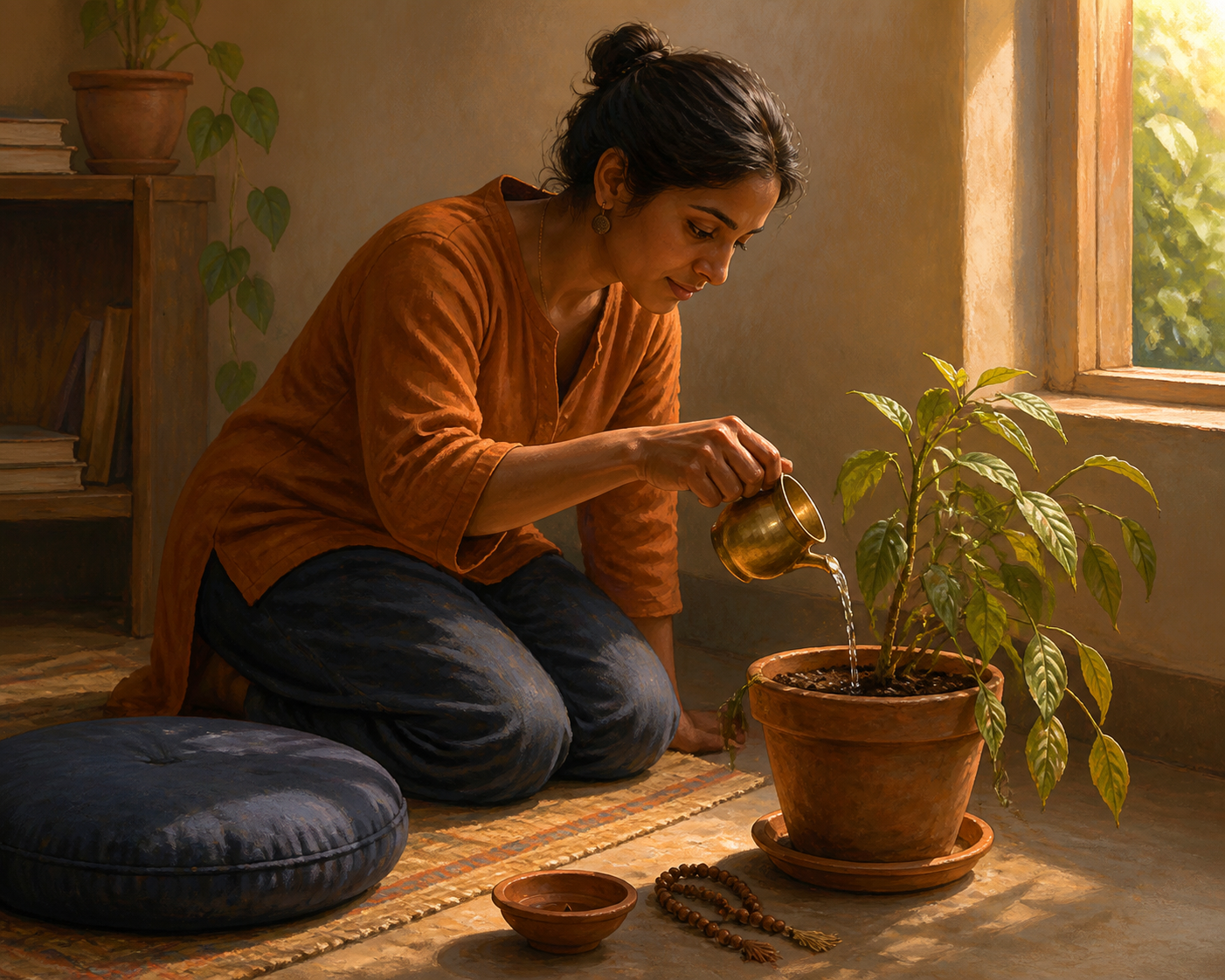
Hinduism, Buddhism, Jainism, and Sikhism are distinct traditions, not interchangeable versions of a single system. Yet several Dharmic principles offer compatible ways to examine compulsive self-improvement: ahimsa, maitri, karuna, aparigraha, and seva. Used carefully, they redirect attention from manufacturing a superior identity toward reducing harm and living responsibly now.
Ahimsa: examine the method as well as the goal
You cannot build inner peace through a method of continual inner aggression. If your self-talk humiliates, threatens, or condemns you into action, the means contradict the end. Applying ahimsa inward does not require pretending that every choice was wise. It means telling the truth without adding cruelty.
After a lapse, separate three things: the fact, its practical consequence, and your next response. For example: I did not meditate this morning. I feel more scattered than usual. I can sit quietly now, or I can continue the day without punishing myself. That statement preserves accountability while refusing character assassination.
Maitri and karuna: respond to difficulty as a condition needing care
Friendliness and compassion change the first question you ask. Instead of Why am I still like this?, ask What is difficult right now, and what would reduce needless suffering without abandoning responsibility?
The answer may still involve an apology, a difficult conversation, focused work, or the resumption of a neglected practice. Compassion is not automatic permission to avoid consequences. It removes the extra layer of contempt that consumes energy without repairing anything.
Aparigraha: loosen your grip on methods and the ideal future self
Grasping does not apply only to possessions. You can accumulate techniques, teachers, identities, streaks, and visions of the person you will finally become. The collection feels productive because every new item promises movement. In practice, too many methods divide attention and keep inadequacy at the centre of the day.
Apply a replacement rule: do not add a new improvement practice unless you can name what it will replace. If nothing can leave, the new method is probably not addressing a clear need. It is joining the pile because novelty briefly relieves doubt.
Seva: let growth return you to participation
Compulsive introspection makes the self the permanent centre of attention. Seva interrupts that enclosure. Cook for someone, listen without preparing your reply, help with an ordinary task, or fulfil a neglected responsibility. Choose an act with a clear boundary, perform it without turning it into evidence of spiritual advancement, and let the act end.
Service must not become another route to depletion. If you are already carrying excessive caregiving or community duties, a Dharmic response may include an honest limit. Self-erasure is not the same as selflessness.
Run a compassionate reset without turning it into a challenge

A reset should reduce performance pressure, not become a new programme to complete perfectly. Use the next ordinary stretch of life as an experiment. Do not score it, post about it, or restart it because one day went differently.
- Stop adding input. Put new self-help purchases, saved talks, challenges, and routine redesigns on hold. You need enough quiet to notice what your existing practices are doing.
- Protect essentials. Separate medical care, safety commitments, necessary movement, sleep needs, work, family duties, and genuine religious obligations from optional optimization. Keep the essentials; question the layers added around them.
- Choose a single anchor. Retain the practice that most reliably returns you to steadiness without demanding a performance. It might be a short prayer, silent sitting, recitation, a walk, or attentive breathing. Give it a minimum form gentle enough for a difficult day.
- Create genuinely unclaimed space. Silence improvement notifications, put the stack of instructional material away, and leave part of the day without a developmental objective. Empty space may feel uncomfortable before it feels restful; discomfort does not mean it must immediately be filled.
- Rest without extracting a benefit. Read for enjoyment, listen to music, drink tea, sit outdoors, or walk without counting. Do not convert the experience into content, insight, a gratitude entry, or proof that you rested correctly.
- Meet guilt with recognition. When the urge to resume everything appears, name it: This is the fixing reflex asking for another assignment. Then choose the next kind and responsible action rather than arguing with the thought.
- Reintroduce by function. Before restoring a practice, state the concrete need it serves, the sign that it is helping, and what it costs in time and attention. If those answers remain vague, leave it out.
The purpose of this reset is not to achieve uninterrupted calm. It is to recover choice. You should be able to engage a practice because it is appropriate, set it aside when it is not, and return without drama. If reducing the routine causes intense fear or makes you unable to function, do not treat that reaction as a test of willpower. Scale back with support from a qualified professional.
Build a rhythm that has a floor, a ceiling, and an exit

Sustainable practice needs limits in both directions. A floor keeps a difficult day from becoming an excuse for abandonment. A ceiling prevents an energetic day from expanding the routine until it becomes tomorrow’s burden. An exit allows you to stop when a method is no longer serving its purpose.
Before beginning a practice, decide what counts as enough. When that point is reached, stop. Do not upgrade the session merely because you still have energy. Leaving some capacity unused teaches you that completion does not require exhaustion.
Use these questions whenever a new book, teacher, method, challenge, or routine appeals to you:
- What exact difficulty am I trying to address?
- Is this practice suitable for my present capacity, or for an imagined version of me?
- What existing commitment will it replace?
- Can I stop using it later without interpreting that choice as failure?
- Does it make me more available for my actual responsibilities and relationships?
- Would I still choose it if nobody could see, praise, or measure it?
If you cannot answer the first three questions plainly, postpone the addition. A vague sense that you should be doing more is not a defined need.
Review practices by their fruits in daily life rather than by streaks alone. Are you more able to tell the truth, repair harm, tolerate discomfort, keep proportion, and attend to another person? Or are you increasingly rigid, preoccupied, and resentful? A long streak can coexist with a narrowing life. A modest practice can be valuable when it makes ordinary conduct more humane.
Alternate inward attention with outward participation. After journaling, close the notebook and complete an ordinary responsibility. After meditation, speak patiently to the next person you encounter. After reflecting on a wound, do something that belongs to the present day. This prevents introspection from becoming a sealed world in which every experience produces more analysis.
Allow for seasons. Illness, grief, caregiving, demanding work, celebration, and religious observance can all change your available energy. Reducing an optional routine during a demanding season is adaptation, not betrayal. The practice should be responsive to life because it exists to support right living within life.
Most importantly, protect some enjoyment from improvement. Music does not have to regulate your nervous system. A walk does not have to produce steps. Friendship does not have to improve your communication skills. Prayer does not have to generate a particular state. When every good thing must justify itself through an outcome, life becomes one continuous performance review.
Key takeaways for the next difficult day
- Judge a practice by the relationship it creates, not by its healthy or spiritual label.
- Keep accountability, but remove humiliation from the method.
- Use ahimsa to reduce inner harm, compassion to meet difficulty, aparigraha to release excess methods, and seva to return attention to life.
- Protect clinician-directed care and safety commitments while simplifying optional self-optimization.
- Give each practice a minimum form, a stopping point, and permission to end.
- Let rest, beauty, friendship, worship, and play exist without making them instruments of productivity.
Today, make the inventory and suspend the optional practice whose clearest result is shame. Keep one steadying anchor, leave some time unclaimed, and perform one ordinary responsibility with full attention. That is already a complete day of practice.
You are not renouncing growth. You are removing aggression from the way you pursue it. From there, discipline can become what it was meant to be: a support for living, not a sentence imposed on the person who is living now.
References
