
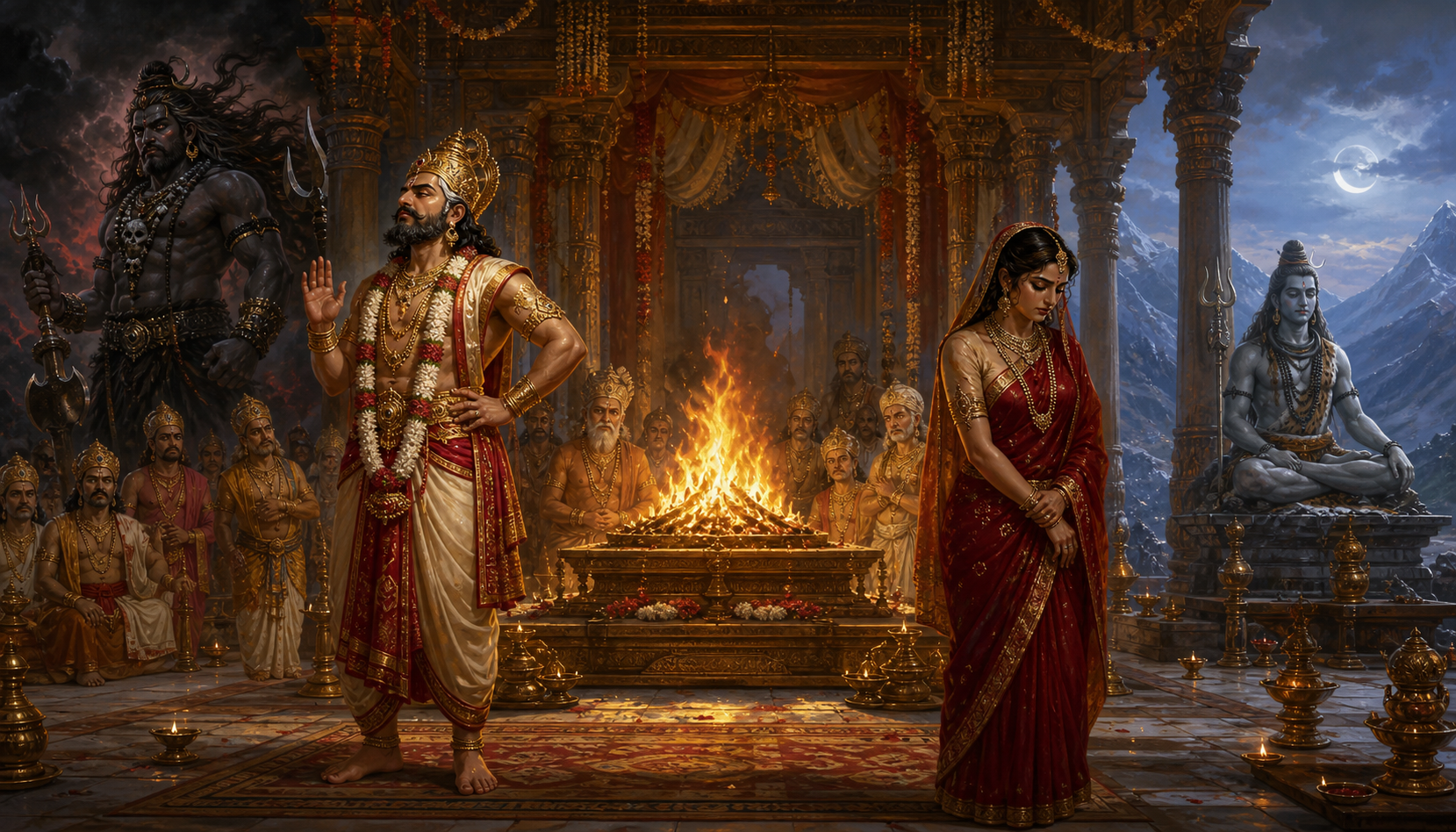
You may know the outline of the Daksha Yagya and still wonder what you are meant to do with such a severe story. Should you read Sati’s death as devotion, Veerabhadra’s violence as justice, or Shiva’s eventual mercy as forgiveness without consequence?
The katha becomes clearer when you follow its moral sequence. A sacred rite is turned into an instrument of humiliation. Prudence is ignored, dignity is violated, corrective force stops the corrupted ceremony, and restoration begins only after accountability. That sequence gives you a practical way to think about family conflict, sectarian pride, religious institutions, and your own anger.
What actually breaks at Daksha’s yajna
A yajna is meant to orient human action toward the sacred. Daksha reverses that direction. He uses an outwardly solemn gathering to express his hostility toward Shiva, deliberately excluding him while inviting other illustrious beings. The problem is therefore deeper than a missing invitation: the rite itself becomes the vehicle of the insult.
- Daksha convenes a grand yajna but pointedly leaves out Shiva.
- Sati learns that her paternal family is gathering and wishes to attend. Shiva warns her that Daksha’s animosity makes the visit unwise.
- Sati goes because the house is her paternal home and because reconciliation still appears possible.
- She encounters public contempt for Shiva. Unable to accept the desecration of her husband and the dharmic order he represents, she relinquishes her body through yogic self-immolation.
- Shiva’s grief and righteous anger bring forth Veerabhadra, who destroys the yajna’s false order and beheads Daksha. Shiva later revives Daksha with a goat’s head, and the rite is completed with Shiva properly honored.
Each turn changes the ethical situation. Daksha begins with calculated exclusion. Sati enters hoping that kinship can overcome hostility. Veerabhadra intervenes only after insult has become catastrophe. Shiva then ends the cycle rather than allowing punishment to become permanent vengeance.
This is why the restored yajna matters as much as the destroyed one. If destruction were the final teaching, the katha would end with Daksha’s death. Instead, Daksha is revived and the sacrifice is completed in corrected form. Dharma requires the false arrangement to be stopped, but it also seeks an order in which sacred action can resume.
Daksha’s failure: sacred form cannot purify contempt
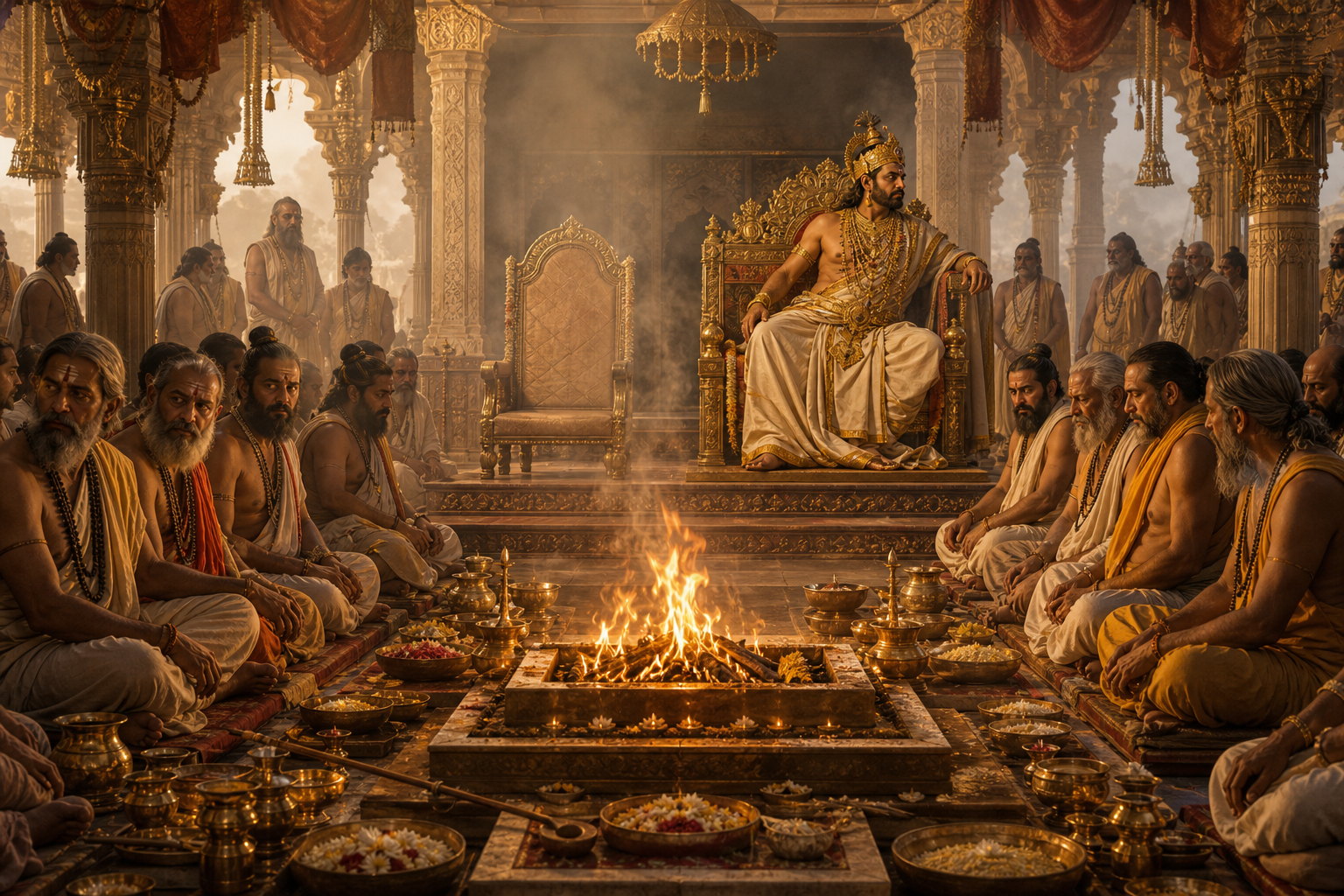
Daksha’s position as Prajapati, the grandeur of the assembly, and the participation of eminent beings do not make his intention dharmic. Authority can organize a ceremony; it cannot turn ahankara into reverence. A ritual becomes hollow when its host uses it to advertise superiority or punish a spiritual rival.
This distinction is important because exclusion is not automatically adharma. A sampradaya may preserve legitimate ritual boundaries, defined roles, or rules of participation. The Daksha Yagya concerns something more specific: a boundary manipulated to humiliate. You can distinguish the two by asking three questions.
- Necessity: Is the boundary genuinely required by the rite, or was it invented to target a person or path?
- Intention: Does the decision protect the integrity of worship, or does it provide a respectable-looking way to express contempt?
- Treatment: Can the decision be explained truthfully and respectfully, or does it depend on mockery, public embarrassment, or the denial of another’s dignity?
If a temple committee, family, or cultural organization cannot answer those questions cleanly, it should pause before proceeding. Adding more decoration, recitation, prestige, or distinguished guests will not repair a hostile purpose. The moral defect sits beneath the ceremony.
The same test protects genuine Dharmic plurality. Respecting Shaiva, Vaishnava, Shakta, Smarta, Buddhist, Jain, and Sikh paths does not require erasing their differences or mixing every form of worship. It requires refusing to turn difference into degradation. Spiritual unity is not sameness; it is the discipline of honoring another path without pretending it is your own.
Sati’s choice teaches dignity, not self-destruction

Shiva’s warning to Sati deserves more attention than it often receives. He sees that Daksha’s hostility has changed the meaning of the invitation-less visit. His restraint is not fear, weakness, or indifference to family. It is discernment: a familiar house is not necessarily a safe or honorable setting when its host has chosen public animosity.
Sati’s wish to go is also understandable within the katha. She remains Daksha’s daughter, and she hopes that the bonds of family may leave room for reconciliation. The tragedy is that filial access does not overcome deliberate contempt. Her arrival gives Daksha an opportunity to repair the relationship, but he uses it to deepen the insult.
Sati’s relinquishment of her body belongs to the sacred and theological world of the narrative. It must not be converted into approval of suicide, self-harm, coercion, or the demand that someone prove loyalty through suffering. The goddess’s name is not a behavioral instruction. If you are applying the katha to an actual conflict, the dharmic response is to protect life while refusing degradation.
That means you do not have to enter a hostile gathering merely because relatives expect you to attend. Before going, ask what has changed since the last insult, whether anyone with authority will prevent another one, and what you will do if the boundary is crossed. If those questions have no credible answers, declining the event may be wiser than arriving in the hope that kinship will spontaneously cure hostility.
If you do attend, do not make endurance your only plan. Bring a trusted ally, state the unacceptable conduct beforehand, keep your own way to leave, and use a respected mediator if repair remains possible. When public humiliation begins, leaving is not an admission that the aggressor was right. It can be the clearest refusal to let your presence legitimize the scene.
No reading of Sati’s sacrifice should be used to romanticize harm to a living person. If the story touches a real urge to harm yourself, leave the confrontation, tell someone you trust immediately, and contact local emergency or crisis support if you may be in immediate danger. Preserving life is the necessary first action; questions of reconciliation can wait.
Veerabhadra’s fierce grace has strict boundaries
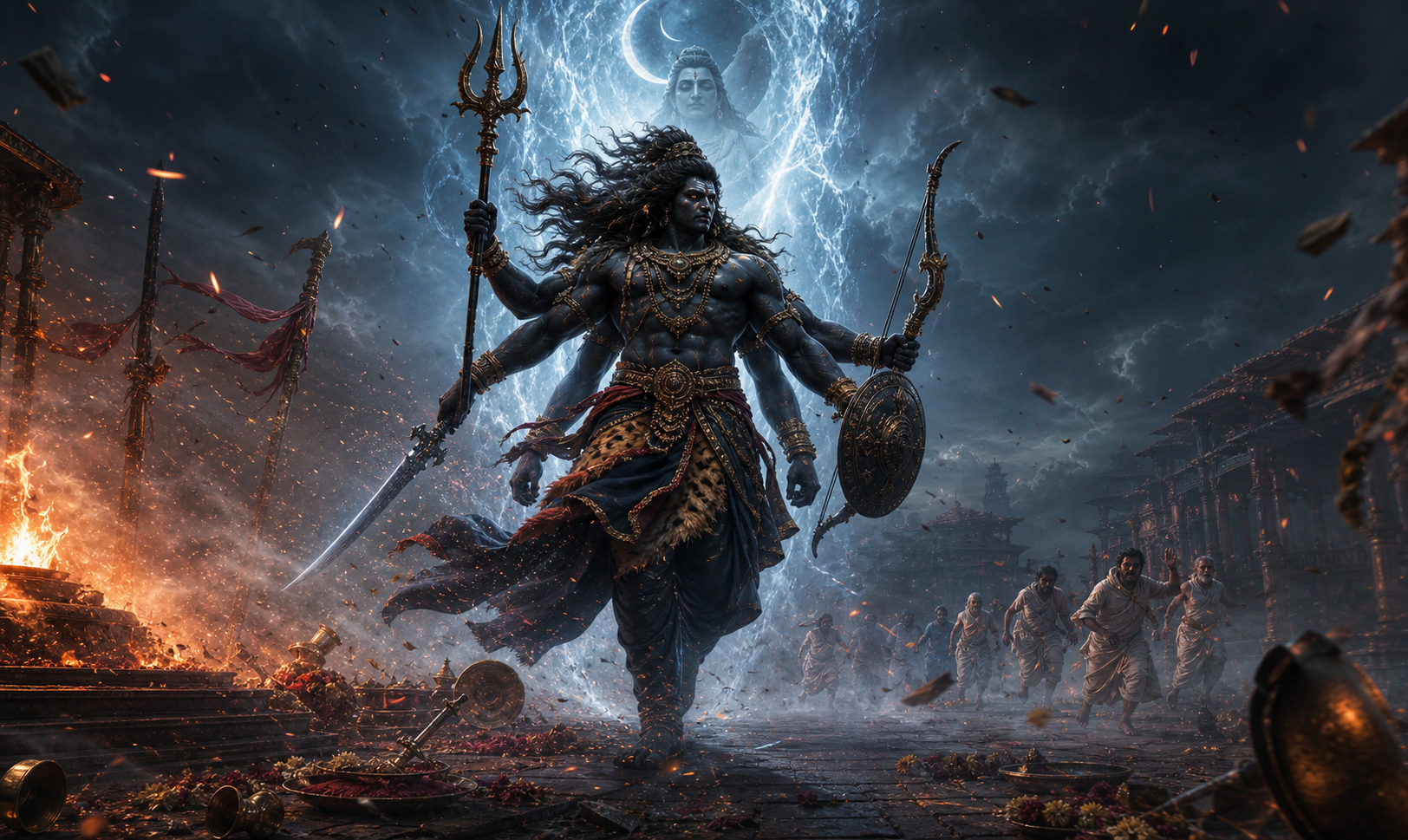
Veerabhadra emerges from Shiva’s matted hair as raudra shakti, the fierce power that confronts an order which has made itself unworthy of continuation. Some tellings accompany him with Bhadrakali. His arrival announces that the yajna cannot simply carry on while pretending that its sanctity remains intact.
That does not make Veerabhadra a divine excuse for uncontrolled human rage. Ordinary anger easily borrows the language of dharma while serving wounded pride. Veerabhadra’s function is narrower: he exposes the corruption beneath the spectacle, halts it, and imposes accountability. The ending then places a limit on corrective force. When the devas and sages seek conciliation, Shiva allows Daksha to live and permits a properly ordered yajna to be completed.
You can test a supposedly dharmic act of resistance against that complete arc:
- Protection: Is the action stopping a real wrong or merely avenging an injured ego?
- Restraint: Is it directed at the misconduct, or is it spreading punishment to everyone associated with the offender?
- Restoration: Will it stop when accountability and credible repair become possible, or does it need an enemy forever?
In ordinary life, the Veerabhadra principle usually calls for firm, nonviolent action. A presiding elder may halt a ceremony. A committee may remove someone who continues to insult worshippers. An institution may correct the public record, require an apology, revise who holds decision-making power, or postpone an event until its purpose is restored. Fierceness lies in refusing to normalize the wrong, not in imitating the katha’s physical destruction.
Mercy also has a sequence. Shiva does not revive Daksha before the arrogant yajna is stopped; nor does he treat Daksha’s humiliation of Sati and Shiva as inconsequential. Restoration follows exposure and consequence. In your own conflicts, forgiveness need not mean returning immediately to the arrangement that enabled the harm. A trustworthy repair changes conduct, responsibilities, or boundaries before asking everyone to move on.
This is the meaning of fierce grace. Grace refuses to reduce Daksha permanently to his worst act. Fierceness refuses to call that act acceptable. Remove either half and the teaching collapses into indulgence on one side or vendetta on the other.
Key takeaways for reading the katha responsibly
- A ceremony does not become dharmic through grandeur alone. Its intention and treatment of others matter.
- Daksha’s central fault is not a minor breach of etiquette but the use of sacred authority to stage contempt.
- Shiva’s first response is prudent restraint. You are not obliged to enter a hostile setting simply because family or custom expects it.
- Sati represents violated dignity and loyalty within the narrative; her death must never be treated as permission or pressure for self-harm.
- Veerabhadra represents bounded corrective power, not personal license for violence or rage.
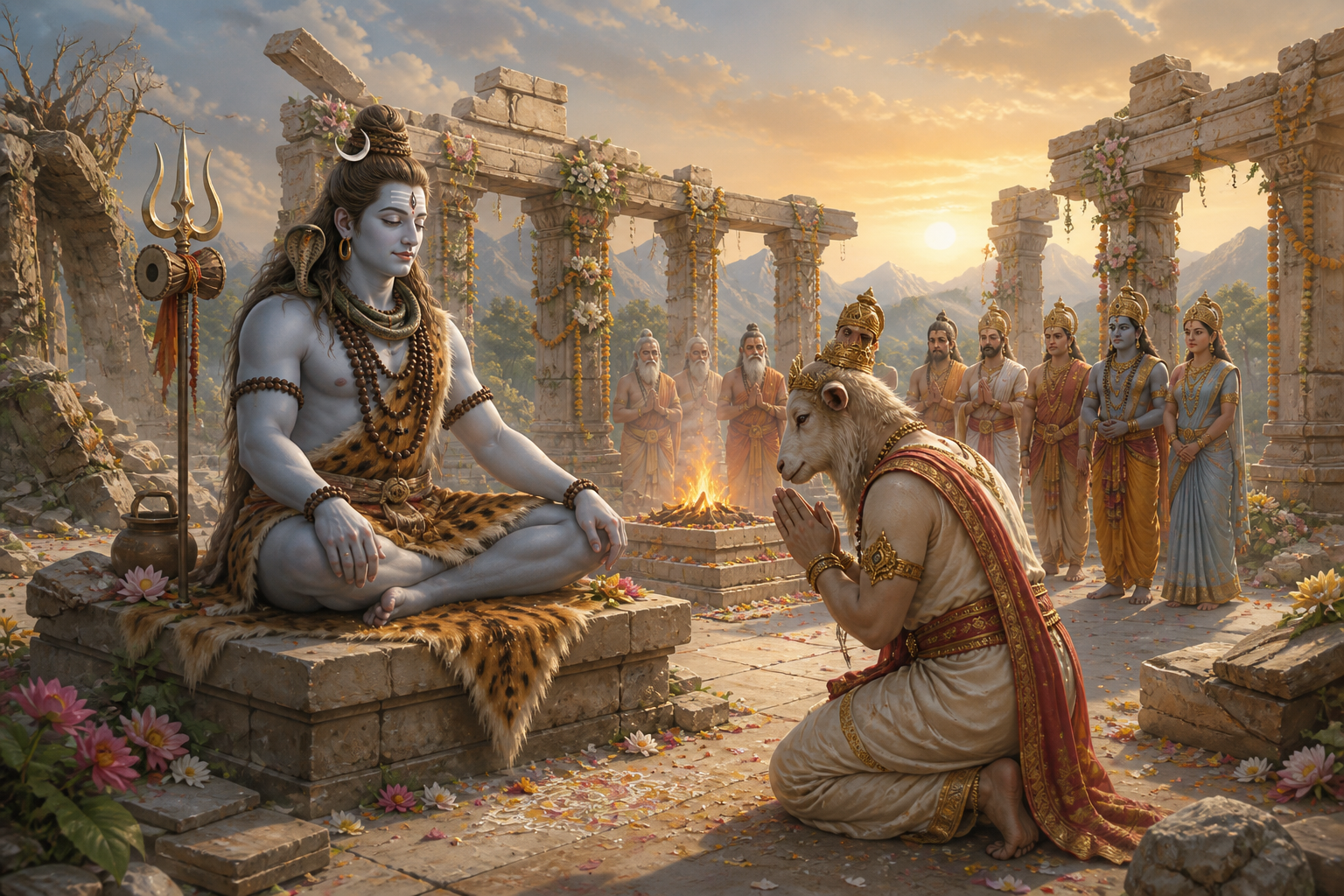
- The goat-headed restoration of Daksha and completion of the yajna show that accountability should reopen a path to right order when genuine repair becomes possible.
Before your next puja, family ceremony, or temple committee meeting, settle one practical question in advance: who has the authority to pause proceedings if worship becomes a platform for humiliation, and what repair must occur before the gathering continues? That small act of preparation carries the katha’s dharma into the place where you can actually uphold it.
References
- DharmaRenaissance Blog — Sati and Daksha Yagya: A Powerful Puranic Tale of Honor, Dharma, and Spiritual Unity
- DharmaRenaissance Blog — Veerabhadra Swamy’s Fierce Grace: Shiva, Daksha Yagna, and the Timeless Lesson of Dharma
