
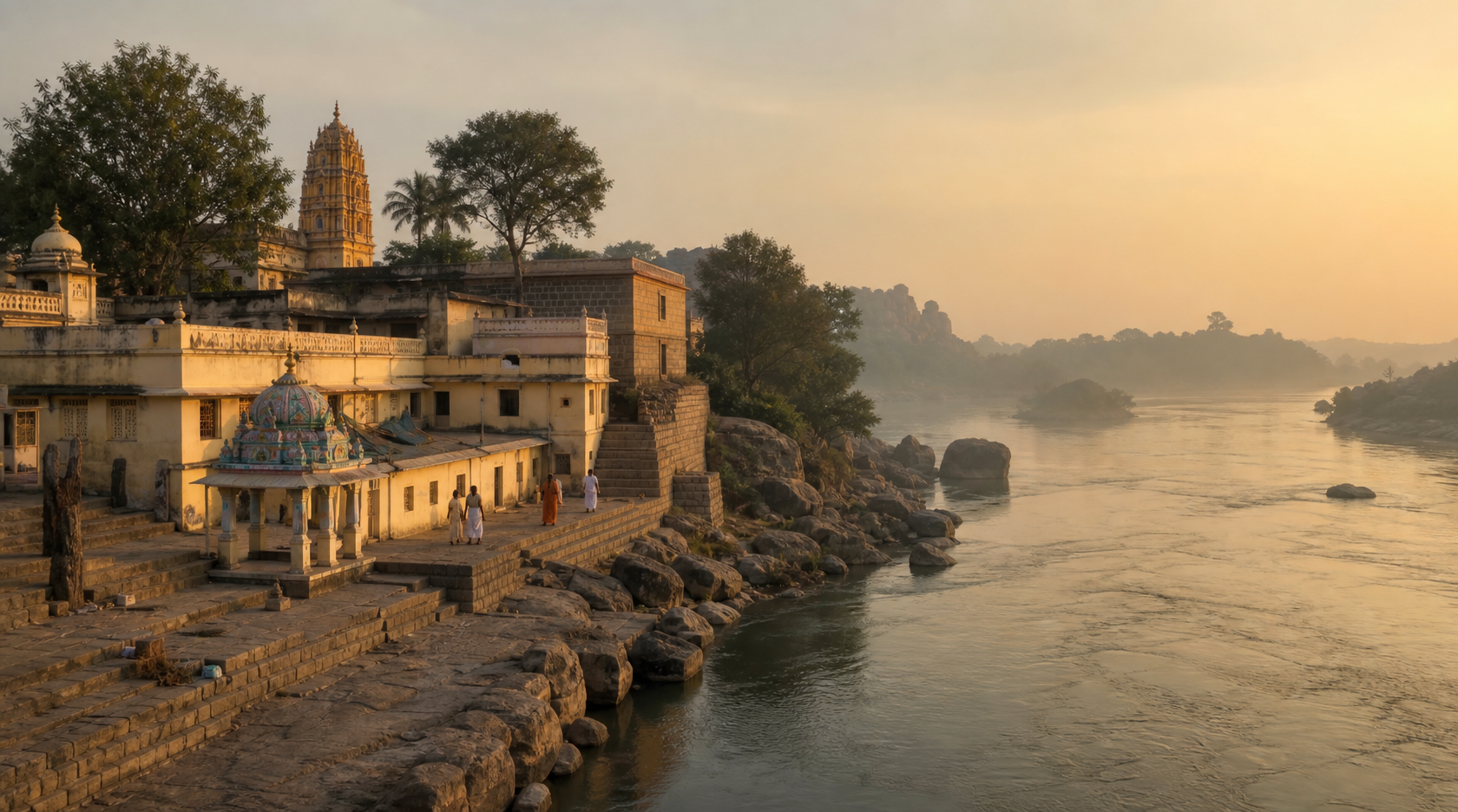
If Mantralayam is already on your route, you may be wondering whether Bichale is worth a separate place in the pilgrimage. It is, but not because it offers one more shrine to check off. Bichale gives you something a crowded itinerary often removes: time to understand the bond between a guru, a disciple and a living tradition.
Situated a few kilometres from Mantralayam on the Tungabhadra River, Bichale is revered as the Third Mantralayam. Tradition holds that Guru Raghavendra Swamy spent several years here in close association with Appanacharya, his foremost disciple. If you approach the site through that relationship, the visit becomes more than an extension of Mantralayam darshan.
Why Bichale changes the meaning of a Mantralayam journey
The title Third Mantralayam is best understood as an expression of sacred continuity, not as a ranking among pilgrimage sites. Bichale preserves the memory of Guru Raghavendra not only as a revered saint, but also as a teacher living and working closely with a disciple. That distinction should shape what you look for when you arrive.
At Mantralayam, your attention may naturally settle on darshan, prayer and the grace of the guru. At Bichale, allow another question to arise: how was that grace received, studied and carried forward? Appanacharya’s presence turns the landscape into a lesson in guru-shishya parampara. A tradition survives because a disciple listens carefully, practises faithfully and transmits what has been learned without placing himself above the teaching.
Bichale is also associated with study, contemplation and the transmission of teachings in the Madhva tradition. Devotional memory connects the place with the recitation of stotras and engagement with commentaries, although accounts differ about particular compositions. You don’t need to settle every historical attribution in order to understand the site’s importance. Notice the larger pattern: devotion here was joined to disciplined learning.
This is why rushing through Bichale can leave its deepest meaning untouched. The riverbank, the ashrama setting and the memory of sustained study invite a slower form of pilgrimage. Your aim isn’t to collect another sacred name. It is to become more teachable.
Give the visit a simple practice instead of a crowded agenda
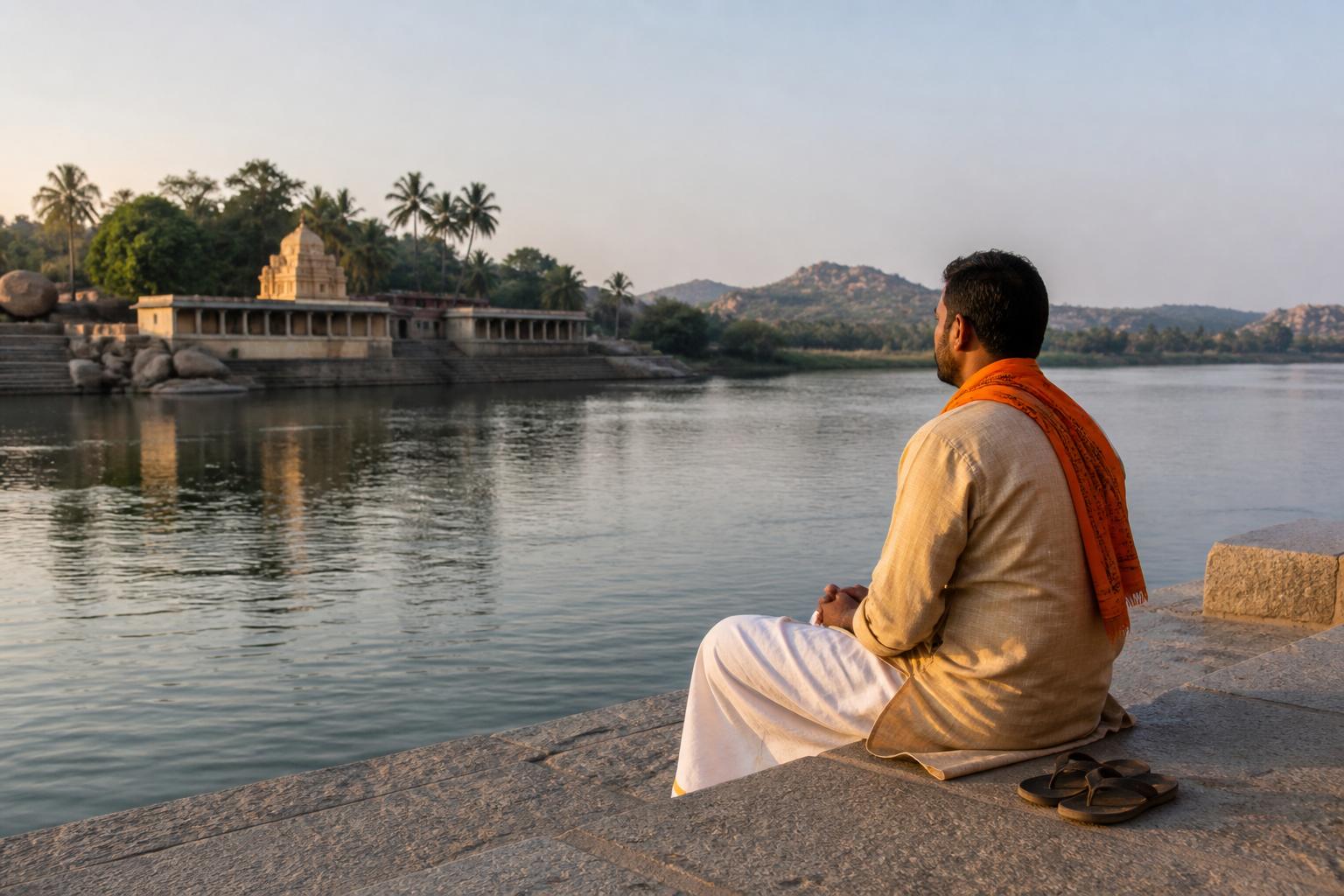
You do not need an elaborate personal ritual to make Bichale meaningful. Choose one familiar practice and give it your full attention. A short, deliberate observance is more fitting than moving anxiously between several activities.
- Pause before beginning. Put away the phone, let the movement of the journey settle and listen to any guidance given at the Mutt.
- Offer simply. Follow the customs explained locally rather than arriving with assumptions about what must be presented or performed.
- Recite what you already know. A familiar stotra or a period of quiet japa is better than attempting an unfamiliar practice merely because you are at a sacred place.
- Sit in reflection. From a permitted and safe place near the Tungabhadra, consider one question: what quality made Appanacharya capable of receiving his guru’s teaching?
- Choose one observance to carry home. It might be a regular period of svadhyaya, more attentive prayer or a concrete act of service. Keep it small enough to continue.
If a caretaker or devotee shares a local account, receive it respectfully as part of the site’s living memory. Where accounts differ about the origin of a particular composition, don’t turn a devotional association into a categorical historical claim. Reverence does not require careless certainty.
The same restraint applies to your inner expectations. You may experience stillness, emotion or a strong sense of presence, but pilgrimage is not a demand for a dramatic feeling. Attention itself is a worthy offering. Sit, recite and listen without judging the visit by whether something unusual happens.
Plan Bichale and Mantralayam as one pilgrimage
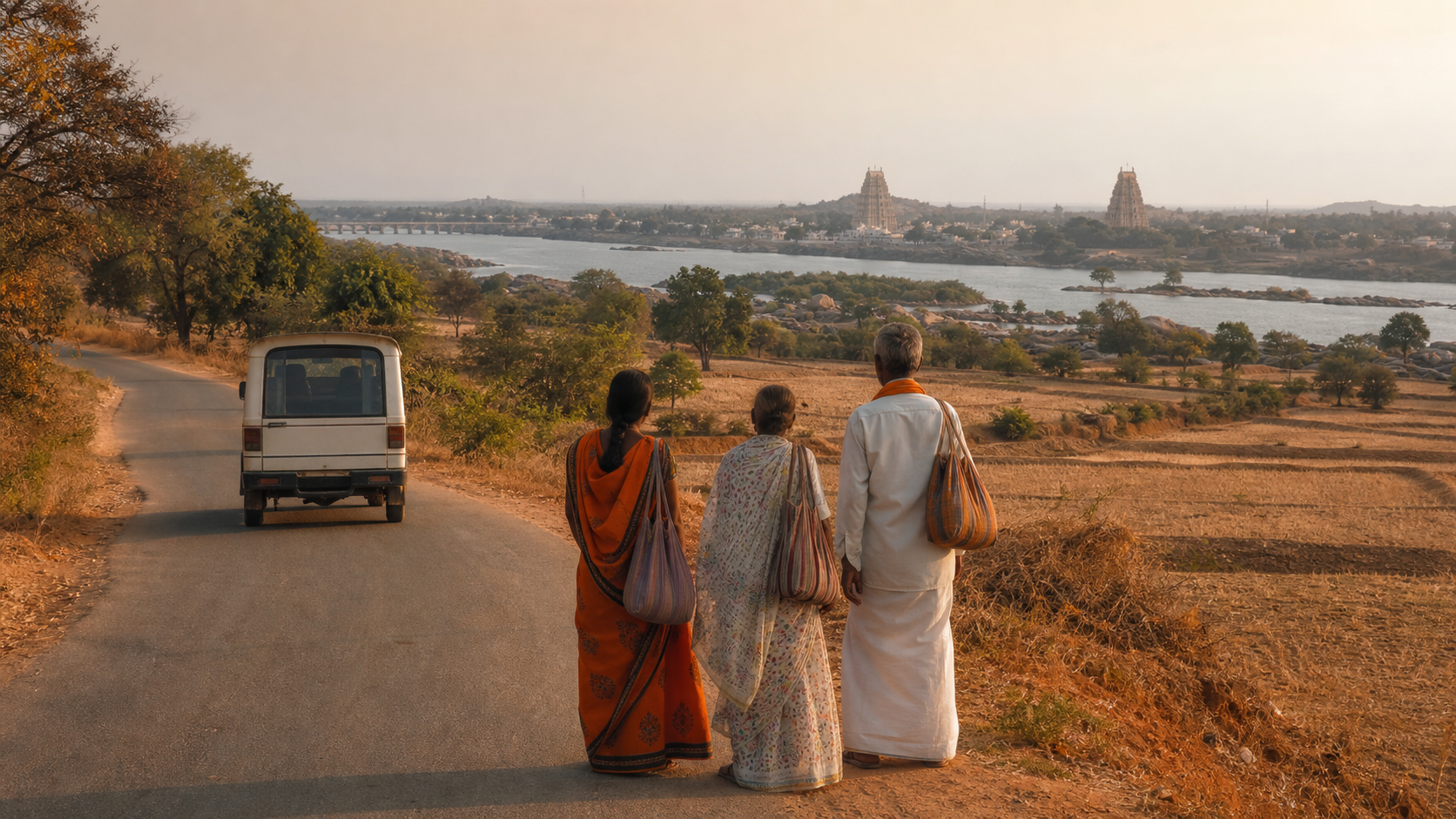
Bichale’s proximity to Mantralayam makes it natural to include both in one pilgrimage plan. The important choice is not merely whether to add the stop, but whether to protect enough unhurried time for it. If Bichale is squeezed between transport deadlines and another long list of destinations, its contemplative character is likely to disappear.
- Verify current opening arrangements, worship schedules, road access and local transport shortly before travelling. These operational details can change and should not be treated as timeless facts.
- Ask locally about the appropriate order of worship and any areas where visitors should not enter. A working Mutt has its own rhythm, and pilgrimage does not give a visitor priority over it.
- Carry only simple offerings that are accepted at the site. If you are uncertain, ask before presenting anything.
- Keep your phone silent and seek permission before taking photographs. A sacred setting is not automatically a public photo location.
- Leave part of your schedule unassigned. That open interval is where recitation, japa or quiet reflection can actually happen.
- Protect the riverbank and ashrama environment. Carry your waste away and avoid disturbing the quiet that gives the place much of its contemplative character.
The Tungabhadra is part of Bichale’s sacred landscape, but a river setting should never be read as automatic permission to bathe, wade or cross. Conditions and access can vary. Follow current local instructions and remain within permitted areas rather than making assumptions based on what another pilgrim once did.
If time forces a choice, decide honestly what kind of visit you can make. A brief, respectful darshan is better than pretending to undertake deep contemplation while watching the clock. If you have flexibility, place Bichale where the day can naturally become quieter rather than treating it as an afterthought.
Let the guru-shishya bond show you how to see Bichale
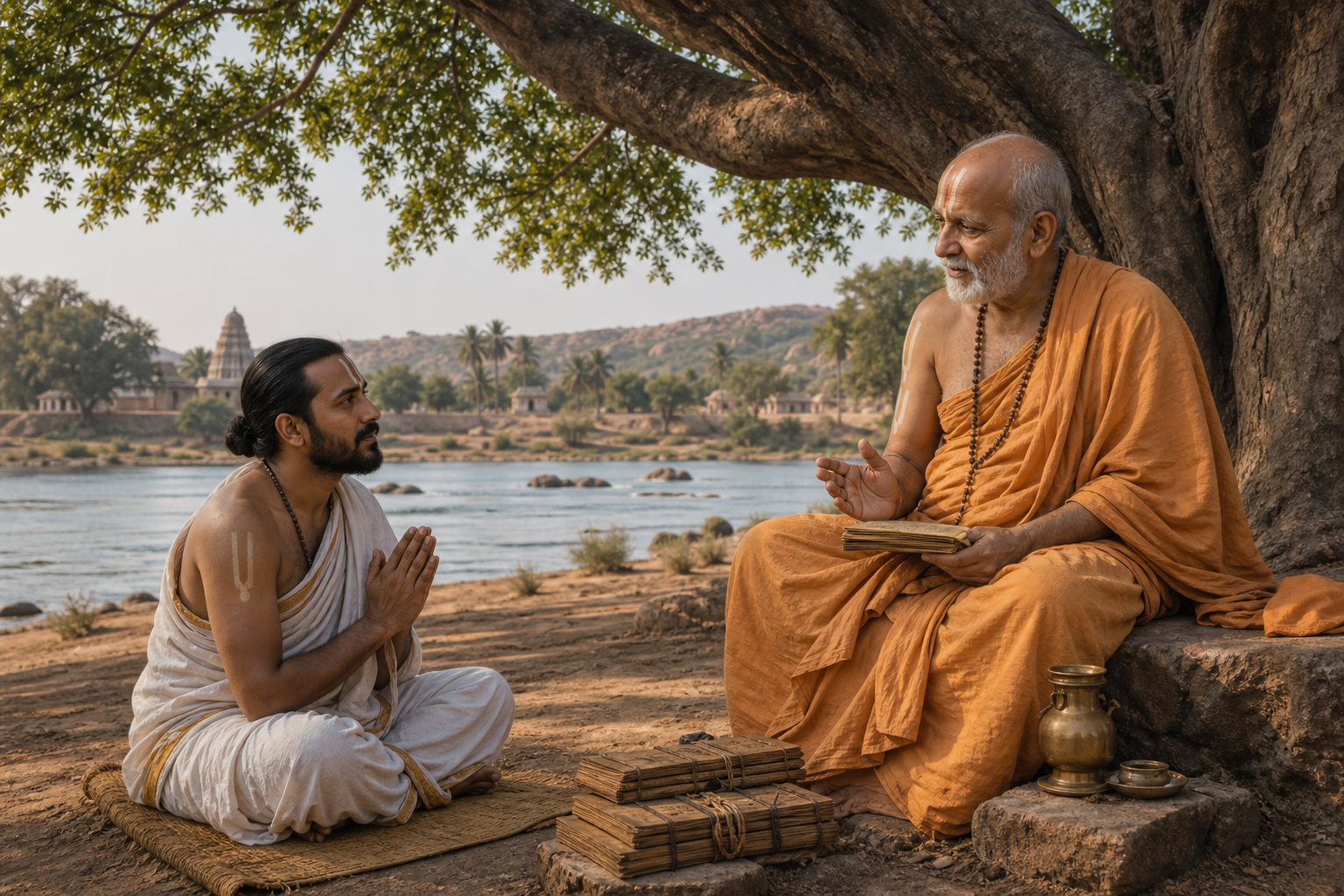
Appanacharya is not a side character in Bichale’s significance. His association with Guru Raghavendra gives the pilgrimage its practical teaching. The guru-shishya relationship asks for more than admiration: it asks whether the disciple has developed the discipline to receive, test through practice and preserve what the guru gives.
Bhakti: arrive to receive, not consume
Bhakti changes the posture of a visit. You are not evaluating whether Bichale provides enough visual spectacle or enough activities. You are making yourself available to a sacred memory. Simple prayer, attentive darshan and gratitude are sufficient. This also means allowing other devotees to worship without becoming part of your photographs, conversation or itinerary.
Svadhyaya: take one teaching seriously
Bichale’s connection with study should affect what happens after you leave. Choose one verse, stotra, commentary question or aspect of the Madhva tradition for continued study. Do not use the visit as a substitute for learning. Let it become the reason you begin learning with greater discipline.
Seva: protect what allowed the teaching to endure
Service at a pilgrimage site begins with conduct. Respect the Mutt’s guidance, preserve silence where it is being observed, avoid litter and do not obstruct worship. If you wish to offer material support, ask how it may be given according to local custom. Unrequested intervention is not automatically seva.
Visitors from Buddhism, Jainism or Sikhism may recognise familiar Dharmic values here: disciplined inquiry, ethical conduct, humility before a teacher and compassionate service. That resonance can support mutual respect, but it should not erase the site’s particular identity. Bichale remains rooted in the Madhva tradition and the devotional legacy of Guru Raghavendra Swamy. Respect begins by allowing that distinctiveness to stand.
Key takeaways before you go
- Bichale matters because of Guru Raghavendra Swamy’s close association with Appanacharya and the life of teaching, study and devotion remembered there.
- The name Third Mantralayam expresses continuity with the larger Raghavendra pilgrimage landscape; it need not be treated as a competitive ranking.
- Add Bichale to your Mantralayam plan only with enough room for an unhurried prayer, recitation or period of reflection.
- Follow current local guidance for worship, offerings, photography, access and conduct instead of assuming that every Mutt follows the same arrangements.
- Use the visit to begin one sustainable practice at home: regular svadhyaya, attentive japa or a definite form of seva.
- Treat the Tungabhadra riverbank as a sacred and natural environment. Stay within permitted areas, follow safety instructions and leave nothing behind.
Before you set out, choose the one practice you will bring to Bichale and the one discipline you will carry away. That decision will do more for your pilgrimage than adding another destination to the route. Let Mantralayam draw you toward the guru, and let Bichale teach you how a disciple responds.
References
