
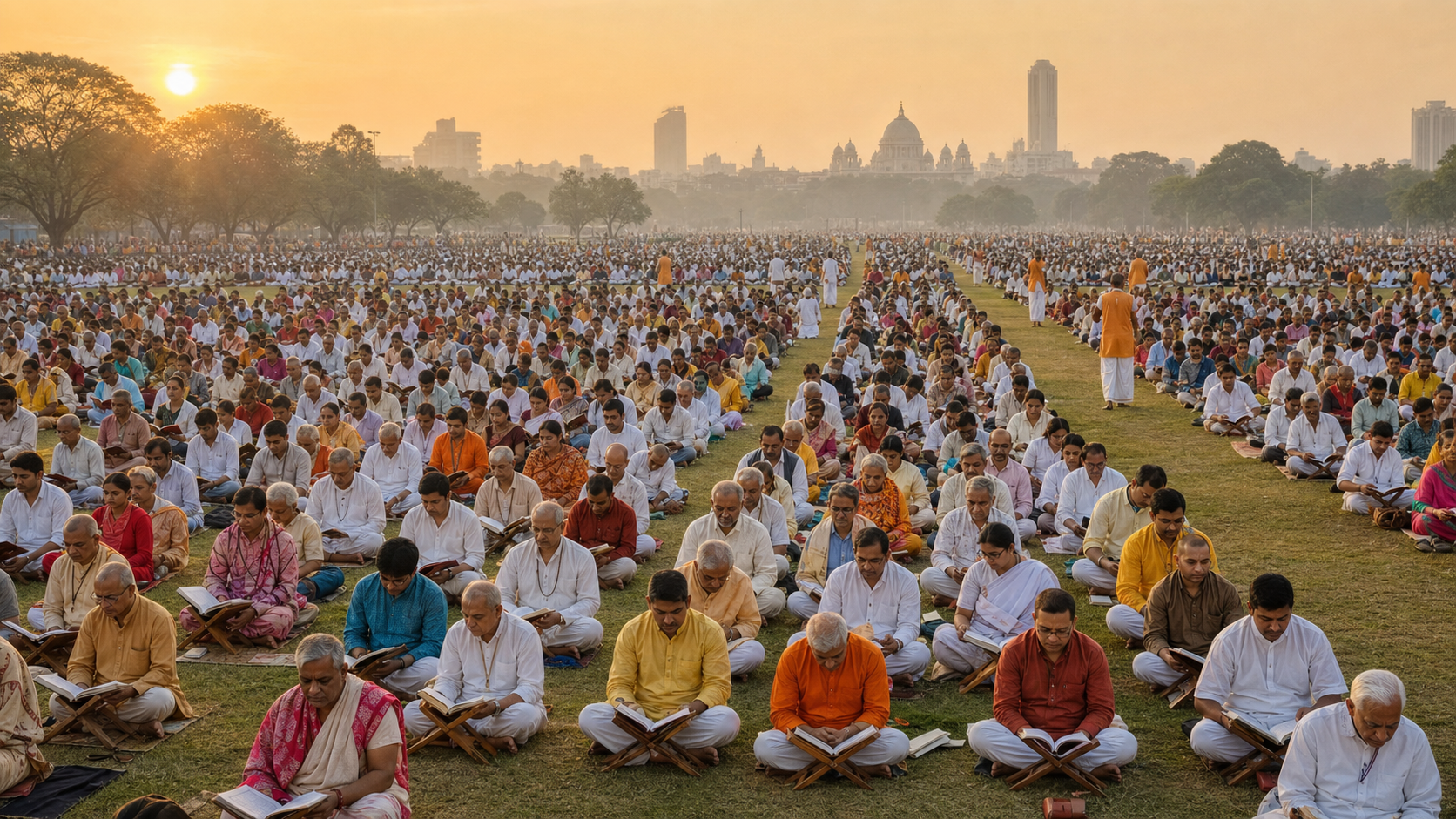
If you encountered the claim that five lakh people would recite the Bhagavad Gita together in Kolkata, your first question may be whether this was a serious act of sadhana or simply a spectacle built around a large number. The answer depends on what the gathering asked people to do before, during, and after the recitation.
A mass Gita path can make scripture publicly visible, but visibility is only the beginning. For you as a participant, supporter, or careful observer, the useful test is straightforward: does the scale serve faithful recitation, civic discipline, dharmic fellowship, and practice beyond the venue?
Key takeaways
- The widely cited five-lakh figure was an expected attendance figure attached to the 2025 plan, not by itself a verified final count.
- A mass recitation succeeds when a common text and pace are supported by orderly movement, medical readiness, water, sanitation, clear information, and trained volunteers.
- If you attend a gathering of this size, prepare for the recitation and the ground conditions: use current organizer instructions, know where assistance is located, and agree on a family regrouping point.
- Dharmic unity can affirm compassion, self-mastery, and service without claiming that Hindu, Buddhist, Jain, and Sikh traditions have identical scriptures or doctrines.
- The gathering bears fruit when you carry one teaching from collective recitation into a definite change in conduct.
Five lakh was a forecast, not the measure of the event
The initiative popularly called Panch Lokkha Konthe Gita Path 2025 was planned for Brigade Parade Ground with an estimated five lakh devotees expected, as part of an observance of Gita Jayanti. The wording matters. An expected figure communicates intended scale and the burden placed on organizers; it does not establish how many people ultimately entered the ground or completed the recitation.
When you describe the event, say that it was planned for five lakh participants unless you have a reliable final count. This small distinction protects a dharmic occasion from an avoidable credibility problem. Inflating an expectation into an accomplished fact does not strengthen the Gita’s place in public life. Precision does.
Nor should headcount become the spiritual standard. A coordinated recitation is different from thousands of unrelated private readings happening in the same place. Each person must accept a common text, sequence, pace, and pause. That voluntary discipline is part of the practice: your voice contributes to the whole only when it stops competing with the voices around it.
You can prepare for that discipline at three levels:
- Prepare the text. Obtain the passage sequence, edition, pronunciation aid, and pacing instructions issued for the gathering. Do not assume that the version familiar in your home follows the same recitation plan.
- Prepare the meaning. Select one theme emphasized by the occasion – such as self-mastery, compassion, or service – and ask what it requires in your present responsibilities. Sound without reflection can stir emotion, but it does not automatically produce understanding.
- Prepare your conduct. Calm queuing, attention to instructions, consideration for elders, and restraint around noise or recording are not interruptions to devotion. In a mass gathering, they are among its clearest expressions.
This is the difference between treating Gita path as a performance and entering it as sadhana. Correct recitation matters, but the deeper standard is whether the discipline of the text becomes visible in the discipline of the participant.
At Brigade scale, crowd discipline becomes seva
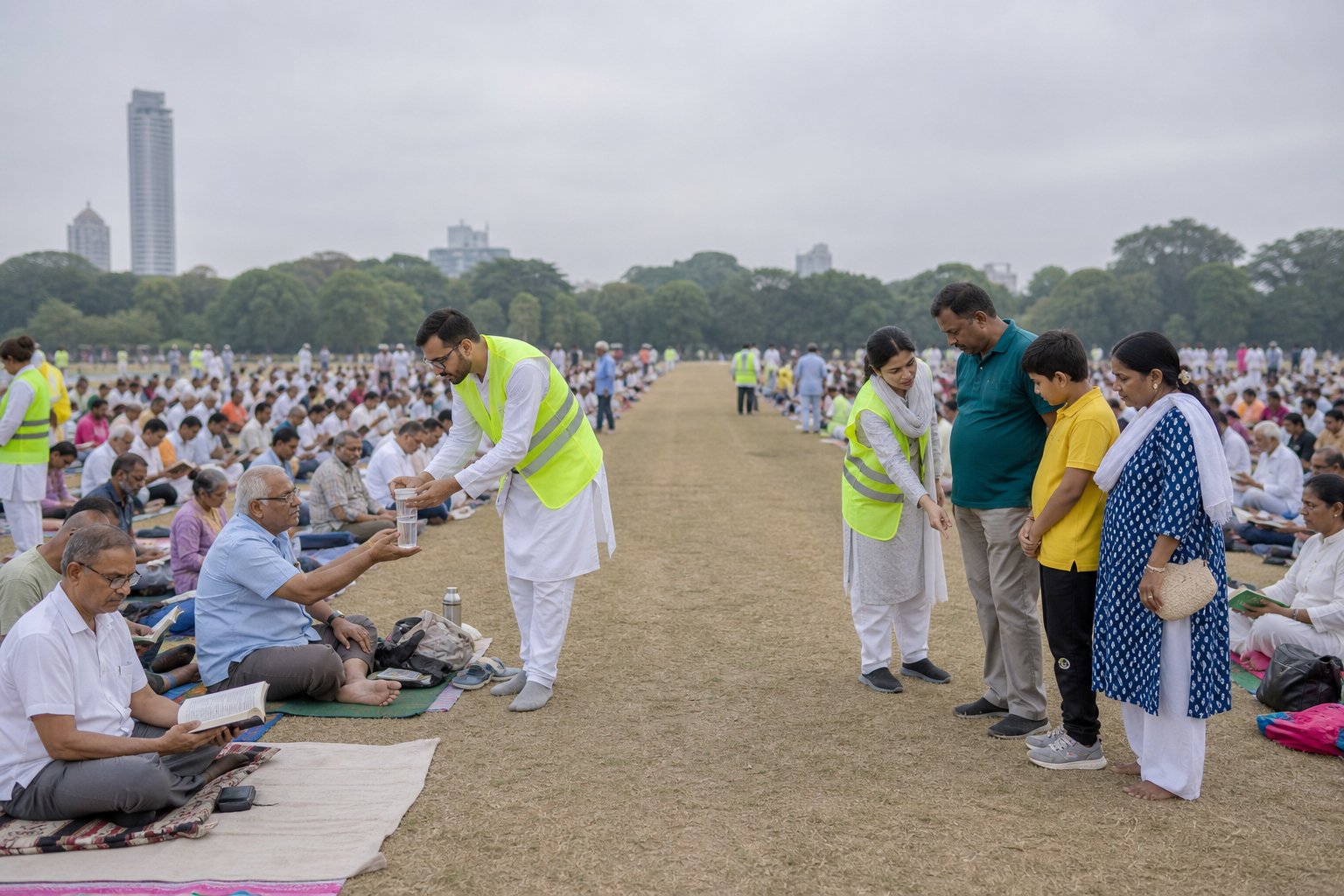
A gathering planned on this scale cannot rely on goodwill alone. The Kolkata preparations emphasized segmented entry and exit areas, medical readiness, drinking-water access, sanitation, information points, and trained volunteers. These are not secondary details surrounding the spiritual program. They determine whether families, elderly devotees, first-time visitors, and people who need assistance can participate with dignity.
If you attend a future staging of this event, or any comparable public recitation, make the following checks before you enter:
- Use the latest instructions distributed by the organizers for your assigned gate, route, and permitted belongings. A forwarded image may be incomplete or outdated, so do not let it overrule a current notice at the venue.
- Agree on a fixed regrouping point with your family before entering the densest part of the crowd. Do not make phone contact your only plan.
- Locate the nearest information point, medical station, drinking-water facility, sanitation area, and exit as soon as you arrive. Finding them during a problem is harder than noticing them at the beginning.
- Keep children, elders, and anyone with limited mobility within the same small group. Use marked assistance, family, or quiet areas when available rather than pushing toward the most crowded position.
- Follow the direction of crowd movement and the instructions of trained volunteers. Do not stop at a gate, barricade, or narrow passage to take a photograph or wait for someone.
- Carry only permitted essentials and keep passages free of bags, discarded packaging, and personal items. A clean route is a safety measure as well as a civic courtesy.
If you feel faint, breathless, disoriented, or unable to remain steady, signal the nearest volunteer and seek the designated medical assistance. Trying to force your way against a moving crowd can endanger you and the people around you. Leaving a recitation for safety is not a failure of devotion.
Accessibility also has a practical test. Announcements and signs must be understandable; assistance points must be easy to identify; and volunteers must be able to help a person who does not already know the ground. The plans included multilingual instructional aids, marked assistance points, quiet zones, and family-friendly areas. If you are helping organize a local recitation, begin with these needs rather than adding them after the main arrangements are complete.
Dharmic unity works best when differences are named
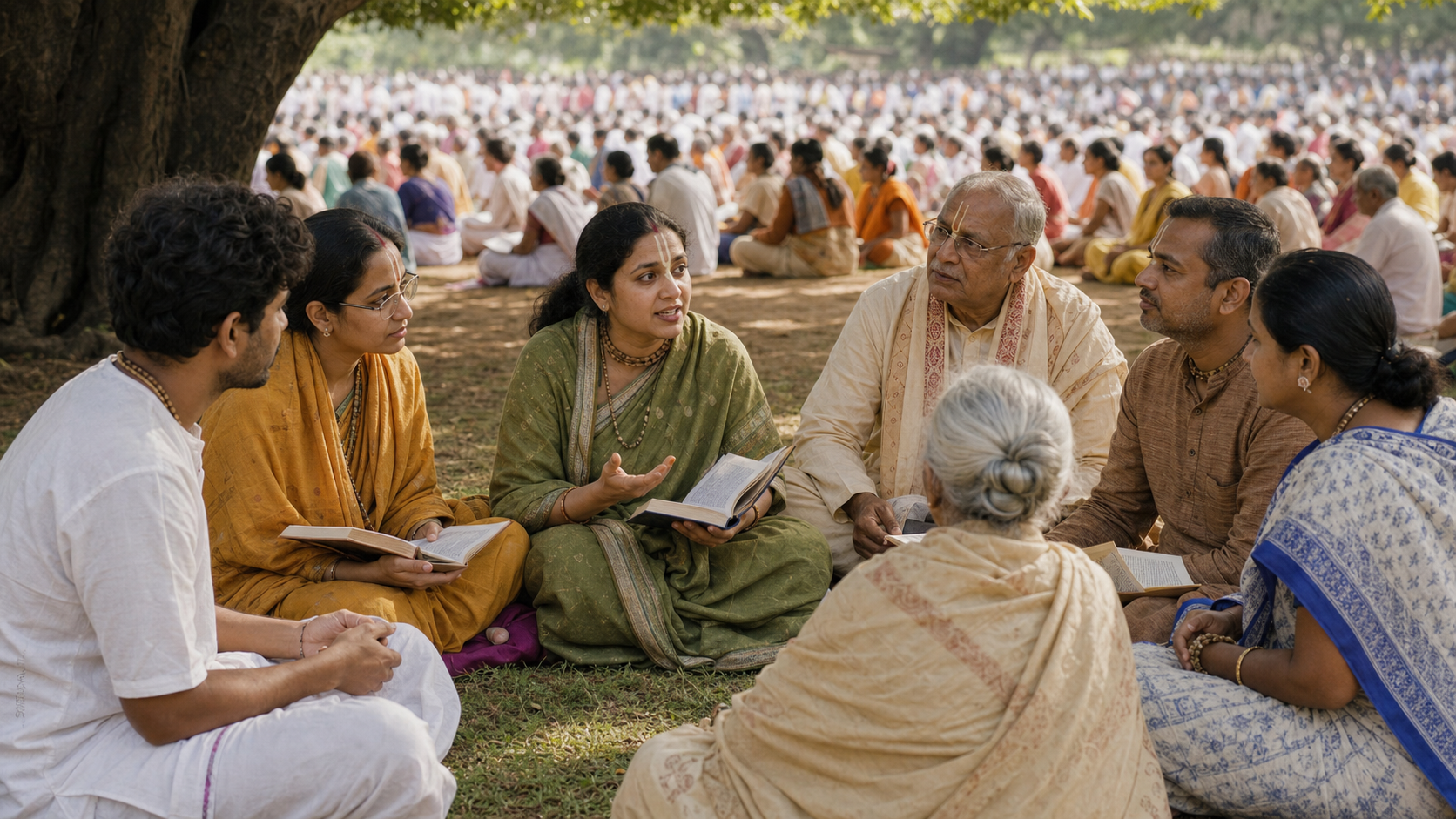
The Kolkata initiative presented the Gita in relation to a wider dharmic family, drawing attention to compassion, self-mastery, service, ethical reflection, and social harmony across Hindu, Buddhist, Jain, and Sikh communities. That aspiration is strongest when stated precisely.
The Bhagavad Gita is a Hindu scripture. Buddhism, Jainism, and Sikhism have their own authoritative texts, doctrinal vocabularies, and spiritual disciplines. Dharmic fellowship does not require us to erase those distinctions or claim that every tradition gives the Gita the same status. It asks whether people shaped by related Indic civilizational worlds can meet respectfully around ethical questions that genuinely concern them all.
If you speak about dharmic unity at such an occasion, keep three distinctions in view:
- Shared values are not identical theology. Compassion or self-restraint may be honored across traditions even when their explanations of the self, liberation, duty, or ultimate reality differ.
- Invitation is not appropriation. Welcome a Buddhist, Jain, or Sikh neighbor as a respected participant or guest; do not assign that person a religious identity or scriptural commitment they have not claimed.
- Seva demonstrates unity more convincingly than slogans. Helping an elder find a seat, keeping drinking-water access clear, translating an instruction, or collecting waste creates fellowship without demanding doctrinal agreement.
This precision is not a retreat from dharmic confidence. It is confidence with intellectual honesty. A living civilizational family can recognize kinship, disagreement, and mutual responsibility at the same time.
Carry one teaching beyond the final shloka
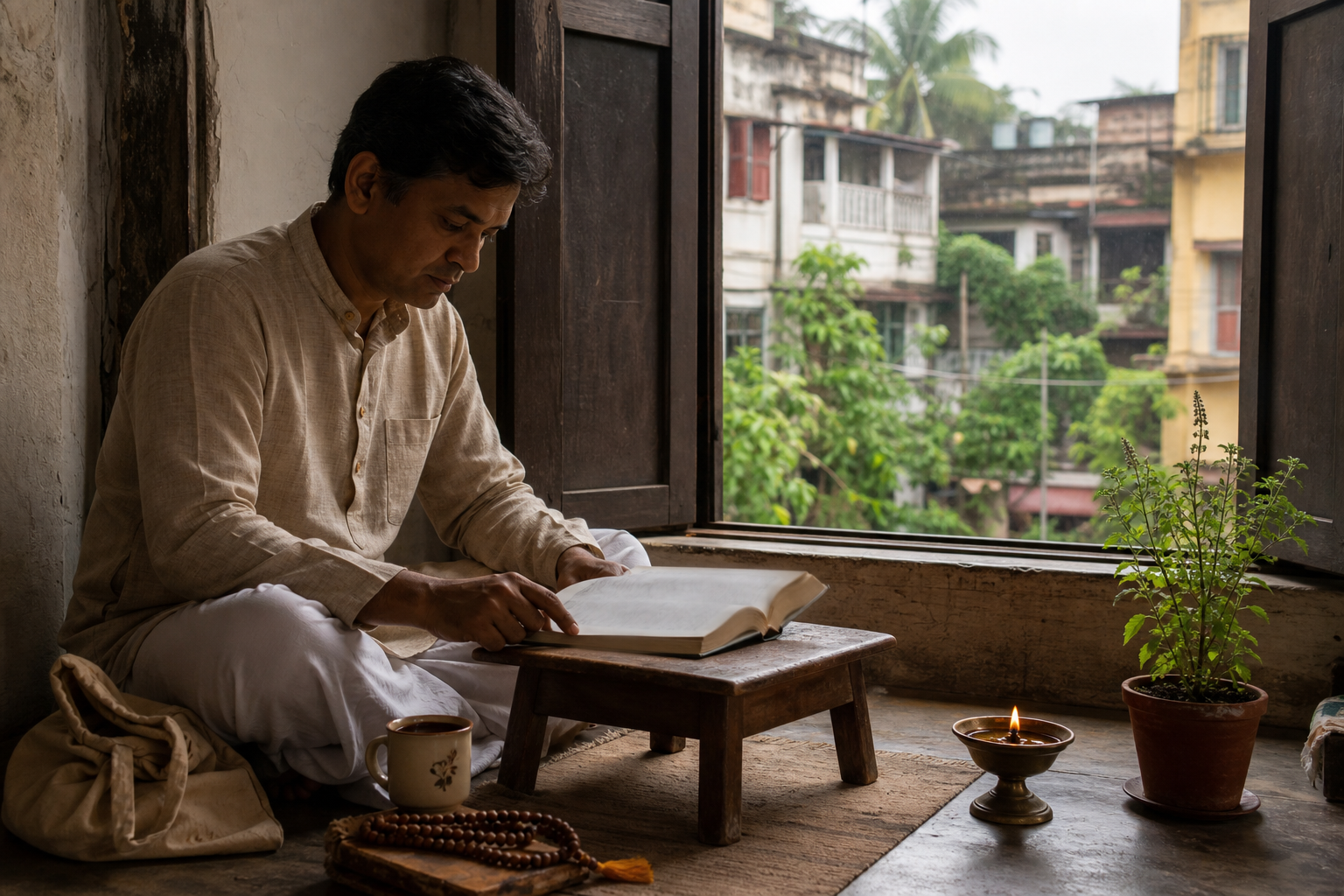
The most important part of a mass Gita recitation may begin when the microphones fall silent. Public sound can create a powerful shared moment, but the Gita addresses the person who must still act amid duty, uncertainty, attachment, and conflict. If nothing changes in that person’s conduct, the event remains memorable without becoming formative.
Before attending, decide how you will preserve one part of the experience. The method can be simple:
- Choose one teaching or passage that bears directly on a duty you are already avoiding, resenting, or performing carelessly.
- Translate it into an observable rule of conduct. You might complete a necessary task without seeking applause, pause before answering in anger, or give time to a form of seva that your community actually needs.
- Discuss the passage with your family, temple group, or study circle after the gathering. Ask what the words demand, not merely which lines sounded most moving.
- Return to the same passage after ordinary life tests your resolution. The point is not to preserve the emotion of the crowd but to deepen steadiness when the crowd is gone.
You can judge the civic legacy just as concretely. Were elderly and first-time participants able to navigate the venue? Did volunteers make instructions clearer? Were exits and assistance points kept usable? Was the ground treated respectfully? Responsible waste collection and mindful use of resources formed part of the announced plan, rightly linking sacred purpose with responsibility for a shared public place.
If you take part in a future mass recitation, arrive as both a practitioner and a citizen. Learn the prescribed text, respect the crowd system, help someone who needs it, and leave with one promise small enough to keep. That is how a vast public Gita path becomes more than a photograph of a vast public crowd.
References
