

You may be trying to settle one practical question: should your puja, vrata, or other tithi-based observance take place before or after the evening change? On Thursday, December 11, 2025, Krishna Paksha Saptami continues until 6:48 PM local time, after which Krishna Paksha Ashtami begins.
That transition gives the day its basic structure. It does not, by itself, provide a universal shubh muhurta. Use the schedule below to organize your practice, then confirm the clock time, Nakshatra, Rashi, and any required muhurta in a trusted Panchang calculated for the place where you will perform the observance.
The day turns on one evening boundary
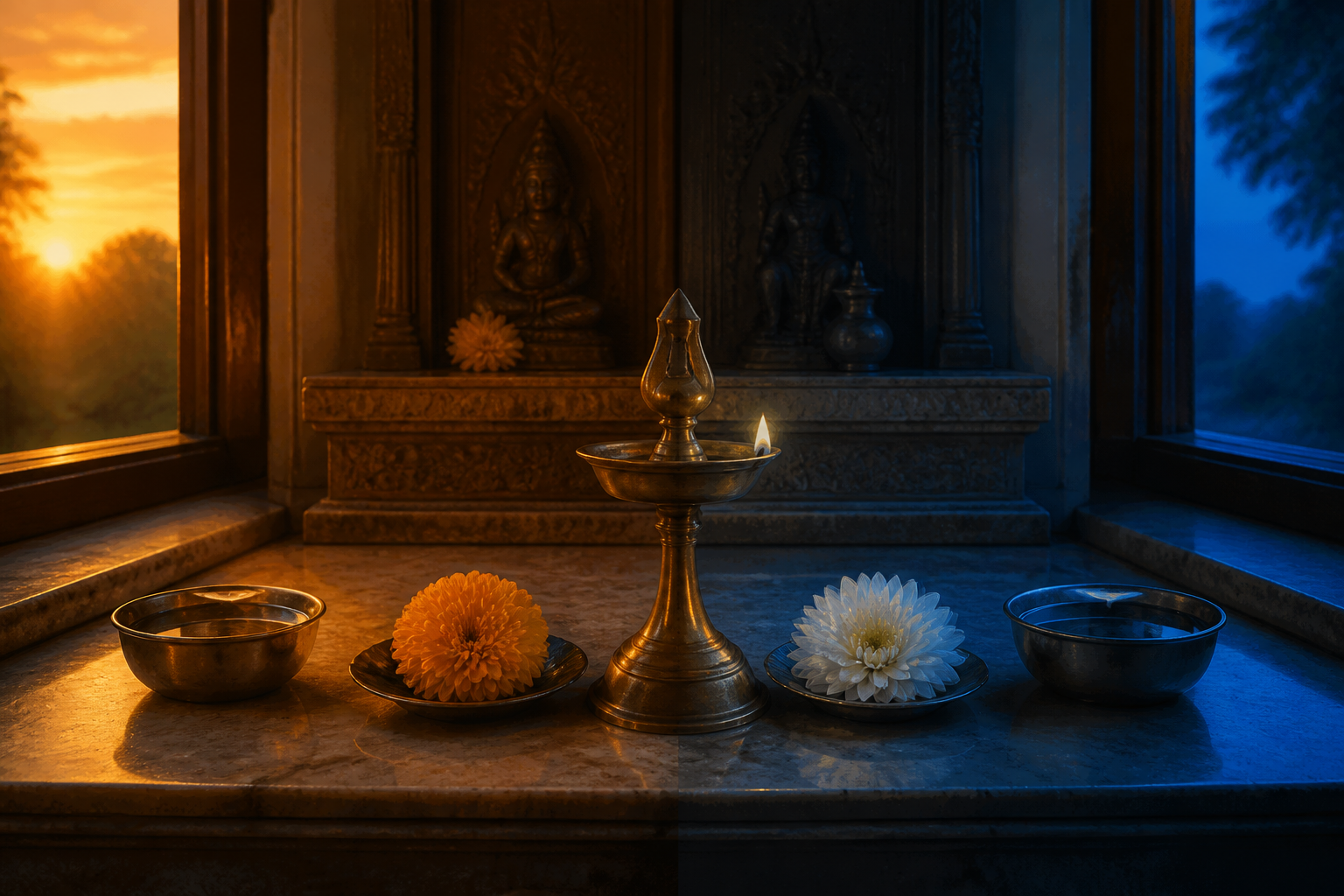
A tithi is a lunar date, so it does not have to begin or end at midnight. December 11 therefore contains parts of two tithis. The civil date remains Thursday throughout, but the relevant lunar designation changes during the evening.
| Planning point | December 11 guidance |
|---|---|
| Civil date | Thursday, December 11, 2025 |
| Lunar fortnight | Krishna Paksha, the waning or dark fortnight |
| Before the transition | Krishna Paksha Saptami |
| Stated transition time | 6:48 PM local time |
| After the transition | Krishna Paksha Ashtami |
| Required local check | Confirm the time for your city before treating 6:48 PM as operative |
The phrase “local time” matters. Panchang calculations depend on location and the time convention being used. If the locality behind a displayed calculation does not match your own, copying its clock time can place your observance on the wrong side of the tithi boundary. A person in another city should therefore verify the transition rather than assuming that 6:48 PM applies everywhere.
There is a second distinction to keep in view. Knowing when Saptami ends tells you which tithi prevails at a given moment, but different observances can use different rules for deciding the appropriate day. Some instructions concern the presence of a tithi during a particular part of the day; others concern when a prescribed act begins or is completed. Follow the rule attached to your vrata, family parampara, temple, or sampradaya instead of inventing a rule from the ending time alone.
Plan Saptami and Ashtami as two distinct phases

Before 6:48 PM: complete Saptami work deliberately
If your local Panchang confirms the stated time, place Saptami-specific worship before 6:48 PM. Do not merely schedule the start of a long ritual immediately before the boundary and assume that this satisfies every observance. First determine whether your tradition requires the central act, the offering, the completion, or simply the prevailing tithi to fall within Saptami.
- Identify the non-negotiable part of the observance: the puja, vrata completion, recitation, offering, or another prescribed act.
- Estimate how long your actual practice normally takes, including preparation, rather than choosing a start time from the ritual text alone.
- Move the time-bound portion earlier if ordinary duties could delay you.
- If you cannot meet the prescribed condition, ask the temple or a knowledgeable practitioner how your tradition handles that case. Do not quietly relabel an after-transition act as Saptami worship.
The change of tithi is not a command to abandon ordinary responsibilities. You can work, care for family, study, or travel as usual unless a vrata you have undertaken requires otherwise. Panchang discipline is most useful when it brings clarity to a practice; it should not create rules that the practice itself does not contain.
After 6:48 PM: let Ashtami shape the evening
Under the stated calculation, Krishna Paksha Ashtami begins at 6:48 PM. If an Ashtami observance requires the tithi to be present in the evening or night, this is the phase to examine, subject to your local calculation and the observance’s own rules.
If you have no formal Ashtami vrata, the evening can still be used well. Krishna Paksha lends itself to a quieter rhythm: japa, meditation, devotional reading, gratitude, and seva all fit an inward-looking close to the day. These are practical options, not mandatory ceremonies created by the clock. Choose one that you can perform attentively instead of assembling an elaborate routine merely because the tithi changed.
You may also use the threshold as a simple reset. Finish the day’s unfinished mental business, sit quietly, remember your ishta-devata or guru, and set a restrained intention for the evening. If your tradition prescribes no special transition ritual, none needs to be invented.
A tithi is not the same thing as a complete muhurta

The most common planning error is to see an auspicious-looking tithi and treat the entire period as a universal green light. A full Panchang judgment can involve several distinct elements, and each answers a different question.
- Tithi identifies the lunar date. On December 11, the operative question is whether Saptami or Ashtami prevails when you perform the relevant act.
- Nakshatra identifies the Moon’s lunar mansion. It changes on its own schedule and cannot be inferred merely from the tithi.
- Rashi refers to a zodiacal sign in the relevant calendrical or personal context. Check what your Panchang is displaying rather than assuming that a generic daily Rashi is your personal one.
- Shubh muhurta is a selected interval for a particular undertaking. The Saptami-to-Ashtami boundary alone does not establish that interval.
This is why a tithi ending time can guide a vrata without settling the timing of a wedding, samskara, major purchase, temple ceremony, or another consequential undertaking. For such an event, use the exact criteria followed by your family or sampradaya and obtain a location-specific calculation. A generic calendar result should not displace guidance from the temple or acharya responsible for the rite.
No locality-independent Nakshatra or Rashi value should be guessed for this date. Before relying on a calendar, check that it is set to the city where the observance will occur, not your birthplace, a temple in another region, or the default city selected by an app. Also make sure the displayed date is Thursday, December 11, 2025, and note whether the listed ending time agrees with 6:48 PM. If it differs, use the properly configured regional calculation.
Build a schedule you can follow without confusion

A small amount of preparation prevents the usual evening uncertainty. Work through these steps before the day becomes busy.
- Fix the place first. Decide where the puja or vrata will actually be performed and select that location in your Panchang.
- Confirm the local tithi ending time. If your regional result agrees with 6:48 PM, use that as the working boundary. If it does not, replace the stated time in your schedule with the verified local one.
- Check the rule of the observance. Establish whether the practice is tied to Saptami, Ashtami, or a particular part of the day. If the rule is unclear, consult your temple, family tradition, or sampradaya.
- Separate tithi timing from muhurta selection. Record Nakshatra, Rashi, and any required shubh muhurta independently. Do not derive them from the 6:48 PM transition.
- Protect the time-bound act. Put preparation and flexible devotional activity around the central ritual so that an ordinary delay does not push the required act across the boundary.
- Keep a simple fallback. If you have no formal tithi-specific obligation, choose japa, meditation, devotional study, gratitude, or seva. These give the day a Dharmic shape without pretending that you have calculated a muhurta you have not verified.
If your household includes practitioners from several Dharmic traditions, shared values do not require identical observances. Mindful attention, ethical conduct, compassion, and service can provide common ground, while Hindu, Buddhist, Jain, and Sikh practices retain their own forms and authorities. Use the Panchang for the practice that calls for it, and do not impose one tradition’s tithi rules on everyone else.
Key takeaways
- Thursday, December 11, 2025 begins under Krishna Paksha Saptami and moves into Krishna Paksha Ashtami at 6:48 PM in the stated local-time calculation.
- Confirm that transition in a trusted Panchang set to the location where you will perform the observance.
- Complete Saptami-specific practice before the verified boundary when your tradition requires it; use the later phase for practices properly associated with Ashtami.
- Do not treat the tithi boundary as a complete shubh muhurta. Check Nakshatra, Rashi, the purpose of the activity, and your tradition’s rules separately.
- If no formal vrata applies, keep the evening grounded through japa, meditation, devotional reading, gratitude, or seva.
Before you set an alarm or tell the family when puja will begin, open your regional Panchang and verify the location. Once that one detail is settled, the day becomes straightforward: honor Saptami in its proper window, cross the evening boundary consciously, and let Ashtami begin without haste.
References
