

You can finish a mentally demanding day having barely moved, then discover that you feel both depleted and unable to settle. Your body is dull, your mind is still racing, and neither more screen time nor passive rest restores you.
You do not need an elaborate spiritual schedule to interrupt this pattern. Start with a Dharmic sequence that moves from body to breath, from breath to attention, and from attention to purposeful conduct. Practised in that order, a few small interventions can turn a desk-bound day from one long stretch of stagnation into a rhythm of renewal.
Your problem is not simply a lack of exercise

Sedentary fatigue is easy to misread. You may assume that you need more stimulation because you feel flat, even while your thoughts are restless and your emotions are unusually reactive. Adding another coffee, another stream of information, or an aggressive workout can intensify the scattered state without restoring steadiness.
A more useful first question is: which part of you is stagnant? The body may need movement. The breath may need an easier rhythm. Attention may need one stable object. Renewed energy may need an ethical direction. Low vitality despite adequate sleep, mental restlessness, emotional volatility, and difficulty sustaining attention can appear together because physical inactivity and fragmented attention reinforce one another.
Dharmic traditions give us language for both the gross and subtle dimensions of this experience. In a Hindu yogic frame, the gross body is mobilised through asana while prana is regulated through pranayama and attention is steadied through dhyana. Descriptions of prana and energy centres such as muladhara, swadishtana, manipura, anahata, and visuddha belong to a subtle map of embodied spiritual life. They should not be reduced to muscular strength, calories, or another biomedical measurement.
Nor should ordinary tiredness be self-diagnosed as a blocked chakra. Persistent or worsening fatigue can have causes that a spiritual routine will not address. If low vitality continues despite adequate rest, or if you have a medical condition that affects movement or breathing, use these practices only as supportive disciplines and seek guidance from a qualified health professional.
Buddhist, Jain, and Sikh disciplines approach the same human predicament through their own distinct forms. Buddhist practice reunites body and mind through mindful presence. Jain Samayik establishes a bounded period of equanimity and restraint. Sikh simran gathers attention in remembrance, while seva carries that gathered energy into service. These are not interchangeable labels, but they reveal a shared practical insight: vitality becomes dependable when embodiment, awareness, discipline, and conduct support one another.
Use the Dharmic order: body, breath, attention, purpose
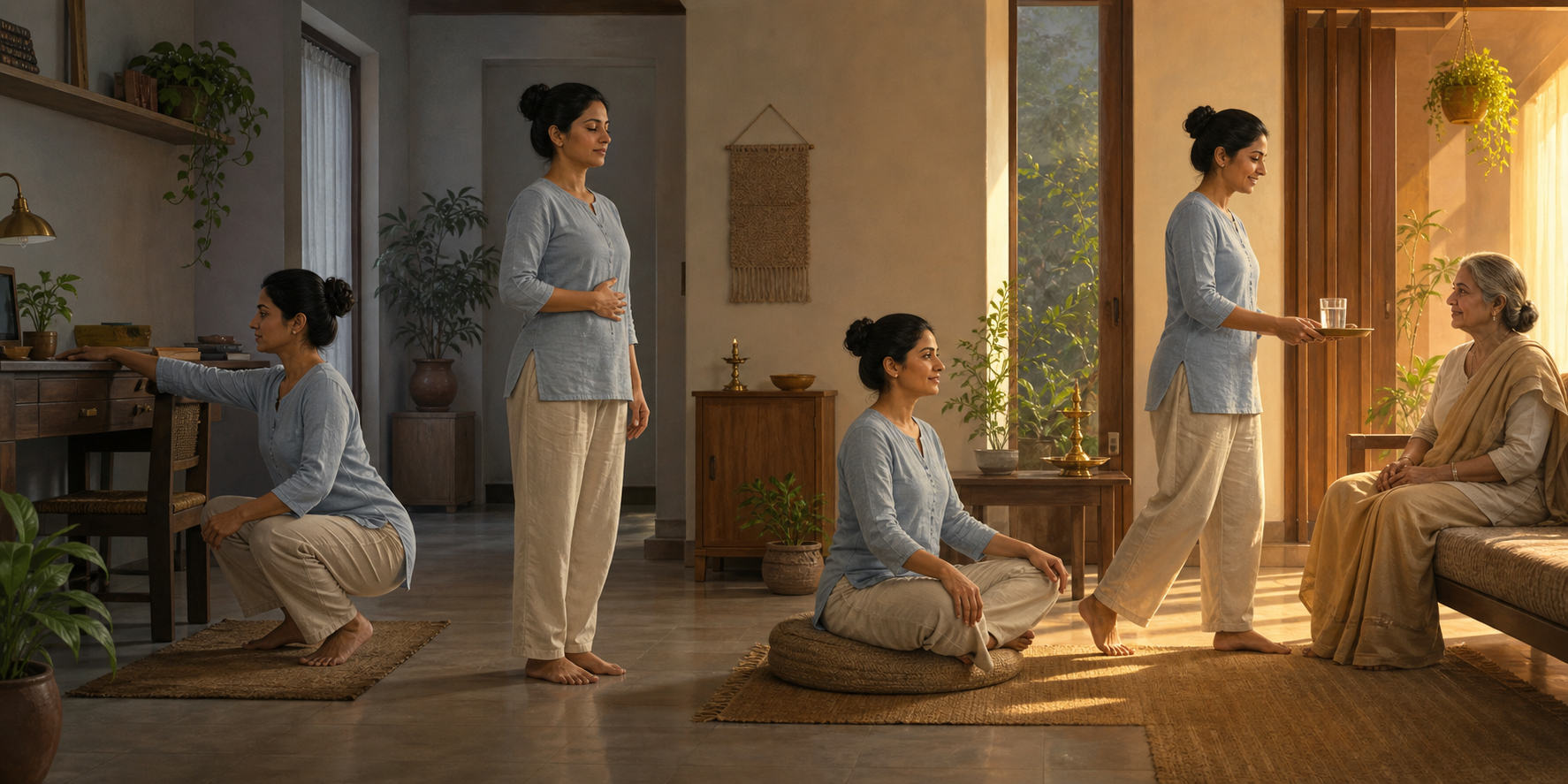
Many desk-bound people begin at the most subtle end. They sit down to meditate while the body is still stiff from hours in one position and the mind is carrying unfinished work. When stillness feels impossible, they conclude that they lack discipline. Often the order is the problem.
- Move the body. Spend 3–5 minutes on comfortable joint rotations, mindful mobility, or Surya Namaskar. The aim is not exhaustion. It is to end physical inertia and restore an alert, inhabitable posture.
- Organise the breath. Use a gentle extended exhalation for about 5 minutes. Inhale for 4 comfortable counts and exhale for 6. Let the counts measure pace rather than lung capacity; do not force either phase.
- Steady attention. Remain with the natural breath for 5 minutes. When thought carries you away, notice that movement and return without turning distraction into a moral failure.
- Direct the energy. Decide where the regained steadiness will go: honest work, care for family, patient speech, community responsibility, or seva. Activation without direction easily becomes another form of agitation.
This order is practical rather than rigid. On a sluggish but calm day, movement may need more emphasis. On a restless day, keep movement gentle and give more care to the extended exhalation. If you are physically awake but mentally scattered, move quickly to breath awareness or nadi shodhana rather than seeking stronger stimulation.
Every stage should remain gradual, pain-free, and adaptable. Stop a movement that causes pain. If controlled breathing produces strain or dizziness, abandon the count and return to an easy natural breath. Pranayama is not a contest in breath capacity, and discomfort is not evidence of spiritual progress.
A daily protocol that fits around desk work
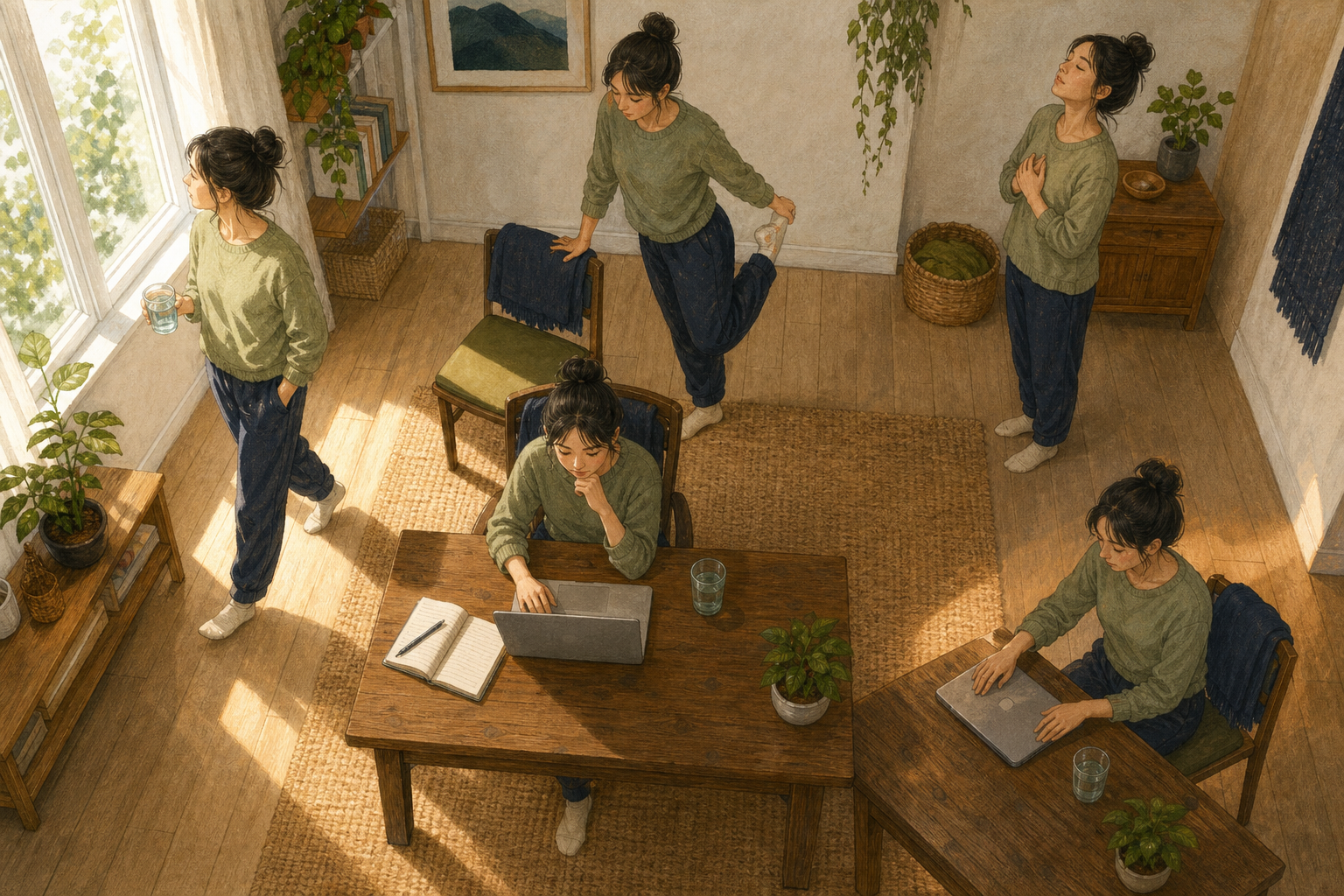
Morning: establish vitality before the first long sitting period
Begin with 3–5 minutes of mobility. Rotate the joints slowly if you wake feeling stiff. If Surya Namaskar is already familiar and comfortable, use it as a coordinated movement-and-breath practice. Do not rush through the forms merely to register that they are complete.
Follow movement with 5 minutes of extended-exhalation breathing: 4 counts in and 6 counts out. No breath retention is needed for this routine. Then sit for 5 minutes of unembellished breath awareness. Feel one inhalation and one exhalation at a time. This entire morning sequence takes 13–15 minutes, depending on the length of the movement phase.
The sequence matters more than ritual perfection. Movement makes stillness more accessible. The longer, comfortable exhalation helps scattered activation settle. Breath awareness then gives the newly organised energy somewhere stable to remain.
Midday: interrupt accumulation instead of repairing it at night
Do not wait until the workday ends to notice that you have hardly moved. Use three mindful movement breaks of 3–5 minutes across the day: morning, midday, and evening. During work, reset your posture every hour by changing position deliberately rather than merely shifting inside the same collapsed pose. Walk during a suitable call instead of remaining seated by default.
At midday, take a short walk and then practise 2–3 minutes of nadi shodhana. Alternate the nostril through which you breathe, keeping the breath soft and unforced. If the technique is new to you, omit breath retention and learn the hand position and sequence from a competent teacher rather than improvising a forceful version.
When a walk is temporarily impossible, close your eyes for a 90-second breath check. Notice whether the breath is hurried, held, or being pushed. Let it become easy before returning to the next task. This is especially useful at a transition point, because it prevents the urgency of one meeting or message from spilling automatically into the next.
Evening: change the quality of energy rather than merely suppressing it
Use the evening movement break to release the fixed posture of the day, not to punish yourself for having sat. Follow it with a brief gratitude reflection, breath awareness, or simran. Reduce screen light as you approach sleep so that mental stimulation is not the final rhythm you carry into rest.
Your wider daily rhythm determines how much work the formal practice must do. Keep waking and sleeping times consistent where possible. Hydrate after waking, receive some sunlight, favour warm nourishment, and eat without turning every meal into another screen session. These ordinary elements of dinacharya protect vitality by reducing avoidable disorder. Do not expect pranayama to compensate indefinitely for a rhythm that repeatedly depletes you.
Keep the practice rooted in dharma, not self-optimisation

A routine can make you more alert without making you wiser. That is why Dharmic vitality cannot end with increased productivity. Yama and niyama, ahimsa, restraint, remembrance, loving-kindness, and seva answer the question that every energy practice eventually raises: what is this capacity for?
If you already belong to a tradition, let that tradition supply the practice’s centre of gravity. A Hindu approach can join asana, pranayama, dhyana, and yama–niyama. A Buddhist approach can centre mindful awareness and metta. A Jain approach can use Samayik to cultivate time-bound equanimity, careful awareness, and restraint. A Sikh approach can join simran with concrete seva. Respecting these differences is more faithful than dissolving every practice into a generic wellness vocabulary.
If you do not have a settled affiliation, begin with the nonsectarian mechanics of gentle movement, comfortable breathing, and steady attention. You can learn from Dharmic methods without pretending that a short routine grants mastery of their philosophical or initiatory dimensions.
End each session with one practical question: where will this steadiness become useful? The answer should be observable. Complete a neglected household responsibility without resentment. Give undivided attention to a family member. Speak truthfully in a difficult exchange. Offer time to a community need. The action need not be dramatic; it needs to prevent spiritual practice from curving inward into self-absorption.
This ethical step also helps you judge whether the routine is working. More sensation is not necessarily more vitality. A useful practice should make sustained attention, measured speech, restraint, and service more available. If it mainly produces agitation, pride, or an appetite for increasingly intense techniques, reduce the intensity and return to the basic sequence.
Key takeaways
- Sedentary fatigue can combine bodily dullness with mental overactivity. Identify whether you need movement, breath regulation, focused attention, or purposeful action.
- Work from gross to subtle: 3–5 minutes of movement, 5 minutes of gentle 4-count inhalation and 6-count exhalation, then 5 minutes of breath awareness.
- Interrupt sitting during the day rather than relying on one evening recovery effort. Use hourly posture resets, a short midday walk, and 2–3 minutes of nadi shodhana.
- Keep movement pain-free and breathing unforced. Return to natural breathing if a count causes strain or dizziness, and seek professional guidance when a medical condition affects practice.
- Choose a tradition-rooted anchor instead of treating Hindu, Buddhist, Jain, and Sikh disciplines as interchangeable techniques.
- Direct renewed vitality into truthful conduct, restraint, compassion, family responsibility, or seva. Energy becomes Dharmic through its use.
At your next long seated stretch, do not wait for exhaustion to force a change. Move before you settle, lengthen the exhalation without strain, and give attention one place to rest. Then use the resulting steadiness for one task or act of service that matters. Repeated at the natural transitions of your day, that small sequence turns vitality from an occasional feeling into a disciplined way of living.
References
