
You may be checking December 13, 2025 for a family record, a religious observance, or one practical question: did an evening activity fall under Navami or Dashami? The decisive transition is at 7:38 PM for most regions. Before that point, the prevailing tithi is Krishna Paksha Navami; afterward, it is Krishna Paksha Dashami.
Use that as date-level guidance, not as a universal clock reading. A Panchang is applied through your location, local sunrise and sunset, and the calendar tradition your household follows. If the timing determines a vrata, sankalpa, or formal ceremony, confirm the entry for your city before acting.
Key takeaways for December 13, 2025
- Saturday, December 13 begins under Krishna Paksha Navami and changes to Krishna Paksha Dashami at 7:38 PM in most regions.
- The morning, afternoon, and early evening therefore do not carry the same tithi as the later evening.
- Navami is well suited to introspection, disciplined study, japa, dhyana, and quiet devotion.
- After Dashami begins, give attention to steady progress and the completion of pending responsibilities.
- Exact Shubh Muhurat, Nakshatra, and Rashi guidance must be checked against a local Panchang rather than copied from another city.
The tithi changes during the civil date
A civil date runs from midnight to midnight, but a tithi is a lunar-calendar division and can end at any point during that date. That distinction matters on December 13 because Krishna Paksha Navami prevails until 7:38 PM in most regions, after which Krishna Paksha Dashami begins.
| Period on December 13 | Prevailing tithi | Practical emphasis |
|---|---|---|
| Beginning of the date through 7:38 PM | Krishna Paksha Navami | Reflection, disciplined study, mantra-japa, meditation, and quiet devotional practice |
| After 7:38 PM | Krishna Paksha Dashami | Steady effort, orderly follow-through, and completion of pending work |
This distinction gives you a simple rule. If a practice specifically needs Navami, complete it before the locally confirmed Navami ending time. If it specifically belongs to Dashami, begin only after your local Panchang shows the transition. Do not decide from the date label alone.
For ordinary work, study, household responsibilities, or daily worship, there is no need to treat the transition anxiously. Routine activities may proceed normally. The timing becomes especially important when your tradition attaches an observance to a particular tithi or asks you to name the prevailing tithi in a sankalpa.
The phrase “in most regions” is important. The 7:38 PM entry is useful for general orientation, but it should not be carried unchanged across cities, time zones, or regional almanac systems. A difference in a local calendar does not necessarily mean that one calculation is careless; location and Panchang convention can change the displayed result.
How to find a trustworthy local Shubh Muhurat
Tithi, Nakshatra, Rashi, and Shubh Muhurat answer different questions. Knowing the tithi transition does not automatically supply the day’s Nakshatra, Moon sign, or every auspicious interval. Combining an ending time from one city with a Nakshatra or muhurta from another can produce a schedule that belongs to neither place.
- Set the location first. Use the city where the observance will actually take place, not the location of a temple, relative, or website elsewhere.
- Stay with one Panchang tradition. If your family, temple, or sampradaya regularly follows a particular regional calendar, use its calculations consistently for the tithi, Nakshatra, Rashi, and muhurta.
- Confirm local sunrise and sunset. Spiritual periods connected with dawn or dusk move with those local times.
- Read each field separately. Check the tithi ending time, Nakshatra, Rashi, and auspicious or inauspicious intervals as distinct entries. Do not assume that one can be derived safely from another.
- Ask for guidance when the ritual has formal requirements. For a samskara, temple rite, or lineage-specific vrata, your family priest or traditional authority can apply the local data to the actual ritual rule.
For personal prayer, two broadly useful periods remain available without pretending to give city-specific clock times. Brahma-muhurta is the pre-dawn spiritual period, while the Sandhya periods occur around sunrise and sunset. Brahma-muhurta can be used for meditation, mantra recitation, or scriptural reading. Sandhya is appropriate for daily prayer and a deliberate pause as day passes into night.
No single exact Brahma-muhurta or Sandhya clock range can be responsibly assigned to every reader because sunrise and sunset vary by location. If you do not have a local Panchang, use these periods as a general rhythm for private devotion, but postpone claims about a precise Shubh Muhurat until you can verify the city-specific calculation.
The same restraint applies to Nakshatra and Rashi. If your local calendar is not available, leave those details unstated. Guessing them from a generic daily listing creates more confusion than clarity, especially when a sankalpa or ritual instruction depends on the exact entry.
A simple observance for Navami moving into Dashami
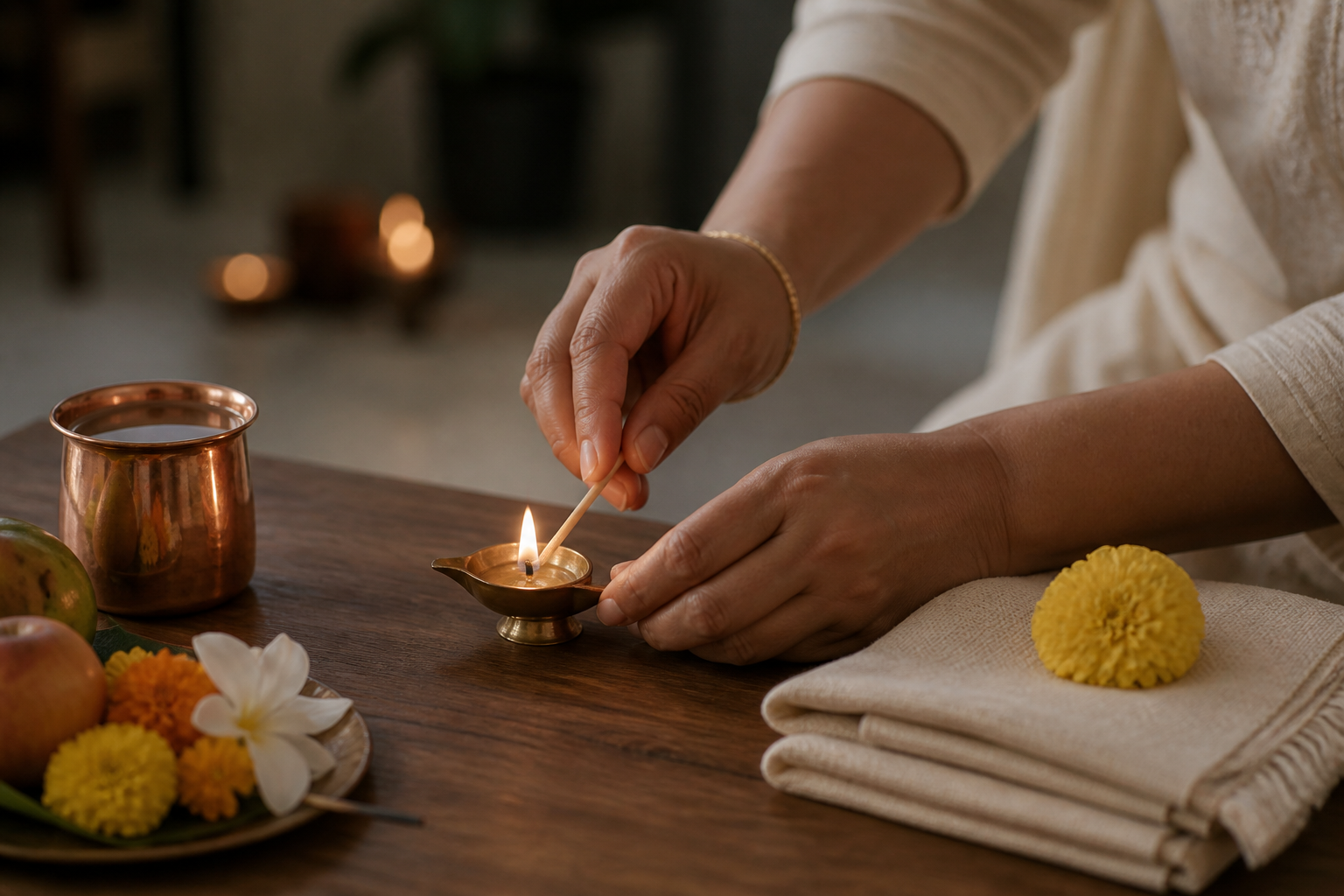
You do not need an elaborate ritual to use this Panchang meaningfully. A restrained schedule can honor the reflective character of Navami and the steady, completing movement associated with Dashami.
- Before dawn: If your routine permits, sit during Brahma-muhurta for japa, dhyana, or quiet reading from a scripture recognized in your tradition. Choose a familiar mantra or practice rather than inventing a new observance for the date.
- During Navami: Set aside a short period for self-examination or disciplined study. Identify one habit, duty, or unfinished matter that needs honest attention. Routine employment, household work, and study can continue normally.
- During the day: Make daana according to your capacity or perform a concrete act of seva. Keep the act proportionate and sincere; the point is disciplined generosity, not display.
- At dusk: Light a lamp if that belongs to your household practice, offer Sandhya prayer, and let the transition from daylight become a conscious pause rather than another rushed part of the day.
- After Dashami begins: Where your local Panchang confirms the transition, complete one pending responsibility with composure. This could be household work, study, correspondence, or preparation for the coming week.
Nothing in this date-level guidance creates a universal fast, a mandatory deity-specific puja, or a single ritual for every Hindu household. If your family or sampradaya observes a Navami vrata, follow that inherited procedure. If it does not, japa, study, lamp-lighting, daana, and seva are sufficient ways to engage the day without manufacturing obligations.
Readers from Hindu, Buddhist, Jain, and Sikh communities may also recognize the day’s ethical possibilities through ahimsa, maitri, self-discipline, and seva. These shared resonances need not erase the distinct calendars, teachings, and ritual authorities of each tradition. Practice the virtue through the form your own path gives it.
When you record this Panchang for future use, write down three things together: the city, the local Navami ending time, and the calendar tradition consulted. That small habit will make the entry far more useful than a date and tithi copied without context.
References
