

If you have ever wondered how Ravana could be an extraordinary devotee of Shiva and still be destroyed by Rama, the answer begins with an uncomfortable distinction: sincere devotion and righteous conduct are not automatically the same thing.
Ravana’s bhakti was not necessarily false. His failure was trying to carry the fruits of devotion into conduct that contradicted dharma. Shiva’s withdrawal of grace is therefore best understood not as divine fickleness, but as the refusal of divine protection to become complicity in adharma.
What the withdrawal of grace actually means
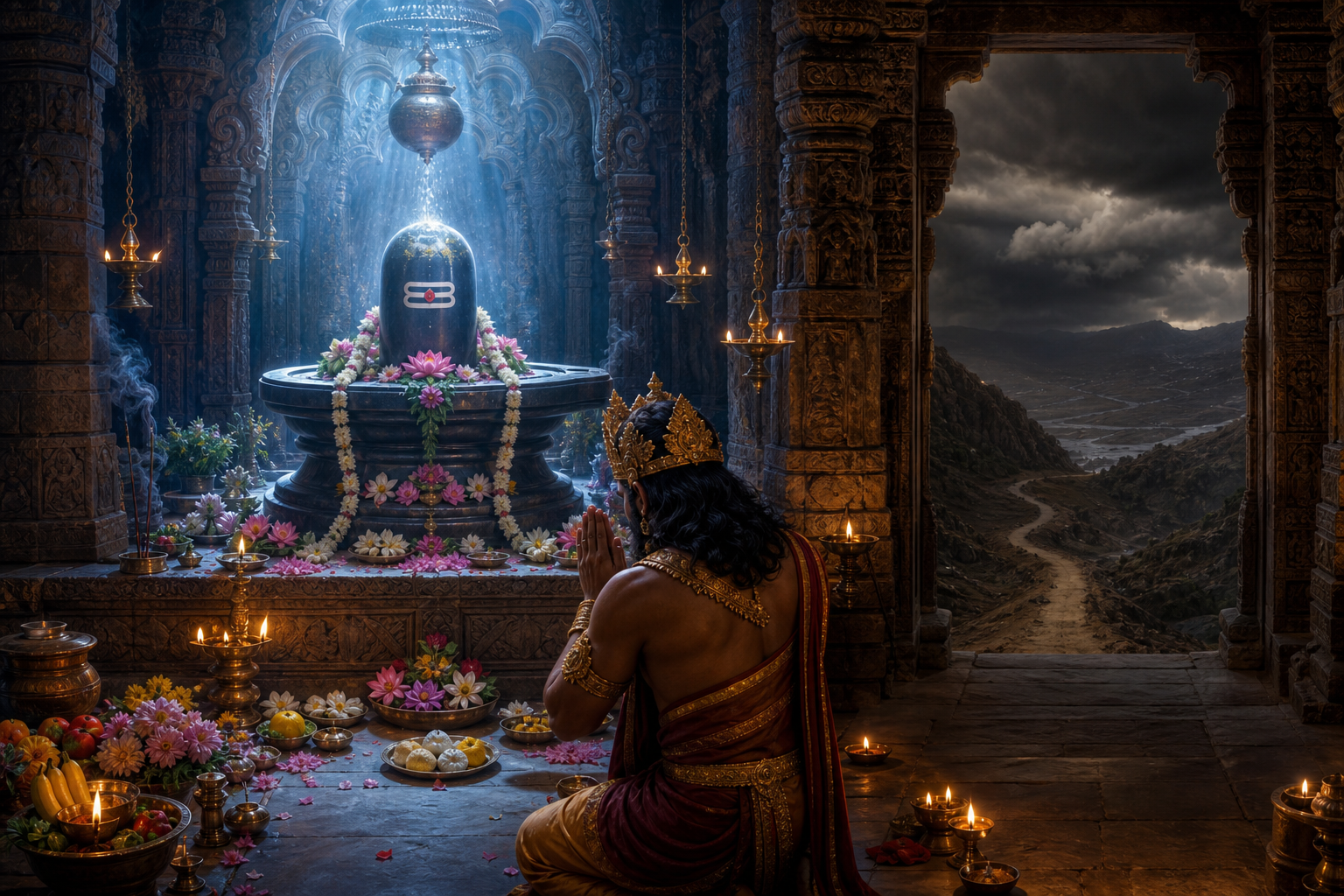
It is tempting to imagine Ravana’s relationship with Shiva as a contract: Ravana performed immense tapas, Shiva granted extraordinary blessings, and those blessings should have protected him regardless of what he later did. That interpretation turns spiritual attainment into a kind of permanent immunity. It is precisely the mistake Ravana’s fall exposes.
Ravana’s austerities, learning, traditional association with the Shiva Tandava Stotra, and encounter at Kailasa establish the depth of his devotion to Shiva. None of these, however, establishes moral infallibility. A person may possess discipline, scriptural knowledge, ritual ability, and even unusual spiritual power while remaining vulnerable to pride, possessiveness, and self-deception.
Three ideas must be kept separate:
- Tapas is disciplined austerity. Its fruits may increase a person’s capacity, endurance, concentration, or power, but capacity does not decide how that power will be used.
- A boon is not a declaration that every future choice of its recipient is righteous. It creates responsibility in proportion to the ability received.
- Anugraha, or grace, cannot coherently serve as a shield for conduct opposed to truth, restraint, and dharma. Grace leads the devotee beyond bondage; it does not protect the devotee’s attachment to wrongdoing.
Withdrawal, in this sense, does not require us to picture Shiva suddenly becoming hostile toward a former devotee. It describes the point at which Ravana’s relationship with the divine could no longer function as protection for the course he had chosen. Whatever strength his tapas had produced, it could not overrule the moral order within which divine blessings have meaning.
This distinction prevents two opposite errors. The first is dismissing Ravana as someone who never possessed genuine bhakti. The second is treating genuine bhakti as proof that his later actions deserved divine approval. His devotion could be real while his use of power became profoundly corrupt.
Sita’s abduction crossed three sacred boundaries

The abduction of Sita was not merely another violent act by an ambitious ruler. Its method compounded its gravity. Ravana used disguise, exploited hospitality, violated the protected space of a forest dwelling, and carried away a woman against her will. His wrongdoing therefore operated on several levels at once.
- He violated atithi-dharma. Hospitality depends on trust. Ravana approached under a false appearance and used a sacred obligation as an opening for harm. The deception was not incidental to the offence; it made the code of hospitality itself into a weapon.
- He violated the maryada of the hermitage. A vanavasi dwelling represents restraint, refuge, and a life ordered away from royal conquest. Ravana carried the logic of domination into a space whose boundaries he was obliged to respect.
- He violated the dignity embodied by Sita. In many Hindu traditions, Sita is understood not only as Rama’s wife but as Sri Lakshmi and a manifestation of Shakti. Ravana’s act consequently acquires a cosmic dimension: the recipient of Shiva’s grace directs his power against the sacred feminine.
This is why intention alone cannot rescue Ravana’s conduct. Attraction, injury to pride, political calculation, or a claimed grievance could not cleanse the means he chose. Dharma tests both the goal and the path taken toward it. When the path requires deception, coercion, and betrayal of sacred trust, religious identity cannot make it righteous.
You can apply that distinction without possessing Ravana’s power. Whenever a person uses the trust attached to a sacred role, family obligation, office, or spiritual reputation to gain access that would otherwise be refused, the violation is larger than the immediate harm. It also damages the code that made trust possible. Repair must therefore address both the injury and the betrayed trust.
Ravana’s bhakti failed at the point of ahankara

Ravana’s tragedy was not lack of knowledge. It was the inability to let knowledge place limits on the self. In the Kamba Ramayanam’s theological emphasis, ahankara, or prideful self-assertion, becomes the fracture through which devotion loses its ethical direction.
Ahankara does more than produce boastfulness. It makes the self the final interpreter of everything. A boon becomes evidence of permanent superiority. Success becomes evidence of divine endorsement. Correction becomes an insult. Desire becomes a right. Devotion then stops transforming the devotee and starts furnishing the devotee with arguments.
That is the danger in calling Ravana a great bhakta without asking what his bhakti was doing to his character. The proper measure of spiritual practice is not intensity alone. You must also ask whether the practice makes you more truthful, more restrained, less willing to harm, and more open to correction. If your ritual life expands while your capacity to accept limits contracts, the expansion is not reliable evidence of spiritual progress.
Watch for four signs that practice may be serving ahankara:
- You cite your devotion, sacrifices, knowledge, or service as evidence that you cannot be seriously wrong.
- You treat opposition to your conduct as hostility toward your deity, tradition, community, or spiritual identity.
- You increase ritual activity when the actual obligation is to stop the harm, tell the truth, return what was taken, or accept a consequence.
- You interpret power, status, survival, or success as proof that the divine approves of the means you used.
These signs do not make every flawed practitioner another Ravana. They identify the mechanism that made Ravana’s learning and austerity insufficient. His capacities grew, but his willingness to submit desire to dharma failed at the decisive moment.
Shiva and Rama do not represent rival divine camps

A sectarian reading creates a problem that the deeper theology does not require. Shiva does not have to defeat Vishnu’s avatar, and Rama does not have to humiliate Shiva’s devotee. In many Hindu understandings, Shiva and Vishnu are harmonious manifestations of the same ultimate truth. Their grace cannot be reduced to competing patronage networks.
Rama’s campaign against Ravana restores the order Ravana violated. If Rama is understood as an avatar of Vishnu, Shiva’s protection cannot be recruited to obstruct that restoration merely because Ravana once performed exceptional tapas. Such intervention would turn divine loyalty into partiality toward the powerful and place personal favour above dharma.
Regional and spiritual retellings illuminate different parts of this same problem. In the Krittivasi tradition, Shiva recognizes Rama’s divinity and the triumph of dharma. In the Kamba Ramayanam, Ravana’s ahankara receives particular emphasis. In the Adhyatma Ramayana, the unity of the divine places the conflict within a metaphysical order larger than allegiance to one form. These are distinct theological lenses, not reasons to manufacture hostility between Shaivas and Vaishnavas.
The practical correction is simple: do not ask which deity took whose side. Ask which conduct upheld dharma. This moves your attention from sectarian identity to the ethical standard the narrative is teaching. A deity’s devotee is still accountable for deception, coercion, and injury; a divine name cannot sanctify those acts.
Key takeaways
- Ravana’s devotion to Shiva can be accepted as real without treating Ravana as morally infallible.
- Tapas and divine boons confer capacity and responsibility, not permission to violate dharma.
- Sita’s abduction joined coercion to the betrayal of hospitality, the violation of a hermitage, and an offence against the sacred feminine.
- Shiva’s withdrawal of protection is best understood as moral coherence, not rivalry between Shiva and Vishnu.
- The test of bhakti is not ritual intensity alone, but whether devotion produces satya, ahimsa, humility, and right conduct.
Use Ravana’s fall as a test of your own practice
The episode becomes useful when you stop treating Ravana as a safely distant villain. His scale is mythic, but his error is recognizable: he allowed spiritual achievement to strengthen his self-image without permitting dharma to restrain his will.
When you face a decision involving desire, authority, loyalty, or injury to pride, work through these questions before asking whether the divine is on your side:
- Would you defend the same method if an opponent used it? If deception or coercion becomes acceptable only when it serves your preferred outcome, attachment is probably doing the reasoning.
- Which trust gives you access or power here? Identify whether you are relying on hospitality, kinship, office, seniority, religious standing, or another person’s vulnerability. That trust creates an additional duty; it is not a tool to exploit.
- What fact are you refusing to state plainly? Describe the act without invoking your good intentions, past sacrifices, group identity, or spiritual record. Clear naming weakens self-justification.
- Are you substituting worship for repair? Mantra, puja, meditation, pilgrimage, and seva do not remove the need to stop an ongoing wrong. Where repair is possible, practice should strengthen your ability to make it.
- Has devotion made you easier to correct? If years of practice have made criticism feel more intolerable, examine whether spiritual identity has become armour for ahankara.
If the answers expose a breach, respond in the right order. Stop the harmful conduct. Name it truthfully. Restore what can be restored. Accept the consequences that properly belong to you. Then return to spiritual practice as a discipline that reforms conduct, not as leverage meant to cancel accountability.
This order matters. Ritual performed while harm continues can become another layer of avoidance. Ritual joined to truthful correction can help loosen the pride that resisted correction in the first place. Across Dharmic paths, integrity of means and ends is not an ornamental virtue; it is what prevents spiritual power from becoming another form of bondage.
Before your next act of worship, choose one decision in which your spiritual self-image has made you resistant to a limit or correction. Test it against satya, ahimsa, and dharma. If it fails, change the conduct first. That is how Ravana’s fall becomes a guardrail in your own life rather than only a story about someone else’s destruction.
References
