

You want to live with less harm, but ordinary choices rarely arrive with clean moral labels. A reusable object may be unnecessary. A joyful festival may generate a pile of waste. A convenient meal may conflict with your concern for animals, land, or water. Trying to make every choice perfectly pure soon becomes exhausting.
Dharmic environmental ethics offers a more durable approach. You do not have to perform an ecological identity or withdraw from material life. You need a way to distinguish necessary use from careless consumption, private virtue from shared responsibility, and symbolic gestures from practices that actually protect life.
Begin with relationship, not an environmental shopping list
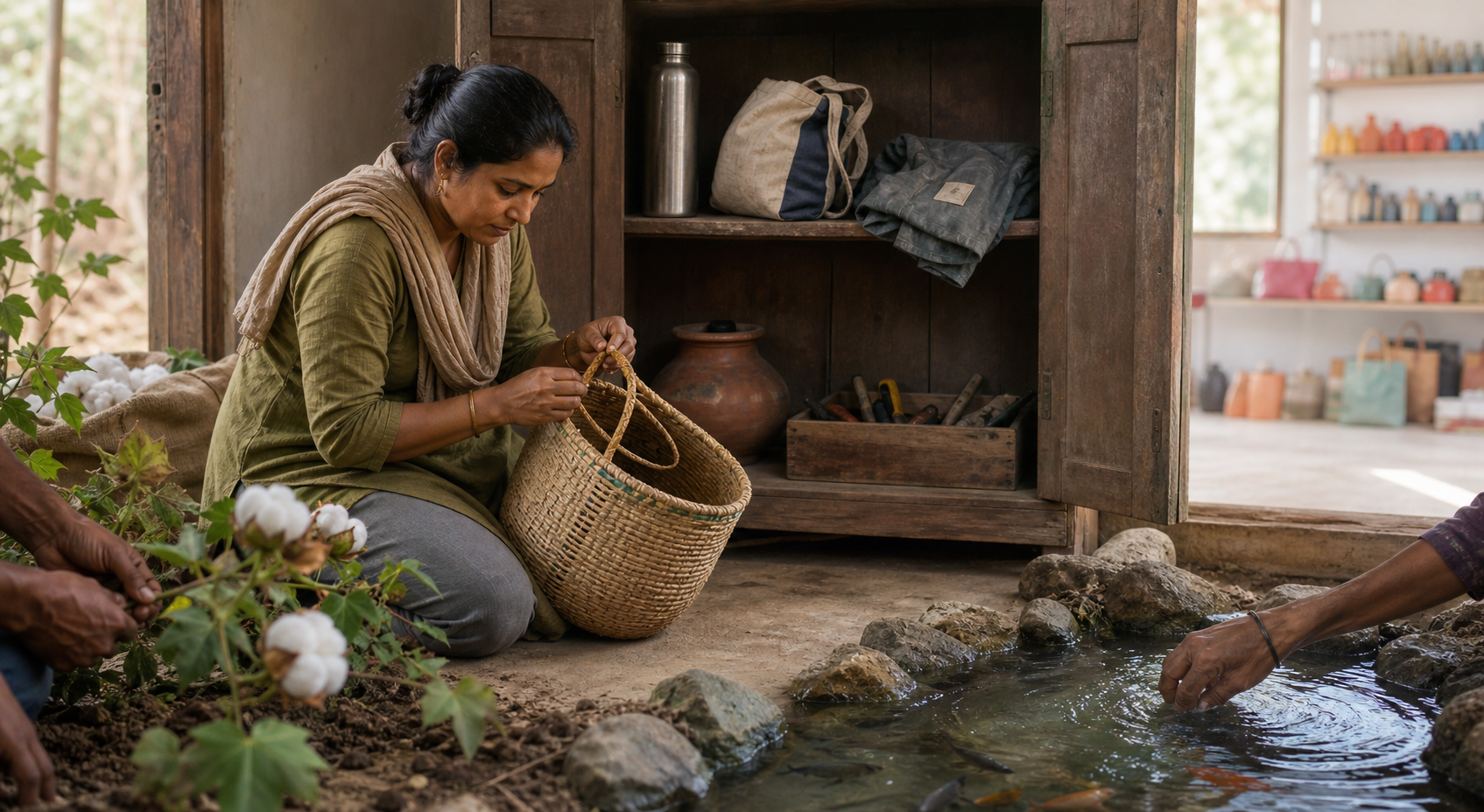
Much modern environmental language treats nature as a collection of resources that must be managed more efficiently. A Dharmic view starts further back. The river is not valuable only because it supplies water. The tree is not worthy only because it stores carbon or produces fruit. Animals, plants, mountains, soil, water, and human communities belong to an interconnected field of life rather than standing outside us as inventory.
Within Hindu thought, reverence for Prakriti is deepened by ways of understanding ātman in relation to Brahman. Vedic attention to rivers, forests, mountains, the earth, and celestial powers trains the mind to meet the world with gratitude. That does not mean every Hindu school expresses nature through an identical metaphysics. It means the living world cannot be reduced to disposable matter without also diminishing our own moral and spiritual life.
The wider Dharmic family reaches compassionate conduct through distinct teachings:
- Hindu traditions place artha and kāma within the guidance of dharma. Prosperity and enjoyment have a legitimate place, but neither is exempt from responsibility.
- Buddhism uses dependent arising, or pratītyasamutpāda, to expose the illusion that actions remain isolated. What you consume depends on networks of beings, labour, land, water, and intention.
- Jainism brings unusual ethical clarity through Ahimsa and Aparigraha. Reducing violence and loosening possessiveness naturally challenge excess consumption.
- Sikhism joins compassion to seva and sarbat da bhala. Care becomes service directed toward the well-being of all, not merely a private preference.
These teachings are not interchangeable, and respecting them requires more than blending their vocabulary. Their practical meeting point is a disciplined refusal to treat other life as morally irrelevant.
To make that insight concrete, choose one place where your daily routine meets the living world: your meals, water tap, rubbish bin, commute, garden, or place of worship. Ask what relationships pass through it. Who or what receives care from this routine? Who or what bears its cost? That question usually reveals more than searching for another product labelled green.
Use dharma to decide when good intentions conflict

Environmental decisions become confusing when every value is treated as absolute. Local food may not always be available. Public transport may be unsafe or inaccessible. A person caring for children, elders, or someone with a disability may need forms of convenience that another household does not. Dharma is not a contest in visible austerity. It asks what responsible action looks like within real relationships and duties.
The puruṣārtha framework is useful here. Artha and kāma are to be pursued under the direction of dharma, with mokṣa as the highest horizon. The question is therefore not whether you may earn, enjoy, travel, celebrate, or use technology. It is whether those pursuits remain answerable to the lives and places that sustain them.
When you face a purchase or household decision, work through this sequence:
- Name the purpose. Say what the choice is meant to accomplish. A clear need, a fitting pleasure, social pressure, and restless acquisition are not the same motive.
- Identify the burden. Consider animals, plants, water, energy, waste, human labour, and your local community. You may not know the entire chain, but you can still notice the most visible cost.
- Remove the avoidable part. Ask whether you can use what you own, take less, share, borrow, repair, refill, or choose a gentler option.
- Prefer continuity over novelty. A serviceable object already in your home often deserves continued use more than a fashionable replacement deserves purchase.
- Look for a shared benefit. A solution that also helps relatives, neighbours, a congregation, or a local ecosystem carries the spirit of seva further than a private badge of virtue.
Ahimsa does not require the fantasy that embodied life can leave no trace. It requires serious attention to avoidable and disproportionate harm. Aparigraha does not turn every possession into a sin. It asks whether possessions serve life or whether acquiring, storing, displaying, and discarding them has begun to govern you.
This distinction also protects you from the trap of moral shopping. Buying a new reusable object is not automatically better than continuing to use an ordinary object you already have. A tiny visible substitution should not distract you from a wasteful practice repeated throughout the week. Begin with recurring patterns because the ethical decision has to be made only once, while its effect continues through the routine.
Inner discipline supports this work without replacing it. Breath awareness and meditation can steady attention for wiser choices, but meditation does not clean a river or reduce a rubbish pile by itself. Before a non-essential purchase, pause long enough to name the need and the likely afterlife of the object. The pause is useful only when it changes conduct.
Build compassion into meals, utilities, possessions, and festivals

Values survive when the compassionate option becomes the normal option. Do not begin by redesigning your whole life. Find the waste or harm that returns most predictably, and change the routine that produces it.
Let Ahimsa reach both the plate and the bin
A gentler diet is an obvious expression of concern for living beings, but food ethics does not end with the label attached to a meal. Food bought and then discarded still represents land, water, energy, labour, and life used without fulfilling its purpose.
- Plan the next meals around food already at home before buying more.
- Choose local and seasonal foods when they are practical, affordable, and suitable for your household.
- Move meals in a less harmful direction with changes you can repeat, rather than making a dramatic promise you abandon.
- Store leftovers visibly and decide when they will be eaten instead of allowing them to disappear at the back of a shelf.
- Compost unavoidable plant scraps where an appropriate home or community system exists.
Different Dharmic communities maintain different disciplines around food. Do not flatten them into a single compulsory menu, and do not use your own observance to humiliate someone else. The useful question is direct: what avoidable harm can you remove from the way you obtain, prepare, share, and discard food?
Work on water, energy, and transport through repetition
Utility use is easy to ignore because it disappears behind taps, switches, bills, and infrastructure. Make it visible. Review a normal billing cycle, note the household routines that recur, and choose the one you can change without compromising health, safety, caregiving, or essential work.
- Repair a persistent leak instead of compensating for it with occasional gestures elsewhere.
- Run washing or cleaning equipment with purposeful loads rather than from habit.
- Switch off lighting and equipment that no one is using, and make the last person leaving a room responsible for the check.
- Combine compatible errands, walk, cycle, share a ride, or use public transport where local conditions make the option safe and workable.
- Compare your next bill or routine with your own baseline. The aim is a durable reduction, not competition with a household whose needs differ from yours.
Practise Aparigraha before the next object enters your home
Decluttering after excessive acquisition treats the symptom. Aparigraha intervenes earlier. Before purchasing, check whether you can decline, borrow, repair, refill, adapt, or buy used. If purchase remains the right choice, prefer something that can be maintained and kept in service.
Apply the same care when an object leaves. Giving an unusable item to another person merely transfers the burden. Separate what can genuinely be repaired or reused from what requires responsible disposal. Gratitude for an object is expressed by caring for it through its useful life, not by keeping everything forever.
Keep sacred celebration from becoming disposable
A festival should intensify gratitude, beauty, memory, and community. Waste is not necessary to any of those aims. Before buying decorations or arranging offerings, inventory what the family, mandir, vihara, derasar, gurdwara, or neighbourhood already owns.
- Reuse durable lamps, cloth, vessels, and decorations before buying a new themed set.
- Prefer simple décor and suitable natural dyes where they meet the needs of the observance.
- Avoid synthetic material that will be abandoned in soil or water after a brief ceremonial use.
- Arrange collection, washing, storage, donation, composting, and responsible disposal before the event begins.
- Assign stewardship to named participants. When care belongs vaguely to everyone, it often becomes the final task left to no one.
Restraint does not require a colourless celebration. Skill, music, rangoli, flowers, shared food, inherited objects, and community labour can make an observance abundant without making it disposable. The test is whether the form of celebration honours the sacred reality invoked by the ritual.
Make seva measurable without reducing it to a performance
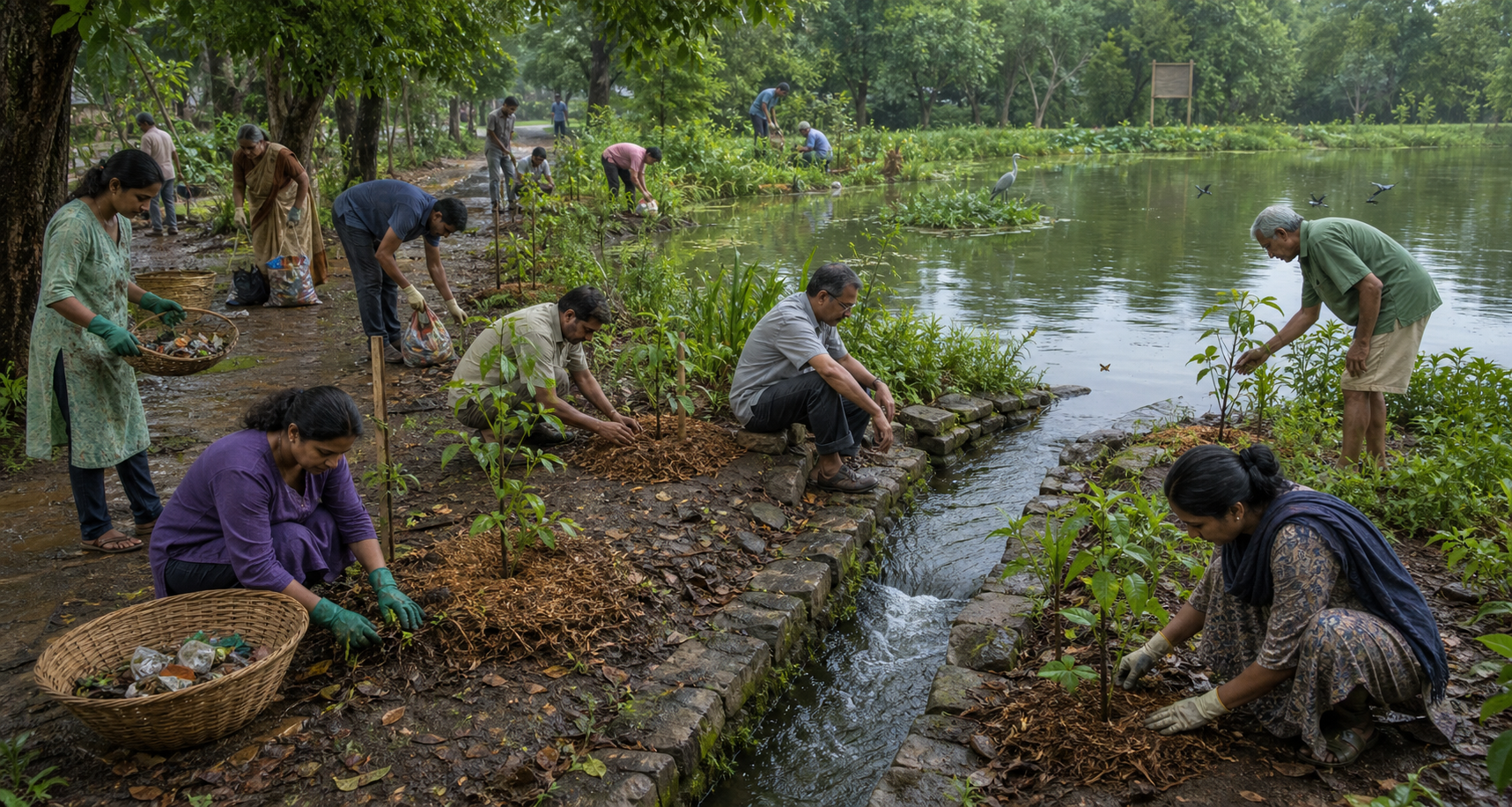
Household restraint matters, but compassionate living cannot remain a private lifestyle. Waste systems, public spaces, water bodies, transport, food distribution, and land care are shared concerns. Sikh seva and sarbat da bhala make that movement from personal intention to collective well-being explicit. Vasudhaiva Kutumbakam likewise asks you to treat the world as family rather than as a distant storehouse.
Choose community action by locating the neglected stage of care. If saplings are planted ceremonially and then forgotten, organise watering and aftercare rather than another planting photograph. If usable objects are routinely discarded, create a repair or exchange gathering. If every celebration buys the same temporary supplies, build a shared kit. If a community garden has enthusiasm but no maintenance, establish a roster before expanding it.
A modest scorecard can keep seva honest:
| Area of care | What to notice | What to do next |
|---|---|---|
| Household | Recurring discarded food, unnecessary purchases, and avoidable utility use | Change the routine that produces the largest repeated burden |
| Celebration | Disposable materials, synthetic residue, and unassigned cleanup | Reuse shared materials and decide their aftercare in advance |
| Community | Participation, maintenance, repair, and continuity after an event | Give each ongoing task an accountable steward |
| Living environment | Condition of local water, air, soil, trees, and biodiversity | Support locally appropriate restoration and seek relevant expertise where needed |
| Cultural life | Whether tradition remains meaningful while harmful habits are removed | Preserve the sacred purpose and improve the materials or logistics |
This is also a better way to think about progress. Income, convenience, and technological capacity are incomplete measures when water is degraded, biodiversity disappears, communities weaken, or cultural practices become dependent on disposability. Clean air and water, biodiversity, community well-being, and cultural continuity belong beside material prosperity when you evaluate whether a household, institution, or society is genuinely flourishing.
Technology can support that flourishing, but novelty is not its own justification. Ask whether a tool reduces a real burden, whether it can be maintained, whether it shifts harm out of sight, and whether its benefits reach more than the buyer. Innovation serves dharma when it protects and restores life rather than merely accelerating consumption.
Key takeaways
- Treat nature as a relationship to honour, not merely a resource to optimise.
- Use dharma to guide prosperity and enjoyment instead of treating ecological care as a rejection of material life.
- Apply Ahimsa to avoidable harm, Aparigraha to unnecessary acquisition, and seva to shared responsibilities.
- Change recurring routines before chasing impressive but temporary gestures.
- Preserve the sacred purpose of festivals while replacing disposable materials and careless cleanup.
- Measure progress through continuity: food used, objects repaired, resources conserved, trees tended, water protected, and communities able to sustain the work.
Start with the next ordinary choice that repeats: the meal you plan, the object you consider buying, the tap you leave running, or the celebration you help organise. Name the life connected to it, remove one avoidable harm, and make the better practice easy to repeat. Compassionate living becomes credible when reverence survives contact with routine.
References
