
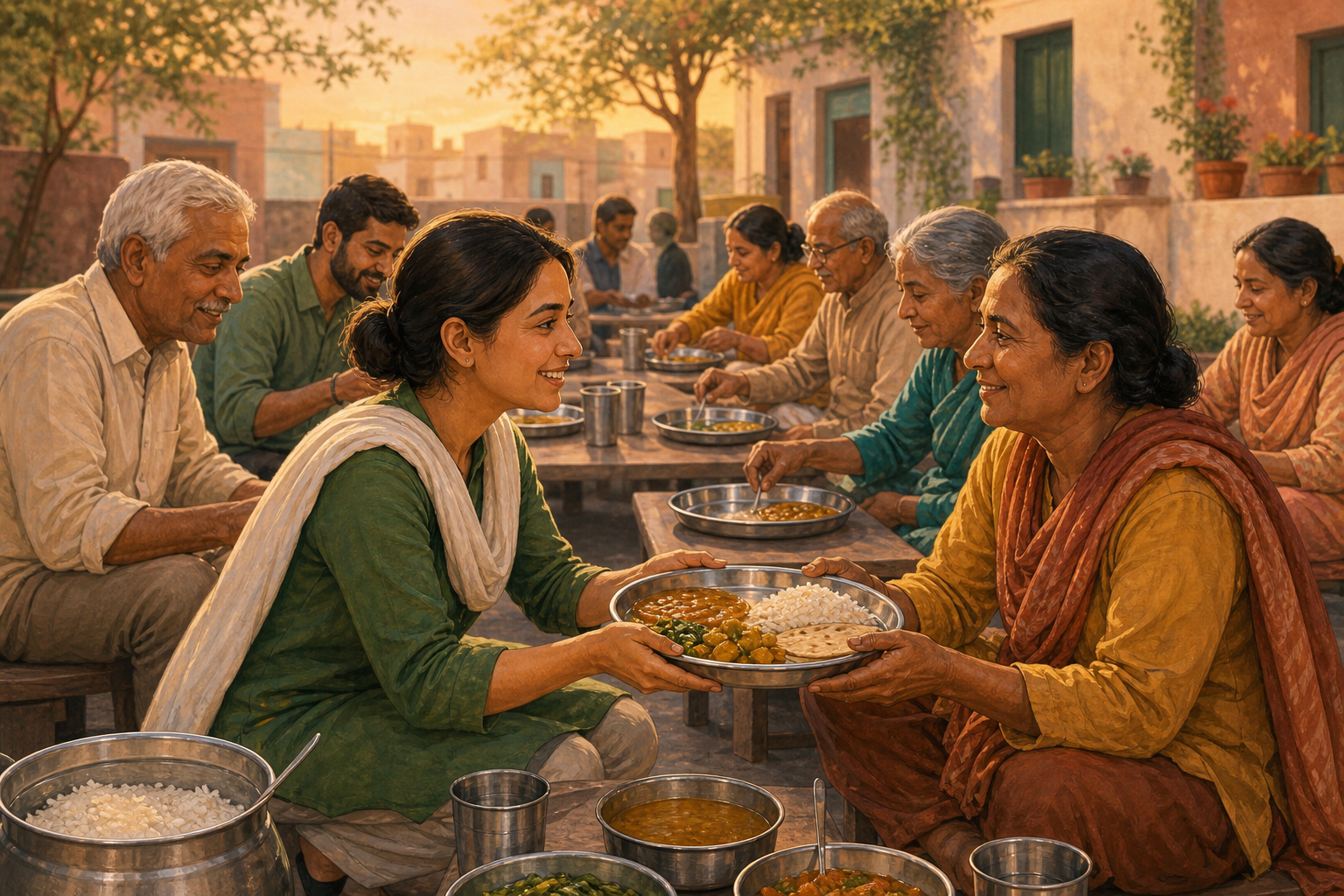
Someone asks you for food. You can help, but questions arrive first: Is the need genuine? Is one meal enough? Should you give food or money? In a Dharmic frame, the immediate decision is simpler than those doubts. If you can safely relieve a person’s hunger, feed them.
The duty is not fulfilled by feeling compassion. It becomes real when suitable food reaches the hungry person without humiliation, coercion, or needless delay. That standard can guide an encounter at your door, a family practice, a temple programme, or a community kitchen.
Hunger changes the order of moral priorities

Many forms of charity promise a future benefit. Food meets a present necessity. A hungry person may need employment, shelter, counselling, or long-term support, but those questions do not make the next meal less urgent. Feed first when you can; discuss the larger problem after the immediate distress has eased.
This is why anna-dana, the giving of food, carries unusual moral weight in Hindu life. Food sustains the body through which every ordinary and spiritual duty must be performed. The Padma Purana and related dharma traditions praise feeding the hungry because the gift protects life directly. Atithi devo bhava gives the householder another discipline: hospitality is not an ornamental virtue but a sacred responsibility toward someone dependent on your welcome.
Paryavartanakam gives the refusal of food a stark karmic form. Within the Purāṇic imagination, denying sustenance to a hungry person is not a minor lapse in politeness. It reverses the proper relationship between those who possess food and those whose lives presently depend on receiving it. Whether you understand Naraka literally, symbolically, or through both lenses, the ethical warning remains clear: obstructing another person’s access to food carries consequences.
This does not require you to satisfy every request, endanger yourself, or give beyond your means. It does require an honest test. Are you refusing because you truly cannot help, or because suspicion, inconvenience, caste prejudice, social distance, or indifference has made another person’s hunger easy to ignore? Dharma begins with telling yourself the truth about that distinction.
Dignity determines whether your gift is service or disposal

A plate of food can preserve dignity or diminish it. The difference lies in how you choose, offer, and serve it. Use the following sequence when helping someone directly.
- Ask before choosing. A simple question such as whether the person would like food, and what they can eat, preserves agency. When options are available, offer them. Do not assume that every recipient can eat the same ingredients.
- Give food you would regard as fit to serve. Hunger does not make spoiled, contaminated, or carelessly handled food acceptable. If the condition of leftovers is uncertain, do not pass the risk to someone with fewer choices. Purchase a fresh meal or support a kitchen equipped to prepare and distribute food safely.
- Remove the price of humiliation. Do not demand a sermon audience, a photograph, a display of gratitude, a caste identity, political agreement, or a convincing account of misfortune. A need for food should not become someone else’s opportunity to exercise power.
- Respect religious, ethical, and physical limits. Ask about ingredients when possible. Clearly identify food whose contents may be uncertain. If a person declines what you offer, accept the refusal without treating it as evidence that the hunger was false.
- Make the next step visible. If the person is likely to need another meal, share the location and opening time of a reliable community kitchen, langar, temple feeding programme, anna-kṣetra, school meal service, or local relief organisation. Immediate food and continuity answer different parts of the need.
If you are uncomfortable handing over money, offer to buy a requested meal from a nearby vendor. That keeps the help direct without turning the encounter into an interrogation. For a single plate of food, a complicated test of deservingness usually costs more dignity than it protects. Formal verification may have a place when an organisation allocates limited long-term assistance; it should not become the gate in front of an urgently needed meal.
Prasada can be offered with reverence, but material need should never be used to compel religious participation. The sacred quality of the gift is expressed through generosity and care. It is not strengthened by extracting conformity from a person who is hungry.
Four Dharmic traditions turn compassion into practice
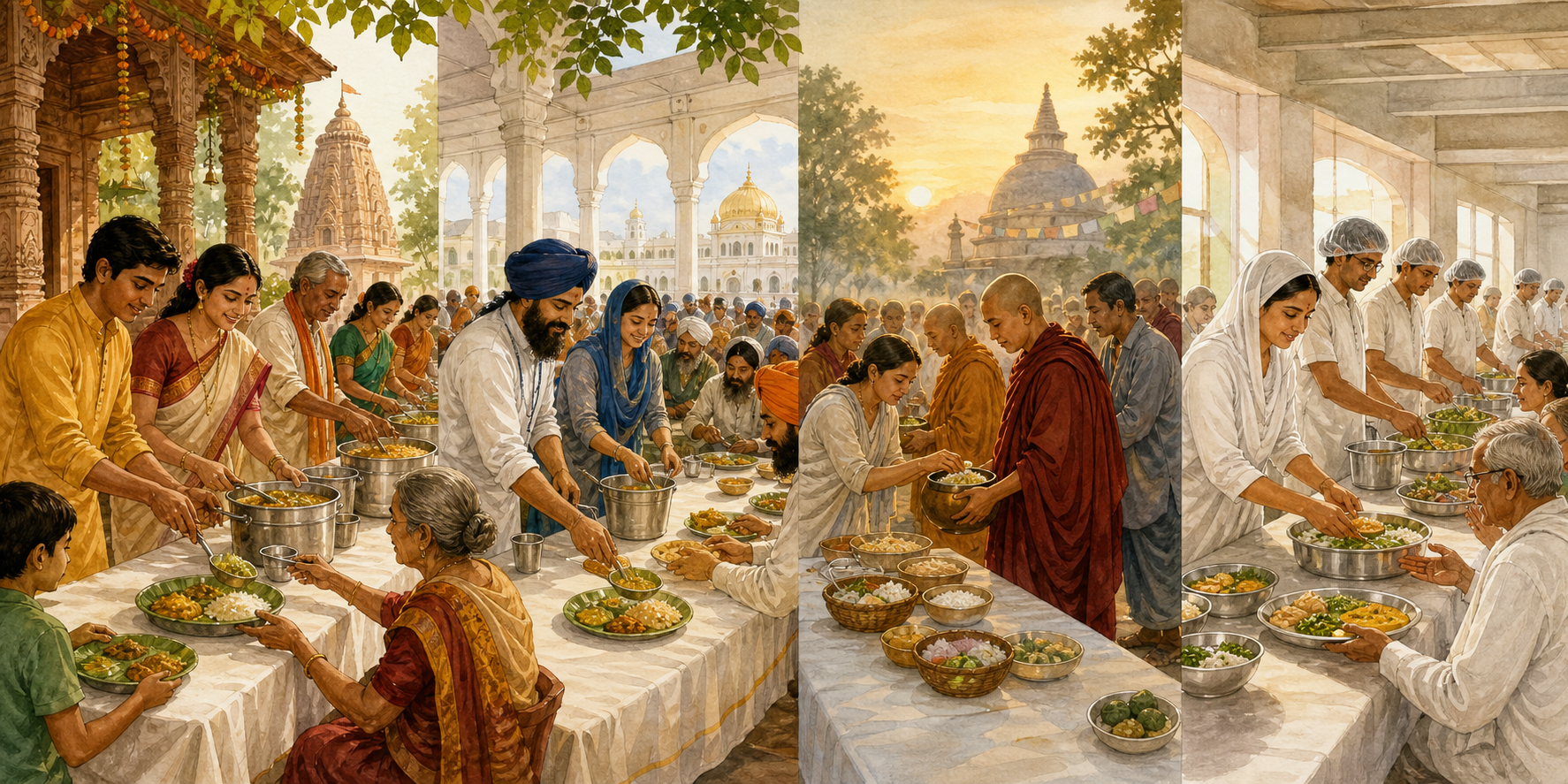
Hinduism, Buddhism, Jainism, and Sikhism do not reduce feeding to identical doctrines. Each approaches the duty through its own vocabulary and institutions. Their convergence is nevertheless practical and unmistakable: spiritual seriousness must become care for embodied life.
- Hindu traditions place anna-dana, hospitality, prasada, and seva within the duties of household and temple life. Giving food sustains the recipient while training the giver to loosen possessiveness.
- Buddhist traditions treat dāna as a foundational virtue. Giving interrupts attachment, while karuṇā directs attention toward another being’s suffering rather than the giver’s self-image.
- Jain traditions connect care for hungry beings with ahiṃsā. Anna-kṣetras and community feeding make non-harm tangible through the provision of sustenance.
- Sikh tradition institutionalises the duty through langar. A recurring communal kitchen does more than distribute calories: it places feeding, voluntary service, and shared human standing within one practice.
These practices share an ethical horizon without erasing their theological differences. Food is not merely transferred from a fortunate person to an unfortunate one. The meal becomes a way to restrain ego, practise compassion, honour life, and restore a social bond that hunger has exposed as broken.
You can borrow the institutional wisdom even when you do not run a religious organisation. Make help predictable. Divide the work. Welcome people without singling them out. Serve comparable food with comparable care. Where circumstances permit, create a common eating space rather than a visible boundary between benefactor and beneficiary. The closer a meal comes to fellowship, the less it resembles the disposal of surplus.
Build a feeding practice that does not depend on mood
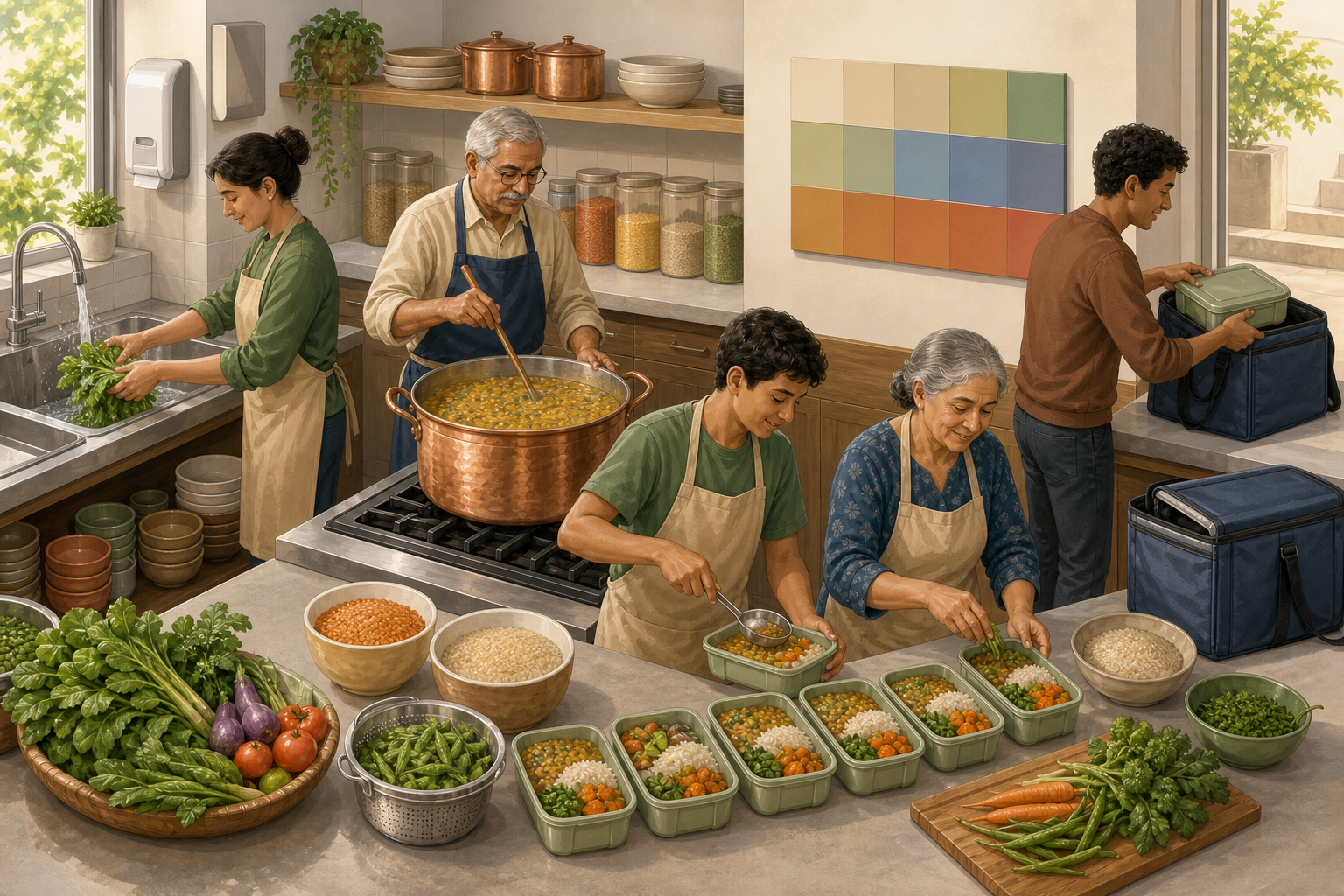
Compassion often fails in the gap between intention and logistics. You remember anna-dana during a festival or after seeing visible suffering, then ordinary routines resume. A modest commitment tied to a time, place, and responsibility is more dependable than a large promise with no mechanism behind it.
Choose one rhythm you can sustain: contribute whenever you are paid, sponsor food on a recurring family observance, volunteer on a fixed day, or add a planned quantity to a community kitchen’s regular procurement. The amount matters less than making the duty specific enough to survive distraction.
For a household
- Name the channel before food accumulates. Identify a temple kitchen, gurdwara langar, Jain anna-kṣetra, Buddhist community initiative, neighbourhood kitchen, school meal effort, or food-recovery group that accepts the kind of help you can provide.
- Plan portions before treating leftovers as charity. Reduce avoidable waste by cooking and serving realistically. When safe surplus remains, redirect it promptly through a group capable of handling it. Do not make hungry people the final destination for food no one else wants.
- Keep a separate giving commitment. Food recovery is valuable, but an unpredictable stream of leftovers cannot replace regular support. A fixed budget or service schedule gives a kitchen something it can plan around.
- Include children in the work without displaying recipients. Let younger family members help purchase ingredients, prepare suitable food, or serve under supervision. Teach that the recipient’s privacy is part of the gift.
- Review the habit after each cycle. Ask whether the food was usable, whether the receiving group needed something different, and whether your schedule was realistic. Adjust the method rather than quietly abandoning the commitment.
For a temple or community group
- Publish clear serving times and access information so that people do not travel only to find a closed door.
- Assign responsibility for purchasing, preparation, safe handling, cleaning, and distribution instead of leaving essential tasks to whoever happens to appear.
- Use a menu that recipients can understand, and identify ingredients that may affect religious observance, allergies, or other dietary limits.
- Track meals and recurring supply needs to improve planning, not to rank the moral worth of the people being fed.
- Provide a private way for recipients and volunteers to report poor treatment, unsafe food, or exclusion.
- Coordinate with nearby feeding efforts. Different serving times or locations may cover a gap more effectively than several groups duplicating the same meal.
When food waste and hunger exist near each other, redistribution is an obvious responsibility, but it is not the entire solution. Surplus appears when donors happen to have it; hunger appears when people need to eat. Reliable anna-dana therefore needs planned food as its foundation, with recovered food used as a safe supplement.
If you have previously ignored a hungry guest, wasted usable food, or allowed suspicion to harden into indifference, the Dharmic response is not passive guilt. Correct the habit. Support a feeding programme, take a service shift, reduce waste at home, and make the next encounter different. Expiation has moral value when it changes conduct.
Key takeaways
- When you can safely relieve immediate hunger, do not delay the meal while trying to solve the person’s entire life.
- Give food that is safe, suitable, and offered with choice; another person’s desperation does not lower the standard.
- Do not attach humiliation, publicity, religious pressure, or a performance of gratitude to food assistance.
- Use regular institutions such as anna-dana programmes, anna-kṣetras, community kitchens, and langar to turn individual compassion into dependable access.
- Treat surplus redistribution and planned feeding as complementary practices, not interchangeable ones.
- Measure the sincerity of the duty by whether a hungry person is fed, not by the giver’s intention or self-image.
Before your next meal, put one act on the calendar: offer a meal, fund a kitchen’s stated need, or take a service shift. Hunger should not have to wait for generosity to become convenient.
References
